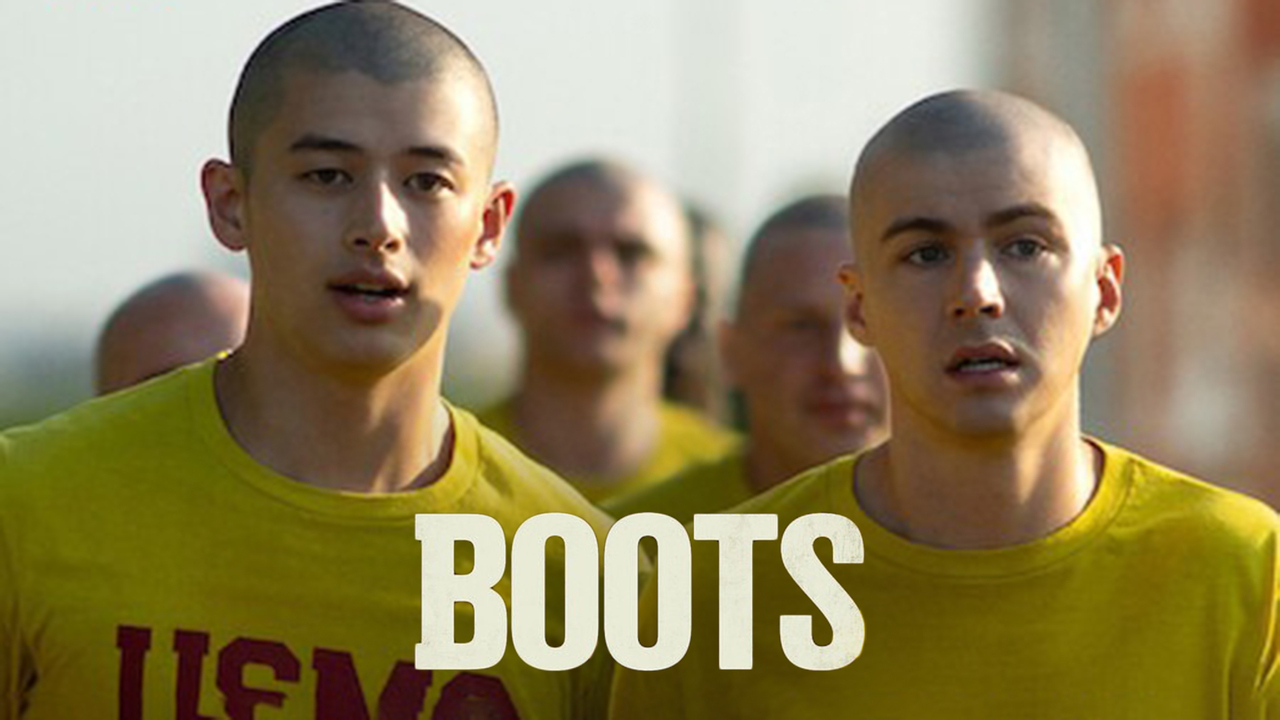
I’ve seen the first episode of Boots, and I have mixed feelings.
I’m not sure how to engage with the show. It’s the sometimes funny, sometimes awful story of a young gay man named Cameron Cope who joins the Marines (in 1990, when homosexuality in the armed forces was still criminalized) without really knowing what he was getting himself into. Boots is based on the book The Pink Marine by Greg Cope White (no relation to the best of my knowledge), which is apparently a memoir of White’s own time in the Marines.
I’m unsure about Boots because I’m not sure what Boots is trying to say, or what conclusion it’s reaching towards. Does it have a negative message about being in boot camp as a young gay man in 1990? Does it have a positive message about that?
Is it both?
Both definitely feel available.
If the message is supposed to be negative, I think Boots falls prey to the problem identified by François Truffaut, of there being no such thing as an anti-war film. Truffaut’s reasoning was that because “violence is very ambiguous in movies” and “to show something is to ennoble it” one could not truly make an anti-war film. For a real life example, the movies Apocalypse Now and Full Metal Jacket and Platoon are all supposedly anti-war, but they were also loved by my high school friend who wanted to join the Marines. That’s a good reminder that the audience always has the final say on how any work is interpreted. It wouldn’t surprise me if making an anti-boot camp TV show would be similarly nigh impossible.
If the show’s message is supposed to be negative, I think its critique is visible right beneath the surface. I can’t watch the end of the first episode—with the new drill instructor explicitly saying “the enemy is inside you” and “you are going to kill that enemy” right after Cope has had another conversation with his very gay (and healthy!) inner self—without thinking that Cope is being told not just that he must ”lock up” his homosexuality (those are Cope’s words) but that he must kill or erase it. The show might not be saying explicitly “you will kill your gayness,” but it sure feels implied.
That’s pretty yikes.
Yet there are also overt moments of camaraderie, success, and commitment. As the first physical tests are administered and Cope is offered a chance to fail out, he nearly fails on purpose in order to escape. Yet in an effort to help one of Cope’s fellow recruits live up to his family’s tradition and prove his asshole brother wrong, Cope instead completes the exam and stays in—spoilers, I know, but this is a show about being in boot camp, not about washing out of boot camp in the first episode. Both Cope and his fellow recruit are then celebrated by the rest of the recruits, and that celebration is obviously impactful. Thus while there are many moments of awfulness and Cope’s feelings of desperation and fear and lack of belonging feel real, so do his feelings of comradeship and pride at his accomplishments.
I’ve seen the first episode of Boots and I have mixed feelings, and maybe I’m supposed to. Maybe I should simply sit with those feelings. Those mixed feelings might be the point—not everything needs to be (nor should it be) straightforward and uncomplicated.
On that note, maybe Boots is honest to its source material. As I said above, Boots is based on the book The Pink Marine by Greg Cope White, a memoir of White’s own time in the Marines. White served in the Marines for six years, attained the rank of Sergeant, and received an honorable discharge. There are many options here: he might have a positive perspective on how the Marines, and boot camp, changed his life; he might feel good overall about his time in the Marines despite mixed experiences; or his feelings about boot camp and the Marines might be complicated. Maybe he’s writing his truth, and the show reflects that. Or maybe he didn’t know another way to write his memoir while delivering “comedy with a heart.”
I haven’t yet watched any more of this show. I probably will. I feel compelled to know what the show is trying to say. I have a lot of thoughts about how our culture depicts and teaches masculinity, and this show is doing a lot of that whether it means to or not.
I feel compelled to know more, but I fear that Boots will depict Cope’s experience as an unalloyed good without looking deeper at the price he had to pay. I fear that the show’s critique of Cope’s treatment will be too easy for an audience to willfully ignore—the “there is no anti-war film” problem. Cope’s story as a young gay American trying to find his own way in 1990 would probably be daunting whether or not he joined the Marines, but I fear that the additional barriers and ill-treatment that he found in the Marines will be valorized instead of criticized.
I don’t think that White, or the show, is trying to say that “you will kill your gayness” is a good message or a necessary one for military training. I hope that the show makes it clear that that message has no place in military culture, clear enough that even those who enjoy this show because they fetishize the “hardness” and “manliness” of the Marines will understand. I think that’s probably too much to hope for, but I’ll hold onto it anyway.
 Fistful of Wits
Pingback: Boots, halfway through: A Marine-shaped box | Fistful of Wits
Pingback: Have baby, still sick; 11/13/25 | Fistful of Wits