Design Elements in Horror: SCP Containment Breach

gentleman-gustaf-figure

I’ve never particularly been a fan of horror games; they don’t weird me out, they don’t make me feel gross, and they don’t frighten me. Amnesia, Slenderman, FEAR, they’ve all struck me as sort of disappointing. They have occasional moments of “OH SHIT SOMETHING JUST HAPPENED!” followed by a lot of feeling in control. But I played one game recently which left me with a unique sense of both horror and dread I’ve never felt playing a game before. That game was SCP Containment Breach.

Warning: this whole post contains minor spoilers of the first 15 minutes (and the basic concept) of the game.

Here are some videos of me playing SCP: Containment Breach

Continue reading

Brandon Sanderson: Elantris, Mistborn, and Way of Kings

gentleman-gustaf-figure

I first heard of Brandon Sanderson five and a half years ago. My favorite author, Robert Jordan, had just died, leaving his epic fantasy series (The Wheel of Time) unfinished forever, or so I thought. Sometime later, it was announced that his works would be completed by Brandon Sanderson, an author I had never heard of. I was cynical from day one.

It turned out that I couldn’t have been more wrong. The final three books had all of the flair and detail of the original 8 or 9. But more, they succeeded in a lot of ways that Robert Jordan’s books never had. Robert Jordan’s worldbuilding was spectacular, without a doubt. And because of that, his scenes are naturally brought to life. For the most part, this bleeds into every scene. His particularly defining scenes stand out strongly, and give you chills, between the leadup and the delivery. But (especially as the series goes on) you start to realize that he seems to feel more comfortable designing worlds and establishing plot than actually writing scenes.

Enter Brandon Sanderson. Brandon Sanderson’s books always seem, to me, to suffer from a lack of planning. But his scenes are packed with so much urgency I feel like I’ve forgotten to do something.

Reading his books after reading his WoT adaptations was a bit disappointing. Brandon Sanderson seems to suffer a bit from BSG syndrome; he’s not a finisher. His universes are all very interesting, his characters are great, and the way he writes scenes makes you want to keep turning pages long after you’ve fallen asleep. Each chapter brings new intrigue and drama to his world, as you, the reader, learn more and more about the world as his characters do as well, but every time they learn something, their situation seems worse (either because it gets worse or because they realize how bad it is) You start to wonder how he’s going to tie up all of the loose ends as things get worse and worse and worse and all of a sudden only 20 pages remain in the book and you think ‘is there going to be a sequel?’ and then — BAM! — somebody becomes a god/demigod/super hero and solves all of the problems with a few effortless strokes.

WARNING: The following reviews contain minor spoilers

Continue reading

Types of Games

gentleman-gustaf-figure

In my last post, I talked a lot about what roleplaying is, and – surprise! – it wasn’t just one thing! That is part of the beauty of roleplaying, it’s full of options. What are these options?

Well, first, we have the three qualities talked about before:

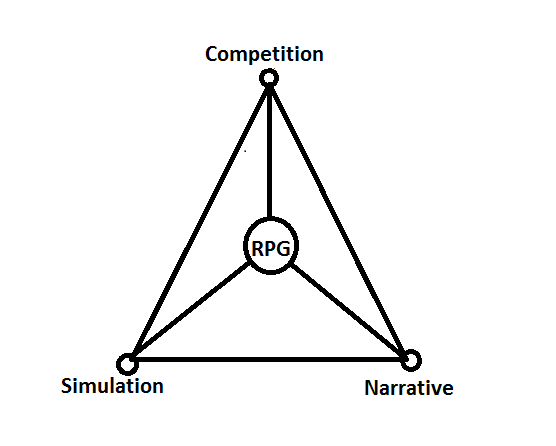
Roleplaying, Storytelling, Mechanics. To keep in line with the existing literature on Gaming Theory, I have slightly renamed the categories I used in the previous post. I have renamed ‘Mechanics’ as ‘Competition’ (it goes by ‘gaming’ in GNS Theory, but I find that to be a bit ambiguous of a term); it essentially refers to how much of the experience of the game is rooted in competition. Storytelling will be referred to as ‘Narrative’, and Roleplaying will be expanded slightly to ‘Simulation’. Simulation refers to how much of the setting goes to recreating system-internal realism. Note that this realism does NOT have to be actual realism. For example, many unrealistic things happen in Star Wars, but there is an assumed set of rules which governs things like lightsabers. Any given game will have a balance of the three, like so:

Game-Qualities

Continue reading

What is Roleplaying?

gentleman-gustaf-figure

If you’ve never been exposed to roleplaying, it can be hard to understand exactly what it is. Thankfully, pop culture knowledge has progressed from the point where roleplaying is no longer linked with satanic ritual, and is instead linked with socially awkward nerds:

Continue reading

The Wheel of Time: A Late Eulogy for Robert Jordan

gentleman-gustaf-figure

For my first review, I was all set to review a book by Brandon Sanderson. I outlined what I liked about the book, what I thought Brandon Sanderson brought to the table, where his writing felt flawed, and so on. And then I tried to introduce Brandon Sanderson. I couldn’t do it. To talk about what Brandon Sanderson does right and wrong was something I had only ever learned to do in contrast to Robert Jordan, and anything I could write about Brandon Sanderson would be overshadowed by my 5 paragraph intro about Robert Jordan. Brandon Sanderson is a spectacular author in his own right, and deserves to be written about on his own, without a page of intro about somebody else. So instead, I find myself writing about Robert Jordan.

Continue reading

The Beginning

We are now live! Stay tuned for more short stories, reviews, articles on game design, roleplaying advice, and eventually, recordings of rpg sessions!