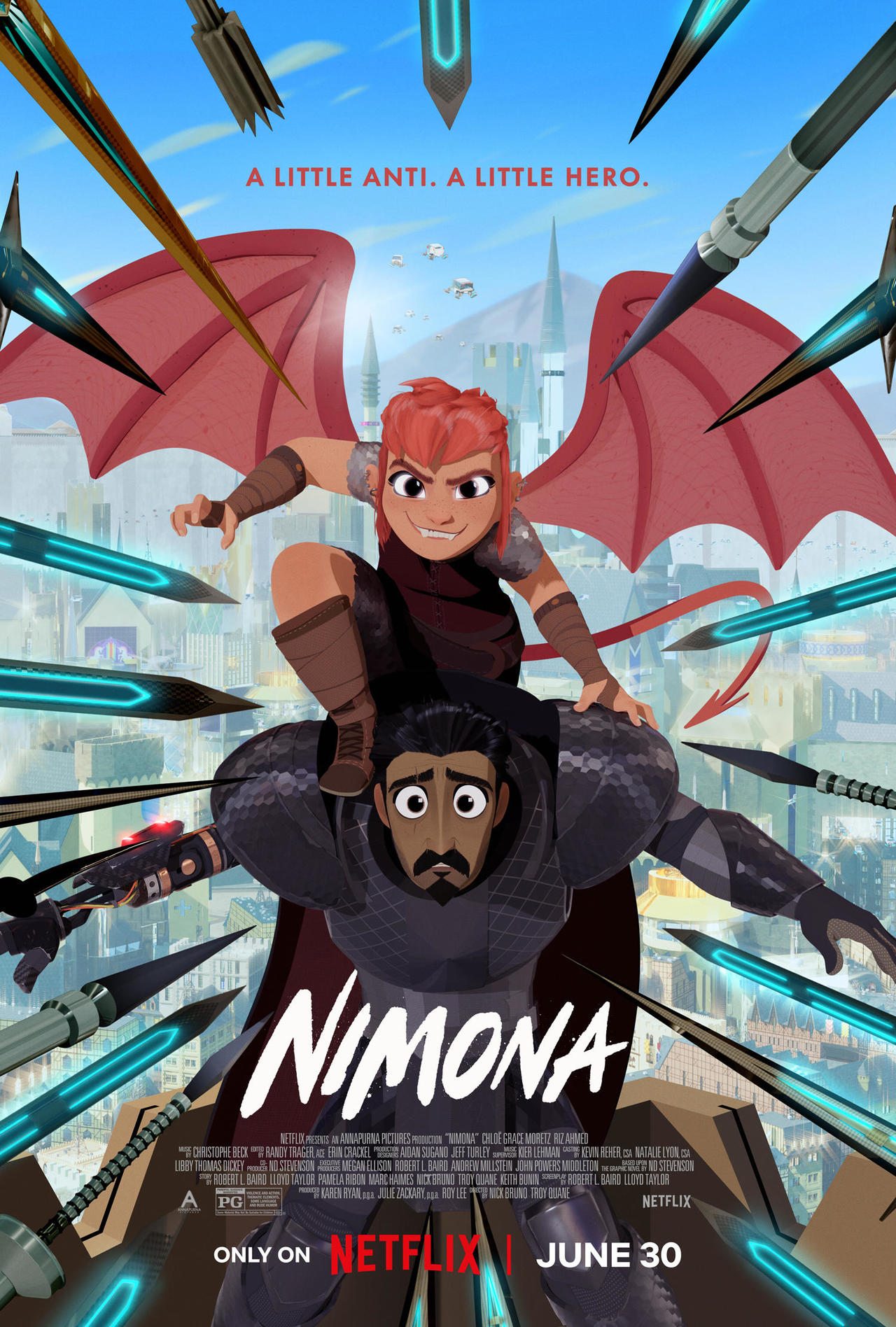
I loved the comic by ND Stevenson.
I loved this movie too, right up to the end, even though it was clearly its own take on the story. 90% of this movie, maybe 98% of this movie, did more or less everything I wanted. The actors, animators, and writers did a marvelous job. Then, at the very end, the movie really frustrated me.
I can’t meaningfully talk about this movie, and how I feel about it, without spoiling the end. Suffice to say I didn’t expect this totally predictable ending. I wish they had written a different one. I’ll mark the spoilers below.
As someone who read and was delighted by the comic years ago (is it a decade ago already?) I was absolutely on board for a movie version. My memory of the comic was of a heartwarming story about a shapeshifting girl who teams up with an ostensible bad guy and who finds love, camaraderie, and acceptance. Not love like romantic love, but the equally vital love of one’s friends.
Yes, the comic has anguish. Yes, it has strife. There’re moral and ethical issues that need more nuance than animated kids movies usually offer. The comic is less clean cut than movies usually are, and more rebellious. That’s about what I’d expect from a graphic novel. Reading back through it, I can see that the comic is less happy than I remembered… but the ending doesn’t hit a sour note for me. It all holds together.
The movie makes a lot of changes. It makes them very early on—I mean, the movie and the comic diverge pretty much right off the bat. But a lot of the basic narrative shapes are still there, still shared between them. There’s enough commonality that, despite the fact that the movie is telling a different story, it still feels connected. The movie still feels like it’s offering an interpretation of the comic rather than something completely unrelated.
Maybe that’s why the end of the movie feels so off to me.
Okay, now we’re headed into *SPOILERS* territory. I’ll let you know before I go off the deep end, but I’ll spoil chunks of the comic in just a moment. It’s been out for a decade. Go read it if you haven’t yet.
To hammer home why and how I think this movie misses the comic’s message, why the movie’s end feels so yucky to me, I need to walk you through the stories’ differences.
Ready?
The movie makes Ballister the audience’s focal character even more than the comic does.
In the comic, the reader mostly follows Ballister’s perspective… but Ballister and Nimona are introduced at the same time and are given more similar narrative focus.
In both movie and comic, Nimona is coded as queer and young. Ballister is clearly older (even parental) in both movie and comic, but while he’s explicitly gay in the movie (instead of implicitly so in the comic) movie-Ballister feels less queer-coded to me.
In the comic, both Ballister and Nimona are firmly against ”the Institution,” the system and authority in control of the setting.
The movie makes Ballister less antiauthoritarian: he is focused on one bad actor using power corruptly rather than on an unjust and corrupt system.
The movie establishes Nimona’s more antiauthoritarian bent in opposition to Ballister’s, and (maybe intentionally, maybe accidentally) undermines her antiauthoritarianism.
The comic’s climax ends with interpersonal conflict, the destruction of the Institution’s authoritarian control, and a quiet personal resolution that feels fitting and touching.
But the movie (*SPOILERS*) ends with heroic self-sacrifice (and possibly self-erasure) that leads to popular acceptance and adoration without any clear change to the authoritarian power structure. Worse, it does this with the most heavily queer-coded character in the film.
Okay, let’s go through all that in more depth.
First: narrative focus.
This one’s quick. The movie starts with us looking at Ballister. We watch events unfold around him from a close third-person perspective for several minutes, and he’s absolutely the main character of the story. Nimona is introduced quickly after those first couple minutes and becomes a main character, but Ballister remains the lens through which the audience experiences the story.
The comic, on the other hand, introduced both Ballister and Nimona on the same page, right at the very start of the story. The frame follows Ballister’s perspective more than it follows Nimona’s, but they’re on more equal footing.
How about the characters’ (and the story’s) antiauthoritarianism?
Comic-Ballister and comic-Nimona are both opposed to the Institution and its abuses of power. They both want to bring it down. They’re united in their antiauthoritarian goal, and the story doesn’t mince words about it—hell, ND Stevenson called the institution of authority “the Institution.” Comic-Ballister’s and comic-Nimona’s disagreements are almost entirely around means and methods; comic-Ballister sees himself as a villain and embraces the label, but he has a strong moral code and refuses to kill out of hand (“I go by the rules. Not their rules. Mine.”). Comic-Nimona is more willing to cause harm and create chaos. Their disagreements feel like they’re about principles rather than goals, and I didn’t feel like either of their perspectives were invalidated by the course of the story.
Like comic-Nimona, movie-Nimona is also more willing to cause harm and create chaos. Comic-Ballister and movie-Ballister are also similar in their unwillingness to kill people (though movie-Ballister seems completely against killing, whereas comic-Ballister opposes unnecessary killing). One important distinction: movie-Ballister doesn’t embrace the label of “villain” in the same way that he did in the comic, while movie-Nimona clearly does.
More importantly, movie-Ballister isn’t opposed to the Institution. He’s trying to uncover and remove one bad actor. He doesn’t want to destroy the authoritarian system, he just wants to get rid of one (or maybe a couple) people. For a modern analogy, he thinks police reform starts and ends with removing a few bad apples.
This is in direct conflict with movie-Nimona’s perspective. Movie-Nimona wants to destroy the Institution. She vehemently argues that the Institution (and its whole system) are bad, broken, and have to go. She helps movie-Ballister, and works with him, but whereas in the comic the disagreement between Ballister and Nimona felt like one about principles and methods, in the movie it feels like a disagreement between dismantling authoritarian structures and leaving them intact.
I liked the antiauthoritarian message of the original story. I liked the story’s close personal focus on the relationship between Nimona and Ballister. By removing Ballister’s antiauthoritarian perspective—and through changes to the climax and conclusion—the movie changes Nimona and Ballister’s relationship and tosses the antiauthoritarian message out the window.
How?
This needs a quick digression into the characters’ age dynamics, goals, and relative queer-coding.
In both movie and comic, Ballister is presented as older and Nimona as younger. Ballister offers Nimona quasi-parental care and guidance. They disagree, they argue, and they collaborate. In the comic, they disagree on means and methods. In the movie, they disagree on ultimate goals. Despite their disagreements, in both movie and comic they work together.
In the comic, they both achieve their original stated goals (more or less). In the movie, only Ballister achieves his original stated goals.
In the comic, neither Nimona nor Ballister are explicitly queer. Both, however, are strongly queer-coded. They are othered by society, they reject the social status quo, they identify as villains—queer self-identification with villains, especially Disney villains, is bigger than I can cover here, go read about it—and Ballister has a very gay-coded frenemy relationship with a man named *ahem* Goldenloin.
In the movie Ballister is explicitly gay. He and Goldenloin are unambiguously an item, and share a kiss early on. But this gayness is socially unmarked; it doesn’t matter to them or to anyone else that they’re gay, and it’s treated as perfectly normal. Ballister also doesn’t have any of the other usual queer-coded markings: he doesn’t reject the social status quo, he supports hierarchy and authority, he doesn’t identify as a villain… he doesn’t feel othered, within or without. He just wants to clear his name of a crime he didn’t commit.
But movie-Nimona still has all the queer-coded markings. She very obviously feels othered, within and without. From aesthetic to self-image to her relationship with authority to mental health challenges, Nimona is queer-coded all the way down.
I could write a whole other essay on how this movie queer-codes Nimona. The people who made this movie clearly saw the comic’s character, recognized her, and built on her. They knew how to make Nimona leap into life on the screen as a person, as someone who often felt painfully real.
That makes the movie’s changes more frustrating for me.
See, in the comic Nimona’s youth doesn’t feel like a hindrance. Her age isn’t tied to anything disqualifying her from agency, nor is it an obstacle to her achieving her goals. She may be Ballister’s sidekick, but they ultimately feel more like equals: they both accomplish what they set out to do, even if there’s unresolved strife between them.
In the movie, Ballister’s goal wins out over Nimona’s. Moreover, young and queer-coded Nimona accomplishes Ballister’s goal for him. She “dies” heroically in the process. Then, after her apparent death, Nimona is celebrated by the city’s populace as a hero and martyr while the Institution makes a few changes to the rules but otherwise carries on as it was.
Nimona vanishes, her goal is left unaccomplished, and she’s finally accepted. Yuck.
I don’t like having the movie’s most heavily queer-coded character give up her own goals in service of the goals of her parental figure, sacrifice herself in a big explosion, and only after her apparent death be celebrated and accepted. They’re celebrating her sacrifice—from the rest of the movie, I doubt they’d celebrate her if she publicly survived.
It’s a bad look. We can do better than that. The comic did.
Now, I say “dies” because the movie walks that death back seconds before the credits roll. This is actually in keeping with the comic, though it feels extremely different.
In the movie, Nimona is believed dead. Everyone saw her explode, and they know that she both blew up the Director of the Institution and saved the city at the same time. She’s celebrated and accepted as a hero. She’s revealed to have survived when she greets Ballister (from off-screen) at the very last moment of the movie—it’s portrayed as a joyous reunion, at least from Ballister’s perspective.
In the comic, Nimona vanishes in a huge explosion that destroys much of the Institution’s HQ without having done anything the larger populace sees as heroic. She’s believed dead. But only a few people knew about her at all. Her goal of dismantling the Institution is achieved, but it’s not because of any big self-sacrifice—the Institution is dismantled because of all the hard work she and Ballister had put in beforehand. Ballister only realizes that she’s still alive by chance, and she silently waves goodbye to him when he briefly catches up with her. In the epilogue, comic-Ballister wonders whether he’ll ever see her again, and hopes that she knows he’s her friend.
That’s poignant. It’s powerful. It’s personal.
The comic doesn’t adhere to standard tropes of heroic sacrifice, hero worship, and other things that so many movies have done to death—things that, even if they aren’t inherently authoritarian, also aren’t antiauthoritarian. The comic doesn’t offer a neat, happy ending. It’s messy. It feels real.
So the movie tosses the comic’s antiauthoritarian message by sacrificing the only actually antiauthoritarian character, having her give up her goals, and not actually showing any of the social transformation or public questioning of authority that the comic does. It undermines the antiauthoritarian message by making the only character espousing that view more childlike than the focus character, and having her give up on her goals to prioritize the focus character’s goals.
Plus, the movie perpetuates the message that queer-coded characters can only be accepted through heroic death (whether or not their death is permanent).
That’s just another version of a very traditional message. It’s only once a troublemaker is safely dead that a sanitized heroic version of them can be accepted. Look at what authority figures said about Martin Luther King Jr. while he was alive, and what they said after he died.
I love so much of this movie. I’m glad to see openly gay characters in fun stories. I think the people who made this movie did a lot of good work.
I detest the movie’s end, and I think it undermines a lot of what made the comic (and the movie) so good in the first place.
It’s enough to make me wonder whether there was meddling at the studio level. Did someone insist that the story conform to well-known tropes of heroic self-sacrifice & hero worship that have served so many other movies well? Did someone require the movie to end neatly, cleanly, familiarly? What did earlier drafts of the script look like?
I wonder about that because, based on the comic, I have a hard time imagining ND Stevenson giving the green light to this version of Nimona without some other pressure. It feels like such a jarring departure from the original.
I strongly recommend the original comic. And I strongly recommend almost all of the movie—everything but the ending. Make of that what you will.
 Fistful of Wits
Pingback: Boots, halfway through: A Marine-shaped box | Fistful of Wits