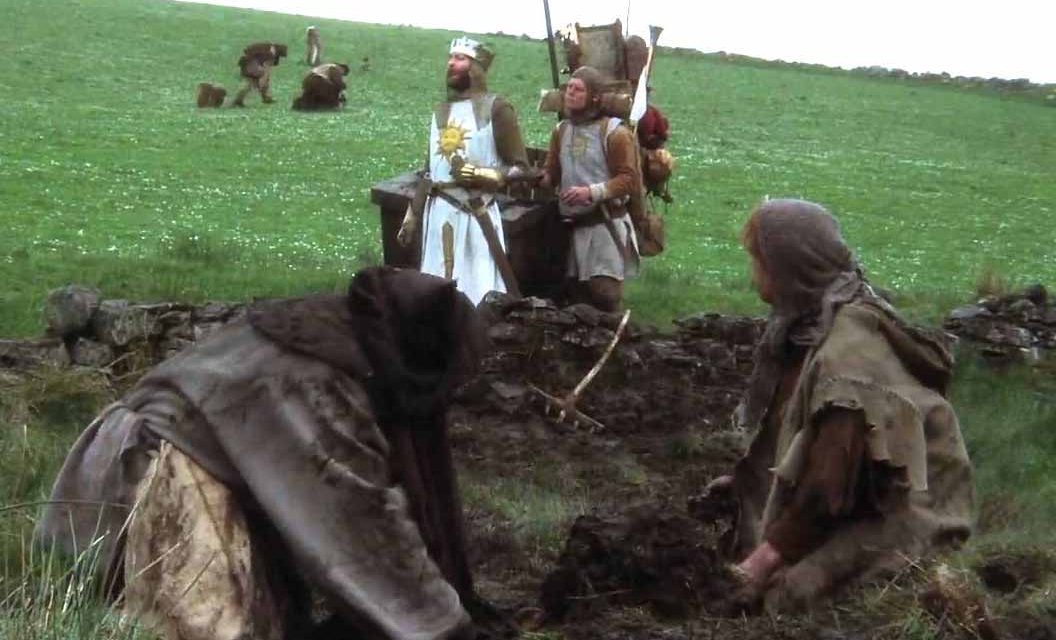
Strange women lying in ponds distributing swords is no basis for a system of government, and feudal lords tossing coins to the poor when they feel like it is no basis for an economy.
If you’ve been listening to economic news…
…you might have heard the phrase “K-shaped economy.” A K-shaped economy isn’t an end state—it’s a trajectory. ‘K’ is used because of that letter’s two diverging limbs; one goes up even as the other goes down. Each limb describes the economic well-being of different groups of people.
You could also say “the rich get richer, the poor get poorer.” That phrase has been around a long time. It’s often been said as though it must be true. But we (both humanity and the USA) have previously found ways to change that trajectory—even if we’ve done a patchy and exclusionary job of it, we’ve expanded wealth and improved lives across social classes. Thus, “the rich get richer, the poor get poorer” can’t be inevitable (no matter how much wannabe-oligarchs might want it to be).
I think a K-shaped economy is a bad thing, a bad path to a worse place. It’s bad when our economy is growing for a few people while leaving most people to suffer. That concentration of wealth is bad for the society I want to be a part of, and (despite what GDP says) I think it’s bad for the economy. I also think it’s bad morally, but I’ll leave that aside for now.
K-shaped economies drive people apart. They widen the gap between the rich and everyone else. Hell, they even widen the gap between the ultra-rich and the not-quite-ultra-rich. They’re a path away from a free and cooperative society. They’re a path towards coercion and repression, aristocracy and oligarchy.
Free and cooperative society functions largely because people agree that they are all in the same boat. They share in each other’s suffering. They share in each other’s success. They mostly agree about reality, they can see eye to eye. They share a common story about “what makes us us.“ The further apart people grow, the harder it is for them to coexist in a free society.
As an aside, that shared story of “what makes us us“ is part of why White Christian Nationalists want to expel people who aren’t white or Christian from the US. It’s part of why rightwing political groups are so stuck on reaching their chosen flavor of ethnic “purity.“ White Christian Nationalists aren’t willing to conceive of a larger, more inclusive idea of “what makes us us.” Their only story about “us” is exclusive, not inclusive. They fear sharing society with people outside their narrow story. There’s more to it, but that’s part of it.
Back on topic…
People don’t have to see eye to eye to coexist in society. They can also be forced into place. Unfree, coerced societies can be kept in line by force and fear and violence. These societies are brittle, like a tree grown in a greenhouse, appearing strong and stable until they suddenly shatter because they cannot weather political disagreement.
Those societies tend to be more hierarchical and repressive. They often concentrate wealth in the hands of the ruling class, and offer little upward mobility. If you need an example, look at Sparta, or the antebellum American South with its slave agriculture. Look at Nazi Germany, with their economy kept afloat by looting their own population, looting those they’d invaded, and enslaving and/or killing anyone they didn’t like (their own political dissidents, Jews, conquered people, etc.). Apartheid South Africa is a more recent example.
But the hierarchy and coercion isn’t always so obvious. It’s often romanticized in historical dramas about aristocrats (like Bridgerton et alia), with all the rough spots smoothed over. And while feudal aristocratic power might be less obvious or systematic in its abuse than was seen in Sparta, the antebellum American South, Nazi Germany, or Apartheid South Africa, it still concentrates power and wealth in the hands of the few. It’s still repression, with few ways for anyone to escape the system or improve their lives. It’s the repression that most of your American ancestors fled when they came to America.
That’s the destination of a K-shaped economy: widely separated economic classes and strictly hierarchical societies. That’s what happens when the rich get richer while the poor get poorer. That’s the society I don’t want.
But what about GDP?
K-shaped economies can have plenty of economic growth. GDP can go up. K-shaped economies can grow and produce lots of wealth for a few people, because the Gross Domestic Product doesn’t care whether the money moving through the economy is being spent by millions of moderately wealthy people or by one trillionaire.
Worse, my understanding is that a K-shaped economy is self-reinforcing. Without intentional pressure from outside the market, without pushing for different industrial policy, oversight, and regulation, without leaders inside the market choosing a different path, the K-shaped economy will continue. This is because in a K-shaped economy the wealthy are the only ones who can regularly buy something more than tomorrow’s shelter, tomorrow’s food. With only the wealthy buying, there’s more and more pressure to make a few high cost goods or services (luxuries) and less and less reward for making decent mass produced affordable goods.
Even if GDP goes up this is a contraction of participation in the market and of productive capacity, not an expansion. It pushes the whole economic system towards less stability. Why?
Making small-scale high-end luxuries might support a few craftsmen or service staff. It rarely employs as many people as making the larger scale goods does, and the employees making luxuries usually can’t afford the luxuries that they make. Relying on selling high-end luxuries is like becoming a resort town; there’s no real depth to the rest of your economy, there’s no alternative when your main source of business dries up. The workers can’t enjoy the fruits of their own labor, and if something goes wrong or causes the wealthy few to choose a different product… poof, there goes your business model. There goes your resort town.
Henry Ford understood this. He loved lots of things that modern wannabe-oligarchs love: making money, technocratic transformations of his business, conspiracy theories, and crushing labor unions. But he also wanted to attract and keep skilled labor. And he understood that—in order to support a market for his own goods—he needed to pay his employees enough that they could buy the product they made. He chose a different path when he started paying $5 a day and when he implemented profit-sharing. That was an expansion, not a contraction.
What’s my takeaway?
If we want to escape a K-shaped economy, we need economic growth and activity to come from many small spenders instead of a few big spenders. That means we need more money in the hands of those smaller spenders—and we don’t need as much money in the hands of the big spenders. Allowing the K-shaped economy to continue without actively spreading the economic growth will only widen our society’s existing gaps. Allowing the K-shaped economy to continue without making the wealthy and ultra-wealthy more evenly share the tax burden will only widen our society’s existing gaps. That way lies (more) aristocracy. That way lies (more) oligarchy.
And by the way, offering a one time tax refund or cash bonus isn’t the same as spreading the economic growth. Those gifts are like a feudal lord riding into town once every few years and tossing some coins to the poor. They make a big difference every so often, but they are not a recipe for durable growth. To paraphrase an old saying, those payments are like handing a man a fish instead of helping him build the fishing boat he needs.
 Fistful of Wits