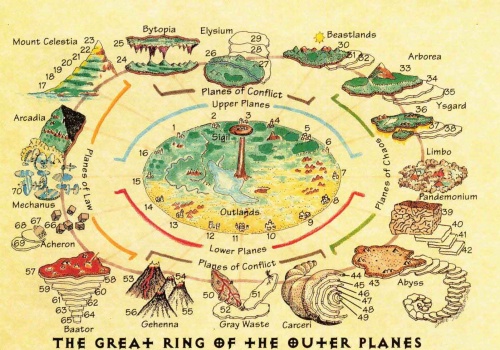
Once again, I find myself investigating the cosmological background of the setting I’ve most recently created. I was reading through the Dungeon Master’s Guide again, reading the section on planes near the beginning, and I’m in that usual place: somewhere between excited and miffed. Fortunately, it’s easy enough to change the things that haven’t excited me.
I’m comfortable, for the most part, with the material the DMG offers on things like the Astral and Ethereal planes. I’m more okay with the DMG’s ideas for the Shadowfell, the Feywild, and the various elemental planes. I’m not very happy about their ideas for the Outer Planes. I have some rewriting to do; let me tell you why.
To clarify for those not already overly familiar with how D&D has long structured its universes, there are related but separate semi-physical spaces called planes (some of which totally aren’t physical, but which are best understood as being so for the sake of discussion). 5th Edition has taken them from the shelf and dusted them off for another round of show and tell, and changed a few minor details while it was at it. The Astral plane is kind of like a dimension of thought and memory, often associated with the soul, and it’s associated with its own set of scary monsters and travelers now. The Ethereal plane is “closer” to the Material plane (the 3D world we all run around in) but is blurrily distinct. It is generally the provenance of spirits and ghosts, or other weird things, and creates problems for GMs by letting ethereal people walk through walls. I think I’ll solve the problem by linking the Ethereal Plane to The Passage, or something like that. The Shadowfell and Feywild are like scarier magical versions of our world, similar to Underhill of old fairy stories, or other similar places, and as such are basically the perfect excuse for an adventure. The Elemental planes are mostly composed of their one element, with occasional elemental intrusions and their own native lifeforms, and now they have cool places to go and fun reasons to visit. The Outer Planes, though, are a collection of planes which appear to exist solely such that every alignment can have a home-base of sorts. I guess that might be over-simplifying things, and the many levels of the Abyss and the various hells are obviously meant for fun adventuring in high-risk situations, but so many other Outer Planes seem like they’re just there because there was a space missing on the alignment wheel.
The idea of having a plane for every type of alignment seems downright silly to me. Why would things be so simple? Why would the metaphysics of the universe separate themselves out so nicely? I’m perfectly happy to accept that a plane would echo the mindscape and preferences of the being(s) that controls and maintains it, but it seems silly to suggest that there would simply be a natural set of planes perfectly aligned with such a nonsensical (and not-innate) feature as “alignments.”
If you don’t know what D&D’s alignment system is, it’s basically a shorthand for an individual’s moral / ethical compass. This is complicated by the fact that D&D’s system assumes that there are truly good and evil things in the world, and that they can be effected by appropriately targeted spells, prayers, and abilities, but whatever.
I’m okay with using the alignment system as a feature of play, and I’m okay with characters having abilities that interact with it to some extent, but I don’t think that the universe of my setting should organize itself around this thing that I view as a non-intrinsic shorthand. So I’m definitely not going to use the Outer Planes as they’re presented by the DMG, though I may steal from them extensively. I’ve already written my own version of the classic hells and the Abyss, so why stop there?
Basically, I think that the Outer Planes are all spaces that have been created by beings, and they should thus reflect the desires and preferences of those beings. Some may have been created long ago and expanded since, some may have been created long ago and have now fallen into neglect and decay… some are going to be fundamentally confusing and alienating to any character who travels to them, because the intelligences and wills which created them are entirely unconnected to any comprehensible reference point for the character. New planes, or demi-planes, or whatever you want to call them, might be made all the time. But they’ll exist because something made them, intentionally or not, rather than because they fill a blank space in the moral cosmos.
 Fistful of Wits
Yep, outplanes have always annoyed meIt felt like DnD just wanted to add some afterlifes from a few mythologies, then realised theres no cohesive metaphysics so forced the allignment system on it, but then forced to fill out the gapsAnd all these outerplanes feel less like a dimension and more of a placeAnd when you are designing your own world for a campaign, being required to either1. Use premade locations for your custom world2. spend ages completely designing a plane for each allignmentWhich eitherway is unidealIts fine if you are running a campaign in a pre-made world, but in a customworld, its extremely limiting for world buildingFirstly, gotta list all the things that the outerplanes are used for:1. Afterlife, whether theres seperate places based on morality or just one place, there needs to be somewhere for souls to go for the afterlife (If the world doesnt have a place in the elemental or inner planes)2. Fiends, due to the existance of tieflings, warlocks, summon demons and fiends etc… unless given a home in a different plane, they need somewhere to live, but it shouldnt rely on fiends to exist, the outerplanes should pre-date fiends3. Some gods and celestials, while gods dont have to have a home, and some gods could live somewhere else (if a world had a god that represents fire, it makes sense if that god lives in the elemental plane of fire)But even if its where some of the gods “live”, it should be able to exist regardless of if the lives in the outerplanes, and regardless of what pantheon of gods are used. If a DM decides to only have 1 god, the concept of the outerplanes shouldnt collapse4. Outerplanes as a whole need to be connected and continuous, even if it is non-euclidian and/or mostly empty space and/or multidimensional. Even if there have distinct and clear planes in the outerplanes, the foundational metaphysics shouldnt rely on clear boundaries. If we do follow the allignment system, then the outerplanes should have metaphysics that work regardless of if you have 2 planes (good and evil, or chaos and law) or if you have 17 like the normal system, 100s if you wish, or even just a continuous subplanes being connected in the overall outerplanes5. Physics be weird, the elemental planes already are non-euclidian and have weird physics, so the outerplanes which are even further away should be even weirder6. The outerplanes should be the edge – because it is the outmost planes, they probably should either act as the boundary, a shell or a container for everything in the universe7. Beyond the outerplanes should remain a mystery, as beyond the outerplanes serves no mechanical purpose, to the universe, and therefore DMs should be free to do what they want with it, whether it leads to different dnd universes, or just nothingness, or eldritch horrors8. Should be backwards compatible, whatever rewrite of the outerplanes is, it should allow the canon outerplanes to fit within the definition still, but the definition should allow something different with minimal effort9. Metaphysics shouldnt rely on places, but purely the foundational building blocks of the world10. Technically you could argue that all the god’s domains/planes are content that should have a place… but id argue that belongs in specific settings, so not a requirementOverall, the main requirements of the outerplanes is that they are weird, they are non-euclidian, they are the edge of the universe, fiends often live there, gods can live there, and dead souls are there (temporarily according to dnd lore)Or at least, thats my opinionBut these requirements arent enough to use as a guide for how to design custom outerplanesElemental plane guides are: Consists of elements, elements can be any list but typically fire water earth and air, non euclidian, and you travel between elemental planes by duel-elemental sub planes, despite the pictures the elemental planes arent just a ring, and can have multiple planes of the same element, although there is usually one large main plain for each of the core elements (for sake of simplicity) and the planes themselves are based around the elements, like water plane is an endless ocean or river, and the air plane is an endless skyThat is a set of guides on how to make elemental planes in my example, as it clearly gives instructions on how it worksSo the requirements i made of outerplanes is not enough for nowAnd i need to do more thinkingId be somewhat tempted to completely ignore the outerplanesGive fiends a mirror plane like feywild or shadowfell, but hell-likeGods just exist as their element, but also can create pocket-planes for their celestials to live inDead Souls just exist in the nothing-ness beyond the elemental planes before fading away, no allignment, no gods, no heavens, just a sea of souls with no physical matterAnd if you want to include all the weird planes/domains ruled by gods…. just build it into the custom world, it doesnt need to be defaultBut i hope my rant helps anyone else reading this
Ok, formatting messed up
I got no idea what happened here, applogies… im just gonna leave before i mess it up more
Hah, no worries, I’ll take care of it :) I enjoyed reading your thoughts!
I think that this could be a sort of chicken-or-the-egg kind of situation. From what little I understand of D&D cosmology, I think that yes the outer planes are shaped by the thoughts and wills of deities. However, I think it also makes sense for those deities to follow the alignment chart to some degree. If we assume that these deities and infernal beings have mostly free will than it makes sense for them to have different or conflicting ideas about what a life best lived looks like.
For example, how might people approach morality (NG, LG, CG)?:
Some people think virtuous acts should be done for their own sake, some think that good should be defined by a creed or code and or laws set in place should not be broken even for the sake of good, and some people think that what the right thing to do varies situationally.
The idea I am trying to illustrate is that the gods of D&D are clearly not all knowing or all powerful, so it would make sense for them to choose to live and behave differently especially when they have different domains as their responsibility. I think that once you get enough beings of sufficient power to create realms by their will and controlled by their minds, of course you are going to get a spectrum of opinions and planes to express them. When a mortal dies in the Forgotten Realms their soul is sent to the plane which most aligns with their attitude and actions while they lived. They choose to go to those planes after death and made that choice with their actions. Everyone gets what they deserve.
I think that your example for the outer planes and the afterlife in D&D is perfectly legit! Your interpretation of as-written D&D is the version of that which I find most appealing.
That said, I personally don’t like D&D’s alignment system having any mechanical force, or implied metaphysical weight. This dislike is my biggest stumbling block with D&D’s outer planes as written. I don’t like the alignment system as anything more than a useful out-of-game shorthand for communication and analysis, and I don’t like the alignment system having any one-to-one connection to realms of existence or afterlives. I’m not totally internally consistent, so there are a few exceptions to this when dealing with powerful forces of Order or Chaos. But I would much rather have there be three or eight or however many planes & afterlives that might be described as Neutral Good, and some different number of planes that might be called Lawful Evil, and yet another number of planes that were Chaotic Neutral, etc. That’s because I want those planes to exist separately from the alignment chart, and because I don’t want to let anyone hide their moral choices behind a “but I’m acting on the side of Good” shield.
A lot of this is because I *do* like making up my own gods, afterlives, moral and ideological systems, and such. I enjoy making players feel like they exist in a different religious and moral space than the one that we live in in our own world, with distinct ideas and disagreements about what constitutes good and evil, right behavior and wrong behavior. That’s my personal preference, not something that everyone needs to agree with nor work that every storyteller needs to do!
Pingback: D&D 5e’s alignment trap | Fistful of Wits
Reblogged this on Carlos Arias Delgado.
Reblogged this on Tome and Tomb.
I’ve always thought of the alignments in D&D as being very directly connected to the gods. Detect evil is a level one cleric spell, and cleric spells are basically entreaties to the deity worshiped. It would make sense for detect evil to simply be the deity in question offering his opinion on the moral character of the character in question. I don’t think they necessarily need to be any more intrinsic than that.
It should be noted that I haven’t dealt with many things that interact with alignments, so I don’t know how many non-divine such instances there are.
I don’t think of the alignment system as having much to do with D&D’s gods, though perhaps I should. It seems strange to me that Lawful Good can cover such a broad range of behaviors (including some which we might not consider especially “good”) while still being acceptable to any given “Lawful-Good preferred” god. I much prefer having gods care about their particular portfolios and purviews, with variable interest in things outside that according to their personalities, etc.
You’re right that most of the ‘detect good and evil,’ ‘protection from good and evil,’ and other such things are based on divine power sources (clerics and paladins get both, wizards only get protection), but they are specifically worded to cover aberrations, celestials, elementals, fey, fiends, and undead. Also magically consecrated or desecrated ground. Regular mortals, in other words, just don’t merit recognition by those spells and abilities most of the time.
If someone wrote a new spell that dealt with mortals’ alignments… I’m not sure if I’d let people use it. It seems like that’s been intentionally phased out of 5e, and I think I agree with it. I will say that the supernatural focus of those other spells makes them a bit less useful for players who’re dealing with lots of humans, but… yeah. That makes sense to me.