“To put this into perspective… The Sirius has 5,600,000 parts and close to a million systems, subsystems, and assemblies. Even if everything was 99.9 percent reliable, that would still be 5,600 defects. It wasn’t a question of if something would go wrong on the way to the moon, it was a question of when and what.”
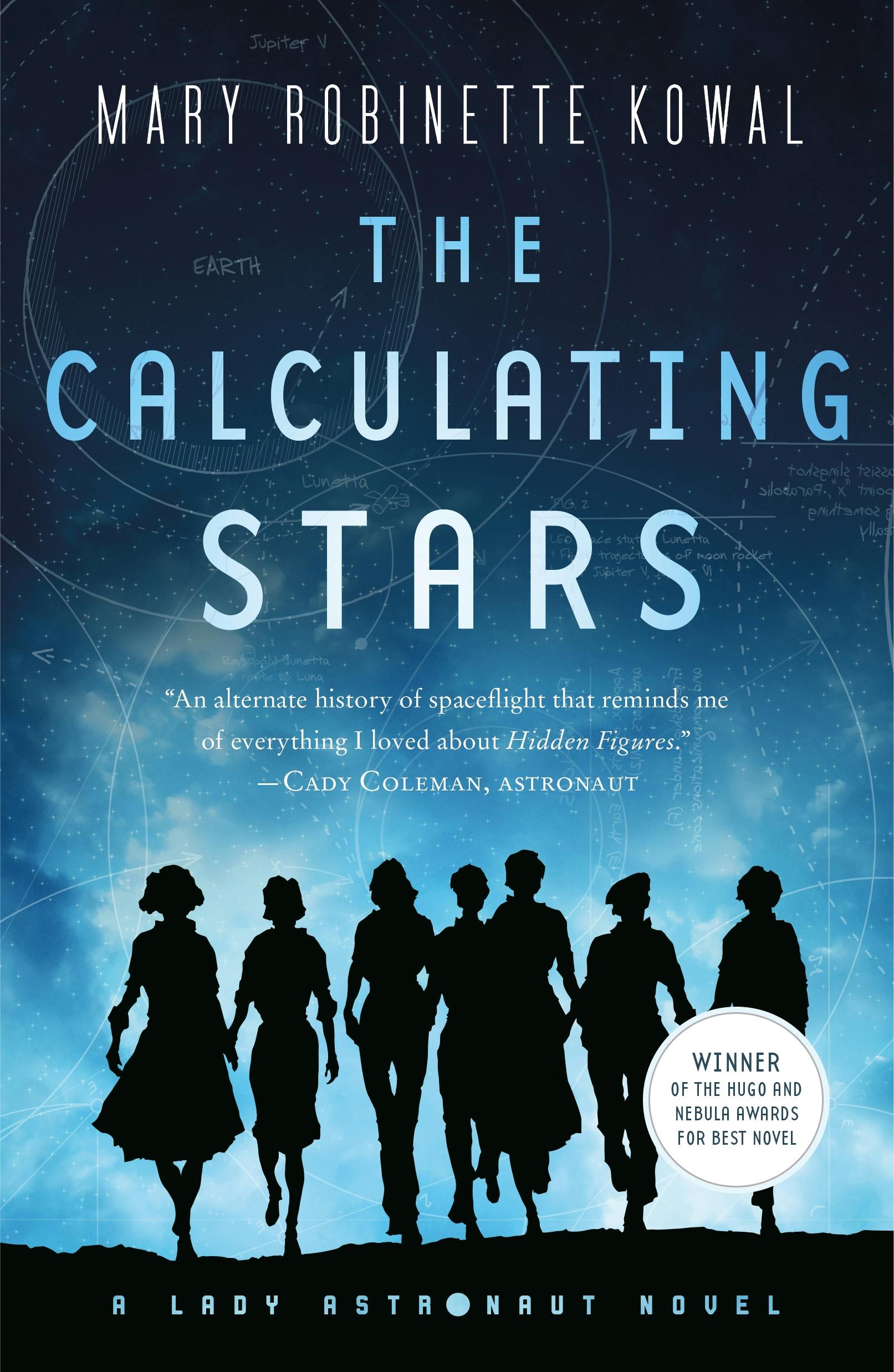
This book has been on my to-read list for years. I somehow never picked it up. That paragraph above is the perfect encapsulation of why I love this book so much. I will try to explain. But honestly I was hooked upon reading the first page.
I found a used copy at Boskone. I knew that the title and author were familiar, that I’d been meaning to read the book, but then I thumbed the thing open and… here, try this for your first two paragraphs:
“Do you remember where you were when the Meteor hit? I’ve never understood why people phrase it as a question, because of course you remember. I was in the mountains with Nathaniel. He had inherited this cabin from his father and we used to go up there for stargazing. By which I mean: sex. Oh, don’t pretend that you’re shocked. Nathaniel and I were a healthy young married couple, so most of the stars I saw were painted across the inside of my eyelids.
If I had known how long the stars were going to be hidden, I would have spent a lot more time outside with the telescope.”
It captivated me!
I read the first page, turned it and started reading the next, and then realized that I should probably buy the book instead of trying to read the whole thing in the bookstore. Suffice to say, I finished this book. The library has already provided the next one.
I love the whole book. That’s my review. But it’s that paragraph and the one immediately following it, anchored around “it wasn’t a question of if something would go wrong on the way to the moon, it was a question of when and what” that sticks with me. I’m struggling to articulate why. Here’s the full version:
“To put this into perspective… The Sirius has 5,600,000 parts and close to a million systems, subsystems, and assemblies. Even if everything was 99.9 percent reliable, that would still be 5,600 defects. It wasn’t a question of if something would go wrong on the way to the moon, it was a question of when and what.
And when that failure occurred, it would occur in a spacecraft that was traveling at twenty-five thousand miles per hour. We weren’t going to have time to run calculations then, so the idea was to create a library of possible answers so we could access a month’s worth of work in a few minutes.”
That so perfectly conveys a perspective, a reality, that I think many people on Earth don’t fully understand. It’s a profound appreciation of entropy. It’s a deep-seated understanding of how complex systems break down, and a commitment to thinking at least one step ahead.
Maybe people grasp this intellectually, but they don’t live their lives with this baseline assumption of entropy. Heck, I don’t usually live that way day to day either. Not on a deeper level, not the way that you need to if you’re going to survive the utterly uncaring vacuum of space.
This deep-seated understanding of entropy was something I came to appreciate leading up to (and while) writing Bury’em Deep. This understanding was how I envisioned the Deep family dealing with their world. They live in the assumption that whatever can break, will. It’s not a question of whether a system will fail, whether a part will give out—it’s a question of when, and alongside what else. Their responsibility, then, is to understand how all the different parts of their home (a spaceship) work, understand how those parts will fail, understand how to recognize that they’ve failed (because maybe your fault indicators broke too), and understand how to recover from those failures into a survivable state.
I thought, while I was writing the book, that maybe Barry has anxiety. He might. But if he’s anxious about things, it’s a totally reasonable response to keeping himself and his family alive in an environment that is ready to kill them without warning. Yes, I took inspiration from astronaut Chris Hadfield’s “what’s the next thing that’s going to kill me?”
That assumption of entropy suffused my thoughts about our world, far beyond Bury’em Deep. How could we make our systems simpler? How could we make them easier to fix? Could we make sure that, when they inevitably failed, they would fail in less dangerous ways? Even if I couldn’t change the larger systems, could I develop habits that would reduce danger when something went wrong?
I think it was around this time that I trained myself to automatically engage the parking brake whenever I parked. Most of the time it’s totally unnecessary. It has hardly ever mattered. A few times, it has saved me and the car from considerable harm.
I wasn’t just thinking of physical products though. I thought of social and political systems too, of logistics and of infrastructure. I still think about that, and how often we opt for complicated solutions that are hard or impossible to repair and offer only marginal benefit over something simpler, more direct, and easier to fix.
All of which is to say that The Calculating Stars hit a sweet spot in my brain that has been lurking there, ready and eager, for YEARS. This book isn’t fixated on thinking about everyday life through those lenses of entropy and graceful failure, but it scratched those itches. Of course, it also told an exciting story through a likable narrator with an excellent voice. Hard to beat that, really.
Yes, my review is still “I love the whole book.” If that’s not helpful enough, I’ll add this: read the first chapter. If you read the first chapter and don’t want more, cool. Don’t worry about it. I’m not sure how aligned our tastes are if that’s the case, but I don’t think you need to push yourself. You could, of course; there is more to the book, and there are layers of complexity and depth that are only gradually revealed. But that first chapter offers an excellent sample of what’s to come and lays the groundwork for nearly all the rest of this story’s drama.
 Fistful of Wits