Middle Grade & Adventure Fiction, 5/21/26

I received really helpful feedback last year alongside a rejection of Bury’em Deep. The agent said (I paraphrase) that she really liked the story, but wouldn’t represent me because she didn’t know an editor who was looking for it. She went on to say that middle grade was an exceptionally difficult market at present; acquiring editors were extremely picky, and she didn’t have the right contacts for upper middle grade space adventure.

I appreciated her candor. Frankly, I think her position is a good one—if she doesn’t know where or how to sell a work, she’s not the agent for that work. She remains the only agent (in over five years of on and off querying) who has given me such clarity in her response.

But all of that left me wondering: what the heck is ”upper middle grade” fiction? Have I been using the wrong term for my story this whole time?

Continue reading

Pain, progress, & Truby, 5/14/26

Success! Since my post last week, I’ve prioritized prep work during my writing time. It’s been good. I haven’t had that much writing time, and I haven’t answered all my questions. I definitely shouldn’t jump back to the story yet. But I have identified several problems that were eating at my subconscious, and I may have resolved one of them.

Unfortunately, that resolution could be painful.

This prep work hasn’t felt satisfying in the same way as putting words on the page. Something about the work has even felt a little hollow. It’s like I’m merely whetting my appetite, and now feel even hungrier for “the real deal.” And yes, I agree, that’s unhelpful terminology for reinforcing my prep work habits.

It doesn’t help that I’m spending a lot of time and effort looking at the holes in my hopes and plans. Realizing that something’s going wrong, that I need to cut or make big changes, isn’t precisely inspiring. But every so often, I get little insights—yes, they sometimes hurt, but I’m excited to try implementing them, to see whether they solve even bigger problems that I’d only barely glimpsed on the horizon.

Let me give you an example.

Continue reading

Cooking, writing, prep work 5/7/26

Here are two scenarios.

First, you’re in the kitchen. You need to make dinner—food for tonight, and leftovers for several days. You’re working from a recipe that you haven’t read before. You haven’t done any prep. You’re sure you have most of the ingredients you’ll need, but you haven’t even pulled any of them out of the cupboard.

Second, you’re in the kitchen again. You still need to make dinner—food for tonight, and leftovers for several days. This time you’re cooking a familiar dish; you know the recipe, you know the flavor palette you want, you know what you’re doing. You’ve already prepped all your ingredients. Each one is on hand, in a bowl or dish or whatever, ready to add when the time comes.

In the first case, you are going to be stressed, and frustrated, and the whole thing is going to take way too long. Forget improvising; you might make changes to the recipe but they’ll be by accident and you’re probably going to burn something.

In the second case you’re relaxed, you’re having fun. You have enough free time and spare brainpower to play around with a few ingredients you thought of as you were cooking. You know what you’re doing well enough that you can track the results of your improvising and experimentation as you go.

If I had a choice, I’d pick the second option every time.

So why do I keep picking the first option with my writing?

Continue reading

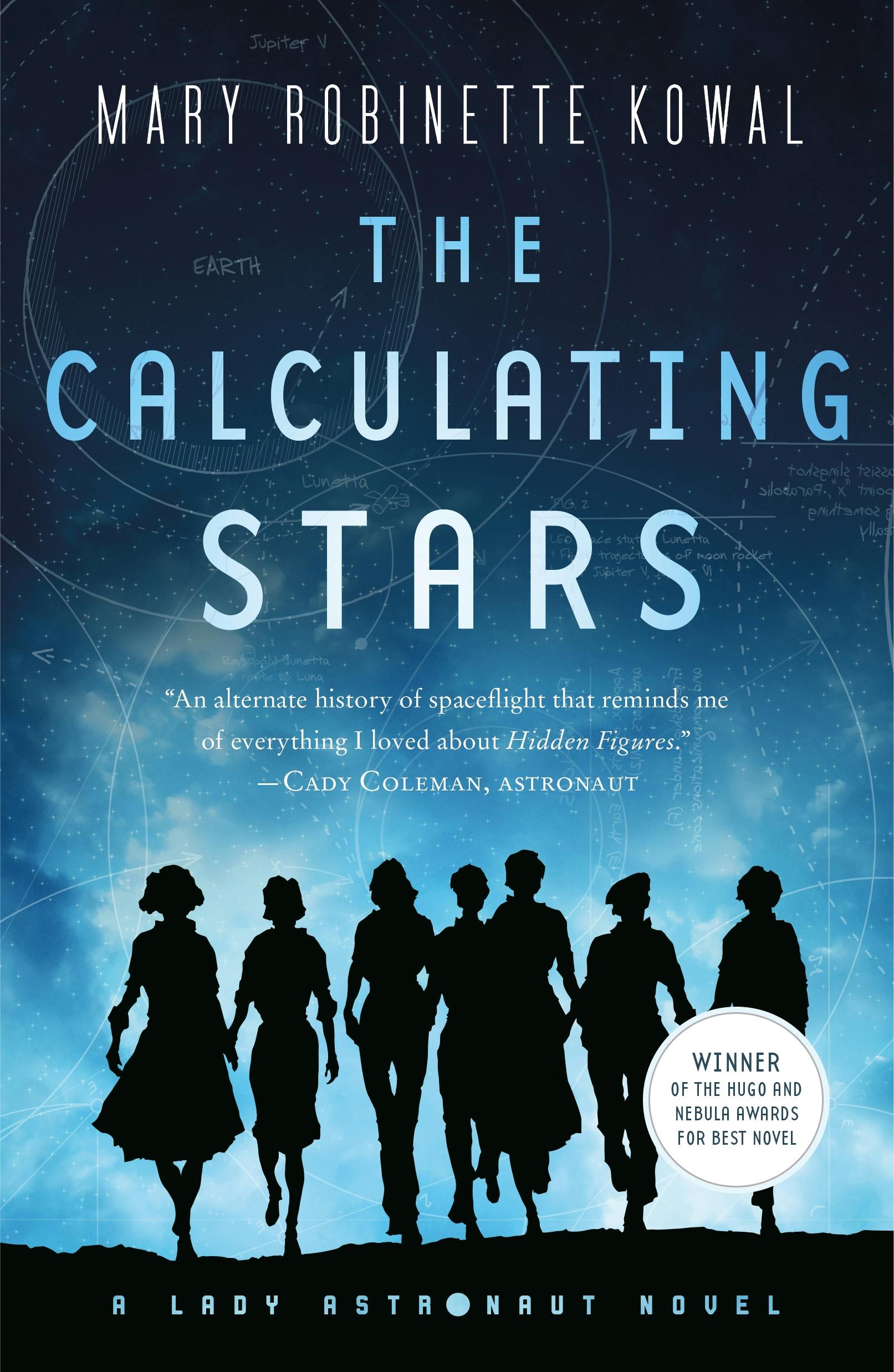
The Calculating Stars, by Mary Robinette Kowal

“To put this into perspective… The Sirius has 5,600,000 parts and close to a million systems, subsystems, and assemblies. Even if everything was 99.9 percent reliable, that would still be 5,600 defects. It wasn’t a question of if something would go wrong on the way to the moon, it was a question of when and what.”

Page 329, The Calculating Stars by Mary Robinette Kowal

This book has been on my to-read list for years. I somehow never picked it up. That paragraph above is the perfect encapsulation of why I love this book so much. I will try to explain. But honestly I was hooked upon reading the first page.

I found a used copy at Boskone. I knew that the title and author were familiar, that I’d been meaning to read the book, but then I thumbed the thing open and… here, try this for your first two paragraphs:

Continue reading

Crit group, 2/19/26

I have been away from my regular crit group for about a year. Caring for a new baby will do that. I recently started back up again with a smaller group of people who are more narrowly focused on my preferred genres. I love the difference.

In the previous group, there were long lulls between my submissions. We had enough people that taking turns meant there could be a month or two between any one person’s submissions. That delay made it harder to stay in the ‘excited creation’ phase of making progress on a project. It wasn’t the only thing pushing me that way (mental health and caring for other duties distracted me just fine) but it didn’t help.

Now I’m submitting smaller pieces more regularly. This feels like a positive feedback loop rather than simply treading water. I’m still juggling my writing alongside everything else in my life, but it’s amazing what a difference feeling excited after a critique session makes.

This smaller group’s composition makes a big difference too. While the larger group had plenty of good insight and good questions, there was enough friction between the genres I was writing and the comfort zones of the other writers to derail my enthusiasm. This smaller group is composed solely of genre fiction writers with overlapping genre expertise and familiarity with more recent genre fiction. I’m no longer asked to explain a genre, or to explain a secondary world in great detail at the start of a story. This has made the difference between feeling uncertain about a piece after submitting it to the larger group, and feeling excited to improve the same piece after receiving precise and knowledgeable feedback from the small group.

I miss the social space of the old group. I enjoyed the people, and I did receive some useful responses. But this smaller group is so much better at delivering what I want from a critique group, there’s no way I’d go back.

It’s a good enough group experience, in fact, that I’m tempted to invite another writer whose critique has been transformative for me previously. At the same time, I fear adding more people—every additional writer dilutes our ability to respond to everyone every session. I’ll have to talk this over with my friends and see how they feel.

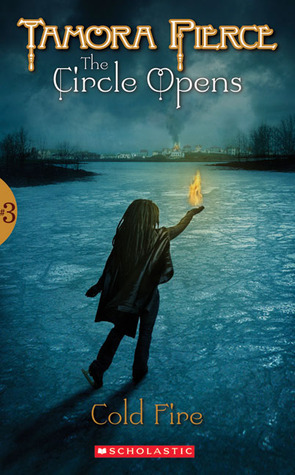
2/3rds through Cold Fire, by Tamora Pierce

I’ve gotten stuck.

I loved Tamora Pierce’s Circle of Magic series, her first quartet about Sandry, Briar, Daja, and Tris. I was eager to read the next quartet. For the most part, I still am.

I breezed through the first two books in this quartet. Sandry’s book (Magic Steps) and Briar’s book (Street Magic) both went by so quickly that I nearly inhaled them. Daja’s book, Cold Fire, has really slowed me down.

I try to find times in the day when I can sneak in a little bit of reading. Often enough this ends up being at night while I’m lying in bed. I’ll read a chapter, then set the book down. Except with Cold Fire reading a chapter leaves me feeling sick to my stomach. Stopping there doesn’t help.

I’ve discovered the hard way that I find it difficult to read a story about arson, especially when lives are lost.

Continue reading

Rewatching Ted Lasso S1

I feel more complicated about the character of Ted Lasso as I rewatch this show. For one, as Ley says, his vibe is very much Manic Pixie Dream Coach. More importantly, I feel as though early on the show distracts from Ted’s flaws because he means well and is the protagonist… and I feel grumpy about that.

I see more of Ted’s shadow (to borrow from Jung) coming to the fore as I rewatch the show. The first time through, I was just keeping up with the writing and admiring the show’s construction and delivery. This time, I have the chance to pay more attention to what’s going on, and to notice the elements that are clearly laid out and planned for later exploration.

It’s a well-written show. Ted is a well-written character. He’s flawed, though we don’t explore that as much in the beginning of the show. He’s admirable and likable in his attempts to catalyze the personal growth of the members of his team (along with everyone around the team), and to drive their transformation into a mutually supportive whole.

In pursuit of that goal he also transgresses or ignores people’s stated boundaries while ‘trying to make things better.’ His transgressions felt off the first time around. They feel more insufferable on a rewatch.

The first example that springs to mind for me is how Ted explicitly ignores Rebecca Welton’s stated preferences when he promises to show up again the next morning despite her saying that he shouldn’t. It’s a small thing. But this small thing is done with a powerful “aw shucks I’m just trying to do right by everyone” attitude, a real “I’m a nice and earnest guy” vibe… and that attitude plus the show’s narrative focus on Ted as our protagonist blurs Ted’s transgressions into the background. 

Maybe Ted is oblivious to the ways he’s transgressing. I think I could empathize with that Ted more, even though it would still feel painful to see. But I don’t think he’s oblivious, at least not with Rebecca—he responds (in)directly to Rebecca’s request by saying that he won’t honor it. And the show validates his actions.

I know how well things will go for Ted. I know how his efforts will ultimately pay off for himself and those around him. The show might not hide that Ted is doing something disrespectful, but it certainly slides it to you in a shit sandwich with such a smooth delivery that you could blink and miss it. We’re also given a brief glimpse of Ted’s relationship with his wife that strongly implies that this sort of behavior is not exactly surprising from Ted—and yet that moment is used mostly to build emotional depth and vulnerability for Ted, rather than to point out that he might have a pattern of self-sabotage via transgressing boundaries. That makes his other boundary transgressions all the more painful to me.

Maybe I’m more sensitive to this because I know more now about Jason Sudekis’s personal life around the time of making Ted Lasso. There are some painful parallels, complete with separation and custody conflicts as he and Olivia Wilde parted. In some ways, Ted is Sudekis’s chance to tell his version of his story, to portray the best version of his story and make himself a victimized tragic hero. No doubt these parallels help Jason Sudekis play Ted Lasso (his own life mirrors his art, he can bring all those pieces to his portrayal of the character!). But I think he’s too close to the experience and too caught up in it—Sudekis’s portrayal of Ted (specifically in the third season) feels more like a polemic or like self-soothing rather than an empathetic nuanced exploration. Worse, these similarities makes the show’s blurring of Ted’s flaws feel bad in a self-indulgent way.

Now, none of this makes the show bad. I still love Ted Lasso. I still think it’s extremely well-written and well-executed. My love for it from four years ago remains. If anything, I’m more impressed by the ways in which the story’s foundations were laid so long in advance. And I’m also finding the ways that it lands differently as I rewatch it.

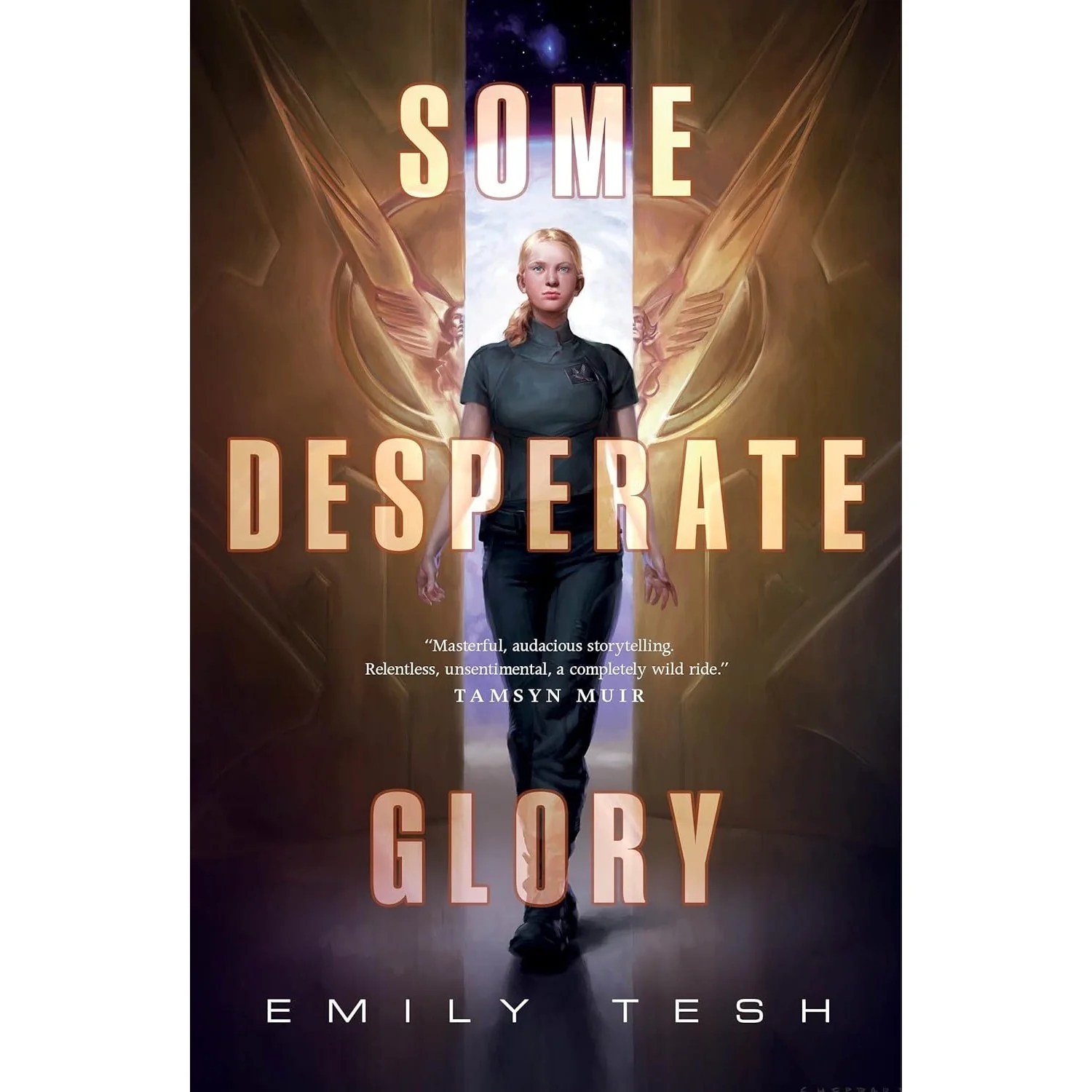
Some Desperate Glory, by Emily Tesh

Emily Tesh’s book Some Desperate Glory is an excellent sci fi story (“queer space opera” quoth many other reviewers) about living inside fascism, coming to terms with and recognizing that fascism, and trying to find ways to resist that fascism even when resistance seems impossible. It’s grim. It’s painful. It feels uncomfortably true, real, and relevant. I mentioned it in passing earlier this spring.

This isn’t a book I wanted to feel was more relevant after I finished it, but here we are.

This is also a book that deals with sexual abuse, assault, forced pregnancy, and suicide. I think the story handles them well, but they’re still rough. You’ve been warned.

With all that said, why does this book still feel hopeful to me?

Continue reading

Squire and Lady Knight, by Tamora Pierce

I finished Lady Knight one day after finishing Squire. I absolutely inhaled that last book in the series. Tamora Pierce did well, as I’ve come to expect. The story of Lady Knight felt more satisfying in so many ways, but I don’t think it would have felt that good without Squire there to lay the foundation for it.

If you’re recommending these books to kids, it’s worth noting that Lady Knight bridges a big (and fascinating) gap in genre, content, and target audience age. I’m not saying that you shouldn’t give these books to kids—I think you should! But you may want to read them yourself, and be ready for the way in which the story’s tone shifts near the end of Squire and throughout Lady Knight.

Continue reading

First Test, by Tamora Pierce

First Test, by Tamora Pierce, was published in 1999. It’s an excellent middle grade fantasy story grounded in one girl’s struggle against gender discrimination, hazing, and abuse while she pursues her dream of knighthood. First Test takes place in Tortall, the same story world as Tamora Pierce’s series about Alanna the Lioness. Where Alanna sought and (spoilers for that series) achieved knighthood while hiding that she was a girl, our protagonist Keladry seeks to follow openly in Alanna’s footsteps. But while that path is now officially open to a girl, reality hasn’t yet caught up. If you want a middle grade story about a young girl facing adversity and misogyny in a hostile school environment, this is a solid option.

First Test is, first and foremost, a story about a young girl and her struggles. Young Henry probably would have loved it… but he probably wouldn’t have read it (I mean, I didn’t read it, but I also wouldn’t have). Even if it had caught my interest, being mocked by my peers for reading ”a girl’s book” was a real and pressing concern. That was a big part of why I missed the Alanna books when I was young.

Oddly, that social pressure also feels connected to First Test’s message.

Continue reading