You watch the heroes as they step up to the front door of the old and abandoned house, lit only by the faint glow of the streetlights down the block. There’s a rustle, and the heroes look around them anxiously before one of them pushes open the door while the other stands watch. A few leaves obscure your vision as the camera shifts, hiding in a bush. The heroes both turn to look inside, and your view rushes forward, surging up the steps towards the heroes as they turn in shock and you…
Category Archives: GMing
Let the Heroes be Strong

Ultimately, campaigns, much like movies, are about your protagonists. Much as Henry said in his previous article on Screen Time, “by running a game you are agreeing to give the PCs the stage”. Of course, by ‘the stage’, he meant something akin to ‘camera time’. But not only should the camera follow them (mostly), but they should also be the movers and shakers of the universe. Of course, there are some exceptions: villains will often be stronger than PCs, especially in games with elements of horror. And there may be campaigns in which the PCs have limited agency (or are a part of events bigger than themselves). But in those cases, they should still, ultimately, be the agents of the events they ARE privy to.
Story Focus: Who Gets Screen Time?
When you’re playing an RPG, which characters get screen time? Where should the focus be? How can a storyteller make sure that they’re not giving their players short shrift? Finding a good balance and learning how to give your players’ characters the focus that they deserve is an art, one that requires awareness of where your attention is at any given moment.
What Makes a Good Game?
It may seem strange to hit this topic now; I haven’t even defined what I think a game is! For now, I’m going to put that question off, but say that there are three types of games:
- Puzzles – These games involve one (or more players) trying to solve some system. These games can be played with some goal: ‘how do I solve the puzzle?’ or in a more exploratory manner: ‘what exactly can I do?” Games that are puzzles include:
- Computer Games: Platformers, Adventure Games, Simulations (Civilization/Sim City)
- Physical Games: Rubik’s Cube, Mind-Benders, Logic Puzzles
- Competitive Games – These games involve multiple players competing against each other within the constraints of some rule system with defined victory conditions. Some of the players CAN be AI simulated; as such, these games can be played as puzzles.
- Computer Games: Starcraft, League of Legends, Street Fighter, HALO, Simulations (Civilization/Sim City).
- Physical Games: Chess, Basketball
- Collaborative Games – These games involve multiple players working together (potentially somewhat competitively) to create something.
- Roleplaying Games
- Team-building games?
Horror and Predetermined Outcomes
In my article on how I run a game, I mentioned that there are specific genres in which I’ll sometimes accept predetermined outcomes. I’ve most often experienced this in horror games, where both the players and the PCs know that there will be certain terrible things that happen, regardless of the actions taken by the PCs. But why does this work? How could any player enjoy knowing that their terrible doom approaches?
Putting Power in Players’ Paws
Ok, so your players probably have hands, not paws, but I liked the alliteration.
The traditional roleplaying game, D&D, is very much structured in a specific way: the GM has a specific game/plot/monster that the players have to beat. In this way, D&D is structured much like a computer RPG, it just happens to be played with multiple players (and so can Baldur’s Gate 2, not to mention World of Warcraft).
There is value to this model; if you have one GM who is particularly good at plotting stories and taking care of all of the details of the world, and a lot of players without a knack for world-building, well, why not run a game like this? Labor gets divided up appropriately, and everybody gets to do what they’re good at.
Typically, however, everybody has something to offer to the story if given the chance, and 4 minds can probably come up with better ideas overall than just 1. This is why, typically (especially if I really trust the players), I prefer to run games that are much more player-driven. For me, good player-driven systems are those which have narrative elements built into them. The most obvious examples would be any game with a Fate point system. Such systems tend to give fate points to the player, and they can narrate something about the world that is unlikely but still possible by expending a Fate point. However, for me, the pinnacle of player-driven games is Apocalypse World. I understand that there are MORE player-driven games, but I find that the lack of a solid authority in completely player-driven games tends to leave most people feeling unsatisfied. Apocalypse World is the perfect balance: it lets the players help create the world and orient the plot, but doesn’t give them too much power to determine results.
Player Action, Player Inaction
I have often focused too narrowly on what will happen when the players follow the trails that I have laid out for them. But what do you do when the players don’t want to play with any of the plot you’ve got prepared for them? And what happens with the problems that they’re ignoring?
Lessons I’ve Learned about Naming NPCs
Names are hard. You want to make sure that the people and places you’re creating sound believable, and you don’t want to keep repeating the same things over and over (unless there’s a name like Michael in your game world, in which case you should probably just name everyone that since that’s how it works in real life). I’ve made and seen some pretty funny mistakes with naming things, so here are a few of the things I’ve learned…
Types of Games
In my last post, I talked a lot about what roleplaying is, and – surprise! – it wasn’t just one thing! That is part of the beauty of roleplaying, it’s full of options. What are these options?
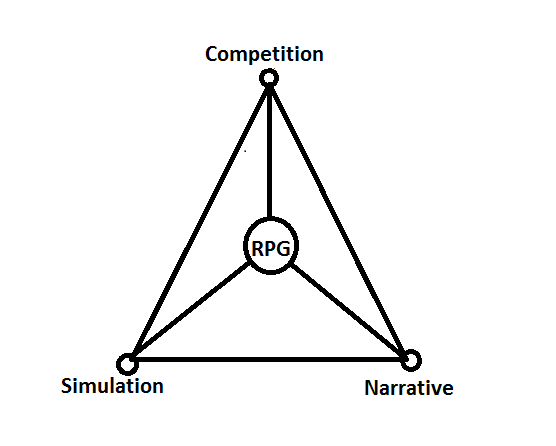
Well, first, we have the three qualities talked about before:
Roleplaying, Storytelling, Mechanics. To keep in line with the existing literature on Gaming Theory, I have slightly renamed the categories I used in the previous post. I have renamed ‘Mechanics’ as ‘Competition’ (it goes by ‘gaming’ in GNS Theory, but I find that to be a bit ambiguous of a term); it essentially refers to how much of the experience of the game is rooted in competition. Storytelling will be referred to as ‘Narrative’, and Roleplaying will be expanded slightly to ‘Simulation’. Simulation refers to how much of the setting goes to recreating system-internal realism. Note that this realism does NOT have to be actual realism. For example, many unrealistic things happen in Star Wars, but there is an assumed set of rules which governs things like lightsabers. Any given game will have a balance of the three, like so:
How I Run a Game
Much like with Jason’s article, this is not meant to be an exhaustive discussion of how to run a game. It also isn’t meant to be prescriptive. Like it says on the tin, I want to share with you how I go about running games these days. Curious about success through brainstorming and improvisation? Keep reading.

