
What Flavor Is Your Game?

cs2012neap

I like vanilla ice cream.  I have for a very long time.  Before I knew my alphabet, much less how to read, I knew that hearing my older brother spell out “I-C-E-C-R-E-A-M” meant that I should start asking Mom for ice cream too.  Better yet, as I got older and discovered the joys of living in Vermont (home of Ben & Jerry’s before it was bought out by Unilever), I learned that there were far more flavors of ice cream available, and that many of them were exceedingly tasty as well.

When I was little, I played make-believe all the time.  A number of my friends simply couldn’t understand the appeal, and stopped playing with me, but at the tender age of seven my older siblings harnessed my ambitions and introduced me to 2nd Edition AD&D.  My introduction might actually have been earlier, but that year was the first time I can remember staying up until midnight to play RPGs with them.  Over the next few years, I was introduced to Vampire: The Masquerade (along with a bundle of other White Wolf games), D&D’s 3rd Edition, In Nomine, and GURPS.  More other games followed.  Just like with ice cream, I had discovered a whole new world of flavors to choose from.  I was very nearly overwhelmed by my enthusiasm.  These days, some people refer to me as an RPG snob.  I much prefer the term ‘connoisseur’: through dedicated consumption, I have built an appreciation for the inherent flavors of different game systems.

But what the heck do I mean by “flavor”?  And how do you figure out what a game’s flavor is?
Continue reading

Monsterhearts: taking a peek under the ribcage

title-postcard

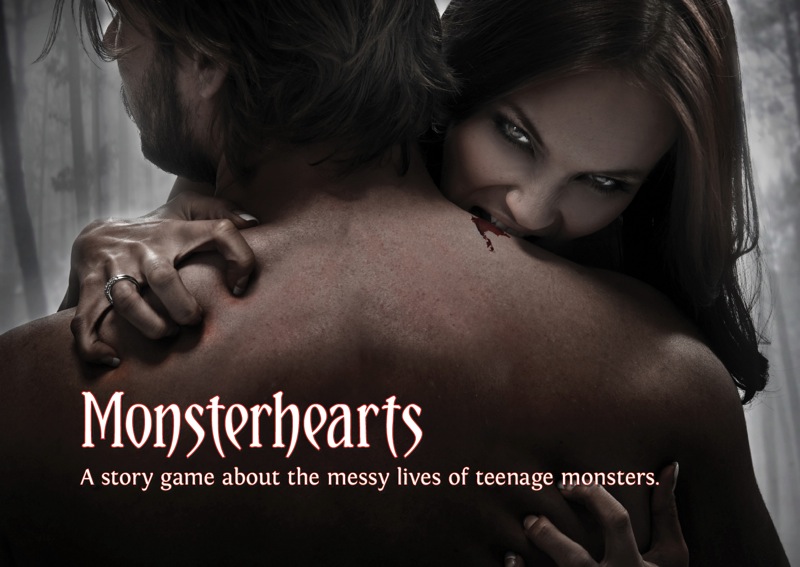
Monsterhearts sells itself as “the messy lives of teenage monsters.”  But the truth is that the monstrous nature of the PCs in any game of Monsterhearts really just serves as a reminder of the alienation, discomfort, and feeling of mislabeled or misunderstood powerlessness that gnawed at so many of us when we were teenagers.  And maybe as adults as well.  Furthermore, themes which have filled classic literature for ages rear their heads again and again in this game; you don’t have to have ever experienced any of them yourself in order to be fascinated by and indulge yourself in them.

A quick background: this is an RPG which has grown out of the Apocalypse World system created by Vincent Baker.  It takes the sparse elegance of Baker’s ruleset and applies it to a very different type of life.  Read on to find out what makes Monsterhearts different from Apocalypse World, and learn some of what makes it so dynamic and so much fun to play.

Continue reading

Putting Power in Players’ Paws

gentleman-gustaf-figure

Ok, so your players probably have hands, not paws, but I liked the alliteration.

The traditional roleplaying game, D&D, is very much structured in a specific way: the GM has a specific game/plot/monster that the players have to beat. In this way, D&D is structured much like a computer RPG, it just happens to be played with multiple players (and so can Baldur’s Gate 2, not to mention World of Warcraft).

There is value to this model; if you have one GM who is particularly good at plotting stories and taking care of all of the details of the world, and a lot of players without a knack for world-building, well, why not run a game like this? Labor gets divided up appropriately, and everybody gets to do what they’re good at.

Typically, however, everybody has something to offer to the story if given the chance, and 4 minds can probably come up with better ideas overall than just 1. This is why, typically (especially if I really trust the players), I prefer to run games that are much more player-driven. For me, good player-driven systems are those which have narrative elements built into them. The most obvious examples would be any game with a Fate point system. Such systems tend to give fate points to the player, and they can narrate something about the world that is unlikely but still possible by expending a Fate point. However, for me, the pinnacle of player-driven games is Apocalypse World. I understand that there are MORE player-driven games, but I find that the lack of a solid authority in completely player-driven games tends to leave most people feeling unsatisfied. Apocalypse World is the perfect balance: it lets the players help create the world and orient the plot, but doesn’t give them too much power to determine results.

Continue reading

Player Action, Player Inaction

I have often focused too narrowly on what will happen when the players follow the trails that I have laid out for them.  But what do you do when the players don’t want to play with any of the plot you’ve got prepared for them?  And what happens with the problems that they’re ignoring?

Continue reading