Making Monsters

You’re a monster. If you’re a good monster, you’ll be able to resist your terrible urges for a long time. We like good monsters! You should be one. But eventually you’ll do something unspeakable and hurt those around you, those you love. Because you’re a monster. We all knew it would happen sooner or later. We were just waiting, dreading the day when you’d reveal how awful you truly are.

But there are other monsters out there who tell you that you aren’t a monster. None of you are. Just like them, you aren’t evil. Maybe you could use a better attitude, some self-improvement. Your new friends have lots of advice about that. But those others who tell you that you’re a monster? Lies. Jealousy. Those lies are sick mind games meant to control you, to trap you, told by liars trying to profit while you suffer.

You don’t have to listen to those lies. You just need to be stronger. You need to be harder, and faster, and better. You need to understand that those people who say you’re a monster, their opinions don’t really matter. They don’t really matter. You can do better without them. If you really want people like that in your life, make sure that you’re the one in control—not them.

After all, you’re the man.

Or maybe you have some other privileged identity, and the people telling you that you aren’t a monster are spinning a slightly different story. That’s not the important part. What really matters is that there are people who tell you that you should feel bad, and others who tell you not to worry about it. Which ones feel better to listen to? Which ones give you hope?

In case you couldn’t guess, this is a follow-up to Are Boys The Problem?

Continue reading
Are Boys The Problem?

A reddit thread has been living rent free in my brain and scattering its gross leftovers all over the couch of my cortex.

Last week, while I was prepping my post about Some Desperate Glory, I read a post on r/newparents from a first time mother wrestling with her cognitive dissonance around having a son. She described herself as a feminist who no longer believed that all men were bad (she cited her husband as a good example), but who still struggled to reconcile her fear, animosity, and resentment towards most men with the idea of raising a young boy. She said (I paraphrase) she was trying to understand how to raise a young boy to be a good man with positive models rather than negative ones. She asked for help and advice.

I was immediately awash with thoughts, with so many ideas that I wanted to share. I wanted to lend my perspective as someone socialized male, as a camp counselor working with teens, and as a new father. Yet as I read on through other’s replies, I despaired.

The post has since been deleted. I’m not surprised that the post was deleted. I’m not happy about it either. I’m caught between wishing I’d replied faster and being glad that I didn’t stick my neck out. You might be able to guess why, but let me explain.

Continue reading

Kinky Boots

Goodness that movie was fun. If you haven’t already seen it, I’d heartily recommend it. There’s a lot to like.

I’m not even sure where to start. How about “heartwarming British comedy about saving a shoe factory by producing boots for drag queens”? I think that hits all the requisite notes without divulging any relevant details. There’s a good deal of gendered pressure and expectations in here that rings especially true of the 2000’s to me… which is funny because I know that it’s still around and still real. I guess it seems like there’s more awareness of other options these days than it felt like there was at that time? Or maybe I’m more aware of other options now than I was then. I don’t feel like I’m being especially clear with my words, and I’m just going to move on.

One of the things that I think I liked most about the movie is that, while the movie tries to be about Charlie Price, straight white guy, it really feels easy to me to read it as being about Chiwetel Ejiofor’s drag queen Lola — a focus that I think is made especially clear with the dance sequence on the boardwalk during the opening credits. I quite like Ejiofor in general, and I’m very happy with him in this movie.

After spending so much time last semester reading Truby’s book on the anatomy of stories (and specifically movies) I had fun looking at the film for the elements of structure he describes. It was a pleasant change from his obsession with Sunset Boulevard, which I’m now both curious about and very reluctant to watch.

Finally, yes, I’m still semi-feverish: I veer into fever at the drop of a hat, even if I don’t spend all of my time there now. And the random onset of fatigue is exciting and annoying. Nothing quite like knowing that you could hit a wall at any given moment to make you reluctant to go anywhere. I’ll do my best to keep up with posts, but I expect that my schedule will continue to be slippery while I’m sorting out my mono symptoms.

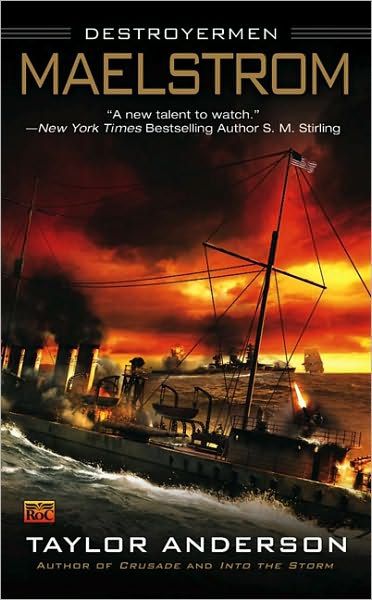
Maelstrom, by Taylor Anderson

b9_6348481_0_TaylorAnderson_MaelstromDestroyermen


Having just finished reading Maelstrom, I’m officially downgrading this series from “potentially profoundly interesting” to “some variety of popcorn lit.”  You know, the stuff that you’ll compulsively eat without thinking too hard about it: sometimes it’s exactly what you’re looking for, but more often it’s just there and you don’t bother to stop yourself.  This series is alt-history tech-bootstrapping military fiction with a very particular set of idealized social dynamics, and as of now it doesn’t look like it will stretch beyond that.  I’m not saying that it’s bad; popcorn lit is definitionally good enough that I’ll pick it up and breeze through it simply for the pleasure of reading it, provided I’m in the right mood.  But it also hasn’t lived up to my hopes of offering more introspection on any of its various conflicts, or breaking further from its genre precedents in an interesting fashion.

I should note that it’s hard for most novels to make it past my popcorn lit category, and the category itself encompasses an almost unhelpfully wide spread of books; furthermore, I can’t pretend to be better than that myself, as I doubt any of my own short stories would qualify as anything but popcorn lit.

I won’t say that the series can’t ever be anything but popcorn lit.  Some of the future books may deliver answers to the niggling contentions I’m sharing with you here.  But thus far my hopes for what I’ll call “deeper” material have not been met.  Specifically, I want Anderson to go deeper into examining the cultural conflicts inherent between the Americans and their various allies, and I especially want him to include the perspective of Lemurians who truly don’t have specified gender roles or gender/sex expectations.  It seems like he’s introduced the Lemurians (the cat-/lemur-like creatures with whom the Americans allied in the first book) as being without specific gender roles, but when we’re treated to the perspective of a Lemurian there are a number of basic social operating assumptions that appear to be based in a society more similar to our own, one which certainly embraces a number of implicitly gender- or sex-based values.  If Anderson wants to write the human perspectives in his book with those value assumptions in place, that’s ok by me, even if I don’t like it.  But much like my love for and disappointment with the use of Drax in Guardians of the Galaxy, I find it frustrating that Anderson should introduce an ostensibly gender- and sex- blind culture and then not do them the justice of writing from a gender- and sex-blind perspective.  I have to give Taylor Anderson credit for trying, and it seems like he might not be aware of how he’s failing to deliver here, but that doesn’t make it un-frustrating.

More after the break.

Continue reading