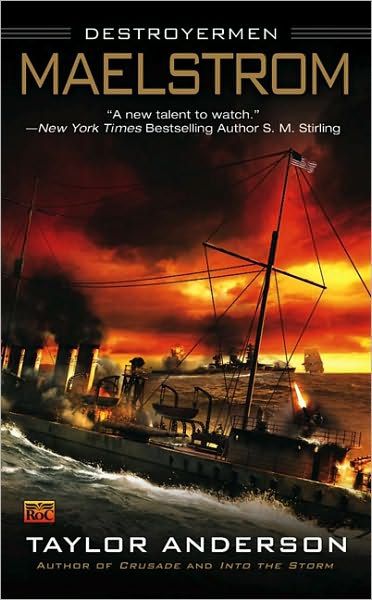
Having just finished reading Maelstrom, I’m officially downgrading this series from “potentially profoundly interesting” to “some variety of popcorn lit.” You know, the stuff that you’ll compulsively eat without thinking too hard about it: sometimes it’s exactly what you’re looking for, but more often it’s just there and you don’t bother to stop yourself. This series is alt-history tech-bootstrapping military fiction with a very particular set of idealized social dynamics, and as of now it doesn’t look like it will stretch beyond that. I’m not saying that it’s bad; popcorn lit is definitionally good enough that I’ll pick it up and breeze through it simply for the pleasure of reading it, provided I’m in the right mood. But it also hasn’t lived up to my hopes of offering more introspection on any of its various conflicts, or breaking further from its genre precedents in an interesting fashion.
I should note that it’s hard for most novels to make it past my popcorn lit category, and the category itself encompasses an almost unhelpfully wide spread of books; furthermore, I can’t pretend to be better than that myself, as I doubt any of my own short stories would qualify as anything but popcorn lit.
I won’t say that the series can’t ever be anything but popcorn lit. Some of the future books may deliver answers to the niggling contentions I’m sharing with you here. But thus far my hopes for what I’ll call “deeper” material have not been met. Specifically, I want Anderson to go deeper into examining the cultural conflicts inherent between the Americans and their various allies, and I especially want him to include the perspective of Lemurians who truly don’t have specified gender roles or gender/sex expectations. It seems like he’s introduced the Lemurians (the cat-/lemur-like creatures with whom the Americans allied in the first book) as being without specific gender roles, but when we’re treated to the perspective of a Lemurian there are a number of basic social operating assumptions that appear to be based in a society more similar to our own, one which certainly embraces a number of implicitly gender- or sex-based values. If Anderson wants to write the human perspectives in his book with those value assumptions in place, that’s ok by me, even if I don’t like it. But much like my love for and disappointment with the use of Drax in Guardians of the Galaxy, I find it frustrating that Anderson should introduce an ostensibly gender- and sex- blind culture and then not do them the justice of writing from a gender- and sex-blind perspective. I have to give Taylor Anderson credit for trying, and it seems like he might not be aware of how he’s failing to deliver here, but that doesn’t make it un-frustrating.
More after the break.
Continue reading →
Share this with your friends:
 Fistful of Wits