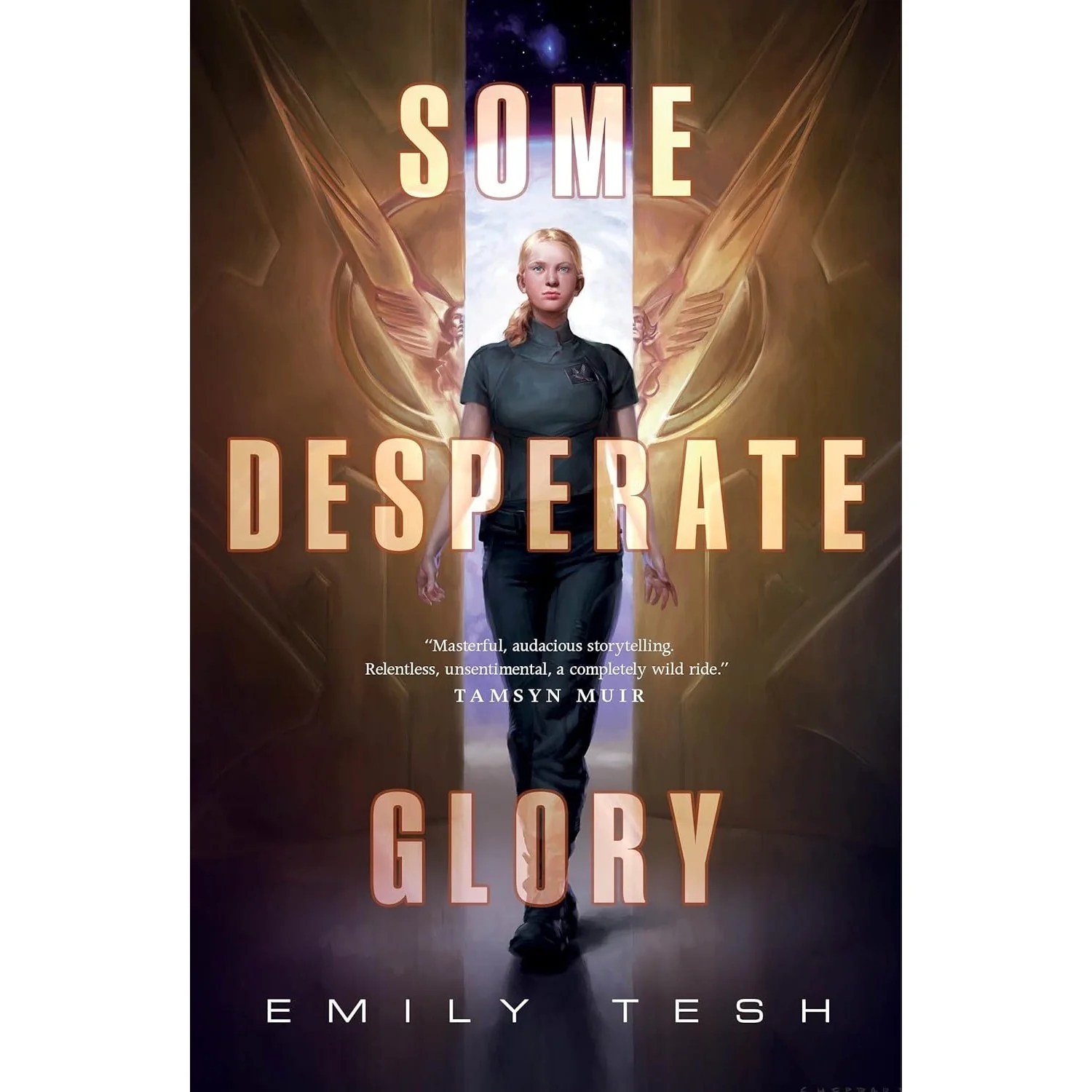
Emily Tesh’s book Some Desperate Glory is an excellent sci fi story (“queer space opera” quoth many other reviewers) about living inside fascism, coming to terms with and recognizing that fascism, and trying to find ways to resist that fascism even when resistance seems impossible. It’s grim. It’s painful. It feels uncomfortably true, real, and relevant. I mentioned it in passing earlier this spring.
This isn’t a book I wanted to feel was more relevant after I finished it, but here we are.
This is also a book that deals with sexual abuse, assault, forced pregnancy, and suicide. I think the story handles them well, but they’re still rough. You’ve been warned.
With all that said, why does this book still feel hopeful to me?
I feel like the obvious point of comparison is The Traitor Baru Cormorant. That book is not uplifting. It does not leave me full of hope. Not to spoil the story, but while the protagonist accomplished much I was left feeling hollowed out (much like the protagonist). There is growth, and learning, and development… and the story left me wondering whether any of it was worthwhile.
I probably need to read the second book, but I have a hard time bringing myself to do so.
Some Desperate Glory is full of growth and learning, and that growth and learning feels powerful and impactful and inspiring. To be clear, this book is also painful. It has one of the best unlikeable protagonists I’ve ever read. I felt caught up in the story and the narrator’s obsessions even though she’s so awful—maybe because she’s so awful, and yet still carries some promise that makes me hope she can be redeemed.
That hope for the awful protagonist’s redemption is fed along the way by how obviously I could see her growing and learning. She starts the story totally on board with the authoritarian regime she’s been a part of her entire life. Bit by bit, I could see her beliefs start to crack around the edges. Seeing that process, even as horribly glacially slow as it was, is part of what gave me hope as I read the book.
Then, of course, the whole story pivots.
*MILD SPOILERS* There’s a spot partway through the book where everything I understood about how the book was going to work changed. I thought the book was going one way, and then suddenly it was going another. All of that had been set up beautifully, and I loved it. From that point on I was just happy to be along for the ride. *END MILD SPOILERS*
That pivot doesn’t make the story happy. It doesn’t make the difficulties facing our protagonist easier. It doesn’t make the setting a magically better place. But the pivot did give me renewed trust in the course the author was taking. It gave me hope that, even if the characters didn’t have happy endings, I as the reader could feel better about what the story was saying and how the story was saying it.
I’m writing all this between shifts with the baby, without much sleep. I’m afraid I’m going to end it here, even though there’s a lot more that Some Desperate Glory deserves to have said about it. I liked it a lot.
Maybe you will too.
 Fistful of Wits
Pingback: Are Boys The Problem? | Fistful of Wits