The Chapel of Weeping

This is intended to be a setting seed for some future story or game, like The Knife Tree or The Tower of Peng the Unprepared.

The Chapel of Weeping is a series of seven spaces, one large central one and six smaller ones surrounding it, connected by paths like spokes. These spaces are set into a cliff face so that the central space is cut into it, forming a massive alcove. Two of the small spaces are thus wholly inside the cliff, two are chambers with windows and doors that open to the outside, and two are outside the cliff and entirely open to the elements.

The central space is mostly filled by a massive statue, a figure paused in a moment of benediction. It towers up, several stories tall, and dwarfs any who set foot in the space. Through some strange miracle, the figure weeps endlessly. Its tears run down the figure’s face and leave the flagstones before the figure slick. There is enough room in the space to walk two abreast all around the statue, and passages have ben cut through stone to reach the four spaces partially or entirely inside the cliff.

The two spaces outside the cliff are simple flagstoned circles, outlined with pieces of unfamiliar rock. People who live nearby have many stories about the purpose of those areas, though few of them agree. Some have called them gathering places for the holy or the faithful, some have said that they are where sacrifices must be made, and others claim that they were only added to give the rest of the chapel a feeling of balance. They are undeniably of the same style and construction as the rest of the chapel, however, and apart from the unfamiliar stone used to outline them the circles are paved in stone carved from the cliff.

The two spaces to either side of the central space and its giant statue, the spaces which are partially open to the outside, hold altars which have been worn by ages of use. Some still pray in these spaces, and the altars may be covered in the wax of votive candles or the dusty ash of burnt incense. These spaces are used by lay folk and travelers, despite the rest of the chapel being largely abandoned. Some have reported receiving miracles in these places, when praying in a spirit of repentance, contrition, or love. There is a great deal of carved ornamentation on the walls of these spaces, though some has clearly been damaged.

The two inner chambers of the chapel complex are not used by anyone who lives nearby: while locals describe the rest of the chapel complex in reverent tones, these chambers are believed to be better left alone. Entirely unlit, they are rumored to be tied to the more dangerous sides of grief, and it’s said that only those in the throes of deepest loss may spend time in them safely. Others claim that they’re safe so long as they are lit by flame. Everyone agrees that foolish people have disappeared in them, and that strange noises can sometimes be heard echoing from them on starry nights. It is well known that the inner chambers were used extensively by the order of clerics that once maintained the chapel, but since the order’s dissolution the inner chambers have been left largely untouched.

Recommending Books for Kids: Six Points

This is written by an adult for adults, about how we can better recommend books for kids.

My goals when recommending books to kids are: Continue reading

Scope, Scale, & Stakes in Genres: Detective Noir

I wrote about Scope, Scale, and Stakes recently, but I didn’t give clear examples of how they shift during the course of a story. I’ll try to give a more concrete account of that here, with a focus on one particular kind of story or genre.

Let’s try the genre of detective noir. Continue reading

Setting Work for Swamp Gangsters

I did some thought exercises and prep work for the setting I developed for Latour and their friends, back around the time that I wrote the first story in that setting. I didn’t share any of that work with an audience when I wrote the first stories, but climate change has been eating up most of my brain space today and this seems like an appropriate time to share.

Yes, Latour and Ren and the Pats and Cap all exist in a loose version of our world. No, I haven’t ever decided exactly what year it is.

But there’s a reason that everything in those stories happens on boats and floating structures.

When I was first thinking through the setting for that group of stories (I have more that I haven’t posted, due to wanting to be paid for them at some point) my thoughts were as follows… Continue reading

Setting Expectations for Rulings in RPGs, Quick Thoughts

Somehow, despite reading hundreds of thousands of words on how to run roleplaying games since the age of twelve, I don’t clearly remember any RPG book giving me this advice:

Explicitly set expectations for your group around how you, the storyteller, will adjudicate rolls, rulings, and mechanical resolutions.

It’s totally possible that I simply glossed over this advice when I did read it. But it’s important enough advice that I’m going to devote more words to it here.

Setting expectations explicitly is helpful because Continue reading

Milestones, XP Rewards, & Training Your Players, Longer Thoughts

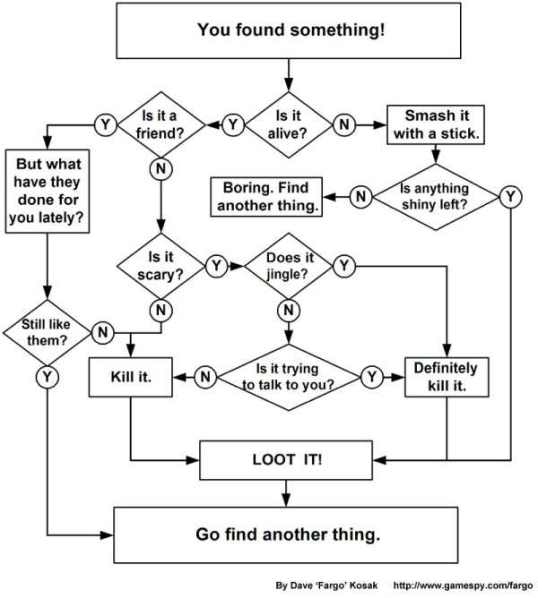
MurderHoboRPG_flowchart

The flowchart of the “murder hobo.”

Game systems, role-playing game systems, are a set of constraints on cooperative imaginative play that are designed to facilitate making up stories together. The constraints they impose create boundaries around the kinds of stories that you can tell within those game systems. This doesn’t make “resistant play” impossible (using resistant play as one might use the term resistant reading), but any system will tend to make a particular kind of play or story experience easier to support than others.

I’ve discussed related thoughts previously, in the context of “flavor.”

But what about experience points, or character advancement?

What about the game’s systems for rewarding players?

Continue reading

Scope, Scale, & Stakes, Longer Thoughts

While Mattias was telling me about a game he’s preparing for, and the layers of growth and reveal that he has planned, he reminded me of terminology I’d first learned in Kenneth Hite’s 3rd ed. GURPS Horror sourcebook (this links to the 4th ed.). Page 71 of the 3rd edition book introduces “scope” and “scale,” two narrative concepts widely applicable to stories beyond horror-gaming. They’re not necessary for good narrative construction or fun gaming, but they’re extremely useful for both analysis and planning. They’re also likely to show up regardless of whether you intend them to or not, and manipulating them is a straightforward way to change tension in a story.

It’s worth noting that scope and scale are related to but separate from stakes. I’ll cover changing scope, scale, and stakes to affect tension later.

First, I’m going to roughly quote Hite’s definitions of scale and scope, and then follow up with a definition of stakes.

In Hite’s usage, scale is “the level at which protagonists are interacting with the world, and the results of their actions upon it.” Characters operating on a prosaic scale are struggling for their lives and hoping to simply get by, while characters operating on an epic scale are larger than life and deciding the fate of countries or worlds. Scale is a measure of the grandiosity of a character’s actions, and it’s possible to operate on multiple scales simultaneously, or to change scale rapidly without detracting from a story. As an example of multiple simultaneous scales, a hero might struggle to survive the onslaught of a demon (prosaic), knowing that if she can withstand it and defeat it she will change the fate of her world (epic).

Meanwhile, Hite defines scope as “what the PCs can see,” meaning the boundaries of their awareness or the perceived importance of their actions. If a story’s characters only know about the spread of a dangerous cult in a small town, or a single person on the run from one person who wants them dead, that’s a fairly narrow scope. The scope is broader if the story’s characters know that this dangerous cult is the latest outgrowth of a wider group bent on finding a potent mystical artifact in the town, or if that person on the run holds a larger power which might ultimately defeat the nation which sent their hunter to murder them. Furthermore, it’s useful to distinguish between a story’s visible scope (what we’d usually just call scope, and what characters are aware of at any given time, like “there’s a cult in this town”) and the story’s actual scope (what the characters might discover, like “this cult is just the tip of the iceberg”).

Stakes, meanwhile, are whatever is in jeopardy, at risk, or to be gained by a course of action. A story’s stakes inform the scale and scope, though it’s possible for them to operate independently. For example, the life of that person on the run is relatively small stakes, and a story about keeping them alive might have a prosaic scale. But as the characters’ visible scope expands (through gaining more information about the world) and the characters recognize their position in a larger story, the stakes increase and the scale at which the characters are operating may take on multiple levels. In that above example, the characters’ struggle to save the person’s life is prosaic, but may ultimately have epic consequences.

Not every story needs scale, scope, or stakes to change. Sometimes we just want something picaresque, episodic, or repetitive. But I think those repetitive stories are less popular than ones in which scale, scope, and stakes change and grow.

And even within those more repetitive stories, there are often changes to the characters’ visible scope: the characters recognize that “X is bigger than we’d thought,” and thus the stakes (and tension) rise. This change in visible scope can happen for characters and audience simultaneously or separately, but it most often happens for characters shortly before the story’s climax. In the denouement following the climax, the visible scope often recedes once again, as various plot threads are tied up and completed. Characters may still know that something greater is going on, or that events are operating at a larger scale, but their access to that broader scope usually diminishes with their part in that larger story.

So, expanding stakes and visible scope are straightforward ways to heighten tension. Focusing on the prosaic scale is also useful for heightening tension, even as it often expands alongside scope and stakes. Remember: expansion of scale is okay, because characters can operate on multiple scales at once… and can feel more relatable by struggling in prosaic conflicts despite possessing epic powers.

Because variation in tension is considered de rigueur in most adventure and dramatic genres, those stories generally thrive on changes in scope and scale. This is especially true of long-running stories that involve character empowerment, or which cover new ground; without that variation in tension, and believable changes in characters’ scale and visible scope, audiences lose interest. Similarly, arbitrarily or too-frequently returning to prosaic scale and stakes will eventually rob that technique of its tension. The eighteenth time Batman fights a dangerous baddie isn’t as tense as the first time.

What does that mean for us as writers or storytellers?

We can plan for expansions of scale, scope, and stakes. And when I say plan, I really mean “have a very general idea of what might change.” If you’re making stories collaboratively, e.g. playing RPGs, it’s best to leave little hints and clues for you to pull on later and tie into something bigger for the players to discover. It’s not necessary to know how those things will work, or what they’ll connect to when you put them there! You could do all that work, but then you run the risk of never having players discover anything you made because they wanted to go elsewhere or follow other clues.

If you leave little hints and tidbits lying around, and have general ideas of what the larger scope, scale, and stakes might look like, it’s easier to put everything together when the time comes and players finally follow those leads. A villain’s ties to a larger organization or their correspondence with an unnamed person are useful here. Likewise, when the PCs learn the specific modus operandi for a particular group and recognize that elsewhere in a new situation, they’ll often connect the dots and identify the relation between the two. It’s all about building up the skills and world-knowledge of your players (or audience), and letting them draw the connection and feel that frisson of understanding (and maybe dread).

This has gone longer than I’d anticipated. I suspect there’s more material here. I may revisit the topic.

Character Connections & Motivations, Longer Thoughts

I recently ran an impromptu game of D&D 5e for some friends. While I was asking the players for their character’s connections to the other players and the world around them, one person said (I paraphrase) “I don’t have any connections. I live alone in the woods and don’t know or care about these people.”

I was a bit short with the player in response, and pushed them to come up with some connections, even if they didn’t feel like close ones. The player did.

Reflecting on that moment…  Continue reading

Characters’ Emotional Arcs, Quick Thoughts

I had a frustrating but informative (and helpful) experience this afternoon while attempting to fix my plotting problems for the sequel to Barium Deep. After I had resolved multiple problems with my plot arcs, charting them out for my own clarity and future reference, I couldn’t plot one of the emotional character arcs that I wanted for Cesium (the POV character for the second book).

I wasn’t doing anything very complicated, just tracking some of the beats for the specific section of storyline that I wanted to follow. That made my struggles all the more obvious.

Minutes before, I’d plotted out a parallel series of arcs for a totally different story; they’d flowed easily, and made good sense. They were simple, straightforward, and very formulaic—which felt fine for the first pass on an idea that came to me last night. I’m sure that they’ll change and become more interesting once I’ve worked more with that story. If they don’t, I might discard the story or put it on ice.

But those arcs, with their clear points of conflict, transformation, and growth, had come so easily that my difficulty with Cesium was glaring.

A brief aside: the idea that came to me last night dealt with using magic (or something similar) as a manifold metaphor for anger, and perhaps war and military service, with weaker connections to violence and abuse.

The physical plot for Cesium felt simple and straightforward. It fit neatly within the expected bounds of adventure fiction and other upper middle grade stories. Even though I know I’ll change it in a heartbeat if I find something else more emotionally and thematically compelling, it feels good to have laid it out. The problem with Cesium’s emotional arc was that I was (and still am) unsure of what approach I want to take, or how to zero in on Cesi’s changes in ways that will feel rewarding without feeling too neat or pat.

I think it comes down to disliking the pattern of total character transformation that I’ve seen in some middle grade stories. I find incomplete transformation more rewarding, because of how it allows individuals to face their struggles as slightly modified versions of themselves rather than as different people. This fractional shift of self is less important when a story covers a long period of time, as more shift can occur without seeming too abrupt. But when I want a reader to follow a character’s emotional shift from A to B, I feel it helps to highlight the ways the character is still uncomfortable / unfamiliar with their new experience at B. At some point they’ll feel comfortable in the new experience, and that will be cool, but if the story is about them facing that experience I want facing it to be dramatic, tense, uncertain.

The upside of all this is that I think I’m closer to a working draft of Cesium’s story. But I clearly still have more work to do.

Writing LARPs for Multiple Audiences, Quick Thoughts

I’ve already submitted the LARP I wrote about last week. Now I’m deep in finishing a second one in time for the deadline tomorrow.

While a more detailed report will have to wait, I can give you additional tidbits. And it just so happens that those tidbits play neatly into another topic: writing for multiple audiences.

The game I mentioned last week is about death and mourning, but I can’t be sure that every person who plays it will engage with it as such. Actually, I can be pretty certain that they won’t. Audiences aren’t monolithic, after all, and some of my players might not yet have experienced death as a personal thing. Even if they had, they might not recognize what I created as anything like their experience.

So I wrote a game that plays with all those themes I mentioned last week, and which has places for good fun outside of but adjacent to those themes—almost like two games running in parallel. My hope is that players who don’t feel the emotional resonance of connecting with and mourning the dead (or being mourned) will find reward in fighting and building relationships with the big scary monsters of the Land of Spirits.

In many ways, the game I wrote is reliant on the skills of my staff and players who start the game as monsters. They need to give the People, the folk traveling into the Land of Spirits, enough space to have their emotional scenes. But they also need to present a challenge to the players who are bored and spoiling for a fight. And I’ve made it clear that I want them to encourage the fighters to engage with them in status-and-respect interactions. The underlying idea is that the Player Characters aren’t the only ones who can be mourned; the mechanics I introduce around mourning and offering respect to the dead work for *everyone* in the game, including people who aren’t PCs. I want the monsters to reward the PCs who mourn them, even after fighting them, because I want the people who are distracted from dealing with mourning and connecting with the dead to be drawn back into the main themes of the game and be rewarded for interacting with them.

The warriors will mostly be self-selecting, so if there are people who want to fight they’ll have the chance. And if the PCs who fight monsters never mourn any of their foes, they’ll still have an opportunity for more fighting. Actually, the more they fight and don’t mourn, the more fighting they’ll get in the future. So while one group of players is connecting with and mourning the dead, getting their enjoyment from the more emotional content of the game, another group can have a totally different experience at the same time in the same place. I hope.

At present, my rules say that dead spirits who are bored can go to RE (our system’s personification of reincarnation). My plan is for bored spirits to come back as more monsters. I see an obvious failure mode here, if RE sends people who lack the requisite skills out as monsters. Game could rapidly devolve into butchery and loss if too-eager monsters murder all the PCs. But as long as RE knows the players well, I think we can avoid that.

With luck, maybe this will work!