Here’s a hot take I’ve flirted with before: unbalanced games are more fun than balanced ones.
I think it has to do with gaming a system, beyond even outplaying an opponent.
Continue readingHere’s a hot take I’ve flirted with before: unbalanced games are more fun than balanced ones.
I think it has to do with gaming a system, beyond even outplaying an opponent.
Continue readingWhat the hell is going on when playing feels like suffering?
Being bad at a game often feels bad to me. That’s most true when I think I *should* be competent, or when I’m playing with my close peers, people I feel competitive with. Being bad at a game feels terrible when I’m emotionally attached to a specific outcome, especially if I think I’m failing my team.
But this suffering is worse in some games.
Continue reading
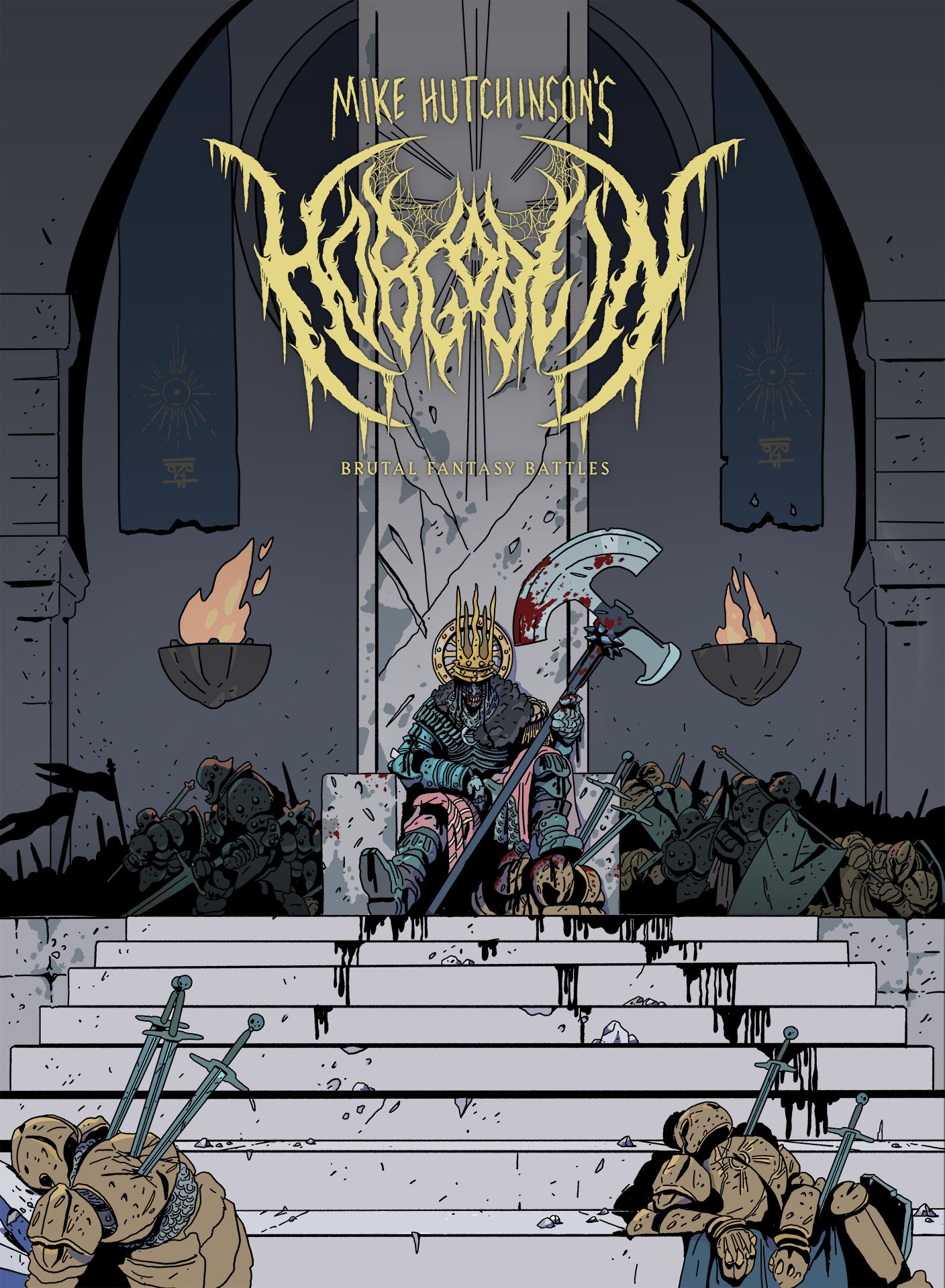
Yesterday I played my first match of Hobgoblin. It was a delight, and an epiphany.
I’ve wanted something like this for years. I was in middle school when I got a copy of the core rulebook for Warhammer Fantasy. I read through that book cover to cover, and then I read it again. I bought a faction’s army book (for the Skaven) with all their special rules and abilities, and read through that over and over too. I bought my first box of models. I yearned to play.
Continue readingWhat if horror games are actually driven by banality? Is Call of Cthulhu best when it’s mostly full of the everyday?
Continue readingLeave yourself room for later. If there’s anything I’ve learned from doing lots of worldbuilding—for my own linear fiction and for the collaborative fiction of RPGs—it’s that trying to fill every last nook and cranny of a setting is a daunting task. And actually filling up everything is choking, stifling. Don’t fill up everything. It leaves no room for the future, and it leaves no room for anyone else.
Continue readingChasing realism is a trap.
This might be true of art in general, but it’s video game graphics that keep reminding me of it. Chasing realism is an expensive luxury. Unless realism is a core part of whatever you’re trying to make, it’s probably not worth fixating on it. That’s because…
Continue readingSomehow, despite a decade of posts on this blog, I’ve never gone in-depth into Dogs in the Vineyard or what I love so much about it. There’s more to Dogs than I could easily cover in a single post: cooperative story-telling and turn-taking, cinematic descriptive and narrative tools, a conflict mechanic that encourages brinksmanship and escalation, a well-articulated method for understanding what’s at stake… all those elements are a delight.
But there’s another piece that Dogs explicitly encourages groups to home in on. That’s the experience of wrestling with moral conundrums, something many modern CRPGs both want—and struggle—to deliver. That’s what I’m focused on today.
Continue readingI’m thinking about Majora’s Mask again.
One of my RPG groups is currently struggling to solve several time loops and their various disasters. I love time loops (see my thoughts on Palm Springs). But at the end of our last run some of my players asked: “Are we actually getting anywhere? Because I don’t want to keep doing this if we’re not making any progress.” And that showed me that I needed to open up a little more, because, well…
Continue readingCyberpunk megacorps are feudal hierarchies… or at least they’re close enough that we can map one to the other. My brain wandered into this realization a few months ago, and now I can’t stop thinking about cyberpunk stories and fantasy or historical fiction through this lens. If I’m stuck with it, I might as well share it with you.
A set of feudal class assumptions are baked into many cyberpunk stories; the corporate elite, the people running the mega corps are just a renamed set of feudal lords. This lends itself perfectly to the preservation of power within the corporation’s systems. Story-wise, this parallel makes the corporate power politicking easier to understand. We can simply hold onto our assumptions about feudal nobility, swap the words in the marquee, and get a rough idea of whatever is going on.
Is the mapping perfect? Not quite. Some power structures are a little different. Some power is passed differently from one generation of leaders to the next than it is / was in feudal nobility. Transitions of power are probably less bloody.
But the same class divide is still there, separating those with rank in the megacorp (nobility) from the have-nots. The nepotism is often still there. The same sense of inbred privilege and power is there. The same social expectations still reign supreme—a scion of the corporation owes their loyalty to the corp, and will obey the CEO their liege. Power flows down through the hierarchy, and the ultimate responsibility of any person in authority is to contribute the power they create to the corporation’s (the kingdom’s) bottom line.
Most of the same caveats apply too. Maybe someone plans to make a power play, attempting to supplant a current member of the C-suite or the Board. They still need to create a strong enough claim to that position, garner influence and support, etc., before they attempt any sort of uprising. People in a cyberpunk megacorp who make a play for a higher position and fail are likely to suffer consequences, from a slap on the wrist to firing to pressing criminal charges (with whatever repercussions those charges might have).
Honestly, I could go further, draw more parallels with other systems: the key, as far as I can tell, is how each system embodies kyriarchy (a power structure built around assumptions of domination). I’ll leave it here for the moment.
As with many other elements of cyberpunk worldbuilding, I think this connection between semi-feudal social dynamics and corporate hierarchy was frustratingly prescient. Advocates for neo-feudalism exist now (usually with ties to one or many of authoritarianism, the Dark Enlightenment, white supremacist movements, accelerationists, and extreme adherents to the Gospel of Wealth-style capitalist meritocracy myth). Our society’s continuing concentration of power, privilege, and access to wealth and its benefits further stratifies the population and creates a new form of aristocracy, breaking down the egalitarianism that strengthens democracy. All this—the way in which our world continues to develop in strange parallel with the dystopian warnings of cyberpunk novels—gives us another perspective on how to map historical or fantasy feudalism and corporate feudalism onto each other.
I don’t have more here at the moment. I’ve just had this brainworm gnawing at my thoughts for a while. That’s why I’ve been dreaming up feudal fantasy versions of cyberpunk stories and cyberpunk versions of classic tales of medieval nobility. There could be something fun done with the Fisher King in a cyberpunk setting, right?
Hot take: D&D 5e gets Charisma dead wrong. 5e only acknowledges a tiny slice of the greater whole: Charisma isn’t about being likable, it’s about being compelling. It’s about being a metaphysical Mack truck on a highway full of smart cars.
Continue reading