Stats to Who: Roleplaying Doesn’t Care About Numbers Part 2

Zeeblee

As promised I am now going go through the Stats-to-Who process of character creation.  The Stats I will be working with is from Dungeons and Dragons 3.5 because I think most people will be at least passingly familiar with that system (as it is the face of roleplaying).  Below is a quick summary of the Stats:

Race: Human
Class: Fighter
Level: 2
Feats: Exotic Weapon Proficiency(spiked chain), Combat Expertise, Improved Trip, Combat Reflexes

This may not seem like much, and you’re right.  A DnD character also has skills, equipment, attributes, and languages.  But attributes are determined randomly, and the other bits aren’t really required at this point.  For those unfamiliar with the spiked chain Fighter twink, this is the beginning core to a build that has many variations.  The basic idea is that in DnD 3.5 you can trip your opponents from range with the chain, and if they try to get back up you get free attacks on them and can keep them lying prone.  Over time you can add more area control maneuvers, damage, or whatever, but for now I am only going to care about the core.  Now to the steps of character discovery!

Continue reading

Rolling with the Punches

gentleman-gustaf-figure

For me, as somebody who GMs far more than he plays, roleplaying is all about rolling with the punches. You obviously can’t predict 100% what your players will do, and you can’t predict die rolls, or whatever random element is important in your system. Basically, shit happens, and you’ll have to deal with it. Here are a few tips I’ve found to make that easier:

Continue reading

Roleplaying Does Not Care About Numbers

Zeeblee

Has anyone ever told you a story that you really not not care less about?  It was probably about something inane and uncontrollable (they had very little or no influence on the outcome), like winning a game of Chutes and Ladders or War.  It might have even gone like this:

Continue reading

Horror and Predetermined Outcomes

In my article on how I run a game, I mentioned that there are specific genres in which I’ll sometimes accept predetermined outcomes.  I’ve most often experienced this in horror games, where both the players and the PCs know that there will be certain terrible things that happen, regardless of the actions taken by the PCs.  But why does this work?  How could any player enjoy knowing that their terrible doom approaches?

Continue reading

Training Exercise

Ultimately, roleplaying is a game of imagination and improvisation. Some people find that they have trouble with these faculties. I feel forced to credit my own proficiency in these areas to a number of games I played as a kid, and still occasionally play, as well as a few hobbies of mine. I think it should come to no surprise that most roleplayers are also writers or actors; in fact, I noted the similarity between the three media in previous articles, and many actors are famously in support of D&D/credit it with stimulating their mind.

Continue reading

Mechanics Guiding Playstyle

gentleman-gustaf-figure

Earlier, I discussed how certain roleplaying systems exemplified certain gaming orientations. To an extent, this is a very peculiar notion. More specifically, it’s a very basic shorthand. After all, mechanics can never force your actions. But the way mechanics are set up can really impact the way the players think about the game.

Continue reading

Types of Games

gentleman-gustaf-figure

In my last post, I talked a lot about what roleplaying is, and – surprise! – it wasn’t just one thing! That is part of the beauty of roleplaying, it’s full of options. What are these options?

Well, first, we have the three qualities talked about before:

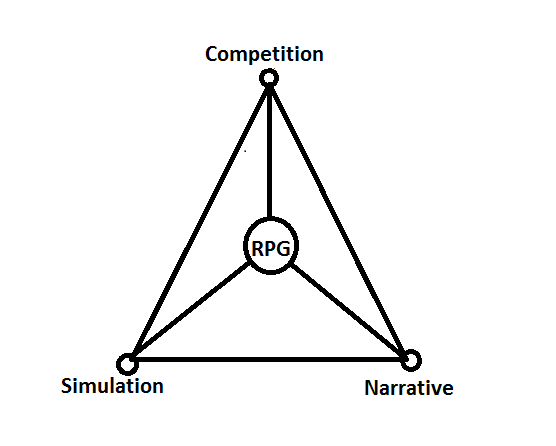
Roleplaying, Storytelling, Mechanics. To keep in line with the existing literature on Gaming Theory, I have slightly renamed the categories I used in the previous post. I have renamed ‘Mechanics’ as ‘Competition’ (it goes by ‘gaming’ in GNS Theory, but I find that to be a bit ambiguous of a term); it essentially refers to how much of the experience of the game is rooted in competition. Storytelling will be referred to as ‘Narrative’, and Roleplaying will be expanded slightly to ‘Simulation’. Simulation refers to how much of the setting goes to recreating system-internal realism. Note that this realism does NOT have to be actual realism. For example, many unrealistic things happen in Star Wars, but there is an assumed set of rules which governs things like lightsabers. Any given game will have a balance of the three, like so:

Game-Qualities

Continue reading

What is Roleplaying?

gentleman-gustaf-figure

If you’ve never been exposed to roleplaying, it can be hard to understand exactly what it is. Thankfully, pop culture knowledge has progressed from the point where roleplaying is no longer linked with satanic ritual, and is instead linked with socially awkward nerds:

Continue reading

How I Make a Character

Zeeblee

As a person who is primarily a player in roleplaying games instead of a storyteller (game master, dungeon master, etc.) I figure the best place to start is where we all start: character creation.  Everyone has their own preferences when it comes to character creation, so in no way will this to be taken as a “how-to” guide.  This article is merely a sort of stepping-stone and perspective-setter.  The three approaches I take to creation I will call Who, Stats, and Hybrid.  In this article I will do a quick overview of what each of those approaches looks like, but I will save delving into each for later articles.

Continue reading