Surreal and unsettling, The Haunting of Hill House is engrossing and admirably well constructed. It starts strong and ends even stronger, though it did lose my focus for a little while in the middle. I’m not sure how to describe my interest in how the story is told; I’m very uncomfortable with the narrator… no, that’s not right, I’m mystified and intrigued by the narrator, which I find disorienting and stylistically unlike nearly every other book that I’ve read. I haven’t read many other narratives that use a disjointed third person semi-stream of consciousness, and which somehow manage to convey a distressing strangeness that seems to be crucial to the horror of the story.
And this book is most certainly a horror story. Shirley Jackson seems entirely aware of “less is more,” the same principle that so clearly guided Aliens, but she takes it to an extreme that I hadn’t even realized was possible. The whole story becomes the experience of the narrator, told at just enough of a remove that we can see the ways in which the narrator is changing and is effected by the horrible house, all while we remain very nearly as confused as she is about what is actually happening.
It’s an incredibly short book, one that moves along quickly if you’re willing to stick with it. If you’re interested in looking at a formative piece of the horror genre, I suggest you pick it up. I don’t want to spoil anything for you, but so long as you’re able to accept the unconventional narrator I think you’ll enjoy it. Or at least find it worth reading, just to have the experience.
Monday night I introduced two of my friends to the oddly enjoyable mystery-adventure movie The Brotherhood of the Wolf. At least, that’s what I thought would happen. Instead, we suffered through an interminable introduction, nonsensical pacing, a piss-poor mystery plot that was never explained well enough to make the reveal make any sense, and some CGI that has aged a little harder than I remembered. It was a train-wreck of a film, and I’m not sure who exactly signed off on releasing it. I was at a complete loss and repeatedly apologized to my friends, because the movie that we watched was not the movie that I remembered seeing years ago.
It turns out that it wasn’t the same film at all. Oh, the actors were all the same, and the footage was clearly all collected at the same time. I doubt that the CGI aged any more gracefully in the version that I do remember, but at least the rest of the movie would still be there to back it up. The problem, you see, was that we watched what we could only guess was the edit intended for UK theatrical release. It was atrocious.
The version of the film that I first saw, and the one which I would recommend to my friends, is a lovely action-mystery-thriller which features slowly building tension surrounding a series of wild animal attacks, culminating in a wonderful set of reveals and some good old ass-kicking. The protagonists gradually piece together that the mysterious beast responsible for the local deaths is no natural creature, and recognize that there are connections between the beast’s killings and a secret society which appears to be trying to supplant the King’s authority in the land. The film is still a trifle weird, but it has pretty costumes, fun action scenes, and a rewarding reveal of a conspiracy plot. It has inspired several of my own RPGs, and I would consider it decent background material for anyone looking for adventure ideas.
And thus we come around to the importance of editing. I was already aware of how much influence editing can have on others’ impressions of your work, but I’d never seen such a painfully clear example of it with something which titillated in one form and disappointed in another. The experience reminded me of Alison J. McKenzie’s good article on drafts, an intimately related topic, and to be honest I’m quite glad that I have chosen an art form in which the overhead costs for creating and prototyping new drafts are so low. The costs and scheduling associated with film make it far less forgiving.
Unfortunately for the version of Brotherhood of the Wolf that I just watched, I can’t really bring myself to forgive it. The experience that I wanted to share with my friends, the one that I thought I was sharing right up until the film started to diverge from my memories of it, was effectively ended by the bizarre editing choices that went into that version of the movie. It was bad enough that I can’t really blame my friends for not wanting to find and watch the version that I remember.
I would still recommend Brotherhood of the Wolf to you for all of the same reasons that I wanted to show it to my friends, but be sure that you’re watching the more standard US release. Otherwise, you may be sorely disappointed.
We now return to our scheduled review of Scalzi’s book Zoe’s Tale, the “odd one out” in the series started by Old Man’s War.
Zoe’s Tale is the parallel novel that accompanies The Last Colony. I’m impressed that Scalzi even attempted to write a second book covering much of the same temporal territory, and I’m even more impressed that he was able to write something that stood on its own despite the fact that I already knew (almost) exactly what was going to happen.
I understand that some people (like my friend Ben) don’t like Zoe’s Tale as much as they like the other books in the Old Man’s War universe. And I can see why: if you were looking for a totally new story, Zoe’s Tale isn’t the place to go. On the other hand, if you are just looking for a good read and are ok with covering some ground that you’ve already been over before, Zoe’s Tale is perfectly solid and enjoyable. My opinion of the book may be influenced by the fact that I didn’t have to wait for it to come out and didn’t have to wait for the next book in the series; there are a number of failings which instant gratification will fix.
But I don’t think it’s fair to call the repetition in Zoe’s Tale a failing. Maybe I just feel this way because I’m impressed by Scalzi’s ability to weave a second story in behind all the elements that I already knew, but I really do think that Zoe’s Tale is quite excellent. Scalzi manages to take a story that I’ve already heard before (right down to many of the essential details, and occasionally even the conversations) and offers it back up in an exciting fashion, following a character that I’ve only ever seen moving around on the sidelines before. It’s great. Also, damn, what a climax.
Enough of generalities! Let’s get down to some specifics, shall we?
I’m sorry, but this post will have spoilers. If you haven’t read Lord of the Rings by now, I can’t be held accountable. They are public domain now, metaphorically, and I will talk about them freely. We all know Darth Vader is Luke’s father, we all know King Kong dies at the end, and we all know Frodo takes the ring to Mordor.
I haven’t been able to put my finger on it for a long time, but there’s something that has disappointed me about The Hobbit’s movie interpretation, under Peter Jackson. This isn’t the “it’s not the book, so I don’t like it” mindset. I know what that’s like. Tolkien and his work were defining, both to the genre and to my young mind. When Lord of the Rings came out, everything about it disappointed me: the exception of Tom Bombadil and Saruman’s scenes in the Shire, the changes to the gates of Moria scene, and so on. Even when the movie perfectly mirrored the book for the first 10 minutes, I held it up only as a sign that I was about to be disappointed.
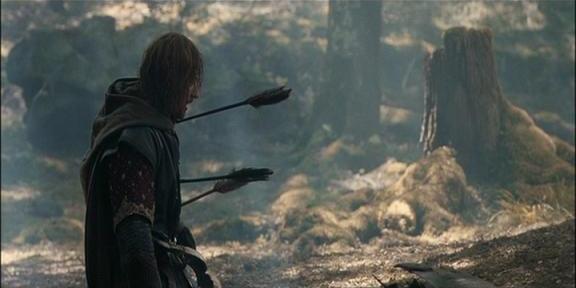
But I enjoyed the movies. I never once was at any threat of falling asleep. When Legolas stabbed an orc with an arrow, sure, part of my brain said “you can’t stab an orc with an arrow”, but most of it said “DUDE, DID YOU SEE LEGOLAS STAB THAT ORC WITH AN ARROW?” When Gandalf stood up to confront the Balrog, my heart rose up into my throat with suspense: would he survive? When Frodo was seemingly killed by a troll, my pulse jumped, even though I knew the mithril reveal was coming. When Boromir was shot full of arrows, my internal monologue screamed: no Boromir! Get up! You can do it! I could literally do this all day, because Lord of the Rings was a well designed movie. It had drama, it had pacing, it had a tone, and it was real. Did I like everything about it? No. Was I disappointed with my vision of the book as a rubric? Yes. But it was good.
The Hobbit has none of these. The Hobbit is a different book than Lord of the Rings. While The Lord of the Rings was inspired by Tolkien’s experience in World War I, and you can see it everywhere. Ultimately, Lord of the Rings is about the suffering that war brings on all people, but especially on those who are not the heroes. The commonfolk, the hobbits, have to simply soldier on in the face of insurmountable forces. It is epic and serious and grim. The Hobbit, on the other hand, is a children’s adventure book, with a lighter tone, more whimsical enemies, and a very fantastic, simplistic quest: find the dragon’s treasure. There are no earthshaking consequences, just an adventure.
In the very first chapter of The Hobbit, Bilbo begins worrying about the dwarves in his house: not why they are there, not about his potential adventure, not even about the dragon, but whether or not they will chip his plates. To one who is familiar with fantasy, this may seem a silly worry, but this is the tone of The Hobbit. Bilbo literally cannot comprehend the idea of his adventure, and so he focuses on what is real to him, the plates. Many viewers have fixed on this particular scene from The Hobbit as something they particularly hate:
But it is exactly this scene which sets the tone for his adventure. Bilbo is a reluctant adventurer, and what he brings to the adventure — the very reason why Gandalf wants him on the adventure — is his sense of quiet responsibility and attention to details and consequences. On the other hand, the dwarves are basically mocking him for focusing on something so unimportant given the context.
A scene later and we have the famous troll scene, with dwarves tied up and who has to save them? Why, who else could keep the trolls distracted until sunrise but Gand — Bilbo? It is here where we first see Peter Jackson’s inability to understand the themes of The Hobbit — although it’s not the first time he’s committed this crime of stealing Gandalf’s credit and giving it to a hobbit; he had Frodo solve the gate of Moria riddle as well — Bilbo at this point is not an agent in his own adventure, but rather an experiencer.
After their capture by and escape from the goblins, when Bilbo emerges from the Misty Mountains with the ring, the dwarves — in the book — are considering leaving him, whilst in the movie they are mourning him. Yet again, this sets the tone difference. Bilbo is not a protagonist, at least not yet. They continue running — as a group — from the goblins until the giant Eagles rescue them.
And there you have it: that’s the whole of movie #1 of The Hobbit. No need for Ratagast scenes to sec the background, no need to actually foreshadow Sauron, no need for any of the epic backdrop that Peter Jackson attempts to instill upon The Hobbit. This is precisely the cause of the 3-part nature of The Hobbit movies: the attempt to make something epic out of something that is simply put, just an adventure. The dwarves cannot simply float into Laketown, they must be brought in by the descendant of the archer who is destined to kill Smaug, while simultaneously being oppressed by an evil king. The Dwarves can’t be looking for gold, but instead, just the Arkenstone (although it should be noted in the book that Thorin is fixated on the Arkenstone in a way that the three Hobbits are fixated on The Ring, a clear sign for Tolkien’s belief that power corrupts).
It is all this that made The Hobbit so much more interesting than other fantasy novels: it was never about destiny, or only one person. It was about small, unimportant people making brave choices. Thorin is not the hero because he is the descendant of the king, but instead, Bilbo is the hero by his choices. Bard doesn’t need to be the descendant of a legendary archer, he is just simple captain of the guard, and so on. Peter Jackon’s rendition loses this low-born, everyman’s quality to The Hobbit, and replaces it with an overly epic interpretation.
But the overly epic also overcomes the very tone of the novel. The Hobbit is a children’s book, with bad jokes, silly villains, and is essentially a kid’s adventure. There are moments where this childlike comedy pops through, such as the video above, the barrel scene, the trolls and goblin’s nature, and so on, but then it is immediately replaced with an epic and serious scene that leaves you wondering which tone is out of place.
Overall, Peter Jackson’s The Hobbit fails to deliver a coherent movie in tone, and imposes themes onto the book that were never present, leaving an all-around awkward patchwork. This, combined with his penchant for drawing every scene out 30 minutes longer than it ever need to be, makes The Hobbit a movie to be slogged through, not enjoyed.
I love Boromir. I know I’m not the only one who does. And however much I like Boromir when he’s alive, there’s something that’s almost even more (tragically) appealing about him dead. This is less because I like his ruggedly handsome corpse, and more because of what Homer touched on thousands of years ago: in his death, because of how he died, Boromir becomes something more than he was in life. Boromir had what we might call a good death. Key to this, Boromir dies before he truly succumbs to the power of the Ring, and in his death he tries to make up for some of the mistakes that he has made previously. His act of self-sacrifice protecting the Ring-bearer is a fairly hefty weight in his favor on the scales of Judgement, making up for some of his earlier errors. Interestingly enough for such a perilous setting, he is also the only member of the Fellowship to die and stay dead.
It turns out that that single heroic death is pretty standard. Most stories, like most role-playing games, don’t have lots of character death. In reality, people engaging in the same activities that most adventurers and main characters pursue with wild abandon have a fairly high casualty rate. People are killed while fighting, they’re permanently injured, they get sick… and in many cases, their deaths and debilities feel meaningless. For every handful of people that die doing something we would idolize as heroic, far more are killed or injured in an almost banal fashion. Would we feel the same way about Boromir’s death if he had, I don’t know, been killed without having a chance to fight back? Stepped on a landmine? Slipped in the shower and broken his neck?
I don’t like to call anything impossible. Why? Because I don’t think it’s a meaningful word. People set up limits as to what they can and can’t do all the time with this word: that’s impossible! But most things aren’t impossible. Sure, some things are just a priori unattainable (you can’t be in two distant places at once, you can’t violate fundamental laws of physics, etc.), but many achievements we’ve labeled ‘impossible’ have later been made into playthings by scientists and innovators. Every time I get on a plane, I have to marvel at the fact that the combined weight of this giant metal tube — its cargo, passengers, and fuel included — is not quite a MILLION pounds. And it flies. If you ask me, that sounds like a load of impossible. I’m not saying flight is magic, I understand the physics behind it. But if you’ve never seen an airplane or any of the technology that goes into it, and I say ‘I can make a MILLION pounds fly’? You can bet that claim is met with skepticism. And maybe rightfully so. If it isn’t a part of your daily society, that’s impossible.
I live in Portland, and as such, everybody I know is a ‘writer’. I imagine it’s like being an ‘actor’ in Los Angeles; people use the word as a catch-all for their hopes and dreams. But wanting to write and doing it occasionally doesn’t make you a writer any more than playing pick-up basketball every once in awhile makes you a basketball player, or playing with Legos makes you an engineer. And so most ‘writers’ I know are actually baristas, with most ‘actors’ being waiters/waitresses.
As with most things, success is hard, and most success will be measured in degrees. So what is a writer? Well, I’d struggle to define ‘writer’. My first attempt would be: