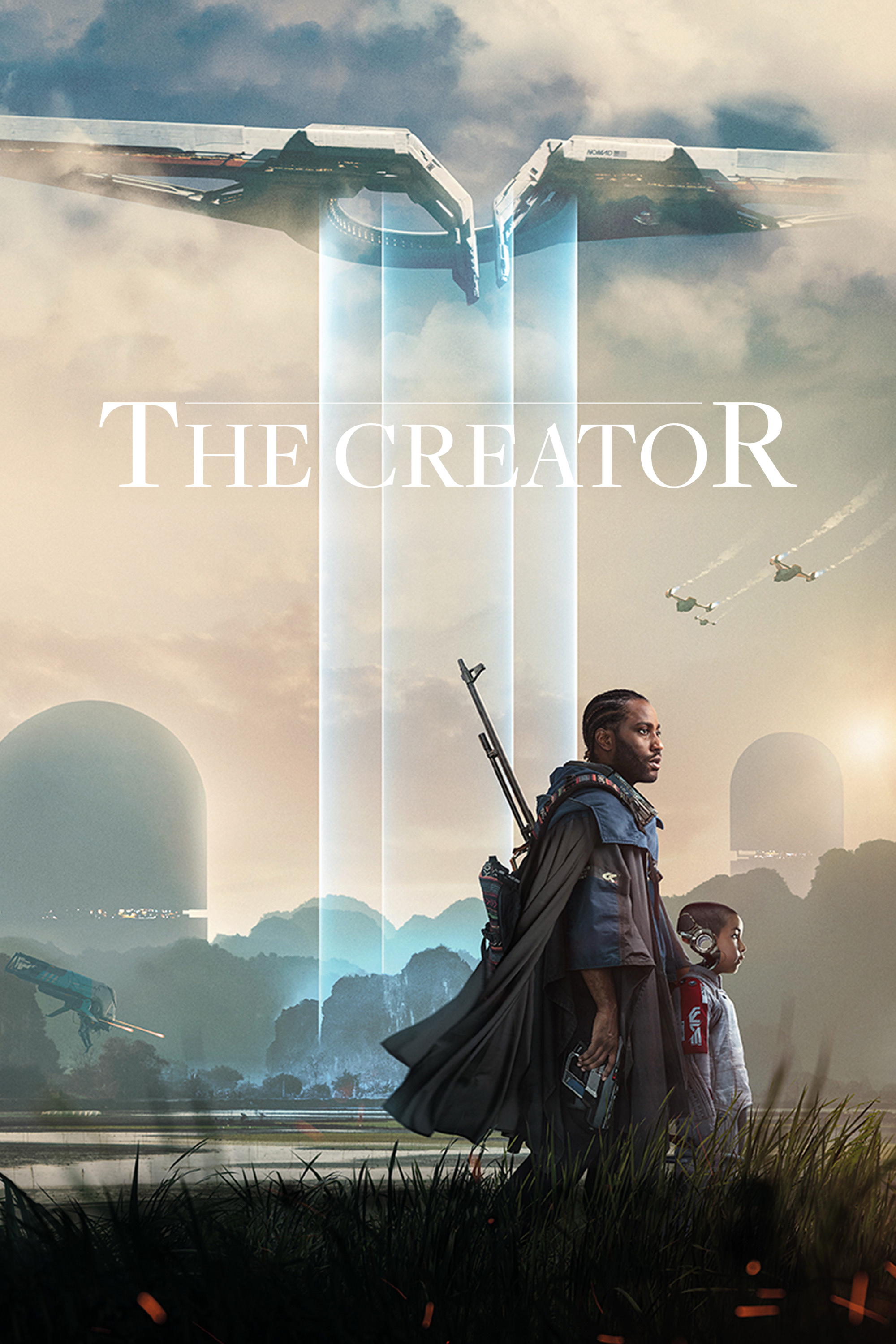
I finally watched The Creator, a movie directed by Gareth Edwards (the director of Rogue One). I’m a fan of Rogue One. I’ve also long loved stories that use AI and cybernetics to dig into our tender, fleshy explorations of humanity and the soul. I’m clearly the target audience.
If anyone were to love a movie about one person caught up in the conflict between AIs living in syncretic coexistence with humanity, and a fearful and hardhearted imperialist anti-AI America, it would be me. And I do! I do love this movie. But… it’s complicated.
I jotted down this note immediately after finishing The Creator:
“I think this movie is best seen emotions-first.”
I stand by that. If I pay too much attention to the logical flow of action or location or whatever, I get stuck. If I set aside those assessments and just follow the emotional experiences of the scenes, The Creator works. Halfway through the movie I was feeling feels and texting my friend excitedly about The Creator’s attention to aesthetics. By the end of the movie I was still feeling feels but was left with a “huh.”
Let me explain.
For those of you who don’t know what The Creator is about, it follows the story of a man in the middle of a far larger conflict; the US (and perhaps the West in general, though that’s less clear) is violently opposed to AI and simulants (think androids), accepting them only as tools and weapons. The US has created a Death Star-esque orbital bombardment station called NOMAD, and uses NOMAD’s weapons to blow the snot out of those who support AI. It’s very anime / generic-brand Star Wars. Support for AI is concentrated in New Asia, an unexplained political fusion of South, East, and Southeast Asian countries, where humans coexist with AIs and simulants as equals. Somehow this conflict doesn’t take the form of conventional war, stuck instead in a weird anti-terrorist / counterinsurgency limbo. In many ways the US is doing “Afghanistan War #2: Vietnam again, but bigger.”
Our point-of-view character, Joshua, is torn and squeezed between the two sides by ties of heart and of duty.
First, the aesthetics of this movie are marvelous. The sets, the costumes, the technology… I found them appealing and captivating, even when they were gross. Places felt lived in and real: sometimes grimy and grungy, sometimes neat and orderly, often organic and living and beautiful, always evocative in tone. There’s a whole essay to be written about the movie’s visual language and how it connects nature, the organic, and green life to the pro-AI and simulant groups, while the anti-AI groups only ever show up in natural locations as an invading force.
The movie also incorporates a lot of Buddhist-coded (or even explicitly Buddhist) architecture and clothing and apparent cultural practices, connecting all of it to the pro-AI and simulant side. While there are certainly Buddhists in the real world who don’t adhere to non-violence (see Myanmar and ethnic cleansing), Buddhism in general has a powerfully pacifistic reputation. This movie’s scenes of nonviolent robots in monk’s robes clearly show that this movie wants the connection to pacifism.
Unfortunately, the movie’s use of non-American cultures feels odd to me. Not in an intentionally malicious way, but in a “did you think this through?” way.
I’m generally willing to follow the biggest leaps of a story’s world building, especially when it’s included right away to lay the groundwork for the larger story as a whole. The Creator does that, frontloading all its biggest changes and setting the anti-AI US against the pro-AI New Asia from the start. This gives us a solid jumping off point for the next story beats. But while The Creator’s setting choices more-or-less hang together through the course of the movie, they feel increasingly threadbare and questionable as I step back from the spectacle.
One example: The Creator shows non-American / non-Western cultures through a sympathetic lens, but I fear it comes at the cost of being essentialized and oddly disempowered. I mean, yes, clearly they’re essentialized to some extent; South, East, and Southeast Asia are all fused together into a lump called “New Asia” and treated as an undifferentiated whole by the movie’s Americans.
There was some cultural differentiation, not simply a weird homogenization: I loved the inclusion of a wide variety of different languages amongst the New Asian people. With the help of my ears and the magic of closed captioning, I noticed Thai, Japanese, and bits of Chinese (among others). I’m sure there were more.
But the movie’s conceit around “the people of New Asia” feels… off. I mean, there are some pretty heated differences between people of China, Japan, Vietnam, Nepal, and Thailand. Those differences run far deeper than mere borders.
Quick aside: yes, I know there are more countries in South, East, and Southeast Asia. Those I mention are the ones whose languages I heard, and where I know the movie was filmed.
Anyway, the decision to meld all of those nationalities and ethnicities and cultures—is this the right time to mention the treatment of ethnic and cultural minorities by China and Han Chinese?—into one heady stew feels a bit like superimposing a magically more-united-than-our-present version of the European Union on 1910s Europe. Can I imagine it? Sure. It feels like classic “wouldn’t it be cool if” world building. But as is so often the problem with stories set in the near future, I think there’s more time or more story between our ’now’ and the movie’s ‘now’ than the movie makes room for. Somehow, I’m far more willing to give that implausibility a pass in an informal tabletop game (or even anime) than in a movie.
Tied to that implausible fusion we have the disempowerment: where are New Asia’s conventional military forces? If New Asia is a unified state which incorporates all those people and places with their technological and industrial and military might, why do we only ever see militias and robot police? Did New Asia unilaterally disarm at some point? The US obviously didn’t. This was confusing and unsatisfying.
My confusion didn’t stop with the skipped steps in world building. The movie’s plot is a messy and chaotic ride that drags you along with it, at speed. As long as you don’t slow down to think, as long as you just let it flow over and through you, this isn’t too much of an issue. Emotionally, it worked for me. But watching the movie felt like being dropped in the latter half of a William Gibson novel, when everything is going wrong fast and you just have to hope you remember all the context Gibson laid out in the first half of the book.
The problem, of course, is that we don’t really get the first half of the book.
We are given new overt narrative courses to follow time and again throughout this movie. They’re delivered as missions or tasks for our main character Joshua; the ties of duty dictate “Go here, go there, kill this person, don’t kill those people, dance when we tell you to.” The movie races along after each of these threads (and Joshua’s obedience or defiance) with precious little time for us to think. We’re offered very little breathing room, and very narrow windows of time to give depth and variation to the tone and pacing.
There is another conflict that pulls Joshua onwards independently of these missions, accessible underneath all that. It is delivered via subtext and Joshua’s asides, obscured in the rush of all those other constant demands—these are the ties of heart. The problem is that these ties of heart are only given full focus in the movie’s scant moments of breathing room. The emotional shift that Joshua experiences, the transformation that drives us through the movie in counterpoint to all the noisy demands of duty, has to be mostly taken on faith without the quiet pauses that might really let it grow and thrive for the audience.
If this were a James Bond movie, I wouldn’t need as much time for emotional development or introspection. I’d already believe that I understood Bond (well enough, at least). But this isn’t a Bond film—this movie wants us to feel our protagonist’s emotional roller coaster and see him wrestle with his decisions and wonder what course he will take. The Creator wants this, and doesn’t (quite) make the space for it.
In fairness, it makes some space for it. There are brief sequences of chopped up memories interspersed with the current narrative at times. Scenes and dialogue of the past are spliced with dialogue and scenes from the present. I can’t remember seeing this editing approach before, and I really like it. While it’s disorienting, this approach creates a feeling of multiple complicated and weighty memories impinging on the present, surfacing mid-conversation, and altering the course of our (and the characters’) understanding, all at once and far more seamlessly than a straightforward flashback might (at the risk of some audience confusion).
Somehow, despite this light touch, this movie worked for me emotionally. Mostly. There were just enough pieces in place for me to want to follow along and feel able to move past the spots where I got stuck. I think that might not have been true before I became a father; Joshua’s interactions with a simulant child play a big role throughout the movie, and I couldn’t help but feel my own need for connection there. I suspect my desire for that connection did some emotional heavy lifting on the movie’s behalf, possibly allowing it to get away with more than it should have.
Unfortunately the movie’s chaotic narrative—that Gibson-esque mad dash of a plot, but without the Gibson context—undermined my ability to ride the movie’s offered feels all the way to the end. As the movie neared its climax, I kept noticing what felt like continuity and plausibility gaps. Those logical gaps caught me and pulled me off the ride.
One concrete example: there is only one NOMAD. We’re repeatedly offered a (very very cool) visual of NOMAD’s targeting system throughout the course of the movie. It’s threatening, it’s full of foreshadowing, and it’s a great visual effect that the movie uses well. It’s clearly established that the very distinct pattern we see is specific to NOMAD (and distinct from similar visuals that show up from other US military systems). We’re never shown, say, networked targeting satellites delivering the same visual effect on behalf of NOMAD.
Near the end of the movie (oh yeah, *SPOILERS*) we see that targeting system light up a number of different locations that are all geographically distinct. Now, NOMAD appears to be a low Earth orbit space station, and appears to only ever use that targeting system on things directly below it. Again, there’s only one NOMAD. Having it simultaneously light up a bunch of different places that are very far apart, and also be seen from similar perspectives by lots of different people in those different places, broke my immersion.
Was my visual read incorrect? Maybe. From high altitude you can point lights at distant places simultaneously. Maybe I just needed to imagine that all those places were actually not that far from each other (unlike Thailand and Nepal), or imagine that this space station was actually being seen from a bunch of different perspectives than what showed up in the film.
My problem was that, when I tried to collage the different perspectives together, it looked like the many distinct places were seeing NOMAD above them from very similar angles—as though these places that had been established as being distant from each other were actually close together. Maybe other people wouldn’t have the same problem. Personally, this weirdness derailed me right as the movie raced to a close.
*END SPOILERS*
With all that, can I recommend this movie?
Yes, mostly. The ending felt full of small, odd choices. Not wrong ones, just odd ones. Of course, you shouldn’t watch this movie if you think any of the problems I mentioned above would send you into a towering rage (unless you like being furious).
If nothing else I wholeheartedly recommend it as a beautiful experiment in visual design. It also captures a lot of the brutality, capriciousness, chaos, and confusion of warfare, and is one of the few movies I’ve seen that includes any portrayal of American armed forces from the perspective of those on the receiving end of their violence (and not as a celebration). Finally, I think The Creator uses some really neat storytelling techniques. I’d love to see other similar examples elsewhere, if you’re aware of such.
I had hoped The Creator might ask us to question what it meant to be human or have a soul, and whether AI was inside those circles or outside them. That was part of what drove my love for Ghost in the Shell (the anime movie and its sequel, not that live action whitewashing thing), and what got me into this genre in the first place. Instead, I felt like this movie was less curious about those questions or had already arrived at its answers. I was mostly okay with that—if nothing else, it was interesting to see this take on things. If nothing else, the line “It’s not real, it’s just programming!” hits pretty hard in a good way.
Yes, I think this is a movie worth checking out. Yes, it is gorgeous and thrilling and gave me big feels at times. Yes, I’d add it to any bigger watchlist about humanity’s interactions with and thoughts on AI and robots. But it’s not without its faults and I can’t say that it is a new classic or a touchstone beyond its own genre.

