Making Monsters

You’re a monster. If you’re a good monster, you’ll be able to resist your terrible urges for a long time. We like good monsters! You should be one. But eventually you’ll do something unspeakable and hurt those around you, those you love. Because you’re a monster. We all knew it would happen sooner or later. We were just waiting, dreading the day when you’d reveal how awful you truly are.

But there are other monsters out there who tell you that you aren’t a monster. None of you are. Just like them, you aren’t evil. Maybe you could use a better attitude, some self-improvement. Your new friends have lots of advice about that. But those others who tell you that you’re a monster? Lies. Jealousy. Those lies are sick mind games meant to control you, to trap you, told by liars trying to profit while you suffer.

You don’t have to listen to those lies. You just need to be stronger. You need to be harder, and faster, and better. You need to understand that those people who say you’re a monster, their opinions don’t really matter. They don’t really matter. You can do better without them. If you really want people like that in your life, make sure that you’re the one in control—not them.

After all, you’re the man.

Or maybe you have some other privileged identity, and the people telling you that you aren’t a monster are spinning a slightly different story. That’s not the important part. What really matters is that there are people who tell you that you should feel bad, and others who tell you not to worry about it. Which ones feel better to listen to? Which ones give you hope?

In case you couldn’t guess, this is a follow-up to Are Boys The Problem?

Continue reading

Are Boys The Problem?

A reddit thread has been living rent free in my brain and scattering its gross leftovers all over the couch of my cortex.

Last week, while I was prepping my post about Some Desperate Glory, I read a post on r/newparents from a first time mother wrestling with her cognitive dissonance around having a son. She described herself as a feminist who no longer believed that all men were bad (she cited her husband as a good example), but who still struggled to reconcile her fear, animosity, and resentment towards most men with the idea of raising a young boy. She said (I paraphrase) she was trying to understand how to raise a young boy to be a good man with positive models rather than negative ones. She asked for help and advice.

I was immediately awash with thoughts, with so many ideas that I wanted to share. I wanted to lend my perspective as someone socialized male, as a camp counselor working with teens, and as a new father. Yet as I read on through other’s replies, I despaired.

The post has since been deleted. I’m not surprised that the post was deleted. I’m not happy about it either. I’m caught between wishing I’d replied faster and being glad that I didn’t stick my neck out. You might be able to guess why, but let me explain.

Continue reading

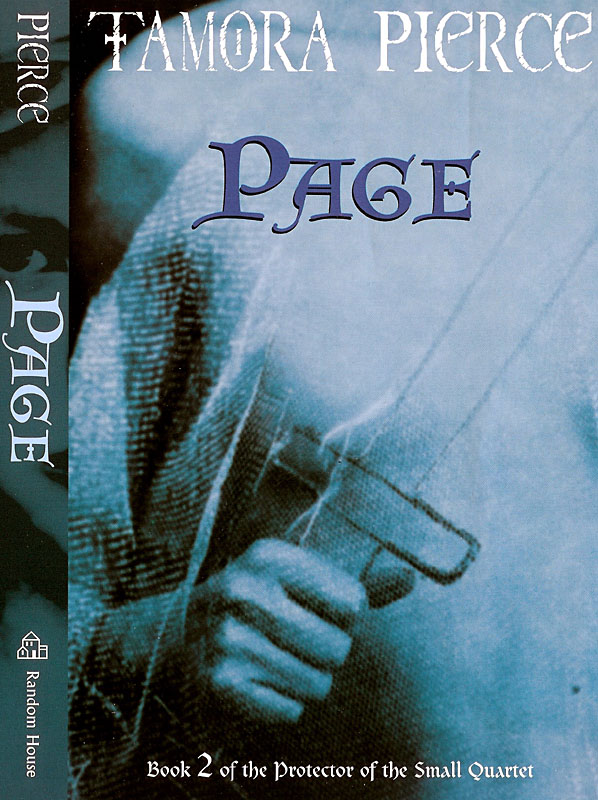
Page, by Tamora Pierce

I’m clobbered again today, but I’m alert enough to tell you that this Tamora Pierce series continues to be good. Page is great. I devoured it despite my sleep deprived state.

Continue reading

The Babysitters Club (Netflix)

Netflix’s version of The Babysitters Club is quite good, and I wonder whether I would have enjoyed the books as a kid as much as I like the show now. I haven’t finished it yet (or gotten very far in) but it’s good. I recall avoiding the books as a kid in part because the branding on the kids’ books was extremely gendered. That makes sense (both for concept and for marketing) but I feel kind of sad about it, because that’s a silly barrier to have between any young reader and some good storytelling. Honestly, the name of the series would probably have been enough to scare me away as a kid even if the covers hadn’t been as gendered, simply because I was raised in a pretty heavily gendered (and gender-policed) time and place.

I don’t mean that boys and girls (because there were only boys and girls in my world there and then) weren’t able to play together or be friends or whatever… but the times and places where that was possible were absolutely constrained. As a boy, I couldn’t be friends with most girls at school, at least not reliably. School was where all the toxic masculinity peer socialization was. And those peers very strongly enforced a social code in which it wasn’t okay for me to play with or enjoy girly things. Dolls, sparkly toys, dresses, colorful clothing, whatever… pink things, or maybe even any bright colors, were not safe to wear or have as an accessory. I remember getting shit from one of my friends in 4th or 5th grade about my yellow rain jacket being a girly color. I avoided bright colors for years afterwards, and was very concerned with maintaining a male gender presentation.

Now, despite this, I did actually play with dolls when I was playing with my friends who were girls. We would make up stories and play out scenes, and I remember delighting one of my friends by some particularly funny interaction between our two dolls (no, I don’t remember what that was). But I, like a fool, stopped playing and spending time with her, because other boys at school teased me about being friends with her. I feel bad about that.

Looking back, I wonder where all that toxic stuff was coming from. There were strong and strange lines drawn, and while I don’t think I questioned them at the time I sure as hell question them now. How was it decided that one girl was okay to hang out with at school, while hanging out with another would get you teased for “having a girlfriend”? Heck, how did “having a girlfriend” become a bad thing? Cooties, gender essentialism, and other reductive nonsense were pervasive.

All of which brings me back to The Babysitters Club. I’m not very far in yet, but I already love it. The first few beats of the first episode don’t bother to wait; they hammer in the unfairness of unequal gendered expectations and permissions, and that first episode’s lingering assignment of an essay on decorum is a perfect example of the struggle writ small *and* large. It’s great.

I admire the way that the characters’ internal perspectives leak into their episodes and tint the world they see through their own concerns. I love the consistency of the characters between episodes, and how we have a chance to see people from both the inside and the outside… it’s magical, having that perspective shifting so readily available. The contrast, from one person’s view to the next, is excellent. It’s written and delivered beautifully. I love seeing work do this, and I’m excited every time I see quality like this in work for kids.

The show doesn’t try to make itself accessible to boys, or try to bury its focus on the lives of young girls, and it doesn’t have to. It’s good just the way it is. I hope that there are young folks of all genders watching and enjoying it, because it’s worth having more people see beyond social boundaries and empathize with people who might be a little different from themselves.

I haven’t finished the season yet, and I understand that it may be a little underwhelming. That’s too bad. But I’d have to be really underwhelmed to be soured on this show.

This is a show worth watching, for a variety of reasons, and I hope there’s more of it. 

Kinky Boots

Goodness that movie was fun. If you haven’t already seen it, I’d heartily recommend it. There’s a lot to like.

I’m not even sure where to start. How about “heartwarming British comedy about saving a shoe factory by producing boots for drag queens”? I think that hits all the requisite notes without divulging any relevant details. There’s a good deal of gendered pressure and expectations in here that rings especially true of the 2000’s to me… which is funny because I know that it’s still around and still real. I guess it seems like there’s more awareness of other options these days than it felt like there was at that time? Or maybe I’m more aware of other options now than I was then. I don’t feel like I’m being especially clear with my words, and I’m just going to move on.

One of the things that I think I liked most about the movie is that, while the movie tries to be about Charlie Price, straight white guy, it really feels easy to me to read it as being about Chiwetel Ejiofor’s drag queen Lola — a focus that I think is made especially clear with the dance sequence on the boardwalk during the opening credits. I quite like Ejiofor in general, and I’m very happy with him in this movie.

After spending so much time last semester reading Truby’s book on the anatomy of stories (and specifically movies) I had fun looking at the film for the elements of structure he describes. It was a pleasant change from his obsession with Sunset Boulevard, which I’m now both curious about and very reluctant to watch.

Finally, yes, I’m still semi-feverish: I veer into fever at the drop of a hat, even if I don’t spend all of my time there now. And the random onset of fatigue is exciting and annoying. Nothing quite like knowing that you could hit a wall at any given moment to make you reluctant to go anywhere. I’ll do my best to keep up with posts, but I expect that my schedule will continue to be slippery while I’m sorting out my mono symptoms.