Squire and Lady Knight, by Tamora Pierce

I finished Lady Knight one day after finishing Squire. I absolutely inhaled that last book in the series. Tamora Pierce did well, as I’ve come to expect. The story of Lady Knight felt more satisfying in so many ways, but I don’t think it would have felt that good without Squire there to lay the foundation for it.

If you’re recommending these books to kids, it’s worth noting that Lady Knight bridges a big (and fascinating) gap in genre, content, and target audience age. I’m not saying that you shouldn’t give these books to kids—I think you should! But you may want to read them yourself, and be ready for the way in which the story’s tone shifts near the end of Squire and throughout Lady Knight.

Continue reading

David Drake, 1945-2023

Rest in peace, David Drake. May your memory be a blessing.

I did not know David Drake, but I knew his work. I reviewed a number of his books here. Recently, when a friend was looking for a very particular flavor of genre fiction, I recommended Drake. I said, “He may not write the most poetic or literary story, and you might be able to spot tropes from a long ways off, but damn does he know how to drive plot.”

From what little I know about Drake’s writing habits and his collaborations, I admire him. He apparently knew the arc of each story well enough to write detailed plot outlines (there’s a free example here), and would then hand those off to his collaborator and take second billing. He thus helped other writers get published and break into the market. Eric Flint, if my memory of various author’s notes serves, found those outlines to be extremely helpful with their shared Belisarius series.

David Drake also clearly wrote to release some of the awfulness he’d experienced while serving in Vietnam, especially in his Hammer’s Slammers series. He was of the generation of genre authors, especially military fiction authors, whose lives had been turned sideways by the war. His post here from 2009 states his feelings about the war pretty eloquently.

Relatedly, I appreciate Drake’s military fiction; its sense of grim loneliness and futility, blended with camaraderie and the occasional glimpse of something more admirable, feels like a fitting portrait of war. It fits with what I’ve heard from my veteran friends who’ve been in combat. Unlike other mil-fic I’ve read, Drake’s stories don’t pretend that there’s some inner nobility or heroism inherently brought out by war. Nor does he pretend that wars accomplish much good.

I never dug deeper into David Drake’s political leanings. Given my frustration with other mil-fic authors, perhaps I wanted to protect myself from unwanted knowledge. It’s easier for me to read Drake’s work and appreciate it when I don’t feel immediately repelled by him. We’ll see whether I risk learning more. It won’t happen today.

If you want to read Drake’s books, you can find some of them here in the Baen Free Library. I can’t recommend the Larry Correia or John Ringo titles that appear nearby without wreathing my recommendation in enough caveats to float a lead brick. Stick with David Drake instead.

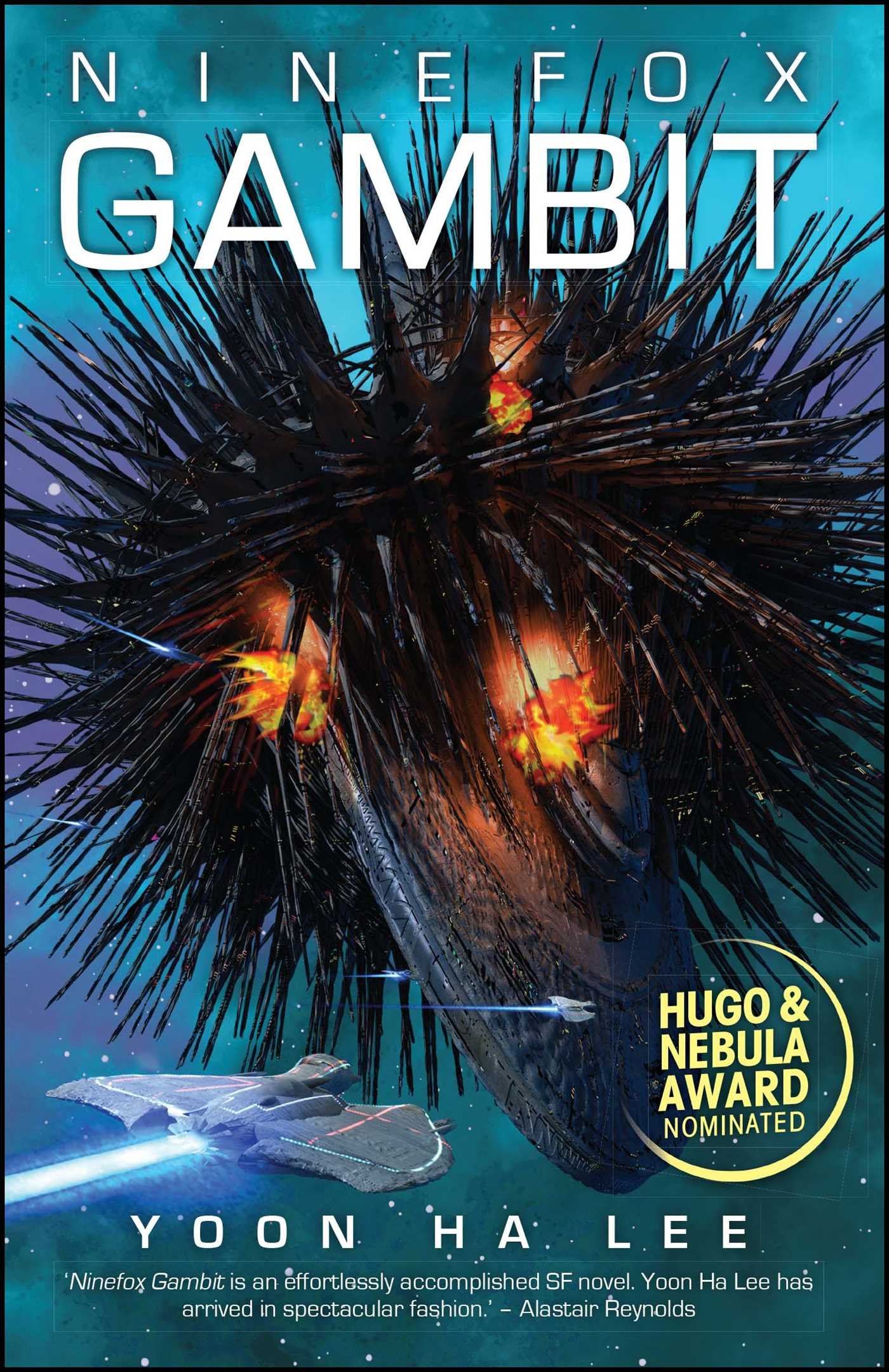
Ninefox Gambit, by Yoon Ha Lee

NinefoxGambit

Layers. Layers on layers on layers, ploys on top of ploys, backstabbing all the way down. And somewhere, sandwiched between all those knives, a few people trying to make a tyrannical empire a better place despite itself.

Yoon Ha Lee’s Machineries of Empire series (of which I’ve read the first two books) feels like a reimagining of the fundamental critiques of Warhammer 40k—but instead of trapping his work beneath cynical satire and Poe’s Law, Yoon Ha Lee renders his critiques of empire transparently and with heart.

Ninefox Gambit is a new presentation of classic sci-fi military fiction, discarding the traditional fetish for the tools of war and replacing it with an exploration of the human cost of imposing and maintaining empire… and of resisting and rectifying it. It does this all with a setting in which the violent and malignant imposition of hegemony is part and parcel of the exotic technological base necessary for interstellar civilization, and in which heretical practice literally erodes the power and capabilities of the empire’s technologies; mathematical and spatial relations, punctuated by suffering and pain, form the bedrock of calendrical technology, and the embrace of this calendrical tech-base has trapped the Hexarchate in a never-ending cycle of violence and subjugation.

With the Hexarchate’s rulers a group of professionally inhumane paranoiacs, determined to retain their power and uphold the stability of their realm with no care for the cost in lives, it takes a very special kind of heretic to oppose them.

If you like science fiction, or military fiction, or anti-imperial explorations in uncomfortably familiar alien settings, this book is for you. If you want your books to explain everything to you and never leave you piecing together elements of a setting or story… I might suggest something else.

Also, if you’ve traditionally avoided sci-fi mil-fic because it’s one long paean to unquestioning support of cis-het male hegemony, don’t worry. This series radically normalizes queered gender and sexuality. I really appreciated that.

In case you couldn’t guess, I think this book (and series) is great. I don’t want to say more, because I want you to experience it for yourself. I strongly recommend Ninefox Gambit.

If you like this book, I’d also recommend Seth Dickinson’s The Traitor Baru Cormorant.

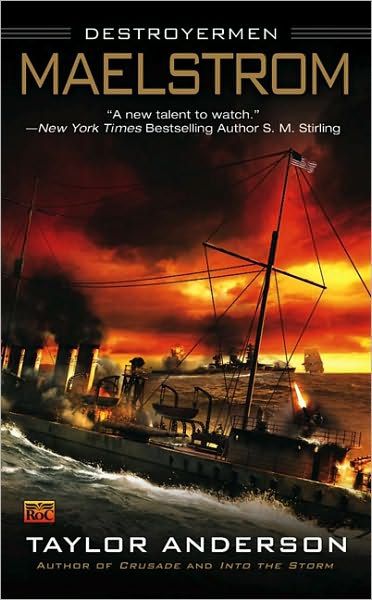
Maelstrom, by Taylor Anderson

b9_6348481_0_TaylorAnderson_MaelstromDestroyermen


Having just finished reading Maelstrom, I’m officially downgrading this series from “potentially profoundly interesting” to “some variety of popcorn lit.”  You know, the stuff that you’ll compulsively eat without thinking too hard about it: sometimes it’s exactly what you’re looking for, but more often it’s just there and you don’t bother to stop yourself.  This series is alt-history tech-bootstrapping military fiction with a very particular set of idealized social dynamics, and as of now it doesn’t look like it will stretch beyond that.  I’m not saying that it’s bad; popcorn lit is definitionally good enough that I’ll pick it up and breeze through it simply for the pleasure of reading it, provided I’m in the right mood.  But it also hasn’t lived up to my hopes of offering more introspection on any of its various conflicts, or breaking further from its genre precedents in an interesting fashion.

I should note that it’s hard for most novels to make it past my popcorn lit category, and the category itself encompasses an almost unhelpfully wide spread of books; furthermore, I can’t pretend to be better than that myself, as I doubt any of my own short stories would qualify as anything but popcorn lit.

I won’t say that the series can’t ever be anything but popcorn lit.  Some of the future books may deliver answers to the niggling contentions I’m sharing with you here.  But thus far my hopes for what I’ll call “deeper” material have not been met.  Specifically, I want Anderson to go deeper into examining the cultural conflicts inherent between the Americans and their various allies, and I especially want him to include the perspective of Lemurians who truly don’t have specified gender roles or gender/sex expectations.  It seems like he’s introduced the Lemurians (the cat-/lemur-like creatures with whom the Americans allied in the first book) as being without specific gender roles, but when we’re treated to the perspective of a Lemurian there are a number of basic social operating assumptions that appear to be based in a society more similar to our own, one which certainly embraces a number of implicitly gender- or sex-based values.  If Anderson wants to write the human perspectives in his book with those value assumptions in place, that’s ok by me, even if I don’t like it.  But much like my love for and disappointment with the use of Drax in Guardians of the Galaxy, I find it frustrating that Anderson should introduce an ostensibly gender- and sex- blind culture and then not do them the justice of writing from a gender- and sex-blind perspective.  I have to give Taylor Anderson credit for trying, and it seems like he might not be aware of how he’s failing to deliver here, but that doesn’t make it un-frustrating.

More after the break.

Continue reading