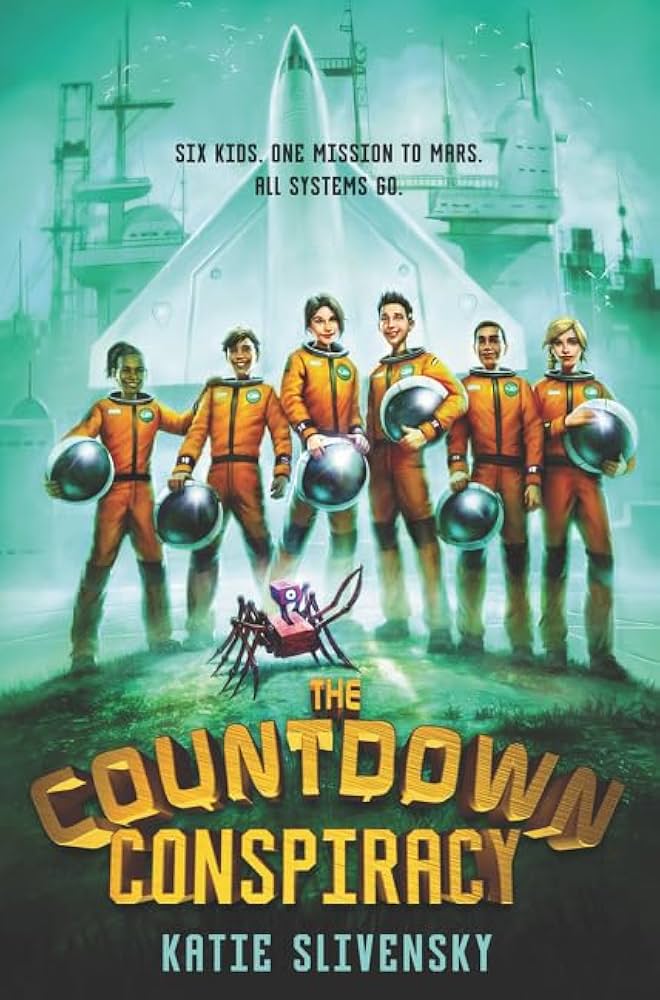
Katie Slivensky’s The Countdown Conspiracy is an upper middle grade adventure story all about six young astronaut candidates preparing for an international mission to Mars. Set on a near-future Earth still recovering from a global war fought over asteroid-mining rights, the story begins with a captivating slow burn and piles of intrigue. The Countdown Conspiracy builds from there to high stakes thrills and a satisfying, ever-escalating race towards the conclusion. I really liked it. A lot.
I’ve fallen off the querying-wagon again, but this book has revived my excitement and renewed my hope. Surely if people enjoy this they’d enjoy Bury’em Deep.
Why do I like this book so much?
There’s a lot to like!
I felt confident that I knew and could trust the narrator’s voice. Not that our POV character Miranda Regent was an inherently reliable narrator, but that her voice was consistent and well-written. Her perspective is laced with enough self-awareness and awkwardness to ground me, while her social observations and relationships and fears were all solid and palpable. She was, as is so often the case, just a little better at reliable interpersonal observation than I think is normal—but that’s usually the price you pay for having a first person narrator in a social intrigue thriller that isn’t fundamentally about questioning your unreliable narrator.
The other young teens felt good too. They were believable enough, all incredibly smart young people in a very serious setting with high stakes. Not all six of them felt like their emotional arcs were given equal focus, or equal depth. I think that would have been infeasible, however, in a book this length. The ones who did get their own arcs arcs felt good, with satisfying setup, turmoil, and payoff. Even better, the ones who didn’t get full arcs still felt like they were real enough people at each layer we were allowed to see, real enough to not kick me out of the story. I appreciate that; I always want writers to maintain the illusion throughout the entirety of the story, and I hate seeing a character revealed as a paper-thin plot convenience.
Speaking of plot conveniences, there’s a reliable pattern in many kids’ stories whereby grownups are either villains or hapless, with nary an ally to be found. Slivensky does a good job of balancing those scales here, with a pleasing mix among her adults of villains, allies, and hapless in-betweeners. In many ways she gets to have her cake and eat it too: the book’s bedrock of social intrigue heightens tension by leaving us uncertain as to which adults are which up until the very end. Slivensky’s solution is worth borrowing for my own purposes.
That tension is worth highlighting too. Though there are flashes of physical peril, the bulk of the book relies on social drivers to keep us engaged and on edge. I admire the smoothness with which Slivensky does this. Her judicious use of those occasional flashes of physical peril, in amongst the social intrigue, really drives home the excitement and keeps the book’s mysterious threats in play.
I’m reminded of a tension map I once made for a Tintin adventure. As an exercise in understanding the progression of tension throughout an adventure story, I graphed a Tintin story and tracked page by page whether the story’s tension increased, decreased, or stayed the same. This was not profoundly scientific; I didn’t have robust definitions for whether tension increased or decreased. But using my “native speaker intuition“ as it were I found a beautiful arc ramping up through the course of the story, with just a few points in the middle which gave the reader some time to breathe, culminating in a final crescendo just before the resolution. The Countdown Conspiracy follows that same model. It’s gripping good fun.
Maybe I’m reading too much into their tone, but Kirkus Review seems salty about a Midwestern white girl being America’s winning astronaut candidate. It’s a legitimate critique grounded in a desire for more diverse books—why not have a character who is more representative of the broader cultural quilt of our country? I was, however, willing to go along for the ride. The ethnic composition of the international team seems so purposefully chosen that I was reminded of old “good on us, we’re diverse” American war movies. Perhaps my resistance to this has been worn down by habituation, or by signaling those old movies I was lulled into accepting old patterns. Either way, given Miranda’s fears about her being chosen for the mission via political games, in some ways I felt even more willing to set aside questions about her being the best American candidate.
On a practical note, I’m willing to give Slivensky credit for choosing a main character that she believed she could write well. If she didn’t trust that she could write a different main character well enough to meet her own standards, especially given that she was writing a near-future America with some cultural continuity to our own, I’m glad she wrote the version of this story that she could. I would feel differently if the book felt worse; say, if more of the characters on the international astronaut team were white, or if the non-white characters felt poorly written. Given that I didn’t feel like the other characters had been done dirty—whether or not they might have deserved more depth or time to shine—I’m pretty okay with it. We need more middle grade sci fi adventure stories in the world. It’d be a shame to toss out this one for a missed opportunity.
In conclusion, I liked this book. I sped through it in a few days, and I probably would have simply inhaled it at a younger age. Is it perfect? No. Is it a good upper middle grade sci fi adventure story? Yes. It doesn’t shy away from the hard science involved in space exploration, but it delivers all of that material in a way that makes it easy to digest without requiring the reader to understand it all. I might need my own copy so that I can take notes in the margins.
If you like thrillers or adventure stories, space exploration, or solid upper middle grade fiction, this book is for you.
 Fistful of Wits