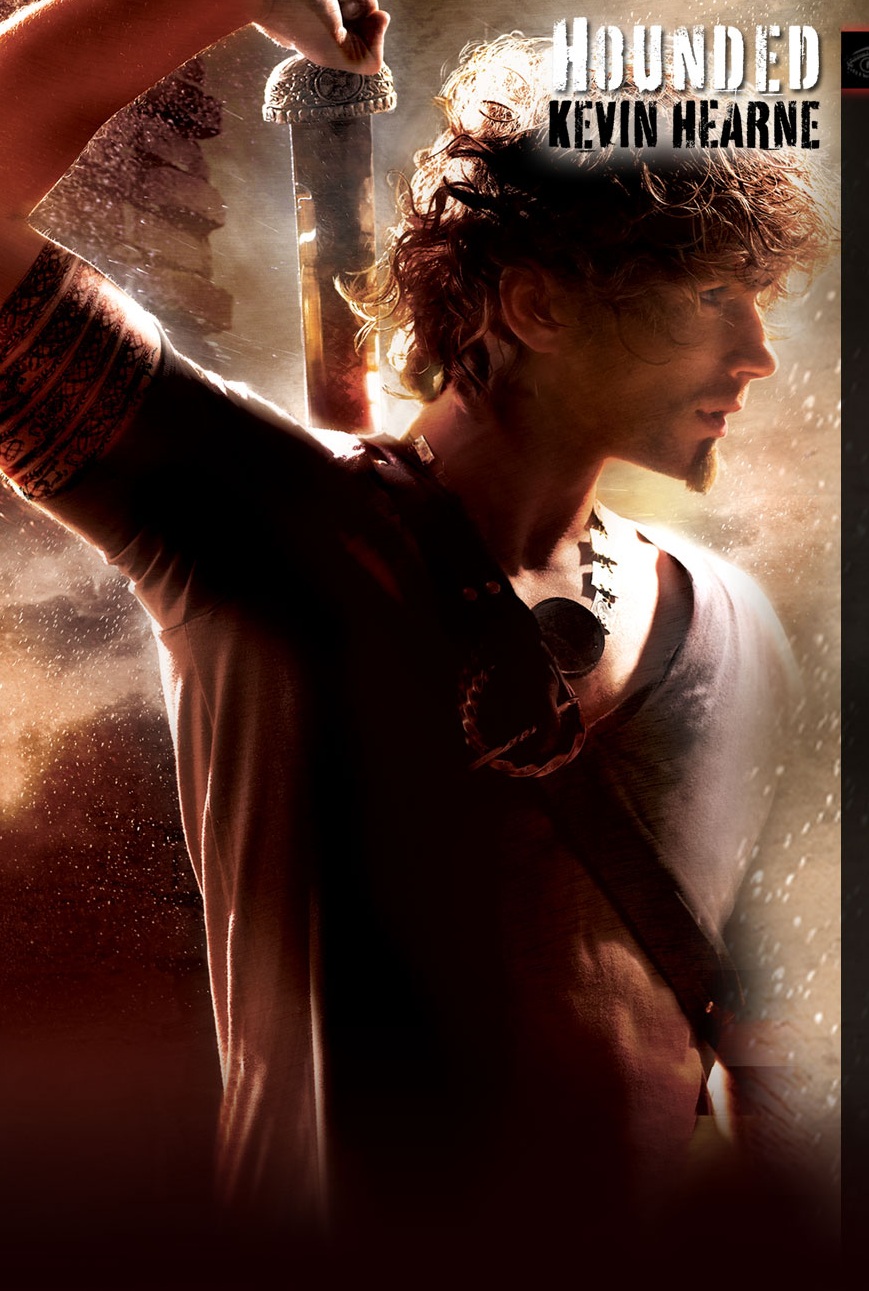
Hounded, by Kevin Hearne

hearne-hounded

So I read Skin Game (that review is over here), and I blazed through it in my usual gluttonous fashion.  One of my friends knew I’d be wanting more books of a similar ilk to fill my gaping maw while I waited for the next entry in the Dresden Files, and so he recommended Kevin Hearne‘s Iron Druid series. It turns out that Hounded, the first book of the series, pretty perfectly satisfies my aforementioned appetite.  It’s not very long, and it’s not very complicated (except insofar as there are a number of different magical beings, most of whom do not get along with each other), but it’s certainly entertaining.  I would say it’s something like literary junk food, with a small helping of mythological nutrition.  Good for a light snack.

An important note for those who have felt burned by previous experience with the Dresden Files: I don’t think this book is particularly offensive, though I should leave any final judgement to the consideration of someone with a more sensitive palate.  Specifically, there are a number of female characters who don’t feel like they’re only set dressing (it turns out Celtic goddesses show up frequently in a high-mythology urban fantasy about an ancient druid, and the few mortal women you meet aren’t helpless damsels either), but there is a Hollywood-esque imbalance in favor of the pretty, and far more attention is lavished on the descriptions of attractive women than on the descriptions of attractive men.   I don’t really see a problem with that focus, given that the narrator appears to be a straight male, but if you’re not interested in stories about a straight man in an urban fantasy setting you should probably look elsewhere.  Like I said, this book scratches a similar itch to the Dresden Files, but with less Noir and all that that entails.

Right, so how about more details on the story and setting?

Continue reading

Skin Game, by Jim Butcher

skingame_lg


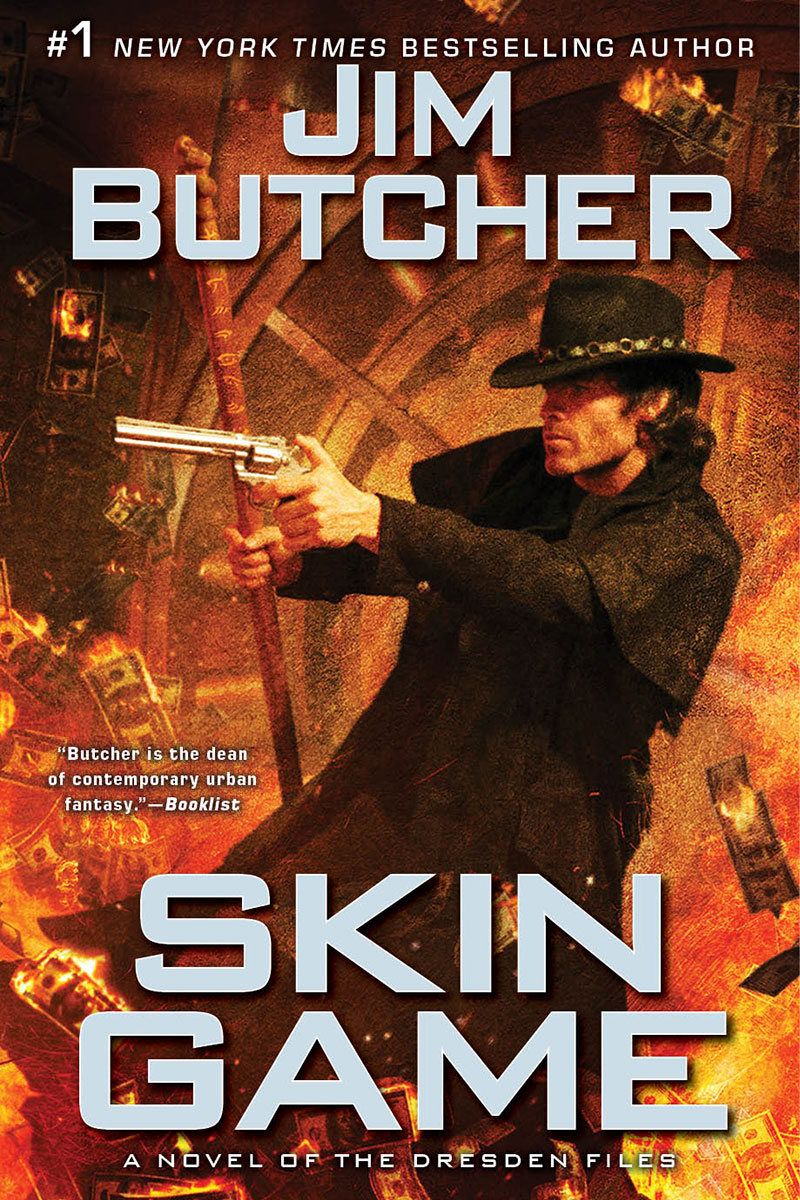
If you haven’t read the Dresden Files, this is not the place to start.  Similarly, if you’re not familiar with the series, I’m not quite sure how best to describe it based on this book.  The Dresden Files began as noir-inspired urban fantasy, focused on the straight white male wish-fulfillment protagonist Harry Dresden, everyone’s favorite (i.e. the only) wizard Private Investigator in Chicago.  According to Jim Butcher, the first book was originally written to prove just how awful formulaic genre writing could be.  Lo and behold, Butcher was actually very good at following genre formulae in generally gratifying ways, and the series has been quite successful.

Thankfully, though it’s still noir-inspired urban fantasy, the series has grown and changed.  Harry Dresden isn’t the same character that he was 15 books ago, and I don’t believe Butcher is still writing to prove just how terrible his writing can be.  The story’s background has grown in depth and complexity, and while not every book has been totally up to snuff (and some of them have their worse sections), I’m still quite thoroughly hooked.  In fact, Skin Game is probably my favorite book in the series to date.  I know, that whole bit about “written to prove how awful formulaic genre writing could be” isn’t exactly the best selling point.  Nor does it put “my favorite book in the series to date” in a very good light.

But the Dresden Files offers up a very specific flavor of story, and it’s one that I have found well-nigh irresistible ever since I read the first book.  It’s a little like guilty pleasure junk food, to be honest, and seeing the series get better over time just makes me feel better about my decision to keep consuming it.  It helps that the legacy of semi-covert noir-inspired misogyny has been slowly leeching out of the books, and I’m glad that the series has reached a point where Harry will more or less listen when his friends call him on his shit.

Enough about the series, how about the book?

Continue reading

1636: Commander Cantrell in the West Indies, by Eric Flint and Charles Gannon

9781476736785

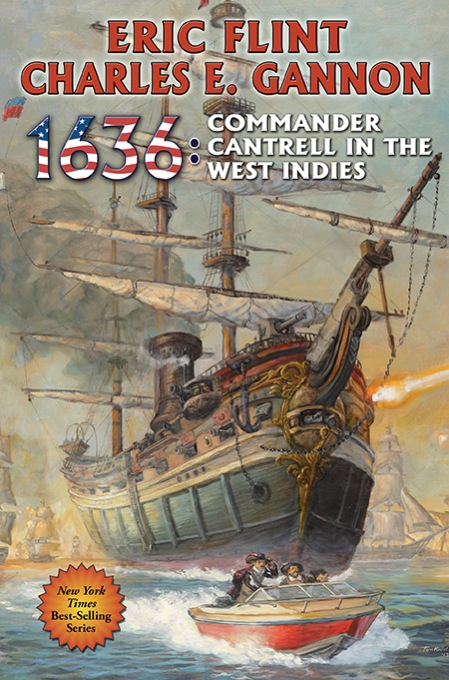
This scene doesn’t happen, but doesn’t it look nice?

My review has been delayed by other distractions, but I read most of 1636: Commander Cantrell in the West Indies before it actually came out.  You see, I’m infatuated with the 1632 universe.  I think that’s at least in part because the series offers a far more optimistic take on the world than most of the other fiction that I read.  If you already know that you don’t like the series, I doubt this book will change your mind… but if you do like them, you’ll want to take a look.  I’m not totally sold on it, and yet I still love it.

What do I mean by that?  Well, this book is a clear sequel to the Baltic War storyline, but it also incorporates at least two other storylines into the mix, with other elements thrown in from the rich milieu which has developed in the rest of the 163X stories.  It’s clearly intended to start a new set of storylines, several of which seem like they deserve their own books, or at least their own short stories.  I can see why they tried to fit so much into this book, but I feel like they ended up trying for too much and then ended up without quite enough to satisfy me with each of the individual stories.

But maybe the piecemeal way in which I read the book has done it a disservice.  I got early partial copies as soon as they became available and, like the literary glutton that I am, devoured each morsel as quickly as I could.  Like I said, it’s an infatuation.  While I doubt I’ll be able to restrain myself from reading new 163X books as fast as I can, I resolve to start over from the beginning next time once the whole book becomes available.  I’ll probably re-read 1636: Commander Cantrell in the West Indies some time soon to see just how much of my impressions came from the disjointed nature of my reading.

Now then, how about my thoughts on the material itself?

Continue reading

Unlocked, by John Scalzi

I don’t know if you follow Scalzi on Whatever, but if you don’t I strongly suggest that you take a look at what he posted today.  In addition to putting up the first chapter of his new book over at Tor, he’s also made his novella Unlocked available for free.  And it’s fascinating.

It’s an oral history of a disease that has yet to happen, and as such it feels very familiar; I kept thinking of World War Z as I read it, reminded of how well Max Brooks managed to create a world through the memories of his fictional interview subjects.  Unlocked doesn’t hit quite as high a note as World War Z did for me, but I don’t think it was meant to.  It doesn’t try to give us a worldwide view of what it was like to survive the end of the world.  Instead it serves as an introduction to the setting of his new book, and also tells a story in its own right.  The background created here sets the stage for a book that looks like it will be a very worthwhile read.

Oh, and it’s also good on its own.  It totally sidetracked me from the article that I was going to write for you today, and here I am writing about it instead.  I suggest that you check it out.

The Haunting of Hill House, by Shirley Jackson

Surreal and unsettling, The Haunting of Hill House is engrossing and admirably well constructed.  It starts strong and ends even stronger, though it did lose my focus for a little while in the middle.  I’m not sure how to describe my interest in how the story is told; I’m very uncomfortable with the narrator… no, that’s not right, I’m mystified and intrigued by the narrator, which I find disorienting and stylistically unlike nearly every other book that I’ve read.  I haven’t read many other narratives that use a disjointed third person semi-stream of consciousness, and which somehow manage to convey a distressing strangeness that seems to be crucial to the horror of the story.

And this book is most certainly a horror story.  Shirley Jackson seems entirely aware of “less is more,” the same principle that so clearly guided Aliens, but she takes it to an extreme that I hadn’t even realized was possible.  The whole story becomes the experience of the narrator, told at just enough of a remove that we can see the ways in which the narrator is changing and is effected by the horrible house, all while we remain very nearly as confused as she is about what is actually happening.

It’s an incredibly short book, one that moves along quickly if you’re willing to stick with it.  If you’re interested in looking at a formative piece of the horror genre, I suggest you pick it up.  I don’t want to spoil anything for you, but so long as you’re able to accept the unconventional narrator I think you’ll enjoy it.  Or at least find it worth reading, just to have the experience.


Wednesday Digest, 4/16

There’s no narrow focus for today’s update.  Instead I have a bevy of options available for you; more thoughts on Dominions 3, a brief glance at Knights of Pen and Paper +1, a few words on Shirley Jackson, and just a tidbit on The World’s End.

The World’s End is the third in a series of parody movies starring Nick Frost and Simon Pegg, and it delivers more or less exactly what I had expected.  It was not as uproariously funny to me as Shaun of the Dead or Hot Fuzz, but it was certainly enjoyable.  Maybe I just wasn’t familiar enough with the genre that it was sending up to really notice all the especially good bits, but I actually think that The World’s End was intentionally less funny than its predecessors.  Its central characters are certainly sad enough for that to be the case, seeing as how the film revolves around a man whose last best memory is of getting shit-faced drunk 20 years prior.

On to the next piece!  I’ve been working my way through Shirley Jackson‘s The Haunting of Hill House.  It started off feeling rather inaccessible to me (apart from the first paragraph, which was great), but now that the main character has finally arrived at Hill House and started meeting and talking to other people I think I rather like it.  I haven’t been reading it at speed, but that will almost certainly change over the weekend.  It seems promising, and I’ll have more for you once I’ve finished it.

As for Knights of Pen and Paper +1… I picked it up for a pittance through a Humble Bundle, and thought I’d give it a look.  It offers a fairly standard faux-RPG experience, and then takes it a few steps towards the meta by including the players and storyteller in the game itself.  While I’ve found it entertaining, it’s not exactly challenging.  It seems to favor grinding and power-leveling, and rather than offering much of a story it has its (admittedly amusing) meta-based gimmick.  Once the novelty of having your characters sitting around a table and fighting things obviously conjured from thin air by the storyteller wears off, I’m not sure how much is left, though I should note that I haven’t yet gotten very far.  Regardless, it certainly does hit those much loved compulsive-reward circuits every time you level or buy sweet new loot.  I expect your mileage may vary.

And now for another brief moment with Dominions 3, making it the game that I have most often posted about.  Be careful who you play with and what rules you set up beforehand for how players will interact with each other.  Different people have different expectations about the veneer of civility covering players’ interactions, and Dominions 3 is designed in such a way that hurt feelings are likely to follow from “strategically optimal” play.  I put that in quotes because, well, it hardly seems strategically optimal for a game to result in hurt feelings, now does it?  My experience of playing thus far has taught me that I prefer people to be very upfront in their dealings with me, and it’s taught me that one of my housemates will take whatever he can get when he feels threatened and sees an opportunity.  I really should have seen that one coming.

Oh, and last but not least, I should have a short story for you soon!  I’ve finally managed to pull apart a piece that I’d been working on and outline something that seems acceptable, so I expect you’ll see that here some time in the next week or two.  We’ll see how editing goes.

Reserved For The Cat, by Mercedes Lackey

Reserved for the Cat is another one of Mercedes Lackey‘s send ups of old fairy tales, still predictable and still entertaining.  It’s a fine retooling of Puss in Boots, but as with all of the other Elemental Masters stories you can’t expect too much in the way of surprises.  Well, that’s not quite true: it does diverge from the original story to offer the heroine a more decisive place in the final climax, but I’ve come to expect that from Lackey’s reworked fairy tales and can’t really count it as a surprise.

I doubt that Reserved for the Cat will win any particular awards, but if you’ve enjoyed the other entries in the series I expect that you’ll like this one too.  In fact, you’ll probably like it more than some of the others; unlike in Shadow of the Serpent, the heroine here actually has a chance to take care of her own problems.  And unlike the original Puss in Boots, the cat here creates nearly as much trouble as he solves and has to deal with the problems his own overconfidence has created.  I find that altogether more satisfying than the alternative.

My thoughts on the book’s high notes after the break.

Continue reading

The Wizard of London, by Mercedes Lackey

The Wizard of London is Mercedes Lackey‘s reconstruction of The Snow Queen, by Hans Christian Andersen.  It comes as the fifth book in her Elemental Masters series, and follows in her tradition of giving the heroines of the story considerably more power and input than they had in the original versions.  As with almost all of the other entries in this series, this one is also set in England in the early 1900’s.

If you’ve read any of Lackey’s other books in this series (or indeed, nearly any of her other books at all), then this story’s style will be intensely familiar to you.  Even if you don’t know the original fairy tale, there are few surprises to be had here; the biggest puzzle I faced came in deciding which of the groups of main characters would be the primary representatives of the original fairy tale.  That said, Lackey is a solid author and routinely manages to make the predictable entertaining, which in my opinion is quite an accomplishment.

Do I think you would enjoy it?  Most likely, yes.  Do I have a few other thoughts to share?  Read on.

Continue reading

Feed, by Mira Grant

Feed‘s appeal is a dangerous, slow, and creeping infection: you likely won’t recognize that it has its hooks in you until it’s too late, and at that point you’ll be too far gone to care.  In its early stages you’ll pick up the book every so often to read the next chapter, intrigued by the ease with which Mira Grant (aka Seanan McGuire) has created these characters and given you a look at what it might mean to live with a real zombie apocalypse.  The midpoint of the infection is your last chance to cut your losses, as the curtain lifts on the real story of the book and intrigue and conspiracy begin to unfold before you.

There’s an exceedingly brief threshold in which you might be able to put down the book, and then the late-stage symptoms set in.  You will put off other work and be made upset by anything that comes between you and finishing.  Your only goal, at that point, is to make sure that you’re able to follow the rest of the story to its conclusion.  The last hundred pages are a rush, an excellent demonstration of a dramatic climax at its finest, and they’re irresistible.  Almost as soon as I had put down the book, I was already putting the next two on hold at the library.

Heck, I even did something else I haven’t done in ages and started reading the sample opening from the beginning of the next book, where it hid in the after-material.  I strongly suggest that you indulge yourself and give the book a try.  For those of you who want to hear more about the book, read on below…

Continue reading

The Human Division, by John Scalzi

Usually by the time that I hit book five of a series, I need a break.  I’ll feel a little tired of the author; I’ll have come to expect their turns of phrase, I’ll know some of the ways in which they think, and I often have some inkling of where the story will go before it ever gets there.  Tired isn’t quite the right word, but you get the idea.  It’s right around then that I start looking at other books longingly and prepare to binge my way through a different series.

But John Scalzi has completely avoided this predicament.  I mean, sure, maybe I expected some of what was coming from Zoe’s Tale, but that’s mostly because it covered a lot of territory that I had already read in The Last Colony.

Where am I going with all of this?  Here: The Human Division is great, and I want more.  In fact, I want to see the next book in my hands as soon as possible.  I accept that this might take some time, as I am certainly aware of the frustratingly slow pace at which stories are often written, but nevertheless.  This series is exceptional, and reading it feels a bit like I imagine being sucked out of an airlock must feel.  Except that the frigid void of space is actually a deeply engrossing series of story lines, and you don’t end up boiling your liquids out through your pores while freezing at the same time.  Ok, look, the analogy was a bit forced, but these books will grab you and pull you along mercilessly with all the force of an explosive decompression, only freeing you once you’ve come out the other side.

Treat yourself to a good time and read this series, you won’t be disappointed.  Would you like to know more?

Continue reading