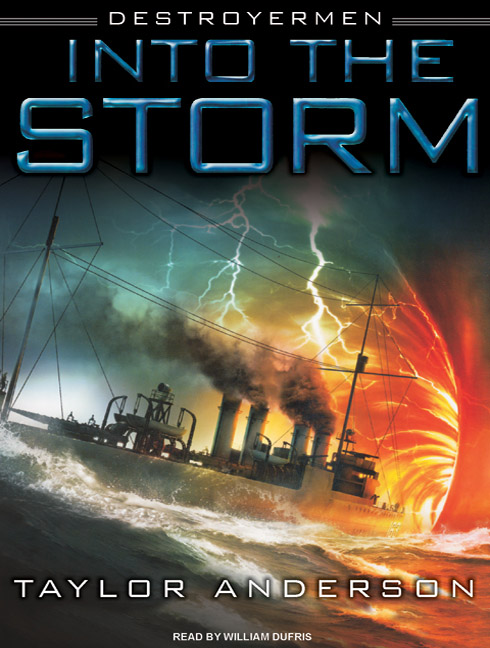
Into the Storm, by Taylor Anderson

islg


This book falls into a strangely particular sweet spot for me; there’s something about the alt-history technological bootstrapping genre that I find appealing, and the obviously idealized social dynamics presented in this book are endearing if not convincing.  Furthermore, S.M. Stirling’s cover blurb pulled me over the edge into reading it.  I was not quite as automatically engrossed as he apparently was, but Into The Storm has made excellent reading material while I’ve been laid up following an unfortunate paintball incident.

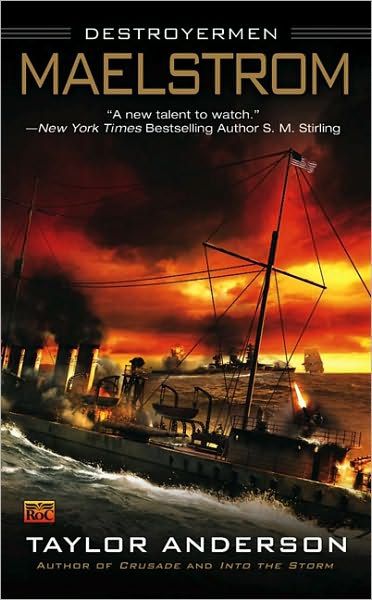
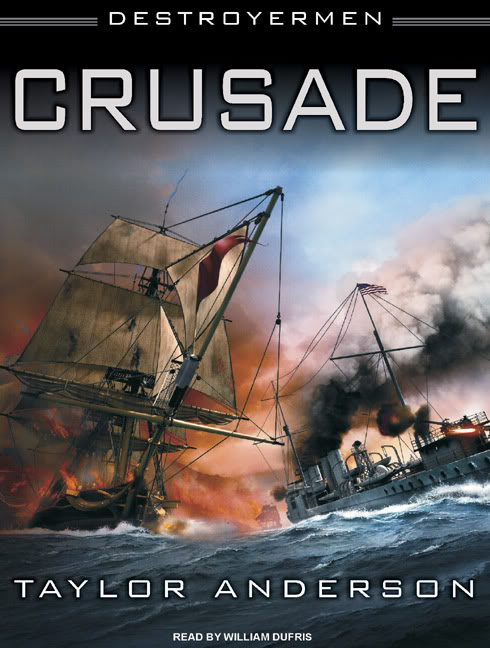
The basic concept is very simple, transposing an American WWI destroyer caught in action against the Japanese at the opening of WWII from our world into an alternate world in which (more or less) the dinosaurs never really died away.  The story is all about the destroyer’s crew doing their best to survive in a strange new world, and doing what they can to find friends who might be able to help them keep their ship operating instead of simply falling apart.  It feels a little like S.M. Stirling’s Island in the Sea of Time crossed with Eric Flint’s 1632, but instead of dealing with a town or island it focuses entirely on a very small warship.  The crew is wonderfully convincing, right down to their malicious pranking and oddly neurotic idiosyncrasies, and I enjoy following all of their various perspectives as the story progresses.  The crew actually reminds me a little of the residents of an Apocalypse World hardhold or members of a Chopper’s gang.

Now, when I say “endearing if not convincing” up above, I don’t mean to disparage the author’s conception of hierarchical systems founded on an egalitarian society.  As it’s presented, it seems to work pretty well.  But the author’s clear preference for the system by which ‘the good guys’ operate is so transparent that I feel unable to accept it at face value.  I don’t have experience with living and working on a US Navy vessel, I have no idea whether or not Anderson’s description is anything like the truth, and I suspect that what Anderson describes is closer to the ideal towards which his hierarchical system strives rather than the reality.  I’m certainly aware of many failure modes that would prevent a hierarchical system from working nearly so well as it’s presented in the book.  I think of it as a variation on the likable / wish-fulfillment protagonist problem; it’s really not actually much of a problem, so long as we remain aware of the fact that we’re idealizing the subjects of our attention, be they characters or systems of governance.

Also, I found the gender relations of the human characters (and characterizations of the male vs. female human characters) to be pretty frustrating.  I had a hard time taking the characterizations of the male and female leads seriously, because they seemed so stereotypically 1940s to me.  At a guess, Anderson was trying to ensure that these things were appropriate for a group of people in the US Navy in 1942 (unsurprising given his previous work as a technical and dialogue consultant for movies and documentaries), and I’m ok with that for the most part even though it turned me off the book to some extent (some things, methinks, are better left in the 1940s).  But he doesn’t really explore any of the disconnect between the humans’ attitudes and those of their newfound allies in this first book.  If/when he does get around to exploring that, and looking at the ramifications of further association between their two cultures, I think that has the potential to be super interesting.  If he just glosses over that topic over the next several books, I suspect I’d be a bit disappointed.

So!  If you’ve read and enjoyed Stirling’s Island in the Sea of Time, or Flint’s 1632, I suspect you’ll enjoy this book as well.  If you haven’t read them but are intrigued by the idea of a group of wanderers on the seas of time and space, doing their best to reestablish themselves safely in a dangerous and not-so-subtly different world, you’ll also probably enjoy this book.  If you don’t think you can tolerate some nearly-stereotypically-1940s gender roles, or some very nearly Apocalypse World-like shenanigans, maybe wait and see what I have to see about the next book before deciding whether this one is worth it.

Resistance, by Samit Basu

51WuUYWtYeL._SY344_BO1,204,203,200_

When I wrote about Turbulence a little more than a month ago, I agreed with the book’s cover blurb in my demand for a sequel.  But while it’s hard to make something that is truly good and worthy of others’ consumption, it’s even harder to make something as good to follow the first.  Fortunately, I think Basu succeeds where many others have failed, and offers a sequel that not only delivers on the promise of the first book, but follows it appropriately in tone and structure as well.  If you want good superhero fiction, this is an excellent place to start.  Or, rather, Turbulence is a good place to start.  Then you should read this.  And for heaven’s sake, don’t read them in the other order, you’ll just spoil lots of cool stuff from the first book.

Like last time, I find myself in agreement with the cover blurb on Basu’s book, and yet again I think that the blurb misses something even more wonderful; I’m still convinced that Samit Basu is some sort of Bob Ross of words, successfully conjuring worlds out of thin air with the sparsest of descriptions.  Unlike last time, I took more than one day to finish reading this book.  Perhaps if my reading hadn’t been interrupted by working at an overnight summer camp I would have powered through this book as well.  I can’t tell whether I did not feel as drawn in by Resistance as I did by Turbulence because of those delays or because of something else, but I’m happy to give the book a pass given how much I enjoyed it anyway.

Suffice it to say that if you liked the first book, you’ll like this one too.  And if you haven’t read the first one but are down with non-American supers and women who aren’t just given the short end of the stick, you should definitely read Turbulence (and then Resistance).  If you like superhero stories at all, I suspect you’ll like Basu’s work here.  More on the details after the break…

Continue reading

So You Want To Be A Wizard, by Diane Duane

so-you-want-to-be-a-wizard

I’m more than a little bit in awe of Diane Duane.  It’s been a while since I read something of hers, and I’d forgotten how good she was at her chosen profession.  Though the genre is no longer quite so thinly populated as it was when this book first came out, I still think that Duane outdoes the young wizard competition.  When it comes to books about serious young people dealing with serious (if fantastical) problems, she’s totally on top of it.  Admittedly, I’m not the most experienced judge for this particular sub-genre, but Duane is worth reading if you like YA literature that doesn’t talk down to its readers.

So You Want To Be A Wizard follows two young newly-sworn-in wizards who are facing their very first duties, which include slowing down the entropic death of the universe and generally trying to make the world a better place.  You know, the usual.  As you might expect from a story with protagonists devoted to such expansive duties, they don’t have an easy time of things and quickly end up in way over their heads.  I admire the depth of the goals Duane sets in front of her characters, as it seems as though they never lack for things to do.  This also means that they’re facing things that are profoundly scary and difficult to deal with, which turns out to be the perfect recipe for excitement and wonderfully climactic scenes.

Without spoiling anything, I think I can safely say that this book is an excellent adventure with exceptionally mature themes for a YA story.  The themes are more cosmically oriented than those of many other YA books that I’ve seen recently, with an emphasis on the broad scope of a story that I normally associate with epics; I admire the way in which Duane manages to include an epic scope even as she keeps the story (and its narration) very personal.  It takes considerable skill to see that through, and Duane clearly has it.  If you enjoy epics, YA stories, modern fantasy, or anything similar, I expect that you’ll like this book.

Ok, so I have an odd story about my history with this book…

Continue reading

Eric Flint and Determined Optimism

I love reading Eric Flint’s books.  Even when they’re not especially “good,” per se, I still go out of my way to get my hands on them.  There’s something special about the way that he constructs story-worlds that I find captivating, and I think I may finally have some of the right words for it.  Time and again, I’m struck by the way in which his stories convey a rigorously optimistic, idealistic world view; his protagonists work together to create a better world, or a better future, or a better something else, but there’s always the underlying presence of cooperating with others in order to improve upon what already exists.  I don’t always agree with everything that he writes, but given a choice between an Eric Flint-esque book and something less hopeful, I’ll pretty much always pick Flint (or at least return to Flint after a jaunt elsewhere).

Part of it has to do with inspiration, and part of it has to do with my personal headspace.  I consistently reference the need for inspiration towards something better when I review Flint’s books, often referring back to my article on Schindler’s List.  I sometimes feel willfully self-deceptive when I consciously shape my media consumption like this, but I find that my own outlook on life is far more positive and constructive when I make sure that I balance my media intake with more hopeful and inspiring stories.

All of which is to say that I find that Flint’s writing serves a very distinct purpose.  I like his work more for the fact that he very specifically introduces such positive people and/or groups into his stories; I find it tremendously reassuring to read about people consciously working together to create a better world, and I often feel more empowered to do the same after reading his work.  It makes a nice counterweight to my research into things like sex slavery, MKUltra, or Operation Condor.  There’s something refreshing to Flint’s idealistic community organizing that helps to clean out the toxicity of the horribly sinister things that we human beings have routinely done to each other.

I think there’s more to be covered here, but I’ll leave it at that for the moment.  What do you think?  Do you have similar mental health management strategies?  Do you actively seek inspiration in the media that you consume?

The Long Earth, by Terry Pratchett and Stephen Baxter

Stepper-Diagram

You too can construct a magical potato box.

The Long Earth is special, and I don’t say that just because it opens with a diagram of a potato in a box of electrical components.  It reminds me of Pandora’s Star, but without the epic not-exactly-space opera and intricate plotting.  They’re actually very different books, and The Long Earth requires nowhere near as much investment of time and energy as Peter F. Hamilton‘s sprawling story… but there is a crucial way in which they are the same: unlike with most books, I’m not angry when these two finish with a teaser rather than a conclusion.  Somehow, as with Pandora’s Star, when this happens in The Long Earth I simply take it in stride and look for the next book.

Maybe I’m tolerant of The Long Earth’s odd ending because I’m so partial to its strange mix of writing styles?  Pratchett‘s almost flippant whimsey leavens the still-serious storyline that he and Baxter have put together, and their look at the ramifications of partially accessible parallel Earths is engrossing.  The fact that they know how to establish a good set-up for future conflict (and how to pull you into reading about that) only makes things better.  I certainly plan to pick up the next book as soon as I go back to the library.

So what sort of book is this, if it’s like Pandora’s Star, but not?  And what if you haven’t read Pandora’s Star to know what I’m talking about?

Continue reading

Parable of the Sower, by Octavia E. Butler

52397


Holy crap, this is a good book.  Many thanks to Monica for the recommendation and the loan.

It turns out that Octavia Butler knew what she was doing when she wrote Parable of the Sower.  She managed to create a believable (and deeply grim) future; perhaps more impressive, the grim future she envisioned in 1993 still feels like a compelling vision of our potential future, even if the dates and tech seem a little bit off.  To be perfectly honest, I find the future shown in this book to be especially frightening because of the fact that I remember imagining something very much like it in my early childhood.  Except, of course, I had no conception then of the persistent undertones of racism that are seamlessly integrated into Butler’s story.

Somehow, despite writing about a world that is so clearly dying, about people caught in the death throes of a failing state, Butler writes a protagonist who retains all the hope that you could possibly ask for.  And this isn’t because our narrator is naive or stupid: it’s because she has looked carefully at the world around her and recognized that she has a choice between giving up and killing herself, or deciding to do something to change things.  And she’s clearly unwilling to give up.  I find her really refreshing, a wonderful narrator to follow through such a wounded world.

I’m not saying that it necessarily feels good to read all the way through; the truth is that this book is quite painful at times.  But it’s also uplifting in a way that only people enduring in the face of adversity can be.  And not just enduring, but people who refuse to simply prey upon each other, and who instead try to make something better from the world around them despite how ruined it is.  I like that a lot.  I find it inspiring, and I think that because of that this story fulfills an extremely important role.

Because I’m on a tight schedule today, I’m going to make this one brief rather than going into further depth about the story or its construction.  I admire what Butler has done with this story, and I wish she were still alive for me to thank her for writing it.  I hope that you pick it up and read it too.  If you’ve read it yourself, please weigh in with your thoughts below.  I’d love to hear them.

As if the good story weren’t enough, this is yet another good example of a teen female narrator for me to learn from.  Yet another reason for me to like the book.


Turbulence, by Samit Basu

1

 The cover doesn’t do justice to the book.

To be perfectly honest, I don’t know that I laughed, cried, or gasped while reading Samit Basu‘s Turbulence.  But I also didn’t put it down once I’d picked it up, and I most certainly do demand a sequel.  I’m not sure how I couldn’t, after having happily finished the book in one day.

This book is profoundly easy to read.  Some stories are told in a way that defies accessibility, that requires you to think hard and work your way through the language to the story underneath.  This is not one of them.  Instead, Basu’s descriptions of the world surrounding our protagonists are offered offhand, seemingly effortless in the way that they paint a picture of the world.  The first analogy that comes to mind is watching Bob Ross paint his happy clouds; one minute there’s a blank blue sky, and the next there are beautiful fluffy cumulus floating in it.  He hardly seems to exert himself beyond the bare minimum necessary, and yet a whole world drifts into being over the course of a few words.  Basu certainly relies on his audience to fill in the gaps, as we always do, but each time he conjures up another tiny detail or reminds me of the appearance of some particular piece of scenery, everything flows together again.

Turbulence is the story of what happens when a single plane full of people are all granted superpowers for no apparent reason.  By focusing on the many and varied people aboard BA flight 142 from London to Delhi, Samit Basu offers a superhero story about people who aren’t American (though American superhero comics exist and are referenced), and in which women aren’t automatically relegated to the status of sex-objects.  I really liked it.  Heck, I think even Spaige would like it.  I wasn’t especially surprised by the twists that Basu provided, but I enjoyed all of them and I loved the end of the story.  Now I can’t wait for more.  Fortunately, it looks like I won’t have to, since the sequel comes out in July.

More after the break.

Continue reading

Hounded, by Kevin Hearne

hearne-hounded

So I read Skin Game (that review is over here), and I blazed through it in my usual gluttonous fashion.  One of my friends knew I’d be wanting more books of a similar ilk to fill my gaping maw while I waited for the next entry in the Dresden Files, and so he recommended Kevin Hearne‘s Iron Druid series. It turns out that Hounded, the first book of the series, pretty perfectly satisfies my aforementioned appetite.  It’s not very long, and it’s not very complicated (except insofar as there are a number of different magical beings, most of whom do not get along with each other), but it’s certainly entertaining.  I would say it’s something like literary junk food, with a small helping of mythological nutrition.  Good for a light snack.

An important note for those who have felt burned by previous experience with the Dresden Files: I don’t think this book is particularly offensive, though I should leave any final judgement to the consideration of someone with a more sensitive palate.  Specifically, there are a number of female characters who don’t feel like they’re only set dressing (it turns out Celtic goddesses show up frequently in a high-mythology urban fantasy about an ancient druid, and the few mortal women you meet aren’t helpless damsels either), but there is a Hollywood-esque imbalance in favor of the pretty, and far more attention is lavished on the descriptions of attractive women than on the descriptions of attractive men.   I don’t really see a problem with that focus, given that the narrator appears to be a straight male, but if you’re not interested in stories about a straight man in an urban fantasy setting you should probably look elsewhere.  Like I said, this book scratches a similar itch to the Dresden Files, but with less Noir and all that that entails.

Right, so how about more details on the story and setting?

Continue reading

Skin Game, by Jim Butcher

skingame_lg


If you haven’t read the Dresden Files, this is not the place to start.  Similarly, if you’re not familiar with the series, I’m not quite sure how best to describe it based on this book.  The Dresden Files began as noir-inspired urban fantasy, focused on the straight white male wish-fulfillment protagonist Harry Dresden, everyone’s favorite (i.e. the only) wizard Private Investigator in Chicago.  According to Jim Butcher, the first book was originally written to prove just how awful formulaic genre writing could be.  Lo and behold, Butcher was actually very good at following genre formulae in generally gratifying ways, and the series has been quite successful.

Thankfully, though it’s still noir-inspired urban fantasy, the series has grown and changed.  Harry Dresden isn’t the same character that he was 15 books ago, and I don’t believe Butcher is still writing to prove just how terrible his writing can be.  The story’s background has grown in depth and complexity, and while not every book has been totally up to snuff (and some of them have their worse sections), I’m still quite thoroughly hooked.  In fact, Skin Game is probably my favorite book in the series to date.  I know, that whole bit about “written to prove how awful formulaic genre writing could be” isn’t exactly the best selling point.  Nor does it put “my favorite book in the series to date” in a very good light.

But the Dresden Files offers up a very specific flavor of story, and it’s one that I have found well-nigh irresistible ever since I read the first book.  It’s a little like guilty pleasure junk food, to be honest, and seeing the series get better over time just makes me feel better about my decision to keep consuming it.  It helps that the legacy of semi-covert noir-inspired misogyny has been slowly leeching out of the books, and I’m glad that the series has reached a point where Harry will more or less listen when his friends call him on his shit.

Enough about the series, how about the book?

Continue reading

1636: Commander Cantrell in the West Indies, by Eric Flint and Charles Gannon

9781476736785

This scene doesn’t happen, but doesn’t it look nice?

My review has been delayed by other distractions, but I read most of 1636: Commander Cantrell in the West Indies before it actually came out.  You see, I’m infatuated with the 1632 universe.  I think that’s at least in part because the series offers a far more optimistic take on the world than most of the other fiction that I read.  If you already know that you don’t like the series, I doubt this book will change your mind… but if you do like them, you’ll want to take a look.  I’m not totally sold on it, and yet I still love it.

What do I mean by that?  Well, this book is a clear sequel to the Baltic War storyline, but it also incorporates at least two other storylines into the mix, with other elements thrown in from the rich milieu which has developed in the rest of the 163X stories.  It’s clearly intended to start a new set of storylines, several of which seem like they deserve their own books, or at least their own short stories.  I can see why they tried to fit so much into this book, but I feel like they ended up trying for too much and then ended up without quite enough to satisfy me with each of the individual stories.

But maybe the piecemeal way in which I read the book has done it a disservice.  I got early partial copies as soon as they became available and, like the literary glutton that I am, devoured each morsel as quickly as I could.  Like I said, it’s an infatuation.  While I doubt I’ll be able to restrain myself from reading new 163X books as fast as I can, I resolve to start over from the beginning next time once the whole book becomes available.  I’ll probably re-read 1636: Commander Cantrell in the West Indies some time soon to see just how much of my impressions came from the disjointed nature of my reading.

Now then, how about my thoughts on the material itself?

Continue reading