Types of Games

gentleman-gustaf-figure

In my last post, I talked a lot about what roleplaying is, and – surprise! – it wasn’t just one thing! That is part of the beauty of roleplaying, it’s full of options. What are these options?

Well, first, we have the three qualities talked about before:

Roleplaying, Storytelling, Mechanics. To keep in line with the existing literature on Gaming Theory, I have slightly renamed the categories I used in the previous post. I have renamed ‘Mechanics’ as ‘Competition’ (it goes by ‘gaming’ in GNS Theory, but I find that to be a bit ambiguous of a term); it essentially refers to how much of the experience of the game is rooted in competition. Storytelling will be referred to as ‘Narrative’, and Roleplaying will be expanded slightly to ‘Simulation’. Simulation refers to how much of the setting goes to recreating system-internal realism. Note that this realism does NOT have to be actual realism. For example, many unrealistic things happen in Star Wars, but there is an assumed set of rules which governs things like lightsabers. Any given game will have a balance of the three, like so:
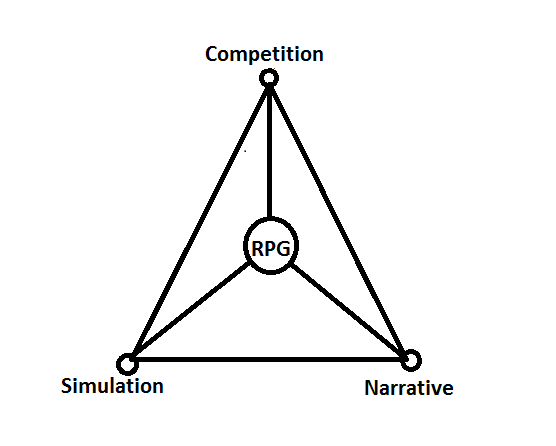
Game-Qualities

Continue reading →

Controllers: Interfacing With Your Audience

Zeeblee

When discussing game mechanics we need to remember that there is more to gameplay than just the on-screen interactions.  There is a real-life interaction happening during every single game you play, and it occurs between you and the controller.  When designing a game you can’t just take this for granted, and it is actually an interaction which deserves a lot of thought.  How you want your player to interact with the game world can determine exactly what system your game should be released for as well as whether or not you will need an extensive controls tutorial to educate your players.

Before getting started on your game you should ask yourself, “What control systems do I have access to?”  This is an important question because each controller type places hard limits on potential player actions.  By this I mean that every controller has a different number of buttons which players can press (or nobs/joysticks to fiddle with, but we can pretend they are just a bunch of buttons), and that number of buttons acts as a ceiling value for how many actions you can offer to the player.  On one end of the spectrum we have the single-button, single-joystick Atari, with the Xbox 360 controller being somewhere in the current middle, and near the end the current rendition of the computer keyboard.  To be more specific:  A Nintendo controller has eight buttons (A, B, Select, Start, four directions on the D-Pad) while a computer keyboard can have around 84-102 buttons.  This means that if you were to assign a single action to a single button that the Nintendo can support eight individual actions where the computer can support at least 80 different individual actions.

Continue reading →