How to Craft a Good Setting

For me, the most interesting part of a creative body of work is the setting. Many people will talk about the characters, and how interesting they are, or the growth they exhibit. Others will point to the plot. But for me, the setting is the foundation; it sets the grounds for any ‘what if’s that the body of work is asking. Now, there are two general qualities of settings.

The first is the obvious: the familiar. By ‘familiar’, I mean that the setting corresponds to our notions of how it typically is. Familiarity is the reason that elves are tall and willowy and removed from the world, dwarves are short and stocky and miners who love alcohol, and halflings/hobbits are playful but possessed of personal hardiness. Familiarity is why protagonists are young and leave their village with mysterious outsiders, and why young people from small towns are protagonists at all. Familiarity is how we know sons kill fathers and hand-loss will show up in half of sci-fi and fantasy, and everything comes in threes. Familiarity is the stuff on which tropes are built.

In this, a good setting is a lot like a good joke. A good joke is all about establishing expectations, building up a story that we all know and understand, and then, in comes the second element: deviation. I agonized over that word for awhile: ‘deviation’. At first, I thought ‘surprise’. But surprise wasn’t quite the word I was looking for. Surprise indicates that you didn’t really see what was coming; didn’t have an inkling. And while there is room for genuine surprise in stories, for the most part, the spectator — the reader, the watcher, the listener — should see the punchline coming. They might not exactly know what that punchline is, but when it does come it should be followed with ‘of course!’ Whether that ‘of course!’ is followed with an ‘I knew it!’ or a ‘How did I not see that coming?’ is largely irrelevant, although it should fall somewhere on that spectrum. That is to say, the context (the setting) should lead up to the punchline.

In a sense, the conclusion — the end of the book, the punchline, the moral — should feel INEVITABLE, even if it wasn’t predictable. When you hear the ending, it should immediately ring true as the ending, or the setting wasn’t established properly. It certainly isn’t impossible that Frodo could simply take the ring at the end of The Lord of the Rings, but it wouldn’t fit in with the tropes of the book: that hobbits are strong of heart and will, that all ages must come to an age, including the age of The Ring and Sauron (much as the age of the Elves is coming to an end even as the books begin), that the thing that distinguished Gollum from Frodo was his close friendship with even just one remaining entity (whereas Smeagol had killed Deagol). Essentially, the plot should live up to the promises that the setting makes, establishing a strong unifying theme.

Now, I’m playing a little fast and loose with ‘setting’, because I’m starting to include parts of the story. But in this case, I don’t mean the plot. I mean the tropes, the imagery, and so on. Sure, discovering the tree elves of Lothlorien happens as a part of the plot, but it is itself not plot; it is a revelation of setting to the spectator. inverting that story in ways we don’t expect but can still clearly see. Reading about a character losing his hand, or being seen surrounded by ravens, or dying and coming back to life is plot, yes. How it happens is plot. But it is also setting, because it serves to establish what tropes the author finds important, and how he chooses to invert them.

If I can walk you through a few examples, I think this will be made clear, but as always, I must warn you of spoilers. In A Song of Ice and Fire (Game of Thrones, on TV), Ned Stark is established as the protagonist quite early on. However, he is killed off before the first book in the series ends. Yes, this is a plot point, but also acts to establish the setting that George R. R. Martin is writing in: in A Song of Ice and Fire, life is short, brutal, and ugly, and you can trust nobody. In a sense, this helps to establish the context of the story. And when the punchline finally comes, that context will be important.

So ultimately, a good setting uses tropes and setting devices to establish the tone of what is expected to happen in the plot.

As such, I’m going to try a new project for my new posts; I’ll be posting a setting I’ve designed, according to these principles, talking about the tropes it exhibits, and how those tropes are inverted, and what those inversions mean!

Game Analysis: Remembering

Zeeblee

As a rather big fan of ambient music and experimental composition I was delighted by the game Remembering, which delivered both exquisitely.  Unfortunately I feel it suffers from some key design flaws which actually run counter to its advertised goal.  On their main site the creators state,

Remembering is a game that leaves room for the player. By building a world based on sound instead of visuals we’ve created a place that relies on interpretation. It offers the chance to perceive it in a personal way.

This is not what I experienced.  Yes, the game had a great soundscape, but it also relied on visuals and was not open to exploration.

Continue reading

What Makes a Good Game?

gentleman-gustaf-figure

It may seem strange to hit this topic now; I haven’t even defined what I think a game is! For now, I’m going to put that question off, but say that there are three types of games:

  1. Puzzles – These games involve one (or more players) trying to solve some system. These games can be played with some goal: ‘how do I solve the puzzle?’ or in a more exploratory manner: ‘what exactly can I do?” Games that are puzzles include:
    • Computer Games: Platformers, Adventure Games, Simulations (Civilization/Sim City)
    • Physical Games: Rubik’s Cube, Mind-Benders, Logic Puzzles
  2. Competitive Games – These games involve multiple players competing against each other within the constraints of some rule system with defined victory conditions. Some of the players CAN be AI simulated; as such, these games can be played as puzzles.
    • Computer Games: Starcraft, League of Legends, Street Fighter, HALO, Simulations (Civilization/Sim City).
    • Physical Games: Chess, Basketball
  3. Collaborative Games – These games involve multiple players working together (potentially somewhat competitively) to create something.
    • Roleplaying Games
    • Team-building games?

Continue reading

Game Analysis: Great Gatsby for NES

Zeeblee

It has been a good long while since I’ve read The Great Gatsby, but I’m fairly sure that The Great Gatsby for NES does not truly reflect the novel in any way outside of its cutscenes and aesthetic.  It’s built just like any old platformer where it tells you the controls, but doesn’t tell you anything about the game world (though the controls are not displayed in-game).  It’s really short, so there isn’t all that much to actually comment on, but I found it enjoyable and worth a playthrough.  The lack of a pause button means it’s sort of an all-in adventure, but due to its short length that’s actually not that awful.

The one thing I will comment on is how I think it did a poor job of educating the player on how to fight the first boss.  Your attack (throwing a hat) operates as a sort of player-seeking boomerang.  The first boss is most easily defeated through the use of this mechanic by throwing the hat and then jumping up near the boss, but there is a problem:  the game doesn’t really present this to you as something important to practice until the boss fight.  Just about every enemy you encounter can be dealt with by just throwing the hat straight at them, which then also makes it bounce straight back to you.  The range on the default hat (there is a yellow hat power-up) is also extremely short, so there isn’t much opportunity to alter its trajectory.  On top of that the screen is actually rather thin, and since it tracks the player avatar (keeps it in the center) the short attack range of the default hat ends up being almost equal to your field of vision.  This makes it so you can’t really prepare for enemies by throwing out long shots, which also means that there isn’t much time to play with hat trajectory.  The issues of range/sight combined with how just throwing straight is all you need means the player likely won’t discover and develop the technique(s) required to manipulate the hat projectile in the first boss fight until that very boss fight.  Developing the skill required to defeat the boss is also rather unsatisfying as it never comes up again and the rest of the game can pretty much be played as before (throwing straight shots).

But I’m willing to look past this flaw because of just how classy the game is.  Or maybe it’s because I drank a martini every time I grabbed up a martini power-up…

Zeeblee

Mechanics Guiding Playstyle

gentleman-gustaf-figure

Earlier, I discussed how certain roleplaying systems exemplified certain gaming orientations. To an extent, this is a very peculiar notion. More specifically, it’s a very basic shorthand. After all, mechanics can never force your actions. But the way mechanics are set up can really impact the way the players think about the game.

Continue reading

Design Elements in Horror: SCP Containment Breach

gentleman-gustaf-figure

I’ve never particularly been a fan of horror games; they don’t weird me out, they don’t make me feel gross, and they don’t frighten me. Amnesia, Slenderman, FEAR, they’ve all struck me as sort of disappointing. They have occasional moments of “OH SHIT SOMETHING JUST HAPPENED!” followed by a lot of feeling in control. But I played one game recently which left me with a unique sense of both horror and dread I’ve never felt playing a game before. That game was SCP Containment Breach.

Warning: this whole post contains minor spoilers of the first 15 minutes (and the basic concept) of the game.

Here are some videos of me playing SCP: Containment Breach

Continue reading

Types of Games

gentleman-gustaf-figure

In my last post, I talked a lot about what roleplaying is, and – surprise! – it wasn’t just one thing! That is part of the beauty of roleplaying, it’s full of options. What are these options?

Well, first, we have the three qualities talked about before:

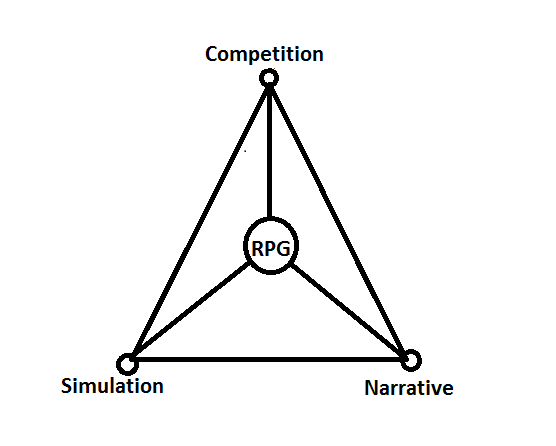
Roleplaying, Storytelling, Mechanics. To keep in line with the existing literature on Gaming Theory, I have slightly renamed the categories I used in the previous post. I have renamed ‘Mechanics’ as ‘Competition’ (it goes by ‘gaming’ in GNS Theory, but I find that to be a bit ambiguous of a term); it essentially refers to how much of the experience of the game is rooted in competition. Storytelling will be referred to as ‘Narrative’, and Roleplaying will be expanded slightly to ‘Simulation’. Simulation refers to how much of the setting goes to recreating system-internal realism. Note that this realism does NOT have to be actual realism. For example, many unrealistic things happen in Star Wars, but there is an assumed set of rules which governs things like lightsabers. Any given game will have a balance of the three, like so:

Game-Qualities

Continue reading

Controllers: Interfacing With Your Audience

Zeeblee

When discussing game mechanics we need to remember that there is more to gameplay than just the on-screen interactions.  There is a real-life interaction happening during every single game you play, and it occurs between you and the controller.  When designing a game you can’t just take this for granted, and it is actually an interaction which deserves a lot of thought.  How you want your player to interact with the game world can determine exactly what system your game should be released for as well as whether or not you will need an extensive controls tutorial to educate your players.

Before getting started on your game you should ask yourself, “What control systems do I have access to?”  This is an important question because each controller type places hard limits on potential player actions.  By this I mean that every controller has a different number of buttons which players can press (or nobs/joysticks to fiddle with, but we can pretend they are just a bunch of buttons), and that number of buttons acts as a ceiling value for how many actions you can offer to the player.  On one end of the spectrum we have the single-button, single-joystick Atari, with the Xbox 360 controller being somewhere in the current middle, and near the end the current rendition of the computer keyboard.  To be more specific:  A Nintendo controller has eight buttons (A, B, Select, Start, four directions on the D-Pad) while a computer keyboard can have around 84-102 buttons.  This means that if you were to assign a single action to a single button that the Nintendo can support eight individual actions where the computer can support at least 80 different individual actions.

Continue reading