World Building: Making The Outer Planes Better

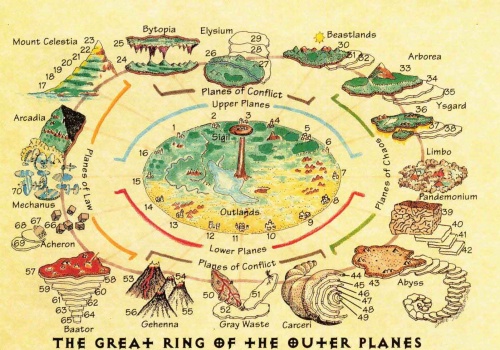
500px-Outer_planes

Once again, I find myself investigating the cosmological background of the setting I’ve most recently created.  I was reading through the Dungeon Master’s Guide again, reading the section on planes near the beginning, and I’m in that usual place: somewhere between excited and miffed.  Fortunately, it’s easy enough to change the things that haven’t excited me.

I’m comfortable, for the most part, with the material the DMG offers on things like the Astral and Ethereal planes.  I’m more okay with the DMG’s ideas for the Shadowfell, the Feywild, and the various elemental planes.  I’m not very happy about their ideas for the Outer Planes.  I have some rewriting to do; let me tell you why.

Continue reading

Shenani-games: Random Character Generation is GREAT

This weekend was a good one for gaming.  On Saturday I ran a last minute seat-of-the-pants adventure involving a great deal of bullshitting, and on Sunday I continued to run a standing campaign based on the material I started posting about last fall, in the setting I’ve been writing about this spring.  I had a great time with both sessions.

I’m not going to tell you much about the campaign, since that would potentially expose spoilers, but I absolutely have to share the basic setup of the Saturday game with you.  You remember whothefuckismydndcharacter, right?

Because we had very little time to set up and run the game, I decided that the players should roll down the line, which is to say that they had to roll their ability scores in order without being able to shift them around and spend too much time thinking about what they were going to be.  Then Spaige whipped out whothefuckismydndcharacter and got “a fucking sentimental Human Warlock from a cavern without echoes who is a recovering cannibal.”  I immediately decided that people could rearrange their ability scores as long as they shifted them to match a randomly generated character from that site.  Two of our players (Thom and Whitney) were hardcore / lucky and both rolled down the line AND used the random character generator.

The party ended up with an elven wizard, two warlocks (one human, one half-elven), a rock gnome rock bard, and a dragonborn barbarian.  The party’s wisdom scores were (I believe) 6, 6, 7, 8, and 12, with the barbarian as the wisest party member.  The lowest charisma score for the party was 14, and most people had 16 or higher.  Marvellor the Shit had a 20.  How did he end up with a name like that?  Well…

As the first few people figured out who their characters were, everyone decided that the PCs should start at 3rd level and that everyone would need an epithet of some sort.  We made a joke about the gnomish bard rocking out, and so he quickly became Duane the Rock, rock gnome rock bard.  The dragonborn barbarian, who had once survived a cookpot (it said so in his backstory), was described as having proportions like unto a Red Delicious; he’s bigger up top than down low, but he’s all around larger than he really should be.  He came to be known as Horgrin the Vast.  Spaige’s human warlock took the Great Old One pact, and was thus able to communicate telepathically (Spaige, seriously, I still want the fluff you came up with for that demon-tainted cave of the cannibalistic thought-collective, it was great), so she became Chathi, the Last Disciple of Silent Whispers, or Chathi the Last for short.

Whitney still needed an epithet and was randomly generating her character name (she got extra bonus points, because she randomly generated everything including wizard her spell list), but she quickly realized that her name was her epithet.  She ended up playing The Gart, which was perfect because it continued the tradition of four letter epithets.

By this point people were starting to get a little cracked out and/or drunk.  Thom showed up late and generated his character as quickly as he could, randomly generating the name Marvellor for his half-elf warlock, but was stumped for what to call himself until we pointed out that he needed a four-letter epithet.  Thus was born Marvellor the Shit, and his less impressive imp familiar Bixby the Crap.

Together these hooligans decided to search out a treasure as yet untouched by the adventuring group which had touched (more like scarred) all of their lives.  There’s so much that I’m skipping over, like the beautiful way in which they connected the fragments of backstory given to them all through the random character generator, but suffice to say that they had reason to despise and outdo the people who had ruined the lives that they once led.  As such, they journeyed into the land of Kraskya, the ancient and ruined city, and promptly fought a large number of things that they were hilariously ill prepared to face.  And despite the fact that high charisma types and people with enchantment and deception spells rarely do that well against the undead, they triumphed.

Of course, we left off while they were still stuck underground, more or less trapped by a very very large number of skeletons, but I’m sure that will be a good story for another time.

World Building: The Hells of Errant Souls

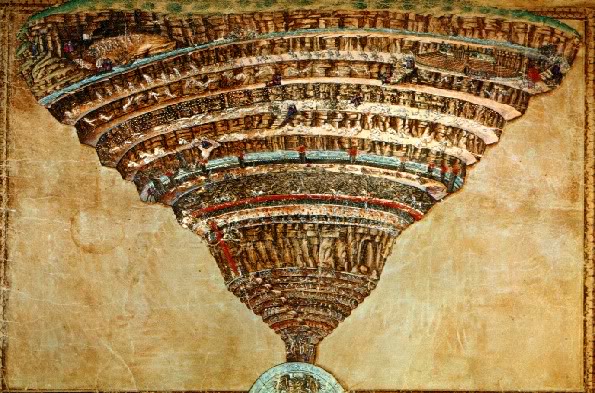
Botticellismapofdantesinferno

Hell, courtesy of Dante.

Last time I kept mentioning someone that I decided to call the Most Powerful Devil (MPD), without ever going any further into who or what that was.  But I’ve come up with more background for them since then, and in so doing I’ve also come up with more details for the game-world as a whole.

So, today I have a stupidly simple calendar (though I haven’t yet bothered to give the months names), I have a better idea of what the afterlife looks like (I’ve totally tossed out the basic alignment-based fare in favor of something a bit more complex), and I have a name and backstory for the Most Powerful Devil.  I think you’ll like this stuff. Continue reading

World Building: Magic, Demons, Angels, and Devils

Back in November I wrote about a new RPG campaign that I had cooked up, a game that I’ll refer to as For The King! for lack of a better name.  If you are currently playing in or are going to play in my 5th edition D&D campaign, you might want to be careful with reading this post.  If not, feel free to read this early-concept campaign overview.  I’ll avoid saying things here that could be too spoiler-y, but I plan to explore the nature of magic, demons, devils, and other such inimical forces.  Your character might or might not have access to this information.

Based on the first few sessions that I ran for my brothers, I already know that the setting allows for angels and fallen angels, though the latter are more like Remnants from In Nomine, powerful supernatural beings from other planes who have had some part of their greater nature stripped from them by intent or by accident.

Angels and their derivatives are all essentially moderately self-willed fragments of the god they serve, and might be thought of as something like having a god let its fingernail clippings (or maybe severed finger?) go off and do its bidding in the world.  A bit like some kind of overpowered intelligent celestial dandruff, I suppose.  But I don’t know off the top of my head how to make demons and devils work, and I don’t just want to sign on to the metaphysics presented in the 5th ed. Monster Manual without some editorial input.  I’d much rather doodle in the margins and make their setting fluff more thoroughly my own.  So read on for sweet lore! Continue reading

A Red and Pleasant Land: Old School RPGs through a Looking Glass

Processed with VSCOcam with f2 preset

My itinerant laser-show friend arrived unexpectedly this week, and as such it was immediately time to play RPGs.  He brought a copy of A Red and Pleasant Land, a Lewis Carroll inspired setting and rules supplement for the system Lamentations of the Flame Princess, and we all thought that this was so cool that we totally had to play it.  We got somewhat distracted by character creation because we’re a bunch of nerds and it’s fun coming up with details about our fictional selves, but I’m really looking forward to playing with these characters.

I can’t tell you that much about the game yet, since I haven’t really gotten much of a chance to play, but I can tell you this: Lamentations of the Flame Princess is a little bit like a more metal version of original DnD, and A Red and Pleasant Land is a far more metal version of Carroll’s visions, chock full of murder, bloodthirsty vampires, and wars.

If you like the idea of playing a stripped down and often lethal version of old-school Dungeons and Dragons, something that will force you to think your way out of your various predicaments (because your stat line and the game systems surely won’t save you), you should check out Lamentations.  If you like the idea of doing that in a fabulously lethal Wonderland, and possibly wandering the world as an Alice (yes, “the Alice” is a class, and from what I’ve seen she’s totally amazing), then you should check out A Red and Pleasant Land.

Ok, that’s enough for now, I’m afraid the time has come for me to go back to seeing my visiting friend before he disappears onto the road once more.

Flash Fiction: Robin’s Songs

Turdus-migratorius-002

Chuck Wendig has a blog called terribleminds, and on the 9th he posted a Flash Fiction challenge.  The prompt: write a 1000 word story about a character created by this random D&D character generator.  My prompt turned out to be a “suspicious half-elf bard from a sheltered upbringing who is lactose intolerant.”  I really had no idea how to work in lactose intolerance, but I think I’ve succeeded.  Check it out below the break!

***

Robin looked up from her book, absentmindedly pushing a strand of hair behind her gently pointed ear.  The little cluster of red feathers that she kept tied at the end of her hair rustled against her shoulder.  She gave the innkeeper a second-degree smile, the one the Enlightened Brethren had taught her to use for disarming the suspicions of others.

Continue reading

Tombs=Raided, Hearts=Won; Tomb Raider Rocks

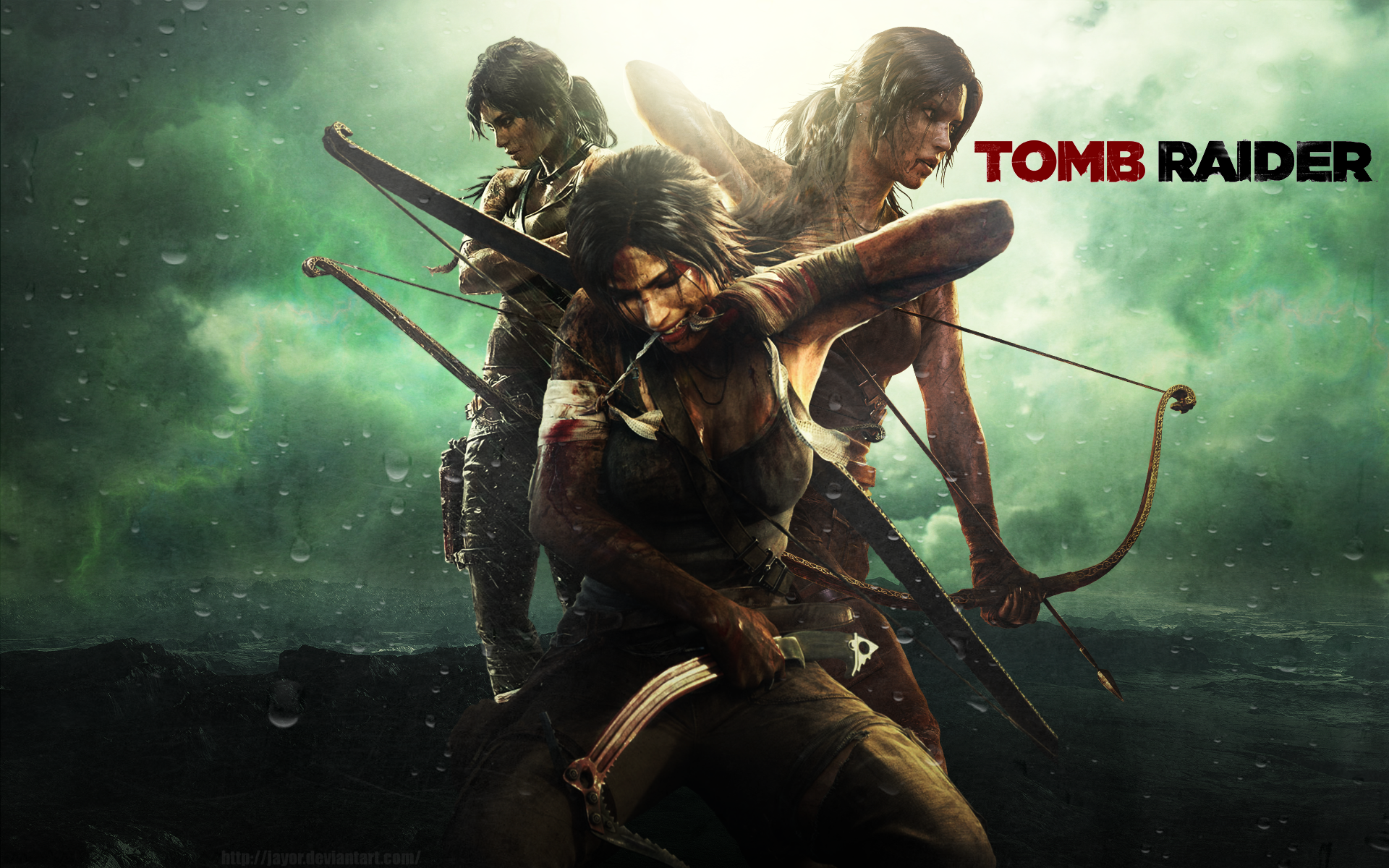
tomb-raider-5

I don’t usually wish that I paid more for a game.  But I liked Tomb Raider so much that I almost wish I hadn’t bought it on sale.  I want the people who made it to know how much I liked it, and I want them to put as much high-quality work into making the next one as they put into making this one.  Because there’s a next one.  I mean, even if I didn’t know that Rise of the Tomb Raider is coming, I wouldn’t have any real doubts (except, I suppose, if the studios involved fell apart or lost the rights, which would be terrible).  The end of Tomb Raider left it clear that Lara is nowhere near finished with being the awesome badass which she’s become, and that makes me very happy.  Watching the announcement trailer for the new game has reduced me to a quivering pile of enthusiasm.

Why am I so happy about all this?  Tomb Raider is a brilliant game, and does things with story-telling that remind me why games are such a fascinating medium in the first place.  It’s an adventure novel with audience participation, a new entry in a genre that I love, and it evades the problematic trappings that spoil so many other adventure stories for me.

Ok, spoil is a strong word.  I love adventure stories enough to enjoy them despite their frequent problems, but being able to enjoy one that isn’t so inherently problematic is a breath of fresh air.  It doesn’t hurt that this particular story is extremely well written, with characters who feel like real people, and who share history with each other that seems fitting and unforced.  It’s a little bit like someone crossed Tintin with Indiana Jones, turned the tone dial to ‘gritty and a bit bloodthirsty,’ and then put you through the Bildungsroman of Lara Croft as she goes from untested and unconfident archaeologist to self-assured and competent survivor and adventurer, hellbent on keeping herself and her friends alive.  Wait, no, that’s almost exactly what it’s like.  It’s glorious.

Look, you don’t have to take my word for it.  You can play the game yourself.  But if you want to read more of my thoughts on the topic, including the few reservations I have, please be my guest:  Continue reading

Godseat, a Wayfinder Adventure

logo

I should note, I have no idea whether or not this game will actually be chosen for use by Wayfinder.  In fact, I still have to finish writing it and submitting it.  I think it’s a pretty cool concept, and it experiments further with some of the player vs. player mechanics that I explored in the 2014 Staff game (along with my excellent co-writers, you rock).  In the interest of not spoiling you for anything, I’ll refrain from telling you too much about the flow of game.  Instead, this post will give you a brief overview of the setting and what the game is all about.

A Brief History

There are many gods and godlings, but there is only one Most-High.  The Most-High reigns over all from the Godseat, the Throne of Supremacy, the Seat of Knowledge, the Bringer of Good Tidings and Ill News.  Whichever being sits upon the Godseat is acknowledged as the ruler of all, but no one being can sit upon the Throne forever.  The prayers of faithful worshippers, and their propitiations, may sometimes elevate a new being to the Godseat, replacing the previous Most-High and beginning a new reign.  There are some times, perhaps once or twice a decade, when the cycles of the moon and the stars and the seasons coincide just so, when the prayers and rituals of worshippers take on special power in the area around the Godseat; these times are known as the Nights of Ascension.

Long ago, before the Years of Ruin, Continue reading

Pairs

1b146dada8c37f3154b556bb7a195dfd_large

There’s something brilliantly simple about Pairs.  This is probably because it’s a very well designed pub game, from the experienced designers at Cheapass Games.  Pairs is in some ways a departure from the style of their other games, but it shows their collected experience: it’s a snappy game with simple rules that pushes you to go big or go home and gives you quick excitement with good replay value.  It rewards you for smart play, yet it’s just random enough to make flirting with risk a rewarding experience, especially when you can force your fellow players into even riskier territory.  Succeeding in Pairs means balancing your untenable position with your knowledge of the deck and the mental states of your fellow players, and somehow staying in just long enough for someone else to crash and burn first.

While the composition of the game’s deck is very easy to understand (there are ten 10’s, nine 9’s, eight 8’s… all the way down to two 2’s and one 1), counting cards has been actively discouraged by means of a few careful tweaks: each deal starts with five cards being dealt off the top of the deck into a burn pile, all cards removed from play during the game are discarded face down into the burn pile, and a cut card is used to cover the bottom of the deck in order to restrict player knowledge.  Players gain points (a bad thing) when they are dealt a card matching a card they already have in their hand, and all players play with open hands.  Points are tracked by leaving cards you’ve scored visible in front of you, separate from your hand.  Because of how the deck is constructed, you have a roughly 50-50 chance of being dealt an 8, 9, or 10, limiting the amount of time that you can last in any given round.  But it’s possible to fold before you are forced to take points, scoring any one card in play instead of risking being dealt a higher value pair.  The moment you score, regardless of how you do it, you discard whatever remains of your hand.  This means that by folding you to both avoid taking a high value card (e.g. by having a matching 10 dealt to your hand), and deprive other players of opportunities to score low-value cards (either from your hand, or from whatever you picked elsewhere in play).  In play, this means that players’ turns cycle quickly around the table as players choose to either fold, accepting that they will take some points, or hit, accepting risk for the chance of taking no points at all.

Once you’ve taken points and your hand has been emptied, you check to see whether your score has passed the threshold set for your number of players (31 for two players, 21 for three, [or 60/(number of players) + 1, with a minimum of 11 for 6 or more players]).  If you haven’t lost, play continues and you are dealt in once again starting with your next turn, while you hope desperately that someone else will lose before the game gets back around to you.

All in all, rapid and easy play combine with just enough chance to make Pairs an excellent game for laughing at your friends.  If you’re looking for more easy pickup games or pub games, check it out and enjoy scrabbling to take as few points as possible while everyone else does the same.

Cooperative Fireworks Puzzles: Hanabi

hanabi_banner_620x3501

Try this: set off a totally awesome fireworks show without every being able to look at your own hands, relying instead on what your friends tell you about what your hands are doing..  I can’t say that Hanabi is exactly that in game form, but it does a good job of approximating it.  It’s can be difficult, but that very difficulty also makes it rewarding.  Sometimes, of course, you misunderstand what others are telling you and everything blows up in your face.  Read on for more detail.

Continue reading