For those of you out there already aware of Monaco and its rave reviews, this will be very familiar. If you haven’t yet read those reviews, they’re right. At least, the ones that refer to Monaco as delightful and occasionally vindictive are. It’s a wonderful heist game that — as you keep taking — just keeps on giving. I haven’t yet finished the game, and I anticipate many more hours with it.
Category Archives: Games
Game Analysis: Great Gatsby for NES

It has been a good long while since I’ve read The Great Gatsby, but I’m fairly sure that The Great Gatsby for NES does not truly reflect the novel in any way outside of its cutscenes and aesthetic. It’s built just like any old platformer where it tells you the controls, but doesn’t tell you anything about the game world (though the controls are not displayed in-game). It’s really short, so there isn’t all that much to actually comment on, but I found it enjoyable and worth a playthrough. The lack of a pause button means it’s sort of an all-in adventure, but due to its short length that’s actually not that awful.
The one thing I will comment on is how I think it did a poor job of educating the player on how to fight the first boss. Your attack (throwing a hat) operates as a sort of player-seeking boomerang. The first boss is most easily defeated through the use of this mechanic by throwing the hat and then jumping up near the boss, but there is a problem: the game doesn’t really present this to you as something important to practice until the boss fight. Just about every enemy you encounter can be dealt with by just throwing the hat straight at them, which then also makes it bounce straight back to you. The range on the default hat (there is a yellow hat power-up) is also extremely short, so there isn’t much opportunity to alter its trajectory. On top of that the screen is actually rather thin, and since it tracks the player avatar (keeps it in the center) the short attack range of the default hat ends up being almost equal to your field of vision. This makes it so you can’t really prepare for enemies by throwing out long shots, which also means that there isn’t much time to play with hat trajectory. The issues of range/sight combined with how just throwing straight is all you need means the player likely won’t discover and develop the technique(s) required to manipulate the hat projectile in the first boss fight until that very boss fight. Developing the skill required to defeat the boss is also rather unsatisfying as it never comes up again and the rest of the game can pretty much be played as before (throwing straight shots).
But I’m willing to look past this flaw because of just how classy the game is. Or maybe it’s because I drank a martini every time I grabbed up a martini power-up…

Horror and Predetermined Outcomes
In my article on how I run a game, I mentioned that there are specific genres in which I’ll sometimes accept predetermined outcomes. I’ve most often experienced this in horror games, where both the players and the PCs know that there will be certain terrible things that happen, regardless of the actions taken by the PCs. But why does this work? How could any player enjoy knowing that their terrible doom approaches?
Training Exercise
Ultimately, roleplaying is a game of imagination and improvisation. Some people find that they have trouble with these faculties. I feel forced to credit my own proficiency in these areas to a number of games I played as a kid, and still occasionally play, as well as a few hobbies of mine. I think it should come to no surprise that most roleplayers are also writers or actors; in fact, I noted the similarity between the three media in previous articles, and many actors are famously in support of D&D/credit it with stimulating their mind.
Continue reading
Putting Power in Players’ Paws

Ok, so your players probably have hands, not paws, but I liked the alliteration.
The traditional roleplaying game, D&D, is very much structured in a specific way: the GM has a specific game/plot/monster that the players have to beat. In this way, D&D is structured much like a computer RPG, it just happens to be played with multiple players (and so can Baldur’s Gate 2, not to mention World of Warcraft).
There is value to this model; if you have one GM who is particularly good at plotting stories and taking care of all of the details of the world, and a lot of players without a knack for world-building, well, why not run a game like this? Labor gets divided up appropriately, and everybody gets to do what they’re good at.
Typically, however, everybody has something to offer to the story if given the chance, and 4 minds can probably come up with better ideas overall than just 1. This is why, typically (especially if I really trust the players), I prefer to run games that are much more player-driven. For me, good player-driven systems are those which have narrative elements built into them. The most obvious examples would be any game with a Fate point system. Such systems tend to give fate points to the player, and they can narrate something about the world that is unlikely but still possible by expending a Fate point. However, for me, the pinnacle of player-driven games is Apocalypse World. I understand that there are MORE player-driven games, but I find that the lack of a solid authority in completely player-driven games tends to leave most people feeling unsatisfied. Apocalypse World is the perfect balance: it lets the players help create the world and orient the plot, but doesn’t give them too much power to determine results.
Player Action, Player Inaction
I have often focused too narrowly on what will happen when the players follow the trails that I have laid out for them. But what do you do when the players don’t want to play with any of the plot you’ve got prepared for them? And what happens with the problems that they’re ignoring?
Mechanics Guiding Playstyle
Earlier, I discussed how certain roleplaying systems exemplified certain gaming orientations. To an extent, this is a very peculiar notion. More specifically, it’s a very basic shorthand. After all, mechanics can never force your actions. But the way mechanics are set up can really impact the way the players think about the game.
Design Elements in Horror: SCP Containment Breach
I’ve never particularly been a fan of horror games; they don’t weird me out, they don’t make me feel gross, and they don’t frighten me. Amnesia, Slenderman, FEAR, they’ve all struck me as sort of disappointing. They have occasional moments of “OH SHIT SOMETHING JUST HAPPENED!” followed by a lot of feeling in control. But I played one game recently which left me with a unique sense of both horror and dread I’ve never felt playing a game before. That game was SCP Containment Breach.
Warning: this whole post contains minor spoilers of the first 15 minutes (and the basic concept) of the game.
Here are some videos of me playing SCP: Containment Breach
Lessons I’ve Learned about Naming NPCs
Names are hard. You want to make sure that the people and places you’re creating sound believable, and you don’t want to keep repeating the same things over and over (unless there’s a name like Michael in your game world, in which case you should probably just name everyone that since that’s how it works in real life). I’ve made and seen some pretty funny mistakes with naming things, so here are a few of the things I’ve learned…
Types of Games
In my last post, I talked a lot about what roleplaying is, and – surprise! – it wasn’t just one thing! That is part of the beauty of roleplaying, it’s full of options. What are these options?
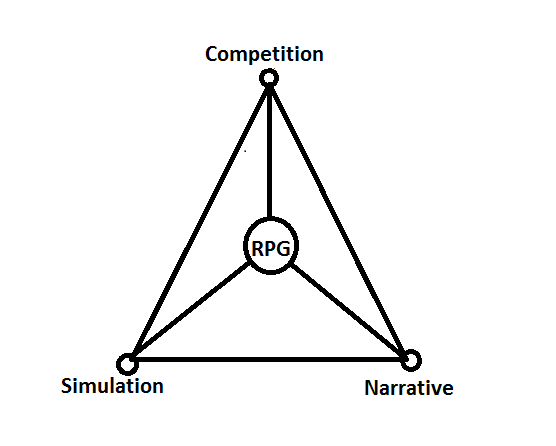
Well, first, we have the three qualities talked about before:
Roleplaying, Storytelling, Mechanics. To keep in line with the existing literature on Gaming Theory, I have slightly renamed the categories I used in the previous post. I have renamed ‘Mechanics’ as ‘Competition’ (it goes by ‘gaming’ in GNS Theory, but I find that to be a bit ambiguous of a term); it essentially refers to how much of the experience of the game is rooted in competition. Storytelling will be referred to as ‘Narrative’, and Roleplaying will be expanded slightly to ‘Simulation’. Simulation refers to how much of the setting goes to recreating system-internal realism. Note that this realism does NOT have to be actual realism. For example, many unrealistic things happen in Star Wars, but there is an assumed set of rules which governs things like lightsabers. Any given game will have a balance of the three, like so:
 Fistful of Wits