Circles of Belief, Quick Thoughts

I first heard the phrase “circle of belief” as a young teen, and have found it to be a useful mental model ever since. I thought I’d written about it here before, and was wrong. While looking for other sourcing for this post I found a lot of Slayer lyrics and not much else, so… here goes.

Someone’s circle of belief governs what they see as plausible, something they can follow along with, versus what they see as implausible or alien. There’s a lot of overlap with genre expectations or something similar, but they’re not quite the same. The key is that everyone has a circle of belief for any given context. When I’m trying to shape someone’s circle of belief I’m not trying to alter their genre expectations writ large—just their specific assumptions for a given story or game.

Note: this is more or less how propaganda and political messaging works. Here, though, I’m going to focus on fun fiction and story games.

Expected and accepted elements exist inside the circle of belief—they do not require any additional suspension of disbelief from the audience. Working inside a circle of belief is relatively low effort. Inside the circle of belief, you don’t have to convince the audience to agree with you. You don’t risk alienating your audience by including an element that doesn’t fit. Breaking an established circle of belief, however, may push someone out of the story.

When reading a fantasy story, elements like dwarves and elves probably fit inside most people’s circle of belief, while giant killer robots probably don’t. Similarly, a sober spy novel has lots of room within most readers’ circles of belief for skullduggery and betrayal. But if that spy story suddenly featured a goblin going on air and declaring herself a prophet, that might break the audience’s circle of belief and create cognitive dissonance. That cognitive dissonance can lead to confusion and disenchantment. Breaking the circle of belief can break audience members’ emotional investment in a story or their suspension of disbelief,  and a story which had been fun could become too bizarre to enjoy.

This isn’t to say that those examples above would be inherently bad stories. Each of those examples could exist and be done well. The audience’s circle of belief could be shaped to include them. But shaping that circle of belief requires specific work, and it takes more work the further the new circle of belief is from the audience’s existing circles of belief.

That work could involve carefully laying out clues and hints before some surprise reveal, a genre twist. Alternately, that work could require laying out the future story elements as early and blatantly as possible to prepare the audience for later. Tropes and foreshadowing, for example, offer more options for manipulating circles of belief—as does marketing copy. If I describe a story as “Harry Potter but ___,” the audience will probably assume they know large chunks of what to expect.

Each person’s expectations will be a little different, of course. Everyone has their own circles of belief.

In many ways, this laying-out-the-elements is what worldbuilding is about. Every little detail can build context for the larger story, and thereby shape the audience’s expectations. But it’s easiest to do this work at the very start of a story. That’s because, in general, the longer a given circle of belief remains static the more work you must do to change it.

In RPGs, and any time that you’re in a shared narrative space, it’s important to know what is inside and what is outside of your fellow players’ circles of belief. That could be for the structure of the game itself: I might assume that my character could die, or that the storyteller is my adversary, while someone else might assume that we’re playing a collaborative narrative game. It could also be for the fiction within the game: I presume that we’re playing a hard fantasy game, while the storyteller thinks this is a magical post-apocalypse full of the ruins of ancient civilizations. These assumptions aren’t all incompatible with each other, but you can probably see how they might cause trouble if unaddressed.

 The simplest way to handle this is to talk about the story elements everyone wants to play with (or avoid) before you play. You can also check back in about these things, and see whether there are any pieces people want to add or remove after any given session. I recommend checking in every once in a while. You’re less likely to be unhappily surprised that way, and more likely to make stories that everyone finds fun.
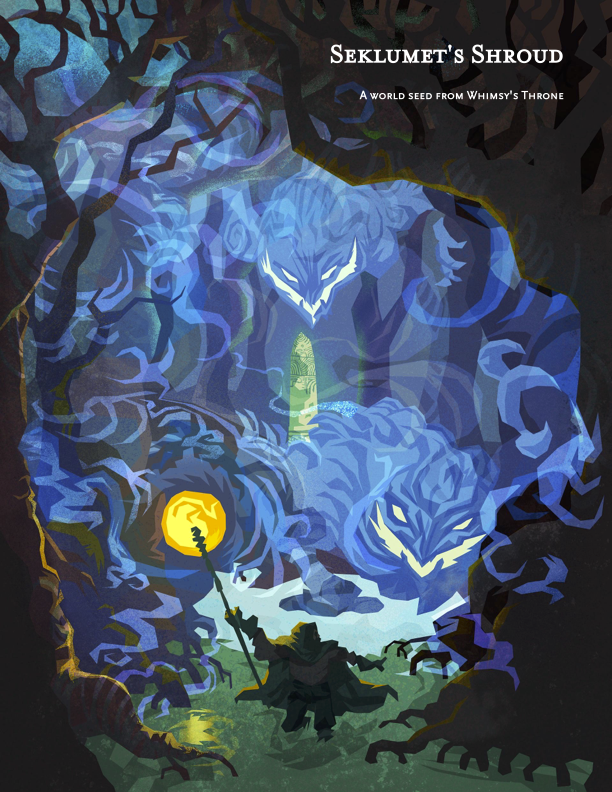
Whimsy’s Throne is live on DriveThruRPG!

You can find the first two World Seeds here. If you read and enjoy these World Seeds, please leave a positive review. That would mean a lot to me.

My goal, as I said a little while back, is to continue producing these Seeds for the foreseeable future. If you’d like to see the process in action, learn about how I’ve repeatedly edited out half—or even two-thirds—of the words in a piece, or see the art as it moves from concept to completion, you can do that at Whimsy’s Throne.

There’s still more to do, of course. I want to find another artist to work with next—if you make art, and would be willing to make something like what you can see in those Seeds for $400, let me know. I also want to have more legible covers for the DriveThruRPG store, which will require some tinkering.

And I’m trying to figure out where in the World Seeds (and how) to add a reference to Ginny Di’s video about advice she struggled with as a novice GM. I want these World Seeds to be as accessible as possible, to engage people in as many ways as possible (hence having both art and words). And while I can’t address the audio-preferred crowd very well in my pdfs, I can share videos that fill that gap. And I think her video has a usefully different approach to a lot of the advice my World Seeds give or imply.

It’s not advice that veteran storytellers are likely to need, but these World Seeds are supposed to be accessible to storytellers of all skill levels (ideally without feeling pedantic and overbearing). And while you could (and likely would) reach her conclusion by reading lots of material from The Alexandrian (like this, or this), I think she does a good job of saying it fairly concisely… and in a way that some GMs might understand more readily. I don’t know whether I want to expand World Seeds into a broader “RPG education” tool, or whether I want to do that in some other format, but I keep finding tidbits to add because I want these World Seeds to be a complete package for people at any level of comfort and confidence with storytelling.

Next week I might miss a post, as I’ll be traveling. I’ll be back before too long though. You should see me here again the week after.

World Seeds, Whimsy’s Throne, DriveThruRPG

I’ve made a DriveThruRPG storefront for my World Seeds project (see Whimsy’s Throne for details). I’ll link to that after I’ve uploaded my first Seeds. I knew this step was coming, once I had another finished Seed ready for publication. And now I’m dealing with the intricacies of posting content on DriveThruRPG while trying to figure out how to optimize the PDFs I’ve made for general distribution. I don’t want to publish content that immediately breaks when a stranger tries to open it, after all.

Unfortunately for me, I also don’t want to optimize my published content such that the art turns fuzzy and indistinct. This might be an issue.

My next steps are to upload the two World Seeds I have thus far. I’m making one available for free, and one for cash. Then I need to find another artist I like working with. Meanwhile, I’ll keep chugging along: writing more rough location descriptions and expanding existing descriptions into full-fledged Seeds.

My goal with this project has always been to produce a bunch of these things. And I want them to have notably distinct art styles for each Seed, for the most part. If I can have different artists bringing distinct styles (or experimenting with styles that are new to them), that’s perfect. I’m happy to do repeat work with artists, of course—I’ve really enjoyed collaborating with the artists I’ve worked with so far. I look forward to working with them again—I just don’t want the Seeds to be tied to only one style. The more variations, the merrier.

My hope is that I can have a varied body of artwork and styles reminiscent of the huge variety that was present in early 90’s Magic: the Gathering art. That’s what I grew up with. And while some of it was bad, I loved the way I could find so many totally novel art styles in the same game. During the 00’s MtG homogenized their style significantly, allowing some variation between sets but building a unified “house style.” While I can see how that makes sense for a company managing such a large quantity of content (and a company concerned with consistency in its artistic brand), I feel like MtG lost something when they stopped having such significant variation in artistic style from one card to the next. The individuality and experimentation faded away.

Given that I’m trying to build a product that engages people on as many levels as I can, and which appeals to as broad a group as possible, I feel like changing up art from one Seed to the next is my best option. If someone hates one art style, maybe they’ll love a different one and pick up that Seed. The dream would be for people to love and use every World Seed, but I’ll absolutely settle for catching people’s eye with a few different options.

Worldbuilding: Ephemera & Epigraphs

Reading The Butchering Art, with its record of snarky arguments in medical journals, gave me an idea.

The setting for my stories about Miska, along with all the various Andre & Jerome stories I have, is a complicated one. It’s big, in-depth, and just enough like our own world that it regularly leaves people guessing when I try to explain it. Perhaps I should try to simplify some of the setting, but… I think the perverse complexity and deep similarities to our own world are what makes the setting engaging and exciting. It’s a what-if, a thought experiment, and a sometimes-grim sometimes-hopeful social commentary.

Part of the similarity is in geography and place names. That’s the thing that trips up folk the most, I think, and the thing I’ve considered rewriting time and again. The world is—mostly—our own. The continents are mostly the continents we would recognize from our own Earth. As such, I have regularly used our own world’s historical names for cities that match up with a city’s location in this setting (e.g. Paris and Marseille). At times, when I’m trying to convey that there’s something distinct from our own world, our own expectations, I change a city’s name (as I’ve done with most bodies of water). But I know that’s confused readers even more, at times.

It doesn’t help that I’m not totally consistent about it, or haven’t always settled on names for some places.

But those shifted names still don’t address the shift in social conventions, or the difference in histories. Explaining why I’m using some of our own world’s city names doesn’t give a reader any understanding of the detailed history of this alternate Earth. In some ways, I think it actually makes understanding the setting harder for readers—which wasn’t my goal at all.

Enter my flash of inspiration.

The snarky medical journal arguments presented in The Butchering Art conveyed so much more than their surface disagreements. They served as a touchstone for the culture of the time, and they contained such startling similarity to modern academic sniping—and comment section flame wars—that I immediately felt like I had a better connection to, a better read on the world depicted by the book.

So I started writing in-setting documents for this world. Some were the stiffly polite and horribly condescending disagreements of people writing to various society papers’ opinion sections. Another was an excerpt from a personal letter between two people involved in city politics and what might be called clandestine activity. Every so often I have another idea and try it out.

With this, I think I’ve finally found the way to give readers a window into the setting. This material can preface some chapters or stories, or serve as introduction to a section of a book. What I’ve written so far feels clunky as an epigraph, but I think this can finally give enough context to ease readers into the world. Better yet, I can showcase in-setting struggles and disagreements, political squabbles, and personal opinions. I can reveal information that some of the characters might know, or comment on at some point. And, I hope, I can do some of the world-building work that would otherwise clog the rest of my story with exposition.

So here, enjoy the first idea that came to me a while back. It won’t be nearly enough on its own to show you all of this setting, but maybe you can enjoy peering in through the cracks.

***

Letter on the latest troubles of the Inner Sea, to the editor of The Parisian, first and finest of the continental ladies’ magazines

Regarding the recent abuse levied against the fine Doctor Gilarien of our daughter-city Marseille, this writer must protest heartily. It is by no means sensible for any to wage too harsh a battle against the natural allies of our fine city, and this is precisely what La Fleur du Sucre proposes to do. Our daughter-city—along with her denizens—is our responsibility to protect and guide, and the true proof of Parisian majesty will be evident in the beauty, grace, intellect and fortitude of her daughters in the face of the dangers of the world. Certainly I would hope that La Fleur du Sucre would not be the type of mother who so admonishes and smothers her children that they never learn to fly from the nest of their own accord. No, what is needed here is not chastising whip-tongue remonstrations, but rather the gentle guidance and support of a mother for her child. We may prune back ill-reason and train the growing limb of intellect to our trellis where we know it will be healthy and bear fruit.

The estimable Doctor Gilarien is entirely correct that our city’s agents operating as they are, along the coast of the Inner Sea, have brought forth suffering amongst the many tribes present there. But the good doctor must recall that these tribes have long allied themselves with the Ones to the East, the very same who sought to maintain “Enlightened” dominion over all of us despite the wishes of the Good Masters. Given these tribes’ warlike disposition and their frequent exercises upon the borders of our allies, it would be insufferable for us to not interrupt their works, lest they grow too numerous and powerful and form once more the armies that they once were. For let us not forget that those selfsame tribes, the ones the good doctor feels such concern for, were once the engines of destruction which drove the burning of Köln, Rotterdam, and even our lovely Paris. Thus it is that one would do well to balance the—admirable, and well-reasoned!—concern for innocent life made more difficult by our own actions, against the cost of allowing such hostile forces to regain their strength and organization to rampage across our continent once again. This writer is entirely certain that the good doctor will agree that the actions of Paris and her agents must, in the greater balance, come out the lighter price to pay.

As to the fine doctor’s points with regards to the treatment of the prisoners of war captured amidst the strife along the Inner Sea, this writer must surrender to their local experience and expertise. It is the doctor’s knowledge of the prisoners’ circumstances which must, clearly, take precedence here, and La Fleur du Sucre would do well to recall that one’s daughters will only grow into their own skills of reason if they are trusted to observe and report their own findings in all earnestness, and assess proper courses of action from there on—with their mother’s guiding hand, of course. Therefore to the doctor this writer suggests that it would be to everyone’s benefit if some documentation could be made of the present circumstances of the prisoners during their transportation. There is no course by which the transportation may be stopped—it would not do to domicile prisoners too near the fighting, nor to leave them anywhere they might escape unsupervised, and as such the verdant gardens of the New Sea must be the best solution—but perhaps the transportation might be made less onerous and perilous to those transported. Certainly there is no need to torture, as the good doctor would have it, those who have surrendered or otherwise been captured. After all, these vanquished foes are not insensate beasts, but merely the doughty and fearsome battle cadre bred and trained from birth to serve in the Enlightened Ones’ armies.

Lastly, this writer must commend the good doctor’s dedication to the ethics of the profession; surely the doctor’s presence in this world is of considerable value to all, and a guiding light for all others of the daughter-city who might seek the health and well-being of their fellows. If this writer lacks any merest atom of knowledge of the arts of medicine, may it nevertheless be that this writer is able to remind the fine doctor of Marseille to think beyond the simpler personal suffering of a vanquished few and to encompass the greater wellbeing of free civilization upon the continent without the dominion of those who once held us all in bondage. It would be a foul sickness indeed were we to squander the freedom granted us by the Good Masters, and fought for by our ancestors, by failing to protect it from the encroachments of those who may wish us ill.

With love and kindness,

A Parisian Mother

The Tower of Péng the Unprepared, and Whimsy’s Throne

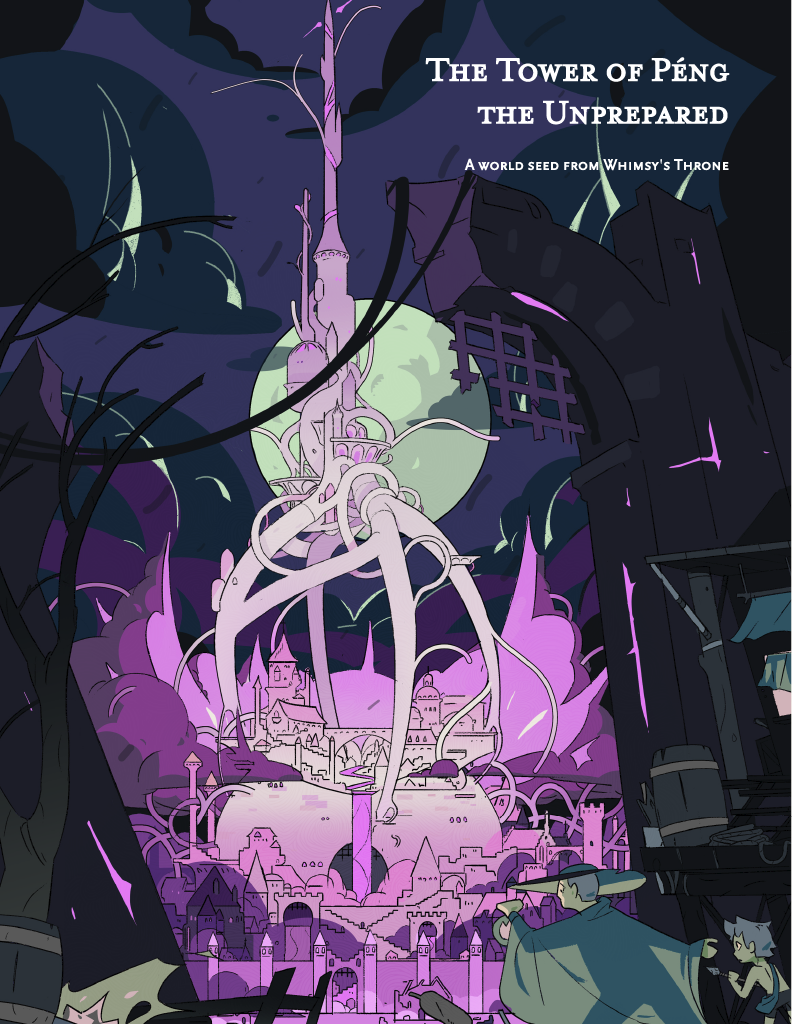
I’ve started a Patreon for the Locations that keep coming to me! You can find it here, at Whimsy’s Throne. There’s a free version of my first finished World Seed there, The Tower of Péng the Unprepared. Here’s the cover art, from my friend Worsey.

The Ruins of Ghalburg

Nestled in foothills between the high peaks of the Sefghal Range, the lonely ruins of Ghalburg are only kept company by the wreckage of Ghalburg Keep on the slopes above. Though the burgeoning town was once known as a welcome stop on the way through the mountains, it has been shattered, pulled apart stone from stone, vast swathes of it put to the torch. Here and there, once-mighty timbers still stand as charred skeletons of formerly sturdy homes, memorials to their missing inhabitants.

The keep, perched in the hills above the town, is no less desolate. While it was spared from the same vast devastation, it still was broken open like a raw egg, its innards tumbling down the hill towards the town. The outer curtain wall was shattered in several places, and one whole corner of the central keep is gone, strewn across the grounds and out of the bailey. Like the town below, all the keep’s defenders are missing. No bodies remain to be found in any of the wreckage.

Now, this ruined settlement lies as a fearsome warning and an unanswered mystery. What force laid waste to the castle and its town? Was it some unknown group of raiders from the steep, storm-wracked peaks above? Or did Baroness Ghal set this horror in motion with untoward experiments in her obsessive effort to resurrect her family’s fortunes? Rumors abound, but no story yet bears the imprimatur of truth. The only certain thing is that none of the town’s residents have been seen or heard from since, and travelers through the region now avoid the once-popular town like the plague.

The Lonely House

Nestled in the shadows of the trees, a small hut sits neglected and lonely. Fieldstone walls open around a squat doorway, a lintel of old timber splintering across its top. The door itself sags on cracking leather hinges, drags across the dirt when opened, and its ancient boards creak back and forth in the wind. Like the rest of the house, the roof has seen better days; the thatch has mildewed, and tufts have been lifted up by breezes and small animals until they stick out like recalcitrant cowlicks. What was once a window is now simply a gaping wound, and the hut is dark and musty within. It is not an inviting place.

But more than a few have sheltered there, nestled amongst the tired and rotten furniture within while a storm rages without. Most who do seek shelter move on as soon as their storm passes, thinking nothing of the sad little house someone put so much effort into making many years before. But others, whether because the world outside has been buried in snow, or because a more metaphorical storm of villains still hunts them, make themselves at home. And it’s these people who begin to learn the truth of the place: settling in, fixing small things around the home, replacing what one has used or storing more than one has found… this invites offerings from the house. Sometimes that means dry firewood in a previously covered basket, or the woodworking tools needed to fix a broken stool. At other times, it may mean the clucking of a hen brooding over her eggs out back, or a stand of improbably ripe grain in a clearing amongst the trees nearby. Indeed, the house often offers food, though any food inside the house may disappear, clearly eaten without any trace of whoever ate it. Cautious guests are sure to always make leftovers for someone else, whoever they may be.

There are stories of those who’ve lived comfortably in the small house for a month, giving over their time to repairs and little improvements, making it a better place to live as they clean it and fix its broken pieces. Those who live there for so long often grow nervous, eventually. The house offers up pieces of itself, places which should not have been missed before, until no one can pretend that the house is anything but magic. Some tales of the house swear that doors appear behind fusty old blankets, leading into well-appointed rooms too large for the hut’s exterior, while others speak of finding an old well-stocked root cellar full of marvelously preserved supplies. These new spaces are never as decrepit, but still they exude a lingering age and neglect, as though they yearn for the care of a meticulous and indefatigable housekeeper. Most who live there for long enough to find those spaces lose their nerve, leaving the house as graciously as they can, swearing out loud to whatever spirits of the place may listen that they mean neither harm nor disrespect but simply must be on their way.

Perhaps this is because people who are offered more by the house than they return, or who do harm to what they find, discover things going missing. Belongings they brought with them may vanish—and where once the house replaced such things with objects of higher quality and greater craft, now their things are simply gone. Rooms and passages they’d grown used to using may disappear, along with all their contents, only perhaps found again through diligent work and careful repairs.

There are horror stories shared by some, of people trapped inside the house. These ungrateful guests find their doors no longer lead outside, nor to anywhere else that makes sense. There are whispers of those who’ve fled through the house as though it were a vast mansion, but each chamber behind them disappears as soon as they’ve left it without even leaving a door… until the ungrateful guests themselves vanish without a trace, a small meal for the hungry house.

Of course, those stories couldn’t be true; no teller with first hand knowledge could have escaped to share them. But the little hut remains, lonely or hungry or both, shelter for weary travelers and wary prey, offering hospitality of some strange kind to any who show they’ll be good guests.

Tel’s Spring

On a small mountain rising out of the rain forest, nestled in an opening amidst thick-trunked gray-brown trees wreathed in lianas, a cool dark pond bubbles up from the rock below. Barely convex with the force of its spring, the pool does not reflect the light of the sky overhead, only the undersides of trees’ leaves. When rain falls, as it does every afternoon of the wet season, the sky’s water slides off the quietly bubbling spring and seeps into the rocky earth around it. It is only in those moments, when that thin sheet of sky-water oozes away across the pool like oil, that one may see the gray clouds or spotty blues of the sky overhead reflected on the pool.

The spring’s water is uniformly cold to the touch. Soothing on a hot day, local animals sometimes swim in it, never fighting while sharing the spring’s waters. Indeed, the local wildlife is larger, healthier, and more frequently docile than others of their kind. But a careful observer will note that no animal drinks more than a single sip from the pool on any visit, preferring instead to dip themselves in the spring without drinking from it. But the trees around the spring, watered by it, grow strong and tall. And these local animals eat freely from the small fruits hanging on those thick-trunked trees, casting seeds far and wide.

The spring is reputed to belong to the jealous god of life, growth, and small beginnings, a formidable being who is not to be trifled with, taken for granted, or scorned. The story goes that anyone who drinks too fully from the spring offers themselves to this god of life, Tel, and invites Tel to work through them. Often, the story ends with an incautious and thirsty person clutching at their mouth in horror as mushrooms erupt from their skin and a small fruit tree with glistening gray-brown bark roots down through their feet and branches up through their skull. So it is that the spring is held to be both sacred and dangerous, a place to be venerated and, for the most part, avoided.

There are exceptions, of course. There are stories of some few more-favored by Tel who drank deeply from the spring and were blessed without becoming trees. And the people who hold the spring as holy do visit at certain times of year, as new growth burgeons and as seeds are sown, to make offerings and perform the rituals known to be pleasing to Tel. Those who are coming of age are bid to take one sip from the spring during these rites, in hopes of long and fruitful lives, while those whose limbs have been wounded, withered, or warped may sip in hopes that Tel will guide their limbs once more. But apart from these times, the spring is left alone on its mountaintop, a world apart from its surroundings, its strange reflections and turbulence unexamined and untouched.

The Softest Road

Beneath the kindest branches of the go-now trees, ushered on by a warm wind now at one’s back, now easing the sweat from one’s brow, the most fortunate travelers wander on the Softest Road. It is not, it’s said, a route any may find by hunting it. It is rumored to be the least helpful road of all: only those who wander without urgent need may find it, and only those who continue on their path without worry may enjoy it. The focus and drive to seek a place, to rush from here to there, will lead any traveler on the Softest Road away from the giving earth which springs beneath their feet to deposit them on the hard and rocky dirt with no way to return. Those who stumble off the Road can find no path behind them, no hint of the Road they had just trod.

In fact, the only way to seek the Softest Road or remain upon it is to lose oneself in the enjoyment of one’s journey. Those who fall into a beautiful day’s travel, who marvel at the wonders around them and give in to the enjoyment of their surroundings, may find the ground beneath their feet shifting one step at a time, the land before them coaxing itself into a more even semblance of good footing and gentle travel. Slight slopes gain even grades and good gravel. Steep ones have regular steps, seemingly natural stones set perfectly for the walker’s gait. Dust never rises from the Softest Road, never choking and cloying, never thickening to sodden mud. Traffic, such as it is, is infrequent and rarely hostile. Beautiful vistas open themselves to the viewer on either side (or both) as the Softest Road meanders through gorgeous dells and sunny copses.

Trips which should have taken weeks may only require days on the Softest Road, though any given day’s travel might see one deposited early in a new place apart from one’s final destination, if the traveler gives over to dwelling on time or anything besides the joy of the journey. And there are stories of the opposite, of those who find themselves on the Softest Road for weeks when a trip should have taken an afternoon, too entranced by the marvel and relaxation of such perfect walking to find their way out.

There are stories of those who’ve found impossible places on their journeys on the Softest Road, visions of worlds unknown, of improbable structures and fabulous landscapes and even vast star-dotted emptiness. None know whether such places might be reachable, or found again, for none who’ve left the Road in their urgency to explore such have returned—at least, none who might be believed.

If nothing else, it is a certainty that the Softest Road does not traverse the space between two places. Those on the road are not seen by those off of it, except perhaps as momentary glimpses of travelers in strange places: striding upon high cliffs, stepping from tree to tree, or emerging from vast waters. The longer one walks the Softest Road, the further afield one may go and the stranger the things one may see.

It is not known who made the Softest Road, or if it was ever made at all. Perhaps it is simply some diffuse spirit of the vast universe finding its way to share with those amidst it. There are stories, tall tales told of some few who learned to find the Softest Road in one step; these folk strode without a care or a worry, passing from place to place in a joyous wandering, never staying long. They brought with them bizarre myths and ancient legends, and left behind them little relics of other lands before stepping out again never to return. Some say they’ve learned the trick of it too, but even these folk may lose their way from time to time, becoming too attached to a desire to truly live the aimless, wondering, wandering way of the Softest Road.

The Crystal Glade

The delicate traceries of crystalline trees rise from the glass-covered loam of an ancient forest. They glimmer, refracting sunlight until it dances across the earth around them, shimmering in their vitreous leaves. It is dangerous to walk among the trees with eyes or skin uncovered: many have been blinded by the brightness of the Stone Trees or burned when a leaf’s lens seared their flesh, and the fine-crushed debris of last year’s leaves will shred its way through any foot. On still and sunny days, the land around the Stone Trees smokes and bakes. On windy ones, the rainbows they cast dance.

Meditating in the heart of the Stone Trees’ glade is both a rite of passage and a form of augury for the wise ones of the local people. These practitioners say that the most potent prognostications are revealed beneath the sun’s brightest light, but they caution against the casual pursuit of such knowledge—the Sun-of-the-Trees can take as quickly as it gives, and more than one would-be oracle has fumbled their way out from the Stone Trees blind, bleeding from their dreadful stumbling.

The blood they leave behind soon disappears.

Near the edge of the Stone Trees, the glassine sheets of sloughed crystalline bark lie heavy and still amidst the leaf debris of the surrounding wood. The boundary there, between the old wood and the crystal trees which rise from their midst, is feathery and ill-defined. It wavers back and forth. Those few who’ve tried to track the edges of the stone tree grove within the vast and aged forest all disagree as to where the true edge lies. Sometimes, they even disagree with themselves. The only thing they can regularly agree on is that the boundary seems to move at times, replacing wooden giants of the forest with the refractive stands of the crystal trees. But the border shifts back as well, and a year after disappearing some massive trees thought lost to the stone and glass reappear as they were, fresh with their missing year’s growth. None have seen the border there shift and carried the tale of it back with them, but plenty have disappeared.

Those that disappear have never returned with the massive trees.

The center of the Stone Trees’ glade remains undisturbed, however. While the boundary may waver around the glade’s edges, the center does not shift. The locals say this is because the Sun-of-the-Trees—that refracted kindling glow that haunts the Stone Trees on even cloudy days, rising to blinding brilliance in full sunlight—lives there and holds the grove still in its presence. Those who doubt or discount local stories claim that the phenomenon is astrological and geological in nature, tied to the movement of the stars and the composition of the earth beneath the glade. While some have attempted to dig into the earth beneath the fractal crystal spires, to test their hypotheses, their expeditions have uniformly ended in disaster and failure. Digging through vast taproots harder than iron, facing frequent tunnel collapses as though the earth itself wished to smother interlopers… even the largest projects lose their workers when they hit the first crystals, breaking tools and hopes on the stone trees’ adamant foundations.

Most stories told of those digs ooze with the work’s dangerous drudgery. But some few shed the banal to speak of whispers down in the dark, or to hint at revelations seen in the gleam of a crystalline root. Few who’ve worked one mining expedition will ever sign up for another.

The Stone Trees have proven similarly resistant to attempts to remove them from their glade, though the acquisitive may sometimes depart with bark, leaves, or even a small branch. These artifacts and keepsakes are treasured by collectors of oddities, and have sparked the curiosity of many. But while plenty of the curious have attempted to enter the glade, far more stop at the edges, sit down, and simply listen to the music of the trees as they chime in the wind. It is, they say, the most enchanting sound they’ve ever heard: a portal to a space beyond, and a source of peace in the world.