Putting Power in Players’ Paws

gentleman-gustaf-figure

Ok, so your players probably have hands, not paws, but I liked the alliteration.

The traditional roleplaying game, D&D, is very much structured in a specific way: the GM has a specific game/plot/monster that the players have to beat. In this way, D&D is structured much like a computer RPG, it just happens to be played with multiple players (and so can Baldur’s Gate 2, not to mention World of Warcraft).

There is value to this model; if you have one GM who is particularly good at plotting stories and taking care of all of the details of the world, and a lot of players without a knack for world-building, well, why not run a game like this? Labor gets divided up appropriately, and everybody gets to do what they’re good at.

Typically, however, everybody has something to offer to the story if given the chance, and 4 minds can probably come up with better ideas overall than just 1. This is why, typically (especially if I really trust the players), I prefer to run games that are much more player-driven. For me, good player-driven systems are those which have narrative elements built into them. The most obvious examples would be any game with a Fate point system. Such systems tend to give fate points to the player, and they can narrate something about the world that is unlikely but still possible by expending a Fate point. However, for me, the pinnacle of player-driven games is Apocalypse World. I understand that there are MORE player-driven games, but I find that the lack of a solid authority in completely player-driven games tends to leave most people feeling unsatisfied. Apocalypse World is the perfect balance: it lets the players help create the world and orient the plot, but doesn’t give them too much power to determine results.
Continue reading

Short Story: Jerome Goes North

A second story in my fantastical alternate history world; this one follows Jerome at a younger age, as he travels to trade with the Northmen.

*    *    *

It was one of those late summer days when the weather somehow thought it was late fall, and Jerome huddled into his wool cloak as the wind forced rain into his eyes.  A truly miserable day to be riding north into the hills on a narrow and winding dirt trail.  He had to manage the wagon as his team of oxen laboriously pulled it over every rut and stone they could find.  The rain had soaked through to his skin several hours back, shortly after he had broken camp with his retainers, and not one of them looked comfortable.  His uncle had neglected to mention anything like this.

Continue reading

Player Action, Player Inaction

I have often focused too narrowly on what will happen when the players follow the trails that I have laid out for them.  But what do you do when the players don’t want to play with any of the plot you’ve got prepared for them?  And what happens with the problems that they’re ignoring?

Continue reading

Mechanics Guiding Playstyle

gentleman-gustaf-figure

Earlier, I discussed how certain roleplaying systems exemplified certain gaming orientations. To an extent, this is a very peculiar notion. More specifically, it’s a very basic shorthand. After all, mechanics can never force your actions. But the way mechanics are set up can really impact the way the players think about the game.

Continue reading

Queen of Demons, by David Drake

Queen of Demons is the second book in the Lord of the Isles series, printed in 1998.  David Drake continues to show that he knows his craft, with this sequel giving a suitably dramatic follow-up to the beginning of the epic.  This time I wasn’t skeptical at all, and I was right not to be.  That musty scent of genuine historic fantasy setting, cobbled together from the corpses of bits of real history, takes life once more.

Continue reading

Design Elements in Horror: SCP Containment Breach

gentleman-gustaf-figure

I’ve never particularly been a fan of horror games; they don’t weird me out, they don’t make me feel gross, and they don’t frighten me. Amnesia, Slenderman, FEAR, they’ve all struck me as sort of disappointing. They have occasional moments of “OH SHIT SOMETHING JUST HAPPENED!” followed by a lot of feeling in control. But I played one game recently which left me with a unique sense of both horror and dread I’ve never felt playing a game before. That game was SCP Containment Breach.

Warning: this whole post contains minor spoilers of the first 15 minutes (and the basic concept) of the game.

Here are some videos of me playing SCP: Containment Breach

Continue reading

Brandon Sanderson: Elantris, Mistborn, and Way of Kings

gentleman-gustaf-figure

I first heard of Brandon Sanderson five and a half years ago. My favorite author, Robert Jordan, had just died, leaving his epic fantasy series (The Wheel of Time) unfinished forever, or so I thought. Sometime later, it was announced that his works would be completed by Brandon Sanderson, an author I had never heard of. I was cynical from day one.

It turned out that I couldn’t have been more wrong. The final three books had all of the flair and detail of the original 8 or 9. But more, they succeeded in a lot of ways that Robert Jordan’s books never had. Robert Jordan’s worldbuilding was spectacular, without a doubt. And because of that, his scenes are naturally brought to life. For the most part, this bleeds into every scene. His particularly defining scenes stand out strongly, and give you chills, between the leadup and the delivery. But (especially as the series goes on) you start to realize that he seems to feel more comfortable designing worlds and establishing plot than actually writing scenes.

Enter Brandon Sanderson. Brandon Sanderson’s books always seem, to me, to suffer from a lack of planning. But his scenes are packed with so much urgency I feel like I’ve forgotten to do something.

Reading his books after reading his WoT adaptations was a bit disappointing. Brandon Sanderson seems to suffer a bit from BSG syndrome; he’s not a finisher. His universes are all very interesting, his characters are great, and the way he writes scenes makes you want to keep turning pages long after you’ve fallen asleep. Each chapter brings new intrigue and drama to his world, as you, the reader, learn more and more about the world as his characters do as well, but every time they learn something, their situation seems worse (either because it gets worse or because they realize how bad it is) You start to wonder how he’s going to tie up all of the loose ends as things get worse and worse and worse and all of a sudden only 20 pages remain in the book and you think ‘is there going to be a sequel?’ and then — BAM! — somebody becomes a god/demigod/super hero and solves all of the problems with a few effortless strokes.

WARNING: The following reviews contain minor spoilers

Continue reading

Lessons I’ve Learned about Naming NPCs

Names are hard.  You want to make sure that the people and places you’re creating sound believable, and you don’t want to keep repeating the same things over and over (unless there’s a name like Michael in your game world, in which case you should probably just name everyone that since that’s how it works in real life).  I’ve made and seen some pretty funny mistakes with naming things, so here are a few of the things I’ve learned…

Continue reading

Types of Games

gentleman-gustaf-figure

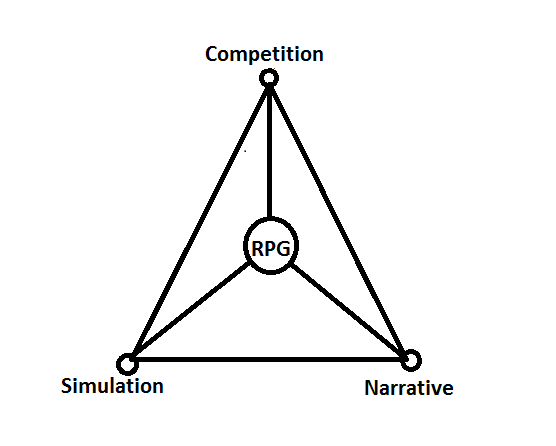
In my last post, I talked a lot about what roleplaying is, and – surprise! – it wasn’t just one thing! That is part of the beauty of roleplaying, it’s full of options. What are these options?

Well, first, we have the three qualities talked about before:

Roleplaying, Storytelling, Mechanics. To keep in line with the existing literature on Gaming Theory, I have slightly renamed the categories I used in the previous post. I have renamed ‘Mechanics’ as ‘Competition’ (it goes by ‘gaming’ in GNS Theory, but I find that to be a bit ambiguous of a term); it essentially refers to how much of the experience of the game is rooted in competition. Storytelling will be referred to as ‘Narrative’, and Roleplaying will be expanded slightly to ‘Simulation’. Simulation refers to how much of the setting goes to recreating system-internal realism. Note that this realism does NOT have to be actual realism. For example, many unrealistic things happen in Star Wars, but there is an assumed set of rules which governs things like lightsabers. Any given game will have a balance of the three, like so:

Game-Qualities

Continue reading

Movie Review: Mad Max trilogy

Zeeblee

Growing up I am relatively sure that I was introduced to the Mad Max movies in reverse order.  Like many people the first one I saw starred Tina Turner and featured the line “Who run Barter Town!”  This also happens to be the one which most people have seen if they have seen any of the three films (at least that’s what I have observed in my own experiences).  Next I saw The Road Warrior and learned to “just walk away from the gasoline.”  Of the series this is the one that people either haven’t seen, or didn’t realize it was a Mad Max film until later.  Finally I saw it.  I saw the original.  I heard the gospel of the Night Rider, and I saw Mad Max.  Now that I’ve built up some drama I’m going to go ahead and ease the tension with a simple categorized review.

Continue reading