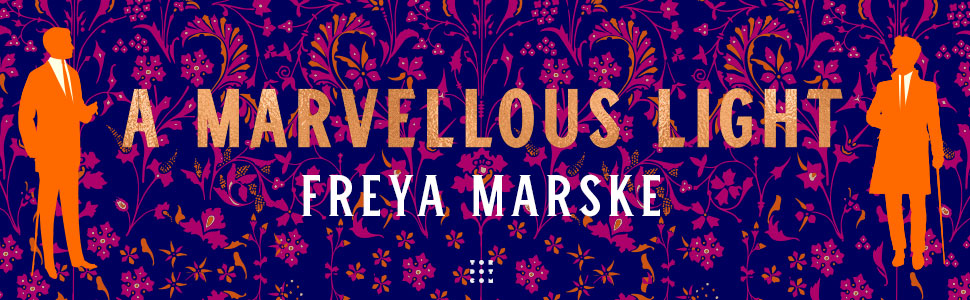
Freya Marske’s A Marvellous Light is magic society intrigue set in early 1900s Britain, with a heaping serving of gay romance on top.
I knew I was reading something very gay before I started, given what little I’d heard about the book beforehand. I *hadn’t* realized I was going to be reading lurid sex scenes. Fortunately, I was able to avoid reading those scenes in public (something I’ve tried to be cautious about since a few awkward experiences in high school—Covid has actually been helpful there), and I was able to just relax and enjoy the book.
If you read the things I had to say about Ursula Vernon’s books, you’ll understand what I mean when I say that this book delivered all the gay romance I’d felt was lacking in the first two Saint of Steel books. Also, I just realized that I read the newest one (Paladin’s Hope) and didn’t write about it here. I’ll try to rectify that.
But I’m distracting myself. This book is good stuff. And it opens with an excellent dramatic scene that sets the stakes for all that is to follow.
In fact, thinking about it from a composition perspective, I wonder when Marske decided to use that as the opening scene; it’s the right choice, I think, and does a marvelous job of creating tension for the reader, but it doesn’t seem like the obvious jumping off point for the next set of scenes. It feels like the teaser intro used to open a spy movie and showcase the future badness our heroes will face. That’s not the wrong choice or the wrong genre for the rest of the story, it’s just not the surface genre for the next step of the story. And I really want to know what inspired Marske to thread these pieces together this way.
Backing up…
Freya Marske has combined several genres here, as I mentioned up top. There’s gay romance, there’s magical fantasy, there’s historical society intrigue and drama (subgenre: British, early 1900s), and there’s the related spy genre. I tie those last two together because, in many ways, spy stories (more le Carré, less Fleming) feel like a reduction of society intrigue: concentrated, cooked down over some higher stakes to something more piquant, seasoned with a dash of paranoia and murderousness. The ultimate dish here is less twisty than an actual le Carré story, but with some of the same flavors and machinations.
So. Back to the novel (heh) genre blending of the book’s first chapters…
When the first scene of the book feels like the opening to a spy story, turning up the pressure and letting us know that something dire is afoot, that’s great. Then the story segues into something that feels more like society drama and leaves the threat lurking under the surface, like a shark too deep to show the reader its fin. And that works too. But, as a tonal shift, I don’t think the choice to do things that way is immediately self-evident. Or, it wasn’t an obvious option to me until I read this.
By the end of the story, it’s clear that all those elements work well together. What’s more, the genres feel well-blended; I’m really looking forward to the (clearly intended) sequel(s) and how they play with this mixture, because I suspect this story’s continuation will give me even more of the magical intrigue and spy fiction that I desperately want. If there’s more queer romance in it, all the better.
All of which is to say, if this blend of genres sounds like your cup of tea then you should hop to and find yourself a copy. It’s good stuff.
Share this with your friends:


 Fistful of Wits