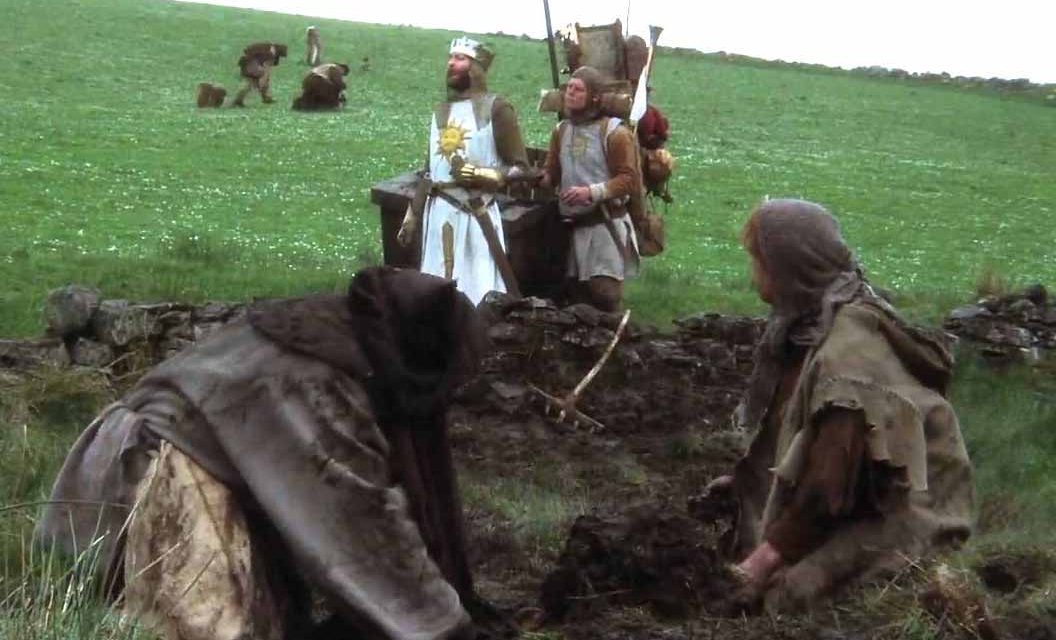
Strange women lying in ponds distributing swords is no basis for a system of government, and feudal lords tossing coins to the poor when they feel like it is no basis for an economy.
If you’ve been listening to economic news…
Continue readingStrange women lying in ponds distributing swords is no basis for a system of government, and feudal lords tossing coins to the poor when they feel like it is no basis for an economy.
If you’ve been listening to economic news…
Continue reading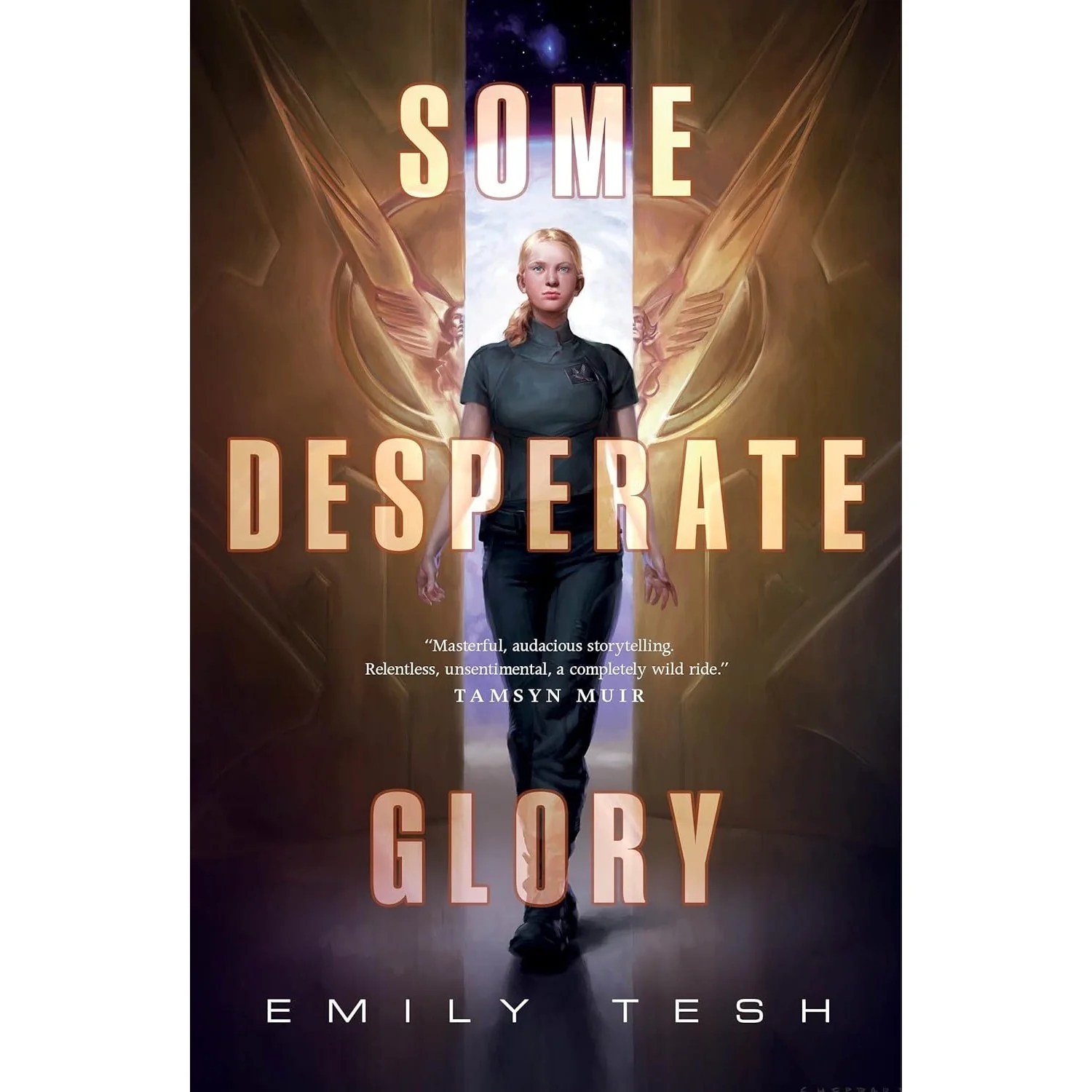
Emily Tesh’s book Some Desperate Glory is an excellent sci fi story (“queer space opera” quoth many other reviewers) about living inside fascism, coming to terms with and recognizing that fascism, and trying to find ways to resist that fascism even when resistance seems impossible. It’s grim. It’s painful. It feels uncomfortably true, real, and relevant. I mentioned it in passing earlier this spring.
This isn’t a book I wanted to feel was more relevant after I finished it, but here we are.
This is also a book that deals with sexual abuse, assault, forced pregnancy, and suicide. I think the story handles them well, but they’re still rough. You’ve been warned.
With all that said, why does this book still feel hopeful to me?
Continue reading
I am such a sucker for this art style.
It’s odd, reflecting on the ways in which an author I love has grown (and stayed the same) over the years.
I’m specifically thinking about Martha Wells. I recently read City of Bones, which was originally published in 1995. I’m in the middle of reviewing City of Bones, because it’s being rereleased this year in trade paperback by Tor. I’ll have my review of that up on GeeklyInc in the not-too-distant future.
City of Bones is intrigue, archaeology, lost civilizations and past apocalypses. It’s a thriller, a mystery, it’s got political machinations and murder… you know, the good stuff. What stood out to me though, was…
Continue readingI had a frustrating but informative (and helpful) experience this afternoon while attempting to fix my plotting problems for the sequel to Barium Deep. After I had resolved multiple problems with my plot arcs, charting them out for my own clarity and future reference, I couldn’t plot one of the emotional character arcs that I wanted for Cesium (the POV character for the second book).
I wasn’t doing anything very complicated, just tracking some of the beats for the specific section of storyline that I wanted to follow. That made my struggles all the more obvious.
Minutes before, I’d plotted out a parallel series of arcs for a totally different story; they’d flowed easily, and made good sense. They were simple, straightforward, and very formulaic—which felt fine for the first pass on an idea that came to me last night. I’m sure that they’ll change and become more interesting once I’ve worked more with that story. If they don’t, I might discard the story or put it on ice.
But those arcs, with their clear points of conflict, transformation, and growth, had come so easily that my difficulty with Cesium was glaring.
A brief aside: the idea that came to me last night dealt with using magic (or something similar) as a manifold metaphor for anger, and perhaps war and military service, with weaker connections to violence and abuse.
The physical plot for Cesium felt simple and straightforward. It fit neatly within the expected bounds of adventure fiction and other upper middle grade stories. Even though I know I’ll change it in a heartbeat if I find something else more emotionally and thematically compelling, it feels good to have laid it out. The problem with Cesium’s emotional arc was that I was (and still am) unsure of what approach I want to take, or how to zero in on Cesi’s changes in ways that will feel rewarding without feeling too neat or pat.
I think it comes down to disliking the pattern of total character transformation that I’ve seen in some middle grade stories. I find incomplete transformation more rewarding, because of how it allows individuals to face their struggles as slightly modified versions of themselves rather than as different people. This fractional shift of self is less important when a story covers a long period of time, as more shift can occur without seeming too abrupt. But when I want a reader to follow a character’s emotional shift from A to B, I feel it helps to highlight the ways the character is still uncomfortable / unfamiliar with their new experience at B. At some point they’ll feel comfortable in the new experience, and that will be cool, but if the story is about them facing that experience I want facing it to be dramatic, tense, uncertain.
The upside of all this is that I think I’m closer to a working draft of Cesium’s story. But I clearly still have more work to do.
 Fistful of Wits