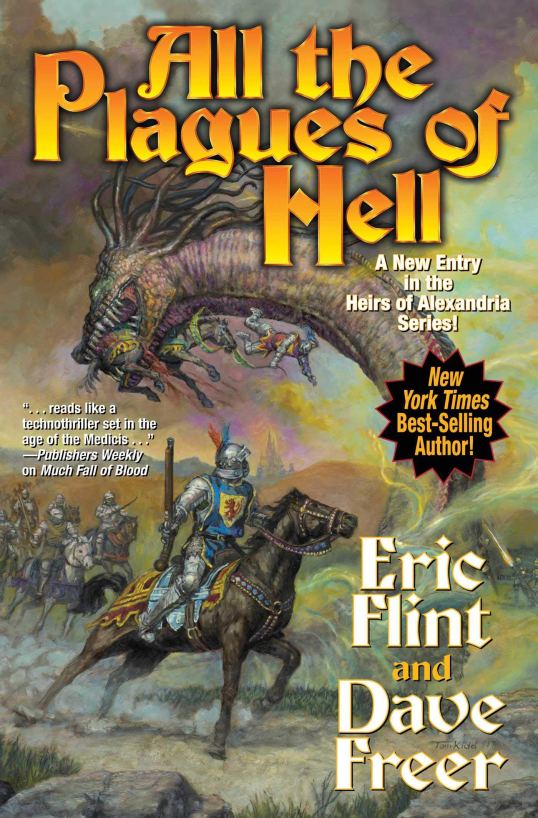
All the Plagues of Hell, by Flint and Freer

AllThePlaguesOfHell

A little context: I’ve enjoyed the previous entries in the Heirs of Alexandria series, and I read All the Plagues of Hell right after reading a much worse book in a different series (which shall remain unnamed).

I thought All the Plagues of Hell was quite good.

There were a few elements to it that frustrated me, which I’ll detail later, but for the most part I had a great time with it. Better yet, it provided an exceptionally good counterpoint to Continue reading

The Music Behind Bury’em Deep

This is an incomplete list of the songs and artists that built the soundscape I tried to stay in while writing Bury’em Deep (and editing and rewriting it, and, well, you know).

The initial bulk of the music was industrial, with a few other genres tossed in. I think there was something about the frequently wordless, highly rhythmic, often distorted quality of that music that drove my sense of living inside a spaceship. My vision of those spaces was not the JJ Abrams Star Trek Apple Store feel of white, glass, and lens flares. It had more in common with World War 2 era submarines. Any gleam or shimmer came from the false realities of glasses’ environmental skins.

The next place I took musical inspiration from was synthwave. Something about the way those sounds combined with the more grating and grinding industrial music fused the feeling of large heavy machinery with complicated computers. Better yet, the synthwave often had a driving beat as well, something that mimicked and pantomimed the rhythms of the industrial tracks that had first sparked my imagination.

This means that alongside Front 242 (Tragedy For You), lots of VNV Nation (specifically tracks with fewer words), Foetus (Love, and (Not Adam)), and Ministry, I had heaps and piles of tracks from Makeup and Vanity Set (everything they made for Brigador, plus at least five other albums), Perturbator, Lazerhawk, Kavinsky, and Waveshaper.

Then, the more idiosyncratic additions and odder pairings, the ones that I couldn’t ignore:

VNV Nation’s song 4 A.M. flows seamlessly into the choral version of Barber’s Adagio for Strings that you find at the opening of the Homeworld soundtrack. I later discovered Edward Higginbottom’s choral version of that Adagio for Strings. I used the rest of the Homeworld soundtrack too.

I listened to two remixes of tracks from Star Control 2. They were Starbase – Under a Red Sky, and Property of the Crimson Corporation.

I listened to Holst’s Planets, and Clutch’s eponymous album. I cycled through several tracks off Tomoyasu Hotei’s album Electric Samurai (especially Dark Wind and Howling). I listened to SomaFM’s space mission station, and Science from the album Sounds of GE. Sometimes I listened to Orbital, primarily their Blue Album and In Sides. I used tracks from Receiver, by H Anton Riehl, and NASA’s Symphonies of the Planets: Voyager Recordings.

Sometimes I listened to one album or track on repeat for hours on end. My musical desires grow strange(r) while I’m writing.

If you have any of that music, I suggest playing it while you read the book. If you don’t have the book, I suggest listening to that music and imagining what it feels like to live trapped in a tin can in the far reaches of our solar system.

Tidbits from The Hacker’s Guide to D&D

One panel I was on, The Hacker’s Guide to D&D, offered up several good nuggets that I’d like to share.

These are mostly not elaborate system hacks; the focus, rather, is on Continue reading

Don’t Know Where the Story’s Going, Quick Thoughts

This post follows Be Boring and Be Hungry. It’s all about making characters for roleplaying games, and how to think about RPG character creation from the perspective of a writer.

Playing RPGs recently, one friend of mine was struggling with how to make and play her character. It was not her first time playing RPGs, but she felt less experienced than most of the other people at the table and was anxious to make a good impression and make good story contributions. She has a writing background, and is familiar with arcs and storyboards and how to make a good dramatic narrative. But she was foundering as we sat at the table, sinking beneath the weight of making a character who would be interesting enough to the rest of the players, a character who would have a complete story. She couldn’t see a way to do that, couldn’t see a way to tell the stories that seemed right for the character she had, and couldn’t reconcile her knowledge of how to tell stories with the structure of our RPG.

In a darkly funny sort of way, Continue reading

Arisia 2020 is next week!

I’ll be at Arisia next weekend, from Jan 17th-20th (Friday through Monday). I’m going to be on seven panels, and will be moderating three of them! Here’s my schedule, and a quick overview of *some* of the material for each panel.

The GM-less Game; Lewis, Friday 7pm: discussing the growing genre of GM-less games, what makes them work, and how to dig into them.

Cooperative Games (mod); Marina 4, Saturday 4pm: discussing cooperative and semi-cooperative board and video games, barriers to entry, how to pick the right ones for your group, and how to navigate their traps and pitfalls.

Feet of Clay, Mind of Light; Marina 2, Saturday 5:30pm: discussing sentient life in non-organic bodies, with plenty of robots, AIs, and conversation about gender, immortality, bodies, dysphoria, and the soul.

Harassment, Missing Stairs, and Safety in LARP; Faneuil, Saturday 7pm: discussing do’s and don’ts of writing and enforcing codes of conduct, dealing with malicious actors in your social groups, and maintaining a healthy and welcoming community that is less vulnerable to abusive behavior.

Death and Funerary Practices in Science Fiction (mod); Marina 4, Sunday 1pm: discussing how genre fiction has dealt with (and failed to deal with) death, how this informs our understanding of the cultures inside those stories, and how our own culture has shaped death and funerary practices in our fiction.

Bringing Horror Into Other Genres (mod); Otis, Sunday 7pm: discussing what horror actually is, the effect of horror’s dread and frisson, what purposes horror may serve (both in horror and elsewhere), and how horror and its elements can expand and improve other genres.

The Hacker’s Guide to D&D; Marina 2, Sunday 8:30pm: discussing D&D 5th edition, how (un)important it is to use the rules as they’re written, and how we as storytellers can use rules and systems from elsewhere to create the experiences we want for our players inside the constraints of D&D’s 5th edition.

What year is Bury’em Deep set in?

What year is it? Why don’t I say?

Well, for one thing I don’t want Continue reading

Nutrient Paste in Bury’em Deep

I don’t ever state this explicitly in Bury’em Deep, but food for spacers is more complicated than simple nutrients. In fact, Continue reading

Setting Material for Bury’em Deep (and sequel), pt. 2

This one’s a close follow up to last week’s post. Again: rough draft material, only partial, subject to change. This time, I’m diving deeper into the Rhean intelligence apparatus, and what influence it’s had on Rhea and beyond! Continue reading

Setting Material for Bury’em Deep (and sequel)

While I’ve been working on writing a sequel to Bury’em Deep (yes, I changed the name), I started working my way through some background material that seemed important. This is all rough draft material, only partial, and subject to change… but I thought you might enjoy some of the details! Read on for tidbits of Rhea’s history and its place in the politics of Saturn-space. Continue reading

Temple in the Blasted Plain

North of the mountains of The Spire lies what was once the heart of an empire. That stretch of fertile rolling plains is now untrammeled, abandoned. The capital city which once dominated that horizon, gone.

A vast temple complex stood at the core of that capital, dedicated to the god of agreements and law, ruler of his pantheon. From there the priests of the empire oversaw the rise and spread of a power few have since matched. Certainly no realm which now rules lands once claimed by the empire can rival its ancient might.

Now that city lies buried, stricken at its height. The central temple is the only building which still emerges fully intact from the land around it, crowning the city’s tallest hill, uncomfortably preserved against the passage of time.

The fall of a god is unkind, never gentle.

Now, few ever visit the city’s stricken corpse. Fewer still dare to enter the holy grounds of the fallen god of order. The skies above wreathe themselves every day with the same storm, an eerie and unrelenting echo of the city’s swift and brutal end. It rolls north from the mountains, the gloom-black cloud front grinding across the sky like a sarcophagus’ closing lid. By the height of midday, the ruined city’s only light flickers from cloud to cloud in dazzling arcs. The blasts, when they come, fall in endless succession; they smite the city’s ruins again, every day, exactly as they did the day the city’s god was deposed and swept, fragmentary, into the abyss.

At midnight, the storm dissolves once again.

This endless cycle has played out for centuries. It has pulverized the ancient empire’s remains. Those who dwell in the lands nearby know not to travel near that god-cursed ground.

But others—the faithful, the learned, the foolish—seek to know what has preserved the fallen god’s sacred place in the center of such destruction. Their stories are inconsistent.

Those few who arrive untouched at the center of the storm, those few who see the fallen god’s holy house, cannot agree. Some find the pediment as it was, the order of the world from top to bottom in gleaming bas relief, the god front and center and larger than life. This temple still stands, but its doors are shut with verdigris and time. Others claim that the temple still stands, yes, but has been replaced by something wrong; the god of that temple screams from his carved likeness, the rain falling from his open mouth as blood. That temple, to that overthrown god, echoes from within with sounds unsought: the voices of those you thought safely dead, the secrets you wished kept, that which will undo you. Its doors stand wide open.

Some claim that those gray-green doors sealed by ages long past have opened at their touch. Few believe them. No one claims they’ve entered the open temple, but a lie of omission is still a lie.

The adventurous speak of other temples taking pride of place in that storm-wracked necropolis, others found instead of the two most well-known. They have told tales of wooden statues brought to life, of warm and welcome darkness with a heartbeat inside, of torchlight and the endless sounds of drums. They have spread rumors of passages into the several hells ruled by the shattered lord, of ways into the precarious past before the fall, of awe-inspiring visions of the broken god’s injustices and of his all-encompassing rule.

But it is the crazed who speak the truth as to why any still venture into that land of lightning and destruction: they would have a glimpse of that old god… and seize a shard of his power for themselves.