Tidbits to tide you over

Hello everyone!  This week I’ve set aside time to spend with my brothers, which means lots of role playing games and storytelling and laughter and yelling (also probably more food and booze than usual).  But because of all that, I’m unlikely to have much for you here.  I’m certainly unlikely to have full-scale reviews or such.  I’ll return with the usual stuff by next Monday, no worries.

But while I’m not writing as much about things, here, have a few tidbits!

Dying Light is a fascinating game: it has gameplay that I find fun and engaging, but a story and characterizations which so far repel me.  It is definitely fun playing with other people, running around the zombie apocalypse at high speed, leaping from building to building, and getting lost in the warrens while hungry monsters chase me.  But every time the story progresses, I shudder and feel that ugly cold spot in my belly; why the hell does the POV character have to be a tool?  Why do they have to make the villain choices they do?  Why did they think the misogynist themes would be worth including?  Why do I feel certain that the “strong female character” they’ve created is just going to be damseled within the next few missions?  For that matter, why are there two or three women survivors in the tower, and everyone else there that I meet is male?

As someone who loves and is fascinated by stories, I’ll probably keep watching the story cutscenes all the way through.  But that may just make me angrier and angrier about their writing choices.  It’s a good thing that the cutscenes are skippable and basically won’t matter in the long run.

On the other end of things, we have Lois McMaster Bujold’s Mirror Dance, which I just finished.  The first time that I picked it up I bounced off the main character’s narration (a first for me with any of Bujold’s books).  But when I started it this time I fell in and couldn’t climb out… which is about what I expect from Bujold at this point.  She really is fabulous.  I’m going to leave my paeans of praise for another post, when I can give this book it’s due, but if you like the other Vorkosigan series books be sure to keep at it with this one, even if the start is a little disorienting.  It’s worth it.

Okay, that’s all for now.  Enjoy yourselves.
World Building: Making The Outer Planes Better

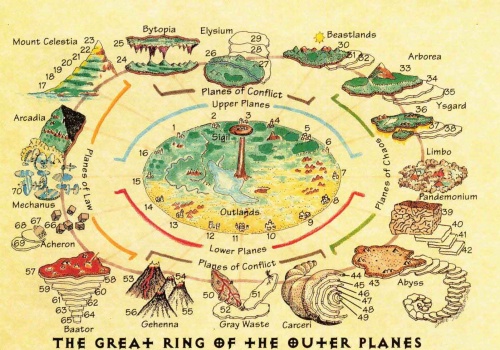
500px-Outer_planes

Once again, I find myself investigating the cosmological background of the setting I’ve most recently created.  I was reading through the Dungeon Master’s Guide again, reading the section on planes near the beginning, and I’m in that usual place: somewhere between excited and miffed.  Fortunately, it’s easy enough to change the things that haven’t excited me.

I’m comfortable, for the most part, with the material the DMG offers on things like the Astral and Ethereal planes.  I’m more okay with the DMG’s ideas for the Shadowfell, the Feywild, and the various elemental planes.  I’m not very happy about their ideas for the Outer Planes.  I have some rewriting to do; let me tell you why.

Continue reading

World Building: The Hells of Errant Souls

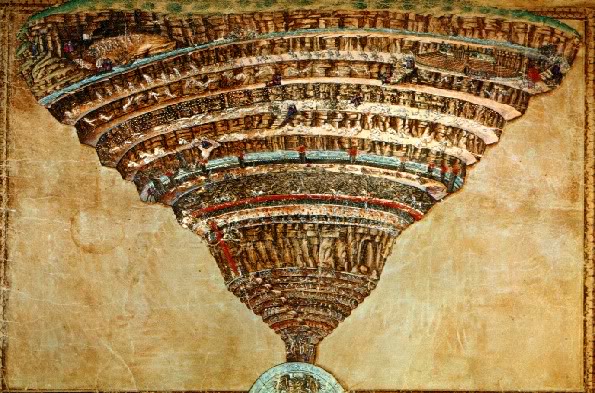
Botticellismapofdantesinferno

Hell, courtesy of Dante.

Last time I kept mentioning someone that I decided to call the Most Powerful Devil (MPD), without ever going any further into who or what that was.  But I’ve come up with more background for them since then, and in so doing I’ve also come up with more details for the game-world as a whole.

So, today I have a stupidly simple calendar (though I haven’t yet bothered to give the months names), I have a better idea of what the afterlife looks like (I’ve totally tossed out the basic alignment-based fare in favor of something a bit more complex), and I have a name and backstory for the Most Powerful Devil.  I think you’ll like this stuff. Continue reading

World Building: Magic, Demons, Angels, and Devils

Back in November I wrote about a new RPG campaign that I had cooked up, a game that I’ll refer to as For The King! for lack of a better name.  If you are currently playing in or are going to play in my 5th edition D&D campaign, you might want to be careful with reading this post.  If not, feel free to read this early-concept campaign overview.  I’ll avoid saying things here that could be too spoiler-y, but I plan to explore the nature of magic, demons, devils, and other such inimical forces.  Your character might or might not have access to this information.

Based on the first few sessions that I ran for my brothers, I already know that the setting allows for angels and fallen angels, though the latter are more like Remnants from In Nomine, powerful supernatural beings from other planes who have had some part of their greater nature stripped from them by intent or by accident.

Angels and their derivatives are all essentially moderately self-willed fragments of the god they serve, and might be thought of as something like having a god let its fingernail clippings (or maybe severed finger?) go off and do its bidding in the world.  A bit like some kind of overpowered intelligent celestial dandruff, I suppose.  But I don’t know off the top of my head how to make demons and devils work, and I don’t just want to sign on to the metaphysics presented in the 5th ed. Monster Manual without some editorial input.  I’d much rather doodle in the margins and make their setting fluff more thoroughly my own.  So read on for sweet lore! Continue reading

Godseat, a Wayfinder Adventure

logo

I should note, I have no idea whether or not this game will actually be chosen for use by Wayfinder.  In fact, I still have to finish writing it and submitting it.  I think it’s a pretty cool concept, and it experiments further with some of the player vs. player mechanics that I explored in the 2014 Staff game (along with my excellent co-writers, you rock).  In the interest of not spoiling you for anything, I’ll refrain from telling you too much about the flow of game.  Instead, this post will give you a brief overview of the setting and what the game is all about.

A Brief History

There are many gods and godlings, but there is only one Most-High.  The Most-High reigns over all from the Godseat, the Throne of Supremacy, the Seat of Knowledge, the Bringer of Good Tidings and Ill News.  Whichever being sits upon the Godseat is acknowledged as the ruler of all, but no one being can sit upon the Throne forever.  The prayers of faithful worshippers, and their propitiations, may sometimes elevate a new being to the Godseat, replacing the previous Most-High and beginning a new reign.  There are some times, perhaps once or twice a decade, when the cycles of the moon and the stars and the seasons coincide just so, when the prayers and rituals of worshippers take on special power in the area around the Godseat; these times are known as the Nights of Ascension.

Long ago, before the Years of Ruin, Continue reading

Pairs

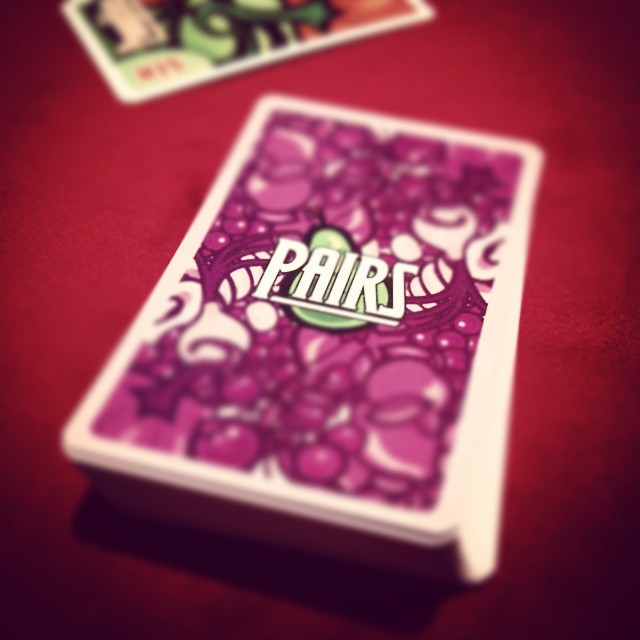
1b146dada8c37f3154b556bb7a195dfd_large

There’s something brilliantly simple about Pairs.  This is probably because it’s a very well designed pub game, from the experienced designers at Cheapass Games.  Pairs is in some ways a departure from the style of their other games, but it shows their collected experience: it’s a snappy game with simple rules that pushes you to go big or go home and gives you quick excitement with good replay value.  It rewards you for smart play, yet it’s just random enough to make flirting with risk a rewarding experience, especially when you can force your fellow players into even riskier territory.  Succeeding in Pairs means balancing your untenable position with your knowledge of the deck and the mental states of your fellow players, and somehow staying in just long enough for someone else to crash and burn first.

While the composition of the game’s deck is very easy to understand (there are ten 10’s, nine 9’s, eight 8’s… all the way down to two 2’s and one 1), counting cards has been actively discouraged by means of a few careful tweaks: each deal starts with five cards being dealt off the top of the deck into a burn pile, all cards removed from play during the game are discarded face down into the burn pile, and a cut card is used to cover the bottom of the deck in order to restrict player knowledge.  Players gain points (a bad thing) when they are dealt a card matching a card they already have in their hand, and all players play with open hands.  Points are tracked by leaving cards you’ve scored visible in front of you, separate from your hand.  Because of how the deck is constructed, you have a roughly 50-50 chance of being dealt an 8, 9, or 10, limiting the amount of time that you can last in any given round.  But it’s possible to fold before you are forced to take points, scoring any one card in play instead of risking being dealt a higher value pair.  The moment you score, regardless of how you do it, you discard whatever remains of your hand.  This means that by folding you to both avoid taking a high value card (e.g. by having a matching 10 dealt to your hand), and deprive other players of opportunities to score low-value cards (either from your hand, or from whatever you picked elsewhere in play).  In play, this means that players’ turns cycle quickly around the table as players choose to either fold, accepting that they will take some points, or hit, accepting risk for the chance of taking no points at all.

Once you’ve taken points and your hand has been emptied, you check to see whether your score has passed the threshold set for your number of players (31 for two players, 21 for three, [or 60/(number of players) + 1, with a minimum of 11 for 6 or more players]).  If you haven’t lost, play continues and you are dealt in once again starting with your next turn, while you hope desperately that someone else will lose before the game gets back around to you.

All in all, rapid and easy play combine with just enough chance to make Pairs an excellent game for laughing at your friends.  If you’re looking for more easy pickup games or pub games, check it out and enjoy scrabbling to take as few points as possible while everyone else does the same.

Cooperative Fireworks Puzzles: Hanabi

hanabi_banner_620x3501

Try this: set off a totally awesome fireworks show without every being able to look at your own hands, relying instead on what your friends tell you about what your hands are doing..  I can’t say that Hanabi is exactly that in game form, but it does a good job of approximating it.  It’s can be difficult, but that very difficulty also makes it rewarding.  Sometimes, of course, you misunderstand what others are telling you and everything blows up in your face.  Read on for more detail.

Continue reading

Behind the scenes of the new campaign…

Monday’s post gave a taste of the game that I’m preparing, but didn’t go into any details about what would follow.  That was intentional.  If there’s any chance that I’ll run this game for you, I strongly suggest that you don’t read what comes after the break.  If you want to see some of what I’ve come up with, and maybe a bit of how I came up with it, read on.

Continue reading

A new campaign in the works…

This post is only going to include non-spoiler material, appropriate for the opening of the game.

You (the players) are the King’s officials, expected to enforce his decisions, act in his interest, and carry out his wishes in the wider Kingdom.  Mostly drawn from the wealthy and noble classes, the King’s officers are expected to outfit themselves out of their own pocket and see to their own expenses.  There are always a few exceptions to the norm of “wealth and privilege,” since an individual’s skills and qualifications for this particular job are far more important than their bloodline, but exceptions are likely to have an interesting story for how they became one of the King’s officers without the usual entrée.  In many ways, you might think of the King’s officers as Musketeers with a little less in the way of Alexandre Dumas.

The game is set in the Kingdom of Duval, and begins with the players being sent from the capitol city of Duval to the backwater county of Mont Mondal.  Count Xavier of Mont Mondal was recently imprisoned for treason against the throne, when he broke his oath of fealty.  He was executed along with many of his closest companions, and the executions have created quite a disturbance at court.  One of his companions, the wizard Castanedra, fled back to Mont Mondal on the same night that Xavier was taken prisoner: you and your compatriots have been tasked with capturing her and returning with her in your custody.  You have also been instructed to raise the county’s levies and send them to the capitol, to join with King Mander’s other forces already mustering for war against the Kingdom of Meius to the east.

While thoughts of war on the nearby eastern border weigh heavy in everyone’s mind, how are you and your companions going to run this powerful wizard to ground and bring her back to Duval?

Other things that people from the Kingdom of Duval would know:

-Meius and Duval share a border that runs through an agriculturally rich valley.  North and south of the valley the terrain becomes increasingly hilly and mountainous, leaving only one clear passage between the two kingdoms.  While the kingdoms have a long history of trade with each other they’ve recently suffered through a series of trade disputes and feuds, and there are now frequent border raids which have further angered each side.

-Count Xavier (that’s pronounced “Sh-avier,” more or less) had a meteoric rise to match his catastrophic fall.  He was ennobled and granted County Mont Mondal a little more than ten years ago, and he and his companions were widely recognized as having done a great deal to make Mont Mondal actually livable for Duvalians.  Xavier and his companions drove out a large clutch of magical aberrations which had claimed the land as their own, and then kept the local bandits in check.  While his breaking of his vow of fealty clearly put him in the wrong, some people have even gone so far as to say that they wish the king hadn’t had Xavier and his companions executed for their treason.  Not that they’re likely to have said as much to the king.  The king, after all, is known to have a bit of a temper.

-The city of Duval is slowly being surrounded by the many thousands of soldiers who have answered their liege-lords’ calls.  The various levies have been joined by a few mercenary companies looking for work, and their spirits are high as they prepare to fight against Meius.  The king’s armies only wait for a few more levies (like those of Mont Mondal) to join them before marching against Meius in the east.

New D&D Sneakily Poaches Inclusivity, Narrative

10325260_10152496571526071_8983892837449015744_n

I grew up playing AD&D, as my brothers introduced me to RPGs before I was 7.  I’ve since moved away from the various D&D systems, flirting with them occasionally in passing while I instead focus on other systems that I find more interesting; I’ve come to prefer more narrativist games for the most part, though my friend Zach’s super-old-school D&D certainly calls to me at times.  But with the release of the newest edition of D&D (5th ed? Next? Whatever we’re supposed to call it) I thought I’d give it a look.  I’d examined some of the playtest documents and made appreciative noises, so I thought I should take a chance.  I’m glad I did.  It seems like the new D&D has learned a few tricks from the games that pulled me away from it in the first place.

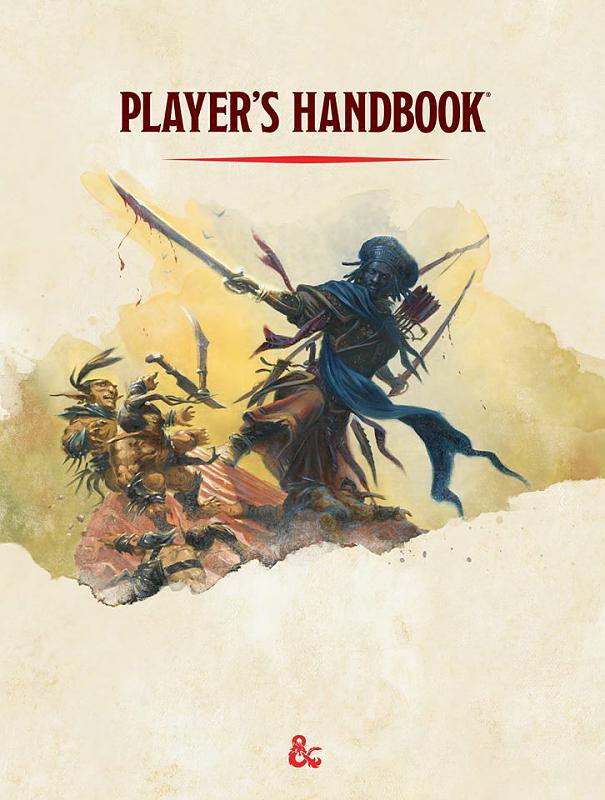
There have been a few things that have really stood out to me while I’ve been reading the new Player’s Handbook (PHB), two quite good and one that I’m not sure how to qualify.  These have nothing to do with the rules, I’ll talk about those later.  The first item is one which I understand has already been discussed elsewhere, namely the game’s specific mention of a player’s ability to construct their character’s gender- or sexual-identity, and statement that that’s a perfectly fine thing to explore in this game; the second item is D&D’s incorporation of distinct backgrounds, personalities, and motivations into character creation, including something called “bonds” which I can only presume has come from Dungeon World; the third item is the art chosen for the book, and its depictions of a diverse group of characters.  I’ll talk more about all of these, but let’s tackle that last one first.

Continue reading