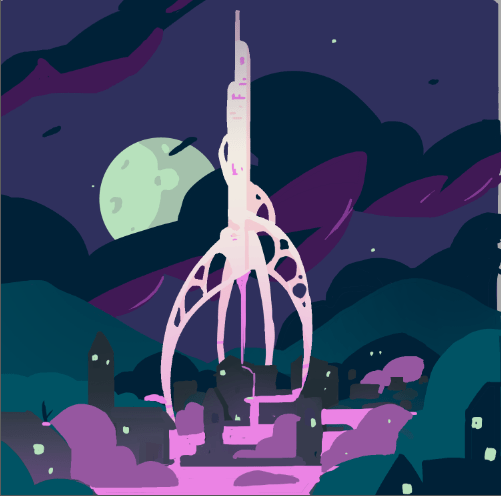
Cloudhome

Cloudhome snags streamers of mist and fog on the plucking fingers of its ruins, a flat-tipped peninsula of stone stretching into the sky from the bone-white rock of Femur Butte. Cloudhome’s expanse hangs unsupported, only open air beneath it, and none know how it remains aloft. Those who live in its shadow say only that it must be the work of the ancients, some mystery known to those who came before that has since been lost. The locals who live below praise it for granting them with shade, and for catching the rainclouds which otherwise would escape their dry land for more hospitable climes. They also say that in times long past, Cloudhome was host to wonders that once changed the world. Now it is but a remnant, a fragment of what came before.

The paths up Femur Butte are arduous but well known, and the local goatherds have made a tradition of racing each other to the top. Only a few of them, however, dare to lead outsiders across the floating bridge of rock which arcs between the butte and Cloudhome. They say, and the visiting outsiders who return agree, that the air itself changes as one crosses the arc. It cools as one crosses the bridge, bringing a chill to the skin and frosting the breath of those still hot from their climb. Dew collects on the stones, dripping from the crumbling walls which yet stand on Cloudhome’s edge. Epiphytic fruiting vines cling to the stonework, their berries a bright and lustrous purple that bursts against the stones’ gray.

Within the walls of Cloudhome visitors find a great sense of peace. Mist clings to every surface, clouds caught inside the ruins’ bounds. Those who have investigated the ruins describe a feeling of rest, of safety, and of a great desire to lay down and let their worries give way to sleep. Those who sleep in Cloudhome and return say they have had the most marvelous dreams, often coming back transformed and inspired by their experience… but few who sleep there have made it back down again. Something about the place pulls one ever deeper into the ruins, with a draw that is difficult to escape. The bodies of those who never wake do not rot, but are called Sleepers by other visitors, and are left undisturbed. They may yet rise from their slumbers, reason others, and more than one legend prophesies the day when all those so blessed by peace will stand again.

Yet the ruins of Cloudhome are not all quiet. In some parts, there are unceasing noises, low rumbles and grinding from inside walls or beneath floors. Elsewhere lights flicker like foxfire in the mists, glimmers that lead ever further into the vine-entombed ruins. There are stories of vast black glass panes, where points of blue and green light gleam and shift, and of statues which speak to all who approach them in tongues long lost. And the ground does not all feel stable beneath one’s feet; inquisitive antiquarians have vanished into suddenly-gaping clefts in the flagstones, and more than one stone block has fallen from the sky to the ground below. Broad stone doors may open or close with little warning and no one to shift them, walls have rattled together and opened new passageways where none before existed, and thus the ruins of Cloudhome have preserved themselves as an unmappable enigma.

Even so, people still come from near and far. Some come seeking peace. Others seek, and find, lost knowledge etched in its stones, or buried in the ruins among the traces of a time and people long past. Healers, alchemists, and herbalists concoct medicines made from the plants and fruit of Cloudhome, fetching a high price far afield amongst those in the know. Many wish to know how it is that such a place could exist, let alone soar among the clouds with only a narrow tether to the earth stretching out beside it. Some few come with the dream of changing the world, of changing themselves, seeking wisdom in the dreams found amidst the clouds. 

Pillars of the Stars

Eight pillars of rock, metal, and glass soar towards the sky from a wide open plain. Set in a circle, with strange arrangements of mid-air arcs and lines connecting each with others, these pillars stand thousands of feet tall. Their shade alone has shaped the world nearby. Each is wider than a copse of vast trees. Together, they dwarf most cities.

No life clings to their exteriors, except a strange lichen that grows on the Pillars and no where else. Their stone is mixed intricately with their glass and metal, not as an ore but as though someone somehow blended all three together from separate pieces. The variation on the surface lies ropy in places, smooth in others, all congealed together in sheets and bands that run from the pillars’ bases to their very tops.

The pillars are believed by many to hold keys to the secrets of the night sky. Their arrangement, and the twining layers of arches and straight lines between them, etch lines across the stars that possess deeper significance. No oracle disagrees with this. Many seers believe that the truest reading of one’s fate can only be found amongst the Pillars. More than that, the Pillars are known to alter the fates of those who have spent time amongst them, though little is known of how such changes occur or how severe they may be. 

Those whose futures have been prophesied, and who have visited the Pillars, find that their prophesies no longer hold power over them. Those whose fates have been spoken, whether by curse or by boon, may have those fates tilted or twisted by visiting the Pillars. So it is that the Pillars receive pilgrims desperate to alter their futures; those who consider themselves truly cursed seek an alternate path forward, and few who know their future holds good fortune are willing to travel anywhere near the vast monoliths.

The Pillars do not guarantee any good outcomes, however. Indeed, many who visit them suffer unlikely and woe-begotten ends. Some few even die at the Pillars themselves, skin blistered by the unyielding cold of the stars, or ears riven and bloody from the Pillars’ rising whine. The columns are not silent: at all times, each has its own hum. But their hums and harmonies come and go, shifting, ebbing, and flowing in volume and tone.

Somehow, these tones do not bother the animals which have come to live in the Pillars’ shade. The most notable of these are the deer which have been said to dwell among the stones. Even when pilgrims have fled, their ears ringing and beginning to seep red, there have been sightings of deer watching, unharmed, while birdsong echoes. Some pilgrims have claimed that a stag with antlers of stone and glass watches over the herds. Others speak of the foxes which roam the land in the Pillars’ shadows, with their unblinking eyes of verdigris.

None have yet ascended the Pillars, though some few have tried. It is thought that any who reached their tips might touch the heavens, or find that they had reached the bridge to the stars themselves—and perhaps even beyond.

Picking Players: Fun vs Creativity, Quick Thoughts

When making a group of players for your RPGs you want people you like playing with, and you want people who will contribute creatively. The first is more important than the second. Honestly, I think that’s true in nearly any group you’re part of; you’d best be able to get along with them if you’re going to spend so much time together. If you’re spending time together for fun, that’s doubly true. I don’t mean there can’t be friction, but I do mean that you should feel comfortable with them, able to ask for what you want and have them honor those requests and talk with you about it.

Those two factors—whether you like spending time with someone, and whether that someone contributes creatively—aren’t entirely separate from each other. Someone that you like playing with, and who likes playing with you, will have an easier time falling into a collaborative creative rhythm over time. Someone who contributes creatively is likely to add things to your game that make it better, and which make playing with them more fun. But.

I don’t think it matters how much creative material someone adds to your game / story / group if they are not fun to play with or be around. Spending time with someone who contributes creatively while being fundamentally not fun to be around is honestly miserable. If they keep adding new ideas but can’t play well with others, or if they aren’t willing to engage with your time together *as play,* you have a recipe for trouble. When I’ve faced this before, I’ve felt stuck: the player’s contributions are excellent, and feel good, but I’m constantly reminded that the player themselves is just not quite right as a fit for the group.

Without outside requirements to include a negative player, there’s no reason to keep them. Until something changes, their creative contributions aren’t worth the added stress of working around their presence. That doesn’t mean that people can’t change, but it helps to have a certain level of shared trust and context before encouraging someone to shift their way of being in a group. Whether you want to put in the work to help them change their behavior is entirely up to you, and that work is *not* required of you. In the long run it may be helpful for them if you tell them why you don’t want to play with them, but you don’t have to engage in that potential drama if you don’t want to.

Relatedly, paying attention to how other people in your group feel about each other is worthwhile. Your experience, obviously, isn’t the only one in your group. If someone in your group is making another person miserable, that should be resolved too.

Also, just because you like spending time with someone in other situations doesn’t mean that they’ll necessarily be a good match to play RPGs with. It helps, but it’s no guarantee.

The Heart Garden

The Heart Garden, as it is called in rumors and legend, is said to lie deep within the brambled thickets of a vast wild… possibly within several different wilds if the stories are true. Those stories say that, no matter from whence one arrived, it is always warm there, and it is lit from within by a softly pulsing glow that rises from the black earth itself. This pulse is always a heart beat, a quiet lub-dub that can be felt through the soles of one’s boots. It suffuses the land and the Garden, and the fruit which grow within that dense thicket are said to pulse in time with it. Those fruit, the heart-fruit, hang at the center of the legends told of the place: glistening dark red, dripping with their juice, all beating in time. They’re said to be the size of a large clenched fist, fibrous, dense, and chewy. But their properties, the stories told of what comes to those who can eat an entire fruit still fresh and warm from the vine, drive the otherwise sane and sensible to unconscionable risk in their pursuit.

The heart-fruit are said to offer many different things, if one knows how to choose wisely.

Some gift the eater with a true vision—though whether prophecy, the ability to see through all lies and misdirection, or ancient knowledge is unclear.

Other heart-fruit are said to beat with the land’s pulse within the chest of the one who eats them, sharing the vitality of the earth itself. There are tales of those so gifted who have ventured into the wilderness to find refuge from the depredations of civilization, or who have gathered up their strength to oust those who twist the earth against itself… or even those who’ve gathered others around them to teach them to hear the land’s heartbeat themselves.

Legends speak of the foolish, those who chose their fruit poorly and so grew a new vine in the Garden from their fertile chest. They also speak of the brave—who sought the heart-fruit for others and thereby returned them from the brink of death—and the kind, who planted seeds of their own gifts in the Garden so that others might benefit from them. There is no one story, no one fate of one who eats that fruit.

Nor is the Garden untended, for the Garden’s keepers are spoken of in hushed tones and are known to linger in the brambles and watch those who seek the Garden’s depths. Most claim that the keepers are robed and retiring, reluctant to speak with others or to engage with the world beyond their Garden. They are sworn to tend the place they protect, and to train the vines together until some greater pattern emerges and the heartbeat may be heard loud and clear. These keepers may be approached and questioned, but they are not bound to help any who trespass within their thicket.

Indeed, it’s claimed that some keepers have set the Garden itself against interlopers. Beasts roam the thicket and may pursue for sport or hunger. Strange mushrooms grow amongst the rich loam, with spores that bring sweet sleep and more rich nourishment for the spreading mycelia. The vines constrict and cluster, choke and grasp. Many who seek the Heart Garden are never again seen.

But yet there are stories which tell how to reach the Garden, and while many fail to reach it those few who succeed all hold the same lesson. The Garden is not bound. It is not a place as other places may be. If it is sought, and if the seeker holds the Heart Garden’s path in their own heart, they will pursue the Garden through the depths of the thickest wilds they can find. Only when they are lost within the deepest reaches, when the growth around them blocks out all light, will they find the brambles drawing closer and tighter until they give way to the warm black earth and the crawling sensation up the back of one’s spine. Then it is up to the seeker to find their way into the center of the Heart Garden, following the beat of the earth and the hints of light which lead them on.

That is the only way in. But no matter what route one took in, the journey out is never the same.

Tower of Peng, revisited

A concept thumbnail for The Tower of Peng the Unprepared.

The Tower of Peng is growing.

My friend is making art for it. I’m editing the piece I wrote and making it more accessible, in more contexts, for other storytellers. The Tower of Peng the Unprepared will become something more people can use to inspire their own games.

I am, simultaneously, moving. So while this project is the proof of concept for a much larger set of offerings, it may be slow to be released. I will continue posting about it here, and eventually elsewhere too.

If this is something you’re excited about, please let me know. If you’d like to see other locations I’ve already posted on this site, I’d love to know which intrigue you most. For now, I hope you enjoy the early concept thumbnail my friend made.

Flexibility in RPGs’ platforms

One of the biggest things I’ve gained through years (decades) of playing roleplaying games is the flexibility to play them in a variety of contexts, via a variety of means. If I had only just started playing RPGs recently, and were I stuck playing them entirely online without the experience of playing them in-person, I am not sure I’d be nearly as committed to them. Nor would I feel capable in them, like I had any reason to believe in my own ability to play and enjoy roleplaying games across the internet.

The biggest impact on my comfort playing RPGs online came from a truly goofy game I played over AIM and some other IM clients, using a home-brewed system to play a dino-loving sorcerer in an alternate history Rome. Yes, I made the “dinosaurcerer” pun repeatedly. It was an incredibly fun game, despite being a clunky system with no verbal interaction and lots and lots of typing.

I loved that game. And it taught me that—with the right group of friends and some good turn-taking dynamics—I could make wonderful fun happen in truly bizarre contexts. We played at a time when video calls were just new, demanding, and unusual enough that we didn’t bother trying to make a multi-person call work. We were absolutely better off for it. We were patient with one another (or at least that’s how I remember it), and we worked together.

If I hadn’t played that game then, I wouldn’t be so comfortable running games for kids over Discord now.

So here’s to practice, and expanding our comfort zones, and finding new ways to explore the things we love together.

Draws, Dangers, and One-Shots, quick thoughts

When I’m building my own one-shot scenarios, I focus particularly on draws and dangers.

Draws are anything that compel people to be somewhere, preferably of their own volition. I want my players, and their characters (the PCs), to *want* to be where they are. I write about this in Be Hungry, a post about making characters, but here I’m thinking of it from the storyteller’s perspective. I want players to feel engaged, for their characters to actively pursue things in the course of play. If they don’t want to be there (player or PC), they have few reasons to stay involved with anything in a scenario. It’s possible to trap characters in a situation they don’t want to be in, but that’s usually more stressful for players. In fact, it’s so uncomfortable that it’s a frequent trope of horror stories. More on that later.

Dangers are just that; a danger is anything that might threaten the well-being of a character, or which presents a potentially harmful obstacle between a character and what they desire. A danger’s potential harm could operate on any of several levels: physical peril, social or emotional threat, or jeopardizing other things a character values. The severity of the danger is critical, and needs to be calibrated against both the draws of the scenario and the other dangers present.

Dangers must be calibrated against each other because they shape how PCs react to the world around them. If a danger is sufficiently scary, PCs will do whatever they can to avoid it. This could include facing other dangers which seem less scary, or simply turning tail and fleeing.

Dangers must also be calibrated against the scenario’s draws, because those dangers may scare off PCs or cause them to despair. As a concrete example, if PCs seek a unique treasure but discover that it lies on the far side of a vast pit full of demons, they may decide that the treasure isn’t worth the trouble. If there’s a secret route to the treasure and the PCs don’t find it, the PCs will probably just shrug and move on, marking that treasure as something to come back for later. This is perfectly normal and fine in most games, and such juxtapositions of draws and dangers have their place in stories, but it’s not going to deliver a triumphant story experience in that game session.

“We came, we saw, we turned around and went home because demons are scary.” As a story, it’s a little anticlimactic. Keep in mind, because this post is focused on one-shots, I’m not as interested in foreshadowing large challenges for later sessions… which is where that anticlimactic story may have a larger role.

To tell a dramatic and triumphant story—a frequent goal of one-shot scenarios—PCs should engage with dangers, resolve them, and reach the draw they sought. Ideally those dangers are scary enough to unsettle the players and make players feel good about resolving or bypassing them, but not bad enough to convince the PCs to give up and go home. It’s a careful balancing act. And it’s a balancing act that you can build into the scenario from the very beginning, both by making sure that the draws pulling PCs in are sufficiently exciting, and by making sure that the dangers don’t seem that bad at the start.

Notice the “seem” in there. It’s entirely possible to reveal that dangers are worse than the PCs expected part way through a scenario. Revealing that the danger’s threat is worse than previously realized is a very traditional way of increasing the tension of any story. It’s possible to do poorly, or to wear out the trope by doing it too reliably, but when done well it’s delightful.

Finally, one quick note on how horror scenarios work with draws and dangers.

Horror stories, which I mentioned near the beginning when talking about trapping PCs, can be different. Some horror stories thrive on the PCs’ sense of helplessness, their feeling stuck with a danger that is too great for them to defeat unscathed, or to overcome without losing in the process. In these horror scenarios, overwhelming dangers lie between the PCs and whatever the scenario’s draw may be (usually escape, or resolving the danger without overwhelming sacrifice). Classic movie examples could include anything involving being trapped in a space with something hunting you: Alien, any number of serial killer movies, various murder-puzzle movies like the Saw series, etc.

This doesn’t describe all horror stories though, and the topic is big enough that I’m going to leave the rest of it for another time.

LARP Camp in the time of Covid

I work at a LARP camp. I love the community there, and my coworkers are some of my favorite people. And when it comes to making magic happen, I would be hard pressed to find a better group of collaborators. I think we do an excellent job giving kids both awesome experiences and tools to change their lives for the better.

Obviously, this spring and summer have been a little complicated because of Covid. We run day camps and overnight camps, we have one-day events, we organize games of capture the flag with swords. All those things happen in-person.

But I’m happy to say that Covid hasn’t stopped us. With some quick thinking on the part of our community, we’ve adapted. One of my friends threw together a discord server for our community as soon as the shutdown started (J. Dragon, the creator of indie horror RPG Sleepaway). Folks have stepped up to run games on our server, and there’s a good feeling of warmth and engagement there.

Better yet, we’re running digital camps this summer. I’d been worried about them at first; they clearly won’t be exactly the same as being together in person, and I’d feared that they wouldn’t capture enough of what makes our camps really sing. But after playtesting our first game last weekend, I’m happy to say that I think we’ve got something really cool to offer.

I was right that these digital camps won’t be exactly the same as our in-person ones. That’s inevitable. But our game writers have put together a really cool set of games for this summer, and I’m really excited about them. I’ll be working the first of them, from July 13th to 17th.

I’ve been playing RPGs since before I could read and write. I’ve played more LARPs than I can remember. And I’ve taught improv theater and LARP for years. These games are good.

Part of what has me so excited is that the games know what they are. They know their constraints, and they’ve embraced those constraints instead of trying to pretend they don’t exist. Because of that, the technological interfaces for our first game actually added to immersion instead of feeling like a barrier.

I love it when a game’s systems and fiction fit together and support each other. That’s a big part of what I like about Monsterhearts, for example. But having the underlying means of interacting with the game world be part of the fiction too is even more exciting. It offers the deep immersion that so many ARGs have sought to offer, blurring the lines between fiction and reality in a way that makes the whole experience far better.

Anyway, I’m excited about all of this. If you happen to be of age to be a camper, I suggest you check out the site.

World Building: Ancient history of the Fell Met Sea

First off, if you’re playing in my Fell Met Sea game please don’t read this yet. It’s 100% full of spoilers for my current thoughts on setting background that you haven’t learned yet. If you’re not playing Fell Met Sea, I’ve put together some ideas about how the previous civilization(s) that preceded my PCs’ present world fell apart. Check out the consequences of sacrificial blood magic!

Continue reading

Highwoodshire

Highwoodshire sits atop the hills, overlooking the fertile farming and grazing land below to the south and east. The land rises from river valleys to high meadows, edged by gentle slopes or crumbling cliffs. Several small forests grace the hilltops, along with a patchwork of farmsteads and villages scattered about amongst the fields, pastures, and groves. There are several productive mines in the area, with a long history of moderate use, but most notably Highwoodshire is home to an old set of forts, small temples, and watchtowers, fallen into variable disrepair.

The shire was once the seat of a knightly order, home to skilled soldiers and a strong fighting levy, held closely by the knights for many years against encroachment from the north and west by the pale people known as the Hungry Ones. The knightly order was eventually disbanded in disgrace, and their primary seat in the shire was sieged and burned when they refused to surrender to their ostensible liege. But their holdings were well built and many remain to this day. Their northwesternmost watchtower still stands strong, watching over the wide, dry grasslands of the northwest, never taken by any sieging force. It was only lost after the order was disbanded, when the small garrison finally starved to death holding off a mass of Hungry People, never receiving the support they had expected.

After the destruction of the knight’s order and several further waves of conflict, the Hungry People and the folk of Highwoodshire co-mingled and settled in peace on the hills overlooking the river valleys beyond. The temples of the order were mostly either neglected or rebuilt for the new beliefs of the mixed folk, though a few smaller ones still retained followers who held to older ways. Much of the knowledge and wealth accrued by the knights was looted or destroyed in the sacking of their forts after they were disbanded, but it is said by many that there were still more treasures and tomes hidden deep within their forts and temples that were never found. The locals are proud of their stories of the knights, even those who are conspicuously pale, and they relish telling stories of the obstinacy of that order… even as they disavow their more reviled practices.

Those in the know doubt the locals’ claims of religious and cultural propriety. There is some evidence that the practices publicly reviled by the folk of Highwoodshire are in fact maintained in secret. Some even say that the knights never partook of those practices, despite their reputation to the contrary, and that they instead were vilified for the practices of the people under their protection. There are scholarly disagreements among those who maintain the knights’ innocence as to whether the knights were aware of the practices and intentionally sheltered the people in their lands, or whether they were unaware of the habits of those they protected. Of course, most people simply lump the knights in with the rest, and say good riddance to the whole lot—ignoring the rumors of people going missing on the high hills, or the odd habits of those who live there still.

Highwoodshire remains strategically valuable as a geographic strongpoint with many remnant structures, but it has been some time since any group was permitted to maintain fortifications in the area. Instead, it is a fairly quiet place these days. Its quiet is only marred by the rumors of old treasures, secrets, and shames hidden deep in the old ruins, and by the whispers of forbidden rituals and almost-forgotten ways maintained by ancient sects in the wooded hills overlooking the peaceful farmland below.