Reading about flat characters in E.M. Forster’s Aspects of the Novel, I have just been reminded of one of the things that routinely frustrates me in David Weber’s work. Weber likes trying to make characters who should essentially be flat, more or less caricatures intended to draw up conflict or drama or comedy (or maybe they should be comic but he refuses to use them in that way, making them painfully comic instead… more on that later). But instead of accepting that these characters should be flat, he tries to flesh them out. He tries to make them round, and make me care about them. Nine times out of ten, he fails.
Category Archives: Roleplaying
Zombies in the Vineyard: a DitV hack

Dogs in the Vineyard is an indie RPG created by Vincent Baker; it has an unusual set of dice mechanics for its conflict resolution, and as part of that it encourages players to take turns shaping the game’s narrative. While it certainly isn’t everyone’s cup of tea, I have had a lot of fun with it.
It’s also highly moddable, much like other Vincent Baker games (Apocalypse World being a prime example). While the DitV sourcebook describes a Wild West setting full of civil and religious strife, I’ve heard or seen others using the system to play in mafia-based story lines, Star Wars settings, feudal Japan, or even The Matrix. And Baker hacked his own system to tell horror stories, in Afraid in the Vineyard.
So of course someone decided to modify things a little further to turn it into a storytelling system that would allow you to play in a classic zombie movie. Sadly, while they’ve playtested their zombie hack, the ruleset that I was able to find online is nowhere near final.
I’m going to cobble something together from those notes as best as I can, and when I’ve done that I’ll share the result with you. If you’re already familiar with DitV and Afraid, maybe you’ll enjoy taking a look too?
Flash Fiction: Characters in 250 words or less
Like it says in the title, this week’s flash fiction challenge is to create characters and convey them in 250 words or less. I’ve had a few knocking around in my head recently, and I decided to let two of them out. I’ve already written stories about both of them before, which you can find (amongst others) right here.
Shenani-games: Random Character Generation is GREAT
This weekend was a good one for gaming. On Saturday I ran a last minute seat-of-the-pants adventure involving a great deal of bullshitting, and on Sunday I continued to run a standing campaign based on the material I started posting about last fall, in the setting I’ve been writing about this spring. I had a great time with both sessions.
I’m not going to tell you much about the campaign, since that would potentially expose spoilers, but I absolutely have to share the basic setup of the Saturday game with you. You remember whothefuckismydndcharacter, right?
Because we had very little time to set up and run the game, I decided that the players should roll down the line, which is to say that they had to roll their ability scores in order without being able to shift them around and spend too much time thinking about what they were going to be. Then Spaige whipped out whothefuckismydndcharacter and got “a fucking sentimental Human Warlock from a cavern without echoes who is a recovering cannibal.” I immediately decided that people could rearrange their ability scores as long as they shifted them to match a randomly generated character from that site. Two of our players (Thom and Whitney) were hardcore / lucky and both rolled down the line AND used the random character generator.
The party ended up with an elven wizard, two warlocks (one human, one half-elven), a rock gnome rock bard, and a dragonborn barbarian. The party’s wisdom scores were (I believe) 6, 6, 7, 8, and 12, with the barbarian as the wisest party member. The lowest charisma score for the party was 14, and most people had 16 or higher. Marvellor the Shit had a 20. How did he end up with a name like that? Well…
As the first few people figured out who their characters were, everyone decided that the PCs should start at 3rd level and that everyone would need an epithet of some sort. We made a joke about the gnomish bard rocking out, and so he quickly became Duane the Rock, rock gnome rock bard. The dragonborn barbarian, who had once survived a cookpot (it said so in his backstory), was described as having proportions like unto a Red Delicious; he’s bigger up top than down low, but he’s all around larger than he really should be. He came to be known as Horgrin the Vast. Spaige’s human warlock took the Great Old One pact, and was thus able to communicate telepathically (Spaige, seriously, I still want the fluff you came up with for that demon-tainted cave of the cannibalistic thought-collective, it was great), so she became Chathi, the Last Disciple of Silent Whispers, or Chathi the Last for short.
Whitney still needed an epithet and was randomly generating her character name (she got extra bonus points, because she randomly generated everything including wizard her spell list), but she quickly realized that her name was her epithet. She ended up playing The Gart, which was perfect because it continued the tradition of four letter epithets.
By this point people were starting to get a little cracked out and/or drunk. Thom showed up late and generated his character as quickly as he could, randomly generating the name Marvellor for his half-elf warlock, but was stumped for what to call himself until we pointed out that he needed a four-letter epithet. Thus was born Marvellor the Shit, and his less impressive imp familiar Bixby the Crap.
Together these hooligans decided to search out a treasure as yet untouched by the adventuring group which had touched (more like scarred) all of their lives. There’s so much that I’m skipping over, like the beautiful way in which they connected the fragments of backstory given to them all through the random character generator, but suffice to say that they had reason to despise and outdo the people who had ruined the lives that they once led. As such, they journeyed into the land of Kraskya, the ancient and ruined city, and promptly fought a large number of things that they were hilariously ill prepared to face. And despite the fact that high charisma types and people with enchantment and deception spells rarely do that well against the undead, they triumphed.
Of course, we left off while they were still stuck underground, more or less trapped by a very very large number of skeletons, but I’m sure that will be a good story for another time.
Flash Fiction: Robin’s Songs
Chuck Wendig has a blog called terribleminds, and on the 9th he posted a Flash Fiction challenge. The prompt: write a 1000 word story about a character created by this random D&D character generator. My prompt turned out to be a “suspicious half-elf bard from a sheltered upbringing who is lactose intolerant.” I really had no idea how to work in lactose intolerance, but I think I’ve succeeded. Check it out below the break!
***
Robin looked up from her book, absentmindedly pushing a strand of hair behind her gently pointed ear. The little cluster of red feathers that she kept tied at the end of her hair rustled against her shoulder. She gave the innkeeper a second-degree smile, the one the Enlightened Brethren had taught her to use for disarming the suspicions of others.
New D&D Sneakily Poaches Inclusivity, Narrative
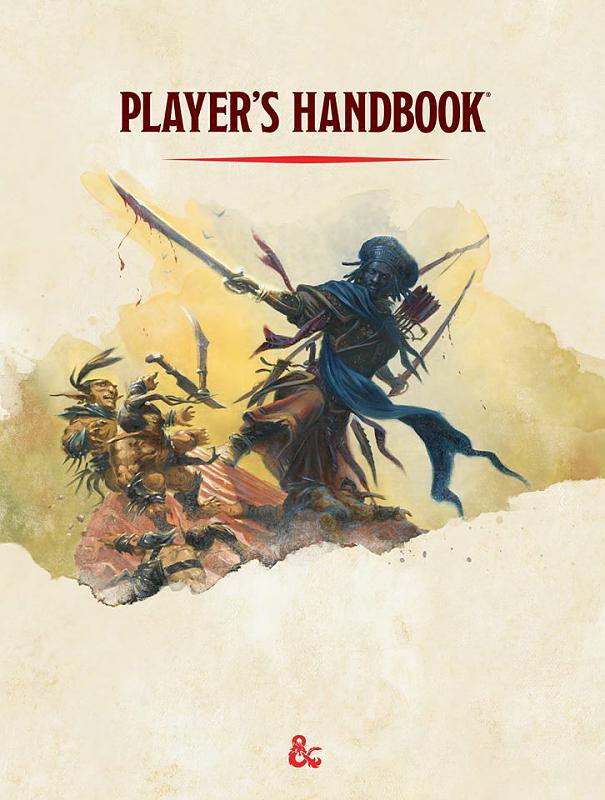
I grew up playing AD&D, as my brothers introduced me to RPGs before I was 7. I’ve since moved away from the various D&D systems, flirting with them occasionally in passing while I instead focus on other systems that I find more interesting; I’ve come to prefer more narrativist games for the most part, though my friend Zach’s super-old-school D&D certainly calls to me at times. But with the release of the newest edition of D&D (5th ed? Next? Whatever we’re supposed to call it) I thought I’d give it a look. I’d examined some of the playtest documents and made appreciative noises, so I thought I should take a chance. I’m glad I did. It seems like the new D&D has learned a few tricks from the games that pulled me away from it in the first place.
There have been a few things that have really stood out to me while I’ve been reading the new Player’s Handbook (PHB), two quite good and one that I’m not sure how to qualify. These have nothing to do with the rules, I’ll talk about those later. The first item is one which I understand has already been discussed elsewhere, namely the game’s specific mention of a player’s ability to construct their character’s gender- or sexual-identity, and statement that that’s a perfectly fine thing to explore in this game; the second item is D&D’s incorporation of distinct backgrounds, personalities, and motivations into character creation, including something called “bonds” which I can only presume has come from Dungeon World; the third item is the art chosen for the book, and its depictions of a diverse group of characters. I’ll talk more about all of these, but let’s tackle that last one first.
What Flavor Is Your Game?

I like vanilla ice cream. I have for a very long time. Before I knew my alphabet, much less how to read, I knew that hearing my older brother spell out “I-C-E-C-R-E-A-M” meant that I should start asking Mom for ice cream too. Better yet, as I got older and discovered the joys of living in Vermont (home of Ben & Jerry’s before it was bought out by Unilever), I learned that there were far more flavors of ice cream available, and that many of them were exceedingly tasty as well.
When I was little, I played make-believe all the time. A number of my friends simply couldn’t understand the appeal, and stopped playing with me, but at the tender age of seven my older siblings harnessed my ambitions and introduced me to 2nd Edition AD&D. My introduction might actually have been earlier, but that year was the first time I can remember staying up until midnight to play RPGs with them. Over the next few years, I was introduced to Vampire: The Masquerade (along with a bundle of other White Wolf games), D&D’s 3rd Edition, In Nomine, and GURPS. More other games followed. Just like with ice cream, I had discovered a whole new world of flavors to choose from. I was very nearly overwhelmed by my enthusiasm. These days, some people refer to me as an RPG snob. I much prefer the term ‘connoisseur’: through dedicated consumption, I have built an appreciation for the inherent flavors of different game systems.
But what the heck do I mean by “flavor”? And how do you figure out what a game’s flavor is?
And Then You Die: A Good (Character) Death
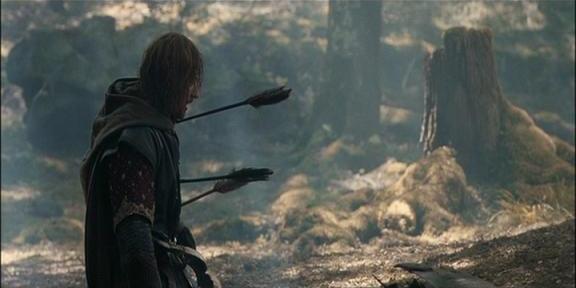
Bye bye Boromir.
I love Boromir. I know I’m not the only one who does. And however much I like Boromir when he’s alive, there’s something that’s almost even more (tragically) appealing about him dead. This is less because I like his ruggedly handsome corpse, and more because of what Homer touched on thousands of years ago: in his death, because of how he died, Boromir becomes something more than he was in life. Boromir had what we might call a good death. Key to this, Boromir dies before he truly succumbs to the power of the Ring, and in his death he tries to make up for some of the mistakes that he has made previously. His act of self-sacrifice protecting the Ring-bearer is a fairly hefty weight in his favor on the scales of Judgement, making up for some of his earlier errors. Interestingly enough for such a perilous setting, he is also the only member of the Fellowship to die and stay dead.
It turns out that that single heroic death is pretty standard. Most stories, like most role-playing games, don’t have lots of character death. In reality, people engaging in the same activities that most adventurers and main characters pursue with wild abandon have a fairly high casualty rate. People are killed while fighting, they’re permanently injured, they get sick… and in many cases, their deaths and debilities feel meaningless. For every handful of people that die doing something we would idolize as heroic, far more are killed or injured in an almost banal fashion. Would we feel the same way about Boromir’s death if he had, I don’t know, been killed without having a chance to fight back? Stepped on a landmine? Slipped in the shower and broken his neck?
RPG Character Progression

Reading the title you may be thinking that I am going to talk about how characters evolve in a narrative in roleplaying games, but if you remember last week’s article you may note the subtle queue in my use of RPG instead of “roleplaying game.” That’s right; today I am going to talk about different styles of stat/ability progression in RPGs along with minor discussion on the role of progression in narrative.
Define Your Terms! Talking about RPGs
Let’s start with the title. When I say RPG, I (usually) don’t mean rocket-propelled grenade. Usually.
No, this post is meant to unpack the terminology surrounding role-playing games, and to be used as a future point of reference. I’m also going to refer back to Mattias’ excellent post about role-playing, because he did such a damn fine job of describing what role-playing is.
All three of us have written about role-playing games (check out the GMing category, and look at the older articles). Yet for the most part our posts have assumed a certain level of familiarity with RPGs and their terminology. I’ve certainly presumed that other people know what I’m talking about; but what the heck does it mean when I call a system “sparsely elegant“?
In an effort to minimize confusion, here’s a quick primer that will begin to bring you up to speed. I’ll do my best not to cover things that were done better elsewhere (see Mattias’ article, really), but there may be a little bit of overlap.
The terminology and topics that I plan to cover…
 Fistful of Wits