Reading the title you may be thinking that I am going to talk about how characters evolve in a narrative in roleplaying games, but if you remember last week’s article you may note the subtle queue in my use of RPG instead of “roleplaying game.” That’s right; today I am going to talk about different styles of stat/ability progression in RPGs along with minor discussion on the role of progression in narrative.
Category Archives: Roleplaying
Define Your Terms! Talking about RPGs
Let’s start with the title. When I say RPG, I (usually) don’t mean rocket-propelled grenade. Usually.
No, this post is meant to unpack the terminology surrounding role-playing games, and to be used as a future point of reference. I’m also going to refer back to Mattias’ excellent post about role-playing, because he did such a damn fine job of describing what role-playing is.
All three of us have written about role-playing games (check out the GMing category, and look at the older articles). Yet for the most part our posts have assumed a certain level of familiarity with RPGs and their terminology. I’ve certainly presumed that other people know what I’m talking about; but what the heck does it mean when I call a system “sparsely elegant“?
In an effort to minimize confusion, here’s a quick primer that will begin to bring you up to speed. I’ll do my best not to cover things that were done better elsewhere (see Mattias’ article, really), but there may be a little bit of overlap.
The terminology and topics that I plan to cover…
Monsterhearts: taking a peek under the ribcage
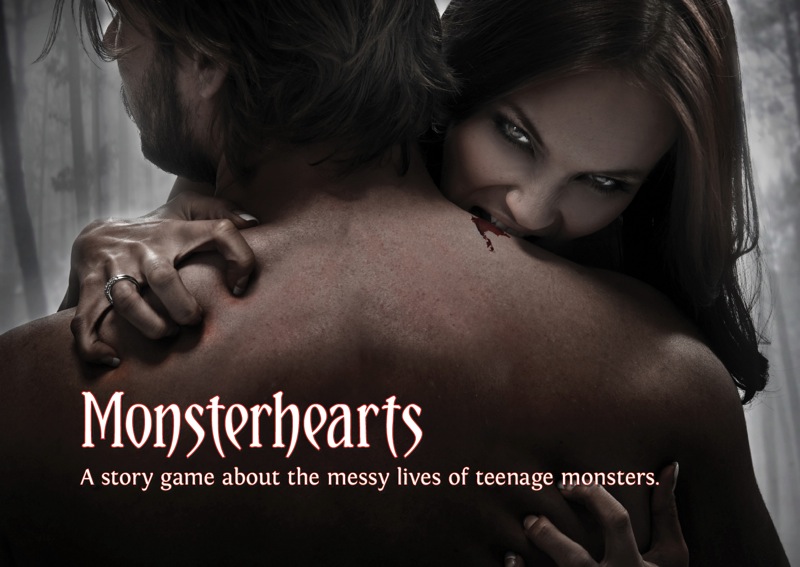
Monsterhearts sells itself as “the messy lives of teenage monsters.” But the truth is that the monstrous nature of the PCs in any game of Monsterhearts really just serves as a reminder of the alienation, discomfort, and feeling of mislabeled or misunderstood powerlessness that gnawed at so many of us when we were teenagers. And maybe as adults as well. Furthermore, themes which have filled classic literature for ages rear their heads again and again in this game; you don’t have to have ever experienced any of them yourself in order to be fascinated by and indulge yourself in them.
A quick background: this is an RPG which has grown out of the Apocalypse World system created by Vincent Baker. It takes the sparse elegance of Baker’s ruleset and applies it to a very different type of life. Read on to find out what makes Monsterhearts different from Apocalypse World, and learn some of what makes it so dynamic and so much fun to play.
Character of the Week: Jason’s Jackmerius
I’m piggybacking off of Mattias’ article because in our discussions before he published it, certain parts of his character caught my fancy, and it inspired me to try my hand at my own iteration. The core of the idea at the time in our discussions was: Demon hunter who uses magic. After more discussion Mattias mentioned how he was playing around with the idea of multiple personalities and the He Who Fights Monsters trope. My thought: What if this were literal?
Character of the Week: Jackmerius
Mostly, I’m a GM; so when friends of mine said that he was setting up a group of campaigns and needed manpower, I thought he meant he needed extra GMs. But lo and behold, he needed a player! I was excited and awaited the details for the setting, which turned out to be little more than ‘basically D&D’, so I didn’t have too much setting to ground my character in. For many people, this is a boon! They have character ideas galore and settings only restrict them. After all, they want to play a character who does magic based on rituals, or based on some anime, or whatever, and the campaign just doesn’t fit that.
But for me, it’s the opposite. Given a lack of prompting, I feel unjustified with any details. I don’t have a character idea that I then fit into a campaign; I build an idea FROM the setting. Without a setting, I feel like I have no non-generic ideas.
And so when I started character creation, I was scared. And then I realized something. My fear made no sense. I was applying a standard from my old-school GMing (what if my characters don’t fit the setting) that didn’t even fit my new-school GMing style. I wanted to let players drive games, and yet here I was, a player, afraid to drive a game! I’d like to say that I overcame this fear right away and dove into character creation. But really, I didn’t until that fateful moment when the GM turned to me and said ‘so tell me about your character’. Until that moment, my character had just been a series of numbers, and character creation had been IMPOSSIBLE. But let’s back up a moment…
Stats to Who: Roleplaying Doesn’t Care About Numbers Part 2
As promised I am now going go through the Stats-to-Who process of character creation. The Stats I will be working with is from Dungeons and Dragons 3.5 because I think most people will be at least passingly familiar with that system (as it is the face of roleplaying). Below is a quick summary of the Stats:
Race: Human
Class: Fighter
Level: 2
Feats: Exotic Weapon Proficiency(spiked chain), Combat Expertise, Improved Trip, Combat Reflexes
This may not seem like much, and you’re right. A DnD character also has skills, equipment, attributes, and languages. But attributes are determined randomly, and the other bits aren’t really required at this point. For those unfamiliar with the spiked chain Fighter twink, this is the beginning core to a build that has many variations. The basic idea is that in DnD 3.5 you can trip your opponents from range with the chain, and if they try to get back up you get free attacks on them and can keep them lying prone. Over time you can add more area control maneuvers, damage, or whatever, but for now I am only going to care about the core. Now to the steps of character discovery!
Rolling with the Punches
For me, as somebody who GMs far more than he plays, roleplaying is all about rolling with the punches. You obviously can’t predict 100% what your players will do, and you can’t predict die rolls, or whatever random element is important in your system. Basically, shit happens, and you’ll have to deal with it. Here are a few tips I’ve found to make that easier:
Roleplaying Does Not Care About Numbers
Has anyone ever told you a story that you really not not care less about? It was probably about something inane and uncontrollable (they had very little or no influence on the outcome), like winning a game of Chutes and Ladders or War. It might have even gone like this:
Horror and Predetermined Outcomes
In my article on how I run a game, I mentioned that there are specific genres in which I’ll sometimes accept predetermined outcomes. I’ve most often experienced this in horror games, where both the players and the PCs know that there will be certain terrible things that happen, regardless of the actions taken by the PCs. But why does this work? How could any player enjoy knowing that their terrible doom approaches?
Training Exercise
Ultimately, roleplaying is a game of imagination and improvisation. Some people find that they have trouble with these faculties. I feel forced to credit my own proficiency in these areas to a number of games I played as a kid, and still occasionally play, as well as a few hobbies of mine. I think it should come to no surprise that most roleplayers are also writers or actors; in fact, I noted the similarity between the three media in previous articles, and many actors are famously in support of D&D/credit it with stimulating their mind.