Last Days of Loneliness, a YA horror story pt. 2

Like I promised, I’ve got some actual text for you today.  I’m a bit late because I’ve just finished pounding through Marcus Sakey’s Brilliance, which I rather liked, but hopefully this material will make up for it.

Keep in mind that this is all still rough.  I’m not even sure that the narrator’s voice is appropriate, so whatever ends up being final may look wildly different.  With that said… I do hope you enjoy it.  Also, please do comment if you think something works particularly well, or really needs to be changed.  The beginning of the story lies after the break…

Continue reading

Last Days of Loneliness, a YA horror story

A number of years ago, one of my writer friends mentioned a story concept that she wanted to share with me.  She wondered what would come of a Lovecraft-inspired horror story in which the protagonist was a high school girl who had just recently moved to a new town.  I immediately latched onto the idea.  We spent a few hours bouncing ideas back and forth, and at the end of our brainstorm session I asked whether she would like to collaborate with me on the project.  She said yes.

I started writing material for the story, occasionally ignoring school work that I really should have been doing at the time.  I soon had a great deal of (questionably valuable) material to share with her, but she’d fallen into a work-hole and been unable to claw her way out.  She ceded the project to me, though we continued to share our thoughts on it.

Fast forward a few years: after finishing my thesis, graduating, and getting back into the swing of writing for a while, I dust off my old drafts of this nascent YA horror novel and get some other people to take a look.  The drafts are, to put it figuratively, mostly made of poo.  I’m now aware of the fact that I have little idea of how to write a teenaged female narrator, which makes looking at my past struggles all the more painful.  But there are some pieces that seem like they still hold some value.  The concept and the basic story beats still seem basically solid, and the story clearly has an excellent ramp up to the climax.  Now the time has come to strip the piece down to its bare bones and tinker with it for a while.  Oh, and write a variety of new attempts at a teenaged female narrator, while reading as many pieces with teenaged female narrators as I can (preferably from the right genres).

In case you’re wondering where this is going, yes, I’ve got some material to share with you today.

Continue reading

Historical Context Matters: Now With More Context

On the 11th I posted the first of my background pieces on the Elven Progenitors setting.  Now I’ve got more material for you.

Last time I covered city names, the names of bodies of water, the basics of city-states, mother-daughter city relations, Elf-home, the Northmen, and the return of slavery.  I still need to talk about the divisions amongst the elves, the cold war, where people get their slaves, why orcs aren’t fighting everyone all the time (and whom they are fighting), the alternative flora and fauna, and maybe something about the Elven Republic.  But there’s no way I’m going to cover all that, so I’ll settle for telling you a bit more about elves.  But to whet your appetite, first, the original conceit of the setting; then a brief background on how much of the world has been explored and settled.

The original conceit of the setting, when I was first developing it with my brother for a series of quick adventures that we wanted to play (yes, it started as an RPG setting), was that we were playing in an alternate version of our own world.  While we didn’t want there to be any magic as most people would recognize it, we did decide to switch things up when it came to evolution, and I’ve used “artistic license” (i.e. unrealistic lies) to hand wave past a few of the problems which follow.  Specifically, the first sapients to evolve were what we would call elves, and they bred all of the other races of sapients in addition to making some awkward accidents along the way.  I know that this doesn’t make much sense when it comes to an evolutionary time-scale (except for the part where elves are actually long-lived enough to breed other species meaningfully), but if you’ll ignore that problem and accept that elves can effectively do magical things with breeding then I suspect you’ll enjoy what follows.

At the time of the great war, elves and their various subject races had cities in Elf-home (Africa), Europe, and western, central, and southern Asia.  A select few elves had performed extensive studies of ocean currents and hypothesized the existence of a land mass to the west of Europe, though with the outbreak of civil war they kept this knowledge secret.  They worried that access to the resources of an entirely new continent would represent a dangerously unbalancing factor in the war, and could only lead to further suffering.  They were also concerned that, if a peace settlement were achieved, the struggle to settle in the New World would re-ignite the civil war.  Therefore, unbeknownst to those fighting the great war, they repurposed a breeding project which had been sidelined by the war and used it to develop a self-replicating massive area denial bioweapon; as more of their fears about the conflict came to pass, and it seemed clear that allowing either side to spread to the New World would only exacerbate the civil war, they deployed their weapon in the New World to prevent exactly that.

Now, with that teaser out of the way, how about a little more detail…

Continue reading

Coming Soon: Another Huge Background Post

Not today, but tomorrow with a little bit of luck.  I’ve got a lot more for you, mostly dealing with elves despite the fact that they’re quite rare in my stories of the setting thus far.  It turns out that the setting is called Elven Progenitors for a good reason, and nearly all of the background politics has its basis in the conflicts of the elves.

So, look here tomorrow for more information on the setting background, and if you haven’t read my short stories you should go do that while you wait.  Here’s a link to the first background post, and here are links to Paying the Tab, Jerome Goes North, Jerome’s Tropical Vacation, A Simple Misunderstanding, and Rum Luck.  My apologies for prolonging the wait, I’ll have more for you soon.

Historical Context Matters: Strange Bedfellows

I’ve been reading quite a bit about Ukraine recently, and marveling at how important historical context is to understanding the present.  Given that our experience of the present is interpreted through the lens of our past, if we lack the appropriate local context for a situation any outsider is likely to be confused.  Here’s a concrete example: in addition to all of the other (traumatic, disgusting, screwed-up) baggage that comes along with Nazi ideology and symbolism, for some in Ukraine those things also represent independence from the Soviet state.  Knowing that, I’m less surprised to see that those particularly toxic things are experiencing a resurgence among some subsections of the population of Ukraine.  Given the local historical context I find it frightening (but not, on reflection, surprising) to see these things coming to the fore once more.  What will come of having the bigotry, fascist tendencies, and virulent hatreds espoused by neo-nazis and their sympathizers in some way legitimated by their connection with the forces that helped to organize the Maidan, and the forces that now do Kiev’s fighting in the east?  I don’t know, but all I can say is “Ick.”

Reading up on all of that has left me thinking about the conflicts and strange bedfellows of my own fictional settings, and particularly the one that I’ve been calling Elven Progenitors (EP).  It’s not a very catchy title for a setting, I know, but it’s the only name I’ve got at the moment.  At least it’s distinct?  I don’t want to explain all of the background of the setting in one go, but I thought I should talk about some of the ways in which it differs from our own history, and some of the background politics that I may have vaguely hinted at without ever explaining.  If you’ve read any of these various stories (Paying the Tab, Jerome Goes North, Jerome’s Tropical Vacation, A Simple Misunderstanding, Rum Luck), you’ve already read something in this setting.  Exposition follows below.

Continue reading

Story Backgrounds Take Time

I seriously underestimated the amount of time it would take me to post a piece of world background for some of my stories.  It’s not like I don’t already know it, I just didn’t realize how much of it I actually wanted to share in one post, or how long it would take to write it.  I plan to have that out for you tomorrow, but for now please accept my apologies for the delay.

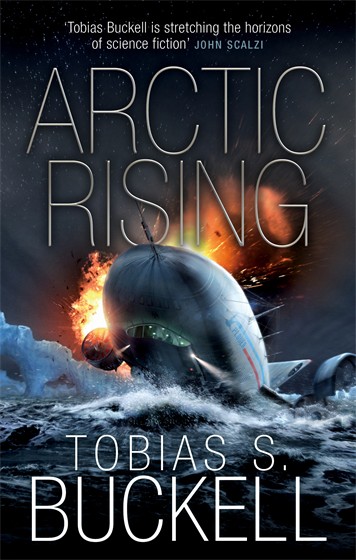
Arctic Rising, by Tobias Buckell

9780091953522


Tobias Buckell has made me very happy indeed.  I can’t decide whether I prefer Arctic Rising to Hurricane Fever, and I really liked Hurricane Fever (seriously, read my review).  It’s rare that I have the pleasure of reading a fast paced high-tension thriller set in a brilliantly developed near-future, let alone reading two of them back to back.  Buckell’s world-building is a tremendous draw for me.  It’s quality shines through in the ease with which he introduces the near-future to the reader; he keeps his obvious enthusiasm for the world he’s created tightly leashed, only revealing it in dribs and drabs, more often than not as an in-character rumination or observation that feels entirely appropriate.  Better yet, I didn’t find any gaping implausibilities.  I’ll admit that I didn’t take a fine-toothed comb to the books and their established background, but they hold together well enough to offer a compelling (and somewhat distressing) view of an imminent future.  If you want to treat yourself to a jaunt down “doesn’t this seem likely…” lane, and you want some hair-raising hijinks in the bargain, try either of these books.  If you don’t want to be spoiled for either book before you read it, be sure to read Arctic Rising first, though I did it in the opposite order and still enjoyed myself immensely.

Why did I enjoy it so much?  Well…

Continue reading

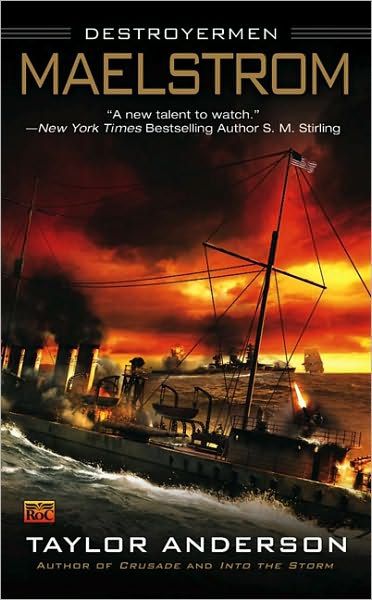
Maelstrom, by Taylor Anderson

b9_6348481_0_TaylorAnderson_MaelstromDestroyermen


Having just finished reading Maelstrom, I’m officially downgrading this series from “potentially profoundly interesting” to “some variety of popcorn lit.”  You know, the stuff that you’ll compulsively eat without thinking too hard about it: sometimes it’s exactly what you’re looking for, but more often it’s just there and you don’t bother to stop yourself.  This series is alt-history tech-bootstrapping military fiction with a very particular set of idealized social dynamics, and as of now it doesn’t look like it will stretch beyond that.  I’m not saying that it’s bad; popcorn lit is definitionally good enough that I’ll pick it up and breeze through it simply for the pleasure of reading it, provided I’m in the right mood.  But it also hasn’t lived up to my hopes of offering more introspection on any of its various conflicts, or breaking further from its genre precedents in an interesting fashion.

I should note that it’s hard for most novels to make it past my popcorn lit category, and the category itself encompasses an almost unhelpfully wide spread of books; furthermore, I can’t pretend to be better than that myself, as I doubt any of my own short stories would qualify as anything but popcorn lit.

I won’t say that the series can’t ever be anything but popcorn lit.  Some of the future books may deliver answers to the niggling contentions I’m sharing with you here.  But thus far my hopes for what I’ll call “deeper” material have not been met.  Specifically, I want Anderson to go deeper into examining the cultural conflicts inherent between the Americans and their various allies, and I especially want him to include the perspective of Lemurians who truly don’t have specified gender roles or gender/sex expectations.  It seems like he’s introduced the Lemurians (the cat-/lemur-like creatures with whom the Americans allied in the first book) as being without specific gender roles, but when we’re treated to the perspective of a Lemurian there are a number of basic social operating assumptions that appear to be based in a society more similar to our own, one which certainly embraces a number of implicitly gender- or sex-based values.  If Anderson wants to write the human perspectives in his book with those value assumptions in place, that’s ok by me, even if I don’t like it.  But much like my love for and disappointment with the use of Drax in Guardians of the Galaxy, I find it frustrating that Anderson should introduce an ostensibly gender- and sex- blind culture and then not do them the justice of writing from a gender- and sex-blind perspective.  I have to give Taylor Anderson credit for trying, and it seems like he might not be aware of how he’s failing to deliver here, but that doesn’t make it un-frustrating.

More after the break.

Continue reading

Short Story: A Simple Misunderstanding

Here’s the return of Andre and Jerome, the pair of accidentally-adventurous miscreants.  If you want to read other stories about them, try Paying the TabJerome Goes North, or Jerome’s Tropical Vacation.  There should be another short story coming along soon!

*     *     *

“Does everyone understand their part?”  The man’s voice was nagging and whiny.

Belly down on the hay-strewn dirt, Andre felt a sneeze coming on.  There was the unmistakable sensation of rising, building pressure, and that odd tingling feeling that came along with it.  He knew it would feel so good to sneeze that the anticipation was almost pleasant in and of itself.  Despite this, he thrust his hand up underneath his nose, trying to press against the bone just above his teeth in an effort to stop the sneeze before it could come out.  Through his desperately squinted eyes he could make out the feet of five people standing less than a yard from where he hid underneath a small wagon, and he knew that sneezing would be a very bad life choice at this moment.  None of the people whose conversation he’d been eavesdropping on would appreciate unexpected company.

Continue reading

“Dawn Breaks” Background Setting Construction

I mentioned a while back that I was having trouble with the setting that I had “developed” for my earlier piece of flash fiction.  I put “developed” in quotes because, let’s face it, I really just made stuff up and went with it at the time.  I didn’t care about making anything make much sense, I just wanted to follow the flavor that I had found in the first few moments of thinking about what I’d do with my catalyst phrase.

But I’ve been thinking further about the setting, and about what would be necessary to make a few basic tenets of the setting possible.  What do I know definitely exists?  It’s a little messy, but here’s a rough list:

  • Brain transplants are possible, shifting from an old body to a new one.
  • There are things called “chop-shops,” and chop-shop gangs, and they are basically analogous to auto chop-shops except that they deal with human tissue instead of car parts.
  • Therefore, there is widespread black market expertise in surgery and tissue transplantation, and presumably lower rates of tissue rejection than there are in our current world.
  • There is a notable criminal underground, and elements of it have penetrated and corrupted law enforcement.
  • Criminal predation on civilians is fairly common, as witnessed by general warnings against travel through specific areas of the setting’s city.
  • The city has dock and warehouse districts, which are strongly influenced (if not controlled by) the criminal underground.

If I want this to all fit together without it simply being bio-fantasy, I need to come up with some good reasons for these various things existing, let alone coexisting.

Starting with the brain transplants, I decided that it would make sense to say that there was some technology that made it easier to regenerate nerve tissue and repair damage.  As best as I understand from Wikipedia, we’re perfectly capable of putting a brain in a new body at present… the real problem is that we can’t hook up the brain to anything in the new body because we can’t regenerate nerve tissue.  So if I dream up a product called Neurogen (let’s ignore the fact that there’s already something by that name, I didn’t know that at the time that I came up with the name), we can pretend that it is essentially something that causes nervous tissue to regrow and form new connections with other nervous tissue in close proximity.  It is a modified function of the body’s normal growth, so this doesn’t solve neurological disorders.  It does, however, make it possible to reconnect severed nerves far faster and more easily than is currently the case.  Let’s just say that, as long as I’m dreaming up a miracle, it will also reduce the amount of time necessary to retrain newly connected nerves and muscles, dropping the necessary recovery time from years to … months or weeks, perhaps.  We’re already transplanting or reattaching limbs, so this seems like a mostly acceptable future jump.

This means that there are far fewer people with paralysis due to trauma, and spinal damage is far less debilitating in the long term than it used to be.  Maybe this enables more adrenaline junkies, but the treatment is probably also relatively expensive, and (based on my understanding of how this works) it won’t stop things like ALS.

On to the chop shops.  There are several things that stand out to me about the concept of human chop-shops: there are problems with disease transmission, there are problems with tissue rejection, there are societal conditions needed to make widespread black market transplants practicable, and there are technological barriers to maintaining healthy tissues beyond a just-in-time supply chain.

Taking those in order, I’m going to ignore the whole disease transmission problem.  I figure some chop shops will be more careful than others, and your chances of getting an infection will vary by where you get your new kidney.

With tissue rejection, I posit that advances in immunosuppression drugs should make this less of a concern.  We’re already fairly good at dealing with this, and (as I understand it) the health of the transplanted organ is generally more of an issue.  That is, more rejection problems and followup complications can be solved by improving tissue health prior to and during transplantation than would be quickly solved with better immunosuppression drugs, especially true given that immunosuppression drugs hurt the body’s chances of fighting off any infection introduced by the new tissue or during the transplantation.  That should be partially addressed by my consideration of the last point.

But what about those societal conditions?  Previous black market transplantation has thrived in areas with legal organ transplants, a sufficiently large body of medical knowledge, basic medical facilities, easy travel, and a relatively large disadvantaged population (prisoners, the unprotected poor, etc.).  My real life examples for this are India in the early 90s, China for an unknown period of time, and the Philippines until 2008.  There are reports of kidnappings in Mexico tied to organ trafficking rings, and regardless of how accurate those reports are I find that idea intriguing, so I’ll add kidnapping victims to that list.  To me, the simultaneous requirements for a large body of medical knowledge, medical facilities, easy travel, and a large vulnerable population suggest a society with a large wealth imbalance.  This goes nicely with the kidnapping idea, since the unprotected poor are more likely to be vulnerable to predation by criminal gangs associated with chop shops, and any roughly middle class kidnapping victim can be given the choice between paying ransom and being used for transplantation, if they aren’t simply given the millionaire’s tour.

Wealth imbalance coupled with weak public institutions lends itself to easy corruption of public institutions, since the average worker will be looking for whatever they can get to pad out their meager paycheck.  This means that there will be wealthy members of society with sections of the public security apparatus on their private payroll, and some of those wealthy members of society will be criminals (when you routinely break the law, owning the public security apparatus is a good business investment).  I think that’s enough on that topic for the moment, though it no doubt deserves further examination.

Which brings us to that last point, and the super cool heart-in-a-box.  We now have hardware that can maintain healthy function of organs post-removal, reducing the time pressure that normally surrounds any transplant operation and potentially giving doctors the opportunity to monitor extracted tissue and treat some pre-existing conditions prior to implantation.  Apparently this is an especially big deal with lung transplants.

I think that answers most of the issues above, if not all of them.  I’ll do more investigation on this topic later.

****

Well shit.  My friend just told me about 3D printing of organs.  I’m not sure what this does, though maybe this is a disruptive technology in this story world, one being fought by the traditional organleggers in a luddite-like response to the potential destruction of their source of revenue.  Time to go burn down the organ-printers, and chop up the scientists for their organs.  Or something.

I had previously disregarded the disruptive effects of cloning based on the premise that growing and maintaining most organs until they were sufficiently mature for healthy & functional transplant would be more expensive than grabbing “user-guaranteed” organs from a relatively healthy abductee.  But this 3D printing stuff may require me to start over with some of this in order to incorporate it without breaking the setting.  Or maybe I just need to break the setting after all.