A new campaign in the works…

This post is only going to include non-spoiler material, appropriate for the opening of the game.

You (the players) are the King’s officials, expected to enforce his decisions, act in his interest, and carry out his wishes in the wider Kingdom.  Mostly drawn from the wealthy and noble classes, the King’s officers are expected to outfit themselves out of their own pocket and see to their own expenses.  There are always a few exceptions to the norm of “wealth and privilege,” since an individual’s skills and qualifications for this particular job are far more important than their bloodline, but exceptions are likely to have an interesting story for how they became one of the King’s officers without the usual entrée.  In many ways, you might think of the King’s officers as Musketeers with a little less in the way of Alexandre Dumas.

The game is set in the Kingdom of Duval, and begins with the players being sent from the capitol city of Duval to the backwater county of Mont Mondal.  Count Xavier of Mont Mondal was recently imprisoned for treason against the throne, when he broke his oath of fealty.  He was executed along with many of his closest companions, and the executions have created quite a disturbance at court.  One of his companions, the wizard Castanedra, fled back to Mont Mondal on the same night that Xavier was taken prisoner: you and your compatriots have been tasked with capturing her and returning with her in your custody.  You have also been instructed to raise the county’s levies and send them to the capitol, to join with King Mander’s other forces already mustering for war against the Kingdom of Meius to the east.

While thoughts of war on the nearby eastern border weigh heavy in everyone’s mind, how are you and your companions going to run this powerful wizard to ground and bring her back to Duval?

Other things that people from the Kingdom of Duval would know:

-Meius and Duval share a border that runs through an agriculturally rich valley.  North and south of the valley the terrain becomes increasingly hilly and mountainous, leaving only one clear passage between the two kingdoms.  While the kingdoms have a long history of trade with each other they’ve recently suffered through a series of trade disputes and feuds, and there are now frequent border raids which have further angered each side.

-Count Xavier (that’s pronounced “Sh-avier,” more or less) had a meteoric rise to match his catastrophic fall.  He was ennobled and granted County Mont Mondal a little more than ten years ago, and he and his companions were widely recognized as having done a great deal to make Mont Mondal actually livable for Duvalians.  Xavier and his companions drove out a large clutch of magical aberrations which had claimed the land as their own, and then kept the local bandits in check.  While his breaking of his vow of fealty clearly put him in the wrong, some people have even gone so far as to say that they wish the king hadn’t had Xavier and his companions executed for their treason.  Not that they’re likely to have said as much to the king.  The king, after all, is known to have a bit of a temper.

-The city of Duval is slowly being surrounded by the many thousands of soldiers who have answered their liege-lords’ calls.  The various levies have been joined by a few mercenary companies looking for work, and their spirits are high as they prepare to fight against Meius.  The king’s armies only wait for a few more levies (like those of Mont Mondal) to join them before marching against Meius in the east.

What Flavor Is Your Game?

cs2012neap

I like vanilla ice cream.  I have for a very long time.  Before I knew my alphabet, much less how to read, I knew that hearing my older brother spell out “I-C-E-C-R-E-A-M” meant that I should start asking Mom for ice cream too.  Better yet, as I got older and discovered the joys of living in Vermont (home of Ben & Jerry’s before it was bought out by Unilever), I learned that there were far more flavors of ice cream available, and that many of them were exceedingly tasty as well.

When I was little, I played make-believe all the time.  A number of my friends simply couldn’t understand the appeal, and stopped playing with me, but at the tender age of seven my older siblings harnessed my ambitions and introduced me to 2nd Edition AD&D.  My introduction might actually have been earlier, but that year was the first time I can remember staying up until midnight to play RPGs with them.  Over the next few years, I was introduced to Vampire: The Masquerade (along with a bundle of other White Wolf games), D&D’s 3rd Edition, In Nomine, and GURPS.  More other games followed.  Just like with ice cream, I had discovered a whole new world of flavors to choose from.  I was very nearly overwhelmed by my enthusiasm.  These days, some people refer to me as an RPG snob.  I much prefer the term ‘connoisseur’: through dedicated consumption, I have built an appreciation for the inherent flavors of different game systems.

But what the heck do I mean by “flavor”?  And how do you figure out what a game’s flavor is?

Continue reading

The Duke’s Men: A DungeonWorld Adventure

A few days ago, I ran a game of DungeonWorld for two of my friends.  It went so well, and ended up feeling so much like a classic Dungeons & Dragons adventure, that I thought I would share the basics of the game with you.  It’s somewhere between an actual play and a scenario description.  I’ll put up an honest-to-goodness Dungeon-starter soon, and with a little creativity you should have an easy time converting it into your own single- or double-episode game.

We didn’t look too closely at the backstories of our heroes, but please allow me to introduce you to the adventures of Kate the thief and Jonah the ranger (and Jonah’s wolfhound, Erasmus), the loyal representatives of Duke Blackforest.  What follows should allow you to live out their adventures for yourself, or change things slightly and experience the adventure anew with other people.

Continue reading

And Then You Die: A Good (Character) Death

boromir-death-three-arrows

Bye bye Boromir.

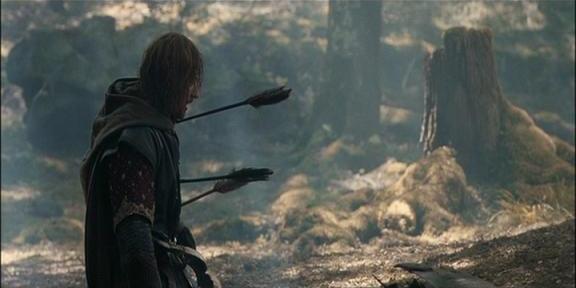
I love Boromir.  I know I’m not the only one who does.  And however much I like Boromir when he’s alive, there’s something that’s almost even more (tragically) appealing about him dead.  This is less because I like his ruggedly handsome corpse, and more because of what Homer touched on thousands of years ago: in his death, because of how he died, Boromir becomes something more than he was in life.  Boromir had what we might call a good death.  Key to this, Boromir dies before he truly succumbs to the power of the Ring, and in his death he tries to make up for some of the mistakes that he has made previously.  His act of self-sacrifice protecting the Ring-bearer is a fairly hefty weight in his favor on the scales of Judgement, making up for some of his earlier errors.  Interestingly enough for such a perilous setting, he is also the only member of the Fellowship to die and stay dead.

It turns out that that single heroic death is pretty standard.  Most stories, like most role-playing games, don’t have lots of character death.  In reality, people engaging in the same activities that most adventurers and main characters pursue with wild abandon have a fairly high casualty rate.  People are killed while fighting, they’re permanently injured, they get sick… and in many cases, their deaths and debilities feel meaningless.  For every handful of people that die doing something we would idolize as heroic, far more are killed or injured in an almost banal fashion.  Would we feel the same way about Boromir’s death if he had, I don’t know, been killed without having a chance to fight back?  Stepped on a landmine?  Slipped in the shower and broken his neck?

Continue reading

Define Your Terms! Talking about RPGs

Let’s start with the title.  When I say RPG, I (usually) don’t mean rocket-propelled grenade.  Usually.

No, this post is meant to unpack the terminology surrounding role-playing games, and to be used as a future point of reference.  I’m also going to refer back to Mattias’ excellent post about role-playing, because he did such a damn fine job of describing what role-playing is.

All three of us have written about role-playing games (check out the GMing category, and look at the older articles).  Yet for the most part our posts have assumed a certain level of familiarity with RPGs and their terminology.  I’ve certainly presumed that other people know what I’m talking about; but what the heck does it mean when I call a system “sparsely elegant“?

In an effort to minimize confusion, here’s a quick primer that will begin to bring you up to speed.  I’ll do my best not to cover things that were done better elsewhere (see Mattias’ article, really), but there may be a little bit of overlap.

The terminology and topics that I plan to cover…

Continue reading

Gamer Typology a la Robin Laws

We’ve been talking a lot about improvisation and working with your players, but we haven’t given you nearly enough background for the topic.  There’s a book that I found years ago called Robin’s Laws of Good Game Mastering, and I lend or recommend it to every one of my friends who asks me for tips on how to be a good storyteller.  I like it so much that when I started looking through my old copy again while I was starting this article, I had to stop myself from simply quoting the book word for word.  It’s more than just a good place to start; the book has an impressively down-to-earth approach that will give you a basis for campaign and adventure design, for preparing easy improvisation, and for reading and managing your gaming group’s social (and problem solving) dynamics.  It also offers a very simple gamer typology that should allow you to identify what drives you and your players and what rewards them most in the realm of RPGs.  If you’re interested in gaming or in group dynamics, I couldn’t recommend a better read.

Continue reading

Player Knowledge and the History of RPGs

First, two quotes to start us off:

“No plan survives contact with the enemy.” (paraphrased quote from Helmuth von Moltke the Elder, a man who was actually quite keen on extensive planning and who might be considered the great-grandfather of RPGs)

“The players are the enemy.” (the storyteller’s corollary to the first quote, promoted in old gaming literature and still embraced by some gamers today)

***

I’ve often heard these quoted, seriously or jokingly, by my RPG playing friends.  The first one I agree with: opposition is a chaotic force, and will often ruin your most carefully laid plans.  The second one I only agree with insofar as players are an inherently chaotic force.  They are other people, and will often do the unexpected.  Unfortunately, the second quote is often interpreted literally.  Players are seen as the opposition and their characters are therefore meant to be outwitted, led by the nose, and then set upon while at a disadvantage.

Worryingly enough, I most often hear these quotes spoken seriously by my friends who have not yet run many games.  With a literal interpretation, where the hell do those two quotes lead us?  If the players are the enemy, it stands to reason that everything the storyteller does is in opposition to the players.  More to the point, it sets up a clearly antagonistic relationship between the players and the storyteller in which the two sides have no reason to cooperate with each other.  It’s like they’re not actually playing a game together.

If they are playing a game together, it’s more like a strategy wargame in which all details are included solely to “get” the players.  This is, of course, where the genre originated: the first games that we would recognize as RPGs grew out of wargames, as the logical result of a progression towards smaller and smaller unit sizes.  Eventually, each player had control of only one individual instead of many units, laying the foundation for the RPG genre that we know today.  The influence of modern gaming’s military history is still visible: the habits of secrets and hostile surprises that we have come to see as part and parcel of the RPG experience come from this background of wargaming.

But even as someone who enjoys wargames, I don’t always want to play a wargame when I sit down to play an RPG.  There’s an opportunity here to explore gaming without those holdouts baked in, and some game designers have been pushing in that direction for years.  Yet if we aren’t following in the habits of our wargaming ancestors, what do we do?

Continue reading

Opportunities vs. Obstacles

What’s the difference between an obstacle and an opportunity in an RPG?  I’ve played in plenty of games where the GM laid down what they thought was an opportunity and what I thought was an insurmountable obstacle.  And I’ve run games where the obstacles I created were instead interpreted as opportunities by my players.  Is there any distinction at all?

Continue reading