Monday’s post gave a taste of the game that I’m preparing, but didn’t go into any details about what would follow. That was intentional. If there’s any chance that I’ll run this game for you, I strongly suggest that you don’t read what comes after the break. If you want to see some of what I’ve come up with, and maybe a bit of how I came up with it, read on.
Tag Archives: RPGs
A new campaign in the works…
This post is only going to include non-spoiler material, appropriate for the opening of the game.
You (the players) are the King’s officials, expected to enforce his decisions, act in his interest, and carry out his wishes in the wider Kingdom. Mostly drawn from the wealthy and noble classes, the King’s officers are expected to outfit themselves out of their own pocket and see to their own expenses. There are always a few exceptions to the norm of “wealth and privilege,” since an individual’s skills and qualifications for this particular job are far more important than their bloodline, but exceptions are likely to have an interesting story for how they became one of the King’s officers without the usual entrée. In many ways, you might think of the King’s officers as Musketeers with a little less in the way of Alexandre Dumas.
The game is set in the Kingdom of Duval, and begins with the players being sent from the capitol city of Duval to the backwater county of Mont Mondal. Count Xavier of Mont Mondal was recently imprisoned for treason against the throne, when he broke his oath of fealty. He was executed along with many of his closest companions, and the executions have created quite a disturbance at court. One of his companions, the wizard Castanedra, fled back to Mont Mondal on the same night that Xavier was taken prisoner: you and your compatriots have been tasked with capturing her and returning with her in your custody. You have also been instructed to raise the county’s levies and send them to the capitol, to join with King Mander’s other forces already mustering for war against the Kingdom of Meius to the east.
While thoughts of war on the nearby eastern border weigh heavy in everyone’s mind, how are you and your companions going to run this powerful wizard to ground and bring her back to Duval?
Other things that people from the Kingdom of Duval would know:
-Meius and Duval share a border that runs through an agriculturally rich valley. North and south of the valley the terrain becomes increasingly hilly and mountainous, leaving only one clear passage between the two kingdoms. While the kingdoms have a long history of trade with each other they’ve recently suffered through a series of trade disputes and feuds, and there are now frequent border raids which have further angered each side.
-Count Xavier (that’s pronounced “Sh-avier,” more or less) had a meteoric rise to match his catastrophic fall. He was ennobled and granted County Mont Mondal a little more than ten years ago, and he and his companions were widely recognized as having done a great deal to make Mont Mondal actually livable for Duvalians. Xavier and his companions drove out a large clutch of magical aberrations which had claimed the land as their own, and then kept the local bandits in check. While his breaking of his vow of fealty clearly put him in the wrong, some people have even gone so far as to say that they wish the king hadn’t had Xavier and his companions executed for their treason. Not that they’re likely to have said as much to the king. The king, after all, is known to have a bit of a temper.
-The city of Duval is slowly being surrounded by the many thousands of soldiers who have answered their liege-lords’ calls. The various levies have been joined by a few mercenary companies looking for work, and their spirits are high as they prepare to fight against Meius. The king’s armies only wait for a few more levies (like those of Mont Mondal) to join them before marching against Meius in the east.
New D&D Sneakily Poaches Inclusivity, Narrative
I grew up playing AD&D, as my brothers introduced me to RPGs before I was 7. I’ve since moved away from the various D&D systems, flirting with them occasionally in passing while I instead focus on other systems that I find more interesting; I’ve come to prefer more narrativist games for the most part, though my friend Zach’s super-old-school D&D certainly calls to me at times. But with the release of the newest edition of D&D (5th ed? Next? Whatever we’re supposed to call it) I thought I’d give it a look. I’d examined some of the playtest documents and made appreciative noises, so I thought I should take a chance. I’m glad I did. It seems like the new D&D has learned a few tricks from the games that pulled me away from it in the first place.
There have been a few things that have really stood out to me while I’ve been reading the new Player’s Handbook (PHB), two quite good and one that I’m not sure how to qualify. These have nothing to do with the rules, I’ll talk about those later. The first item is one which I understand has already been discussed elsewhere, namely the game’s specific mention of a player’s ability to construct their character’s gender- or sexual-identity, and statement that that’s a perfectly fine thing to explore in this game; the second item is D&D’s incorporation of distinct backgrounds, personalities, and motivations into character creation, including something called “bonds” which I can only presume has come from Dungeon World; the third item is the art chosen for the book, and its depictions of a diverse group of characters. I’ll talk more about all of these, but let’s tackle that last one first.
“Roleplaying” Games and the Misused RPG Label
I have written a few reviews for digital roleplaying games (RPGs), but in many cases I find the label is completely inappropriate. When I think of a “roleplaying” game, I think of a game in which I take control and can make important narrative choices. But most digital RPGs don’t let you make narrative choices at all. For that reason I would say that the label of RPG has come to be associated with a mechanic which is common to most RPGs, but isn’t the attribute that makes them RPGs. The mechanic in question is that of leveling up, and I hate it*.
Types of Games
In my last post, I talked a lot about what roleplaying is, and – surprise! – it wasn’t just one thing! That is part of the beauty of roleplaying, it’s full of options. What are these options?
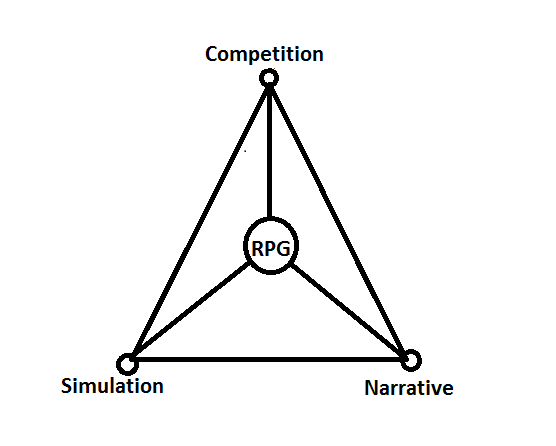
Well, first, we have the three qualities talked about before:
Roleplaying, Storytelling, Mechanics. To keep in line with the existing literature on Gaming Theory, I have slightly renamed the categories I used in the previous post. I have renamed ‘Mechanics’ as ‘Competition’ (it goes by ‘gaming’ in GNS Theory, but I find that to be a bit ambiguous of a term); it essentially refers to how much of the experience of the game is rooted in competition. Storytelling will be referred to as ‘Narrative’, and Roleplaying will be expanded slightly to ‘Simulation’. Simulation refers to how much of the setting goes to recreating system-internal realism. Note that this realism does NOT have to be actual realism. For example, many unrealistic things happen in Star Wars, but there is an assumed set of rules which governs things like lightsabers. Any given game will have a balance of the three, like so: