Room to grow: Lootbound (demo)

The Lootbound demo fascinates me. It scratched a series of my itches, handily eating an hour and a half of my Saturday evening and keeping me up past my bedtime. Days after playing it, I find my mind returning to gnaw at its design choices.

It is not, I think, the game for me. But it might be the game for you.

Continue reading

Teaching storytellers: recipes, ingredients, how to cook

How do you go from “Running a game of D&D sounds fun” to “I have some idea of what to do”?

You could do what I did: play enough RPGs at an early enough age that you don’t remember  feeling daunted by or awkward about the transition from playing to running games. I figured running games was just what you were supposed to do. I paid attention to how my siblings ran games, and I tried to replicate that.

That obviously won’t work for most people. They could try the adult version, playing lots of games run by other people until they have some idea of what to do themselves, but what if they don’t have a good play group? What if they want more tools?

What other entry points can we (the RPG community) offer? What resources and pitfalls should we and new storytellers be aware of?

When I think about resources and pitfalls here, I think of ingredients and recipes. Roleplaying game materials are strong on ingredients; RPG books often include lots of “what” and “who” and even “where” to use in your stories. But these materials are often weak on recipes, and they certainly don’t teach you how to cook; they don’t offer much “why” or even “how”.

Without understanding the “why” and “how,” what is a would-be storyteller to do? How can we help new storytellers learn the why’s and how’s of the art of storytelling?

Continue reading

Why you tilt the camera, Spider-Noir, 6/4/26

I’ve been enjoying watching Spider-Noir with Ley.

I was adamant that we should watch in black and white. Ley was willing to follow my lead. After finishing the first episode we spoke again about whether the show would look as good in color, and they said “No, it’s art.”

It’s not hard to find people who agree with this position online. I happen to think it’s the right one. I’d heard that the show was filmed with black and white in mind, and that seems obvious to me on watching it.

I wanted to be sure, though. I went through different scenes, rewatching them in color. I admit, the color version looks good too! Working in black and white obviously has a cost; I kind of like knowing that Robbie is wearing warm and punchy reddish hues in episode one, and I wouldn’t have known that without going back to check the color version.

But the black and white version sings. Yes, the color version looks good, but it’s a different kind of good—and I’d argue that the color version isn’t the right kind of good for this show. The team that made Spider-Noir knew what they were doing when they shot for black and white. 

That raises some questions though. Clearly, reality isn’t black and white. The filmmakers aren’t working with purely black and white source material. How then are they getting such incredible results?

Like Ley said, it’s art. It’s art, and a lesson in the importance of knowing one’s craft and intended genre. How can we apply that lesson beyond film?

Continue reading

Collaborative worldbuilding cont., deferred exercises 3/12/26

I’ve deferred my Love/Hate connection experiment for at least one more session. I could do this differently; I could use that experiment now to improve my players’ understanding of their own PCs, as well as bettering my understanding of their relationships with the rest of the setting. I deferred that experiment yesterday because I wanted to get a session of play under our belts, whet my players’ appetites, that sort of thing. That went well. I think it was a good choice.

Now I’m holding off because I suspect…

Continue reading

Collaborative worldbuilding for a new game, 2/26/26

I started a new game this week.

Our prior GM is a freshly minted parent. He’s currently in the land of absolute sleep deprivation. Having been there not too long ago myself, I’ve offered to take over with a new game (at least for some of the time).

I’m taking the opportunity to experiment with new ways to build connections between PCs and the setting. I’ve written about at least one of those ideas before. I’m taking things a step further by starting the group even earlier in the world creation process.

We began with a collaborative setting creation session. We’ll be playing Worlds Without Number from Kevin Crawford, and I want to use WWN’s general setting concept… but I want the players to have a hand in how our particular slice of the world feels. I want them to influence what direction our Latter Earth takes.

Alongside that…

Continue reading

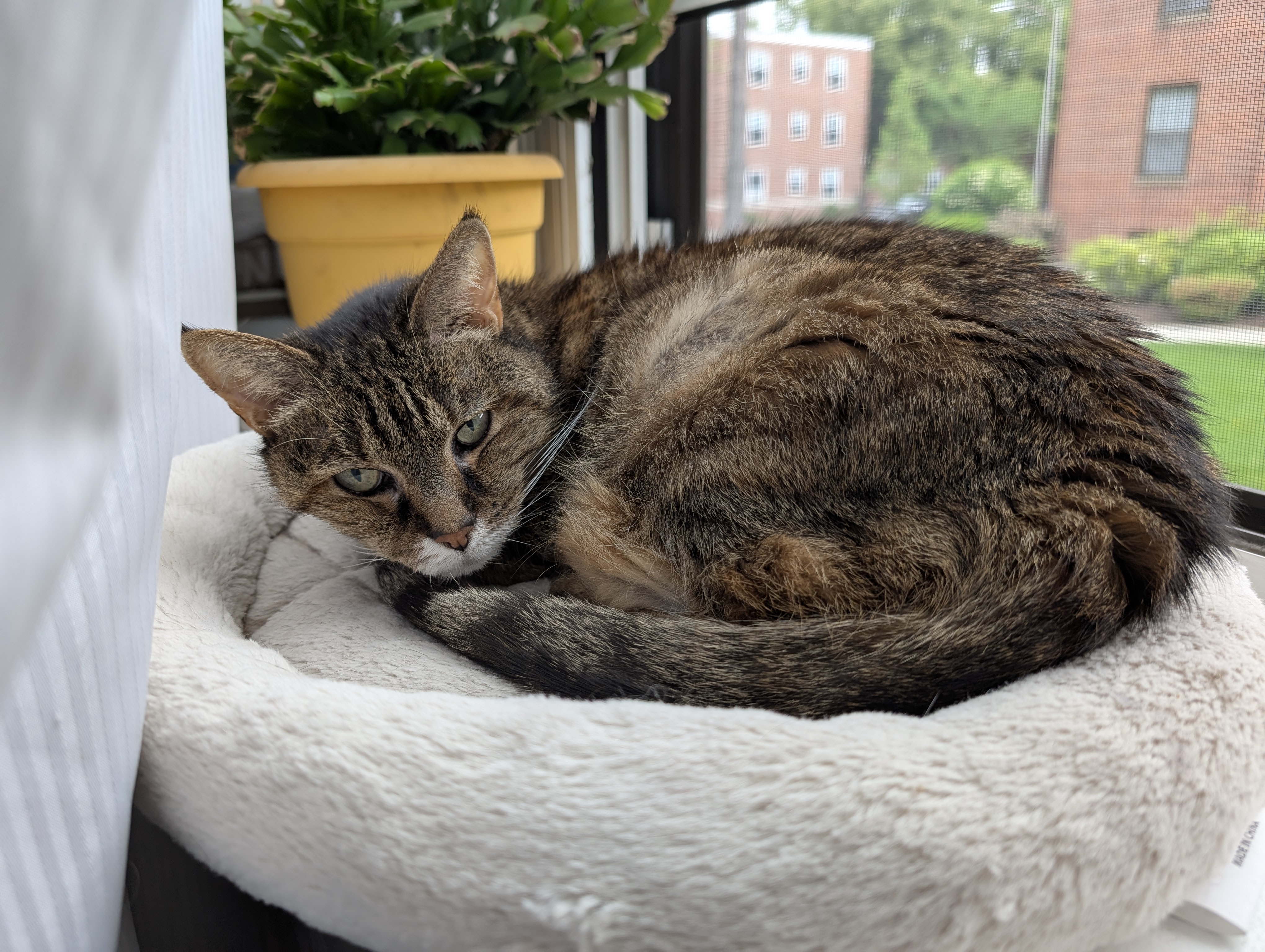
Feline interlude, 5/29/25

Life has been very full of baby recently. I don’t have a full post for you.

I’ve been lucky enough to play a bit of Cities Without Number with a neighbor and some friends. My other games are basically on hiatus, but being able to start early, end early, and walk less than ten minutes to and from game is amazing. There’s also no way I could be doing this without sometimes bringing baby Gibby with me, or sometimes coordinating extra support for Ley. Asking Ley to take care of the baby without any support while I go play RPGs is no good. Having a two-month old is a lot of work.

Cities Without Number, like other Kevin Crawford titles, could really use some editing. It’s… acceptable. The text is definitely better organized and written than some other RPGs or boardgames I’ve seen. Some of Crawford’s verbosity adds evocative texture to both system and setting, and his approach certainly produces consistently fun results. But…

Continue reading

Love/Hate: Priming your game with NPCs & Groups

In our own world, there are people we love and people we hate. Our feelings about others might be distant or dispassionate, or they might be personal and urgent. Sharing a love for the people of a neighborhood, a country, a sports team, or a gang is a quick and easy way to bond with someone else—as is sharing a hatred.

As storytellers, we can use this.

Continue reading

How to make deep NPCs

Are you tempted to make every NPC in your game a deep and complex character?

Don’t.

I love creating and playing NPCs in my games, and it comes easily to me. Part of this is because I’ve done improv theater—lots of improv theater. But mostly it’s because I use a few basic guidelines when I’m coming up with NPCs.

Since I apparently haven’t written anything about making or running NPCs since that article about naming them from over a decade ago, I figure this post is overdue.

Continue reading

Spectaculars, lightweight superhero fun

Spectaculars is a superhero RPG with a simple roll-under percentile die system. There are no cumbersome lists of modifiers, and the math required at the table should be accessible to precocious eight or nine year-olds. The game is clearly a love-letter to superhero comics, right down to players’ ability to invent backstory and create connections at the drop of a hat by spending “Continuity Tokens” to make up past issues with a relevant story detail. The game could also easily mimic the feel of superhero cartoons like Batman: The Animated Series, or any other episodic story where inventing background is expected or would be useful. Whatever your inspirations are, Spectaculars shines brightest when you’re playing episodic adventures in the context of a larger narrative arc. This is especially true if you’re more excited about your game’s larger story than you are about the gritty details of how a specific power works, or quantifying whose ”Mega Power Blast” is bigger.

Continue reading

Immersion & Worldbuilding in Co-op Video Games

Void Crew, Deep Rock Galactic, and Helldivers 2: three co-op games, three “shooters” (kind of, more on that later), and three games that build on their own self-contained fiction. I’ve played all three. I’ve enjoyed all three. So why do I only admire two of them?

Continue reading