White boys and spy stories

There’s more to be written here than I’ll address today. I’m putting this here because I’m sure I’ll have future posts on the topic. This particular topic came to mind through watching some of The Recruit, and through starting Arabella The Traitor of Mars.

Lots of spy fiction (I haven’t done a survey but I’d bet it’s the majority of it) is obsessed with the perspectives of white men. A revolutionary realization, I’m sure.

The thing is… that obsession is laughable. It’s ridiculous. I’ve known this for some time, but every so often I’m forcibly reminded of it.

Despite the relative position of power held by white men in Western society—no, because of it—white men are a strange choice for your default spies. If you could pick someone to be your spy, you’d be better off picking someone more likely to be overlooked or ignored by the society in which you want to gather intelligence. There are certainly other challenges for agents who aren’t white men, and those agents might struggle to reach every place or position of influence an agency might want access to (honestly, spy agencies should want agents of every shape and flavor), but I think there’s a solid reason the British SOE valued middle-aged and not-quite-elderly women for work in Nazi-occupied Europe.

And yet, so many of our spy stories still dwell on white male protagonists. It’s not surprising. White male protagonists have been the default for many genres for many decades, alas. But I’d love to see some fun spy fiction about a frumpy little elderly woman who is consistently overlooked and underestimated. I’m sure the genre exists, now I just need to go find it.

Away

I’m visiting family, and I’ve neglected to prepare a post for today. I am part way through A Taste of Gold and Iron, by Alexandra Rowland, and I’ll probably post about that soon. It’s fun. Court intrigue, gay romance, fun.

I hope that you’re doing well and staying safe and warm. Happy holidays.

Externalities, Perverse Incentives, For-Profit Prisons

I realize, on reflection, that this feels a little John Oliver-y.

It’s something I’ve thought about for a long while. It’s also related to a creative project I’m working on with a friend. Maybe I’ll have more on that here later.

For now, let’s start very zoomed out. Let’s cover some basic questions and concepts before we dive deeper.

Why have a market? What does market competition create that wouldn’t exist if the state provided the service / produced the good instead, without market competition?

Markets—in their idealized and only sometimes achieved form—maximize the efficient production of value within the constraints imposed on them. They reward those companies able to do more, and especially those which do more while spending less. In an ideal market, a company succeeds—winning customers (and thus market-share and greater income) from other companies—by making a better product or service, or offering comparable quality more efficiently than their competitors. Thus, ultimately, success is about maximizing income and minimizing cost.

But companies are only incentivized to minimize the costs they can’t ignore.

This means that, barring external enforcement, no competitor in a market is likely to minimize any cost that can be dismissed as an “externality,” an ignorable cost. For example, prior to the existence of government regulation of pollution, that pollution was an externality (and some pollution still is). So long as there weren’t costs associated with producing toxic ash and soot, few companies bothered to minimize their production of those things.

Those pollutants harmed people working at those companies. They harmed people living nearby, and even people far away. They have poisoned water supplies, killed wildlife, increased the prevalence of disease in humans (and likely caused human deaths). But so long as companies bore no associated costs for these outcomes, they were externalities. Those associated costs didn’t directly harm a company’s profit margin.

This is a pattern. Read about the Tragedy of the Commons, if you want to know more about similar dynamics.

Sometimes those externalities are a direct result of something which produces value for the company. The Cosmos episode “The Clean Room” discusses that to some extent, covering the topic through the history of leaded gasoline.

But sometimes those externalities actually produce additional value for the company, down the line. When this is the case, the company—possibly every company in a given market—is incentivized to create a cost that others must bear because this cost will eventually result in additional value for the company. If this abstraction isn’t clear enough yet, let’s talk about for-profit prisons.

For-profit prisons are paid to house inmates. Generally, they’re paid by the government.

The arguments in favor of for-profit prisons largely revolve around the idea that a for-profit institution will compete in a market, and thereby be incentivized to perform a service more efficiently—i.e. at lower cost to the government & taxpayer—than a non-profit or state-run institution will. For-profit prisons, after all, are strongly incentivized to cut costs wherever and however they can. The benefit of this cost-cutting, the reasoning goes, will be passed on to the taxpayer. Taxpayers will thus pay less for the incarceration of convicts than they would otherwise.

There is a related argument made in favor of for-profit prisons combining this idea of free market efficiency with two other ideas. First, (because of the aforementioned efficiencies, as well as for other reasons) that the free market should provide all goods and services, and second that the government should not compete with companies in the free market. That argument is more ideologically based. It also requires significantly more discussion of how one defines the term “free market.” Thus I’m not going to focus on it at the moment. Right now, I’m just going to talk about incentives and externalities.

For-profit prisons, then, would focus entirely on the service they provide: incarceration. The lives of their inmates after those inmates leave prison would be externalities.

Setting aside those externalities for the moment…

For-profit prisons, like other companies, are incentivized to find additional sources of income available to their business. With prisons, that income could come from the labor of their prisoners, or from charging prisoners for services and goods (phone calls, stationery and writing supplies, stamps, better food, etc.). It could also come from increasing the number of inmates they house. And if they wanted a more reliable level of income (as most companies do), they would be incentivized to ensure that there’s a steady supply of new inmates.

But how could that be done?

In a world where lobbying exists, for-profit prisons are strongly incentivized to pressure lawmakers on multiple fronts. They profit when lawmakers expand the powers of the police and those police secure more convictions. They profit when more behavior is criminalized. They profit when prison sentences are longer. They profit when more people in the criminal-justice system are more likely to be housed in prison. 

In short, for-profit prisons benefit when the criminal-justice system treats people harshly.

Let’s bring those externalities, the lives of ex-convicts after leaving prison, back into focus.

For-profit prisons have no incentive to reduce recidivism. They have every reason to want inmates to be returned to prison after they finish their sentence.

When an inmate leaves prison at the end of their sentence, the for-profit prison stops being paid by the government for housing them. The for-profit prison cannot earn money from the ex-convict’s labor, and cannot charge the ex-convict for goods and services. An inmate who leaves the system is lost income. If that inmate eventually returns to prison, that’s more income.

So an inmate’s life-after-prison might not actually be an externality. It might be a resource. Recidivism is good for for-profit prisons. Rehabilitation is bad.

I’ll spell it out. If a for-profit prison did a good job of helping inmates avoid future problems, helped them to find steady jobs and stable housing and healthy social connections, helped them to avoid being charged for another crime after they leave prison—in short, helped convicts rejoin society at large—that would hurt the for-profit prison’s bottom line. In fact, the harder it is for ex-inmates to readjust to society outside of prison—the harder it is for them to avoid being sent back to prison—the better it is for for-profit prisons.

For for-profit prisons, people who are re-incarcerated create additional profit. They’re repeat customers. At best, with these incentives, an intelligently run for-profit prison would be entirely neutral about whether their current inmates successfully reenter society after leaving. Anything less than the most ethical for-profit prison might be reluctant to help ex-convicts rejoin society.

I don’t know about you, but those incentives seem pretty perverse to me. 

People in prison are at the mercy of the prison. For-profit prisons may not be omniscient or omnipotent, but they have incredible influence over the lives of their prisoners. And as things stand they have very little reason to make those prisoners’ lives better, or to help those prisoners succeed after they leave.

With the current system, there is every reason for a for-profit prison to house prisoners as efficiently as possible, sell their labor, and charge them for basic goods and services. There is every reason for that same company to create environments that harm convicts’ ability to remain connected with the outside world, or to improve their chances of leading successful lives and remaining unincarcerated after leaving prison. There is every reason for those companies to lobby in favor of making life after prison as difficult as possible—because anyone who is re-incarcerated is just more income.

This means that the government is paying money to companies that benefit from having more people behind bars, and benefit from having those people re-incarcerated after they eventually leave. We’re achieving efficient imprisonment at the cost of incentivizing the incarceration of more people. It’s bad.

See, markets don’t automatically produce the best possible outcome. They encourage companies to efficiently deliver a product within the constraints of the system. They encourage companies to expand their market… and in this case, that means increasing the number of people in prison.

I’ve had to trim back a number of side arguments. I’m not responding to all the possible disagreements I can see with what I’ve written here. Not yet. But fundamentally, I think we have too readily asked “how can we do this through the market?” and failed to ask “should we do this through the market in the first place?”

I can imagine some theoretical way to structure a for-profit prison industry that isn’t incentivized to trap people in a cycle of incarceration, but improving outcomes here would be a whole lot easier if we took the profit-motive out of the equation instead.

Anyway.

You have, to some extent, comics to blame for this brain worm. Maybe I’ll have more on that front for you later.

A House With Good Bones, by T. Kingfisher

My experience of reading A House With Good Bones was weird, because I made some silly assumptions. It was also fun, and good, and I’d recommend the book. However, this isn’t an in-depth review; I’ll share more about this book elsewhere through GeeklyInc, so I’m focusing on my reading experience here. When I dive deep into the book, I’ll let you know.

Onwards.

I’ve previously read and enjoyed several other books from T. Kingfisher (Ursula Vernon). I’ve come to expect, for better or worse, a certain flavor of genre fiction. Her Saint of Steel series and her Clocktaur War books are all fantasy romance with other genres laced in (murder mystery, adventure, horror, etc). I foolishly allowed myself to think that everything she published as T. Kingfisher would therefore also have strong romance genre elements, and would feel like romance overall.

I was wrong!

Okay, I wasn’t that wrong. There are still hints of romance genre conventions here. There are plenty of things in this story that feel like they belong in a romance novel. They’re fun when they show up and they help lighten the mood. But the book doesn’t deliver all the requisite story beats for it to feel like or qualify as romance. Instead, it has just enough romance to allow the audience to enjoy a little bit of that flavor while enjoying all the rest of what the book is really about.

Which is horror. Spooky, weird horror. Spooky, weird gradual horror that reminds me powerfully of the RPG Unknown Armies, which is in turn inspired by the fiction of Tim Powers (who you’ll be shocked to know also writes some spooky, weird horror).

And Ursula Vernon, aka T. Kingfisher, is good at writing this horror.

I already knew she was good at other flavors of horror. Her Saint of Steel books revolve around the murder mystery and fantasy horror genres (yes, with romance), and I had a grand time with those. But the horror of those books is different from the horror of A House With Good Bones. And that difference, plus the less-present romance, threw me for a loop.

To dig into that flavor metaphor, I took my first bite of this dish thinking I was eating Italian and found out I was eating Indian. Sure, both words start with “I,” both cuisines make good use of tomatoes, and both are delicious—but what I got was not what I was expecting.

I figured out what was going on pretty quickly. I was happy with it. I spent a good portion of my time with this book smacking my lips and saying “huh!” and trying to suss out the different ingredients.

So. Yes, I recommend this book when it comes out. Yes, I had fun with it. Yes, if you like T. Kingfisher’s other work you’ll probably enjoy this too. But keep in mind that this is—first and foremost—something besides romance. With that, I think you’ll have a good time.

Reader’s experience & author’s influence

Sometimes, you start a chapter and just know that this is the creepy one. You know it as you skim that first page. And when that happens to me while I’m lying in bed in the dim light and drifting towards sleep, my self-preservation kicks in.

I don’t always manage to do this, but the most recent time it happened, I stopped myself. I set the book aside and reminded myself of which world I existed in, and resolutely tried to go to sleep without the drowsy conjured nightmares of this fictional world. That mostly worked.

The problem was, once I’d done that I struggled to pick up the book again. I knew that I was going to return to the story at a spooky moment, and I still had that lingering sense of dread that had warned me away from reading more just before sleeping. Having put the book down that way, it took extra work to pick it back up again.

I haven’t finished that book yet.

I was right about that chapter though. It was spooky. I read the rest of it, after psyching myself up to do so, and I’ve read some more after that chapter since.

But the material since hasn’t been as spooky as I’d expected. It was a very sharp peak of spookiness. As I’ve kept reading, I’ve struggled to tell how much of that diminishment of spookiness is in the story, and how much of it was inside my own head. Did the story actually reach such a heightened peak, or did I create more of a peak through some combination of reading late at night and apprehensively avoiding the book for a few days?

And, critical for me as a writer, how much of that experience was desired or intended by the author? How was that experience created?

People have funky and idiosyncratic responses to stimuli. Sure, there’s some general consistency, but when you’re trying to produce specific emotional responses in your audience via art you’re going to run into some odd responses. People will experience things that you didn’t anticipate, or that you thought weren’t there. It’s even worse when you have little control over how the art will be consumed. Once you’ve released art into the world, you give up any semblance of control over how it’s interpreted and just have to hope for the best.

Back to the spooky piece at hand…

The question that nags at me here is: how much of that experience came from the author’s decisions, and what can I learn from that? How much of that can I use in my own work? And how much of it was inside my own head, and won’t be shared by anyone else reading the book?

I’m lucky. I know that some of my friends are reading this book right now, and I’ll have a chance to talk with them about it soon. I already have a few questions lined up. But until then, I’ll keep reading and stewing, wondering what precisely is going on underneath the surface.

11/24/22

Today is Thanksgiving in the US. It is also the Day of Mourning, as organized by United American Indians of New England.

I grew up in Vermont.

Maybe more importantly, I grew up knowing that I was on Turtle Island. I was surrounded by stories of and from the Abenaki people who had lived there long before my settler ancestors arrived, and who live there still. I studied the history of the Iroquois Confederacy and their governing principles. I learned about how the First People in the Northeast had lived on the land, tending to it and to the well-being of the life around them, seeing the connections between each.

My fascination with stories was fueled by Wolfsong, an Abenaki storyteller. I went to every event of his that I heard of, and I can still hear his voice in my memory. His tales resonated deeply with me. I listened to him enough that (this must have been insufferable, adorable, or both) I would sometimes mutter them to myself while he told them. His stories certainly meant more to me than the ones people told me were my own.

For better and for worse, I was told that I have Mohawk and Huron ancestors (among many others). The family members who told me that were pretty reliable with tracing family connections back in other places, but… I haven’t done that research myself, I can’t trace that back, and I won’t claim it as truth. I am far too aware of the tradition of settlers claiming American Indian descent to be comfortable with it.

But I’m thankful for that old family story. I have no doubt that it drove some of my search for greater understanding of many groups of First People, and gave me greater respect for their traditions. I know that it informed some of my family’s engagement with ecological education and stewardship, environmental advocacy, and community building.

At the same time, I’m also descended from people who were on the Mayflower—and I *can* trace that back. I know that my ancestors received aid, and made treaties and honored them. I know my ancestors also broke those treaties and engineered the death or expulsion of many. I know that I have benefited from that, directly or indirectly.

I say all this to remind you, my mostly USA-based audience, that however much Thanksgiving is a time for giving thanks, this is also a time for remembrance and acknowledgment. The highly sanitized origin myth for this holiday was cobbled together during a time of civil strife, and it erased the sobering legacy of the violence that preceded and followed that feast.

So. Please, listen to what American Indian communities have to say, today and on other days. Learn about our past, and how that has shaped our present. If you want somewhere to start, try UAINE.

Hoping for more Thufir Hawat

This is about Dune. It has some spoilers.

I saw news about filming for Dune: Part Two, and got excited again. I’ll try to explain a little bit of why.

First off, a warning for the unfamiliar. The book Dune has… problems. Plenty of them. It has uncomfortable themes of colonialism and orientalism baked into the original text, and those are still present in most interpretations of its story. It has white savior tropes. It has the gender norms and judgments of a White American man from the 1950s and 60s, complete with a fixation on effeminacy that would fit right in with creepy racist 1800s anthropology. Heck, Dune so exemplifies the troublesome and implicitly misogynistic “hard times make hard men” mythos that Bret Devereaux named his dissection of that mythos “the Fremen Mirage” when writing about it at ACOUP.

But in all that mess there are beautiful, very human stories–and I’d absolutely recommend watching Dune: Part One (preferably on a large screen with a very good sound system). One of those stories, one I’m desperately hoping to see finished on the screen in Denis Villeneuve’s Dune: Part Two, is the tragedy of Thufir Hawat. It’s a sad story of personal loyalty, betrayal and manipulation, and love, and it carries with it all the weight of classical dramatic feudal intrigue.

See, while Dune came out in the era of classic hard science fiction, and certainly takes place in a setting with interstellar travel and many other things we associate with hard sci fi, it’s focused on society and people rather than technology. It is feudal intrigue and political maneuvering in space, an extremely human-focused story exploring the impacts of a technologically constrained setting built from a wide variety of different inspirations. In many ways this is socially and personally focused “soft” sci fi, much as Ursula Le Guin’s work was (maybe the only time I’ll say Dune is like Le Guin’s work). 

Perhaps that personal focus is why Thufir Hawat’s story would fit as neatly in a Shakespearean tragedy as it would in any novel of spaceships and distant worlds.

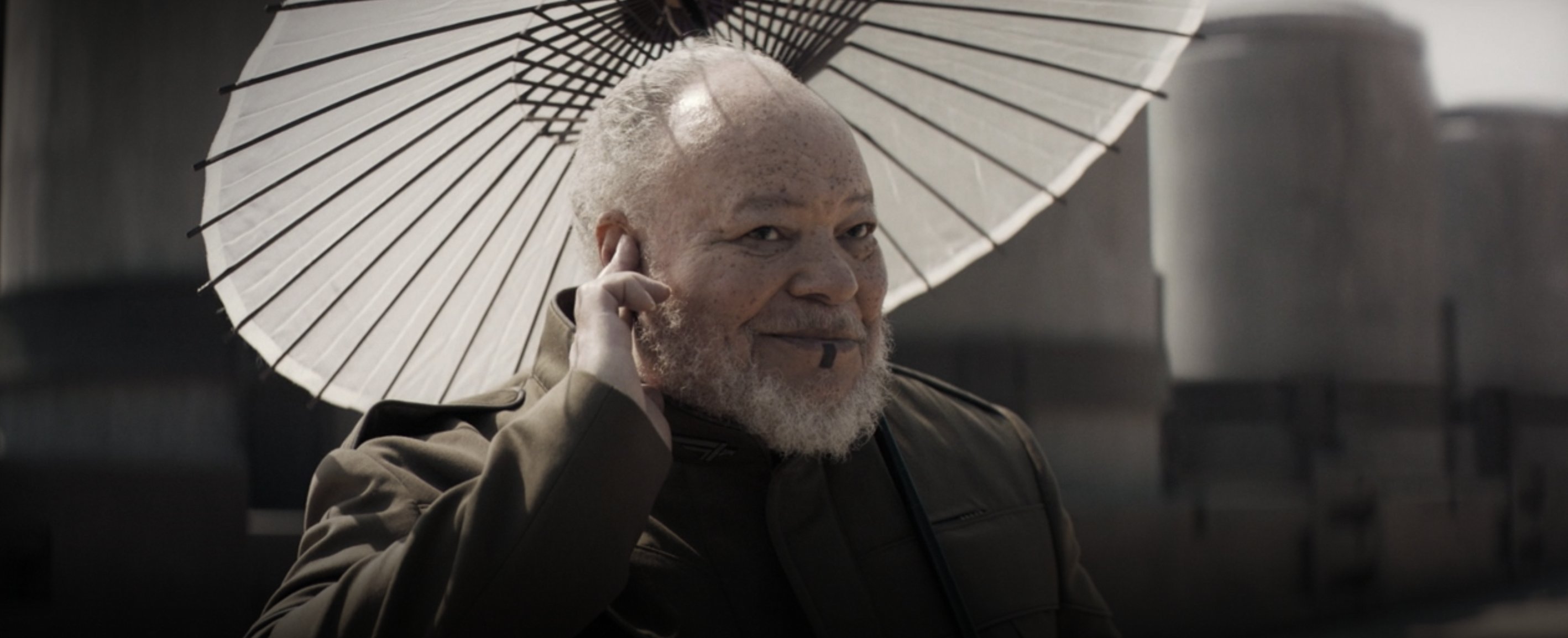
I love Thufir Hawat in the 2021 version of Dune. Stephen McKinley Henderson does a phenomenal job. It’s Henderson’s performance which anchors my love for Hawat, and which leaves me hoping to see the rest of the mentat’s tragedy. I don’t recall having such deep and abiding affection for the character when I read the book (decades ago) or saw the David Lynch version of the movie (also long ago). Perhaps I would feel that connection if I reread the book today, but I wager my fondness would also be a reflection of how I feel for Henderson’s portrayal.

The relationship between Thufir Hawat and Paul Atreides is close. It’s avuncular. This rings true for basically all the Atreides retainers, even Dr. Wellington Yueh in his moment of betrayal, but you can see Hawat’s love for Paul—and his scathing self-judgment—in his immediate and anguished reaction to the assassination attempt against Paul. That continues through the rest of his time on screen, especially when we see his stone-faced, pained stiffness as people commend Paul for outsmarting the hunter-killer.

In fact, 2021’s Dune does a spectacular job of showing us the constellation of House Atreides’ retainers. Villeneuve put so much work into showing us the Atreides as a tight-knit family, as Paul’s family. And the actors played that family to the hilt. It was beautiful. The twisting of their emotional ties as they are caught up in the complex machinations intended to destroy them, the way Paul and each other family member reacts as they see their loved ones shorn away by treachery… it makes the fall of House Atreides all the more tragic.

No doubt that poignant tragedy is why I’m so caught up in the drama of the fall of House Atreides. And why I’m so looking forward to seeing Henderson return as Hawat in Dune: Part Two

I know what the book has in store. Thufir Hawat rises to prominence within House Harkonnen, replacing the Mentat Piter De Vries (poisoned following the Harkonnen attack on Arrakis). In his new position as Mentat for the Harkonnen, Hawat does his best to keep himself alive while setting the Harkonnen against themselves (moreso than they already were). When he finally learns the truth, that Paul survived, he kills himself rather than follow Baron Harkonnen’s orders to kill Paul.

It’s Shakespearean.

Denis Villeneuve has been remarkably faithful to the book thus far. And so I’m extremely excited to see Stephen McKinley Henderson bring all his remarkable talent to the sad path that awaits Thufir Hawat. Thufir Hawat is an excellent tragic hero, and I trust Henderson to once again remind me why I love a good tragedy.

I just hope that the full arc of Hawat’s story makes the cinematic cut.

This is me, sitting with fingers crossed, waiting for Dune: Part Two.

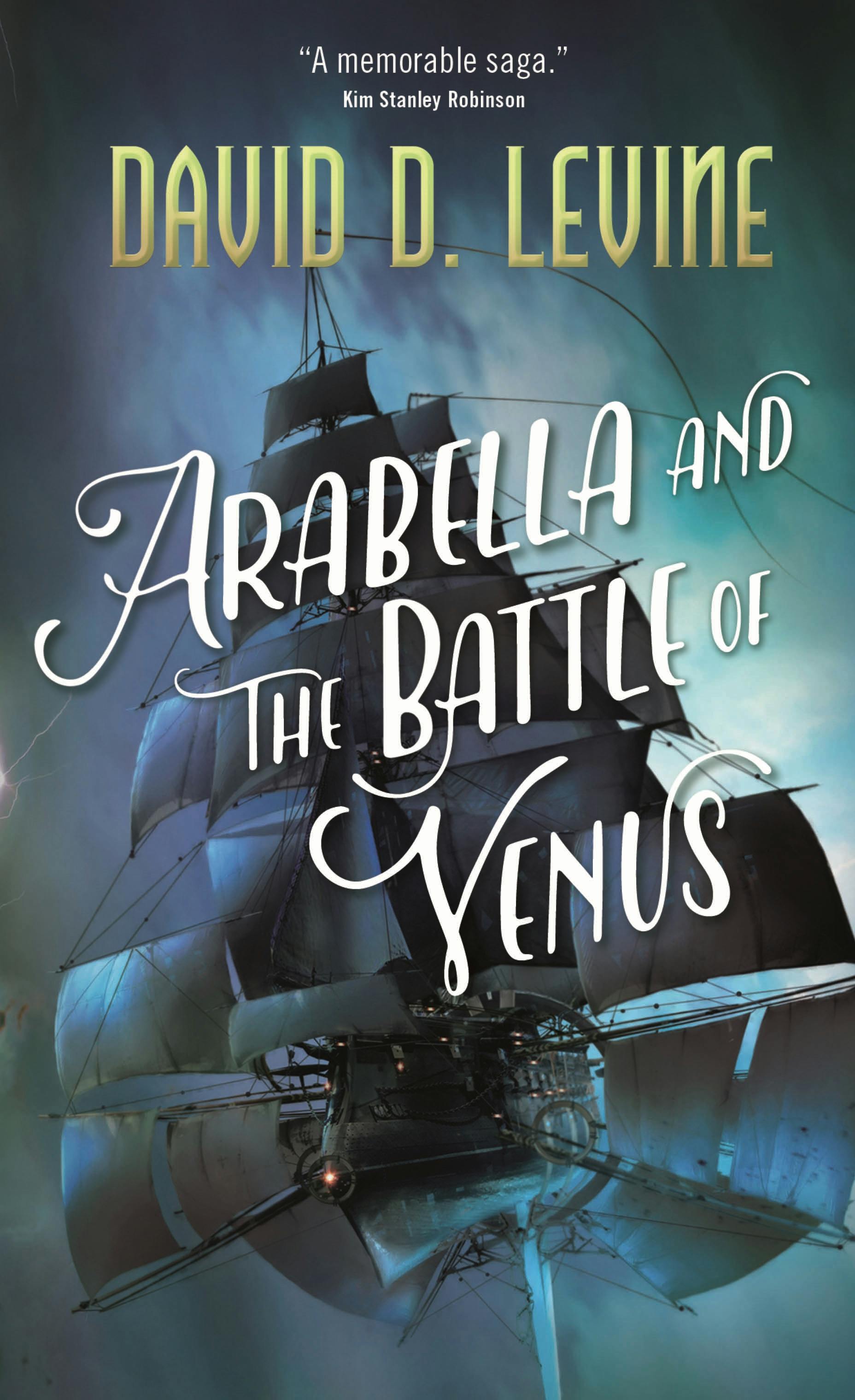
Arabella and the Battle of Venus, by David D. Levine

I really enjoyed the first book in this series, Arabella of Mars, and I’m glad to say that Arabella and the Battle of Venus lived up to all my expectations and then some. David D. Levine has crafted another excellent adventure story in his science fiction alternate history setting. If you like Regency-era drama, Age of Sail adventure, and historical science fiction, these books will (heh, it’s funny if you’ve read the books) float your boat.

If you took my advice and read and enjoyed the first book (yes, I advise you to enjoy the book), I think you’ve got a safe bet with this one. Arabella and the Battle for Venus is a solid sequel. Reading it was a delight, though I did squirm a little bit (more on that in a moment). It offers another excellent adventure while cleaving to the genres of the first book, and reminds me of the enjoyment I found reading Hornblower books in sixth grade but with altogether more depth… and the promise of additional depth to come.

Now, mild thematic and book jacket-level spoilers.

There is a little more weight lent to the romantic subplot this time around, as one might expect from a story about a young woman racing across a war zone to free her fiancé from a POW camp. I hadn’t expected there to be any other romantic complications, though I should have, and those stressed me out a bit! They’re what made me squirm, maybe for the same reasons rom coms do. I’m still not sure I fully understand that part of myself. But—despite my squirming—I think the book and characters are probably better off for those complications. They help to grow Arabella emotionally from where she started in the first book, and I appreciate that.

I’m going to take a tangent here, weaving back through the first book. I’ll eventually return to this book, and my tangent will have some vague thematic spoilers without hitting any concrete plot points.

My biggest concern with the first book was that it wasn’t clear to me whether Arabella—the character or the books in general—would more clearly confront the colonialism and racism of the setting over the course of the series. The first book had some confrontations with these ”isms,” in fairly constrained contexts, but our point of view character Arabella did not seem fully aware of their pervasiveness or their larger ramifications. Nor did she seem cognizant of the implications of her own life on Mars as an Englishwoman living among Martians.

In short, the Arabella of the first book was convincingly blind to problems that her privilege didn’t require her to face. Honestly, that felt very real. I think it was an understandable writing choice, and a solid one.

Crucially, this is not to say that Arabella was willfully blind or actively in denial. She set herself on the right side of those conflicts when they arose, opposing and loudly disagreeing with racist arguments. But it wasn’t clear whether the later books would also dig into the inherent colonialism of the setting.

So. I hoped, and I read into the titles of the two following books and the jacket blurb of this book (Battle of Venus), and I made some assumptions from my sense of the author. All of that, plus the tonal hints of the first book, encouraged me.

Having finished book two, it looks like I was right to be encouraged. I’m glad to say that Levine does continue to bring these issues to the fore. Problems and disagreements slowly and seamlessly bubble up into Arabella’s awareness through her immediate context. The positions Arabella takes and the solutions she finds all suggest that Levine is continuing this thread of growing Arabella’s awareness of the injustices around her, and that these things will all come to a head soon.

Now, Arabella doesn’t feel especially radical from a modern perspective. Arabella’s positions and opinions—as they’ve developed so far—don’t feel revolutionary. Except… they kind of are.

Context matters!

Arabella has a keenly felt sense of justice. She has a disregard for her society’s gender norms that is heartening to a modern reader and would probably place her at the forefront of the women’s suffrage movement in her time, which was (contextually) a pretty damn radical place to be. Her opposition to racism and racist arguments is similarly steadfast, and admirably radical for the time. And that opposition extends to the casual anti-Martian & anti-Venusian racism she encounters, which I think is present to set up for her bigger and more overt confrontation with colonialism in the third book—though that’s merely genre-savvy speculation, since I haven’t read book three yet.

Basically, it looks like Levine has planned all this from the outset, just as I’d hoped. He pulled apart Arabella’s various stages of personal growth and burgeoning awareness into three books, allowing her emotional and political arc to develop across multiple perfectly solid adventure stories. If he’d tried to write this personal arc all in one go, the book would have felt congested and emotionally tumultuous—Arabella’s growth would have felt implausibly rushed and unreal. Instead, because Levine paid attention to spacing this arc out across narrative time and separate books we’re able to enjoy Arabella’s personal growth without ever choking on it.

This is another good example of the dynamic I mentioned in my reflections on Murderbot.

Given all that, I suspect that Levine will stick the landing in book three. I’ll let you know once I’ve finished it.

Okay, that’s enough for now. Like I said at the start, I’m really enjoying these books. Unless those genres I mentioned above sound like torture to you, I suspect you’ll enjoy these books too. Try them out!

Wait, one last thing. Based on his Author’s Note, David Levine finished this book while losing his wife to cancer. Finishing a book is hard enough in good times. I can only imagine that doing so (and doing it well) while experiencing that loss must be tremendously painful and difficult. David, if you read this, thank you for this story. And thank you for persevering to share it with us. May Kate Yule’s memory be a blessing and a comfort for you.

The Golden Enclaves, by Naomi Novik

I’ve deeply enjoyed reading Naomi Novik’s Scholomance series. I’ve recommended it to many people. And now, having finished it, I’m going to recommend it to you again.

This is how I started my review for the first book in the series:

“[W]hat if Harry Potter, but the school is *literally* a death trap full of monsters and there aren’t any adults around to ‘help?’” Add some socioeconomic inequality, teen drama, a pinch of prophecy, and an antisocial and justifiably angry teen girl for a narrator, and you’ll have a pretty good idea of what Naomi Novik’s A Deadly Education is like.

The Golden Enclaves delivers a solid close to that story. It is the third and final book in the series and—while the book ends with room available for more sequels if Novik changes her mind—the story is definitely concluded here in ways that will satisfy most readers. “Most,” because I know some folks will just want the story to keep going with these characters forever, which I believe is all according to plan for Novik (or at least a feature rather than a bug).

This book does what I wanted it to do. It resolves many hanging plot threads, it answers a series of questions I’d had since the first book, and—maybe most importantly—it dreams up a future in which people are able to make the world a better place, by hook or by crook. It has hope.

*That’s* the bit I’m most impressed by. That hope.

This book is full of a lot of struggle. It’s full of lots of traumatized kids. People die, or are hurt in awful ways.

But it’s hopeful. And it’s not hopeful in the Harry Potter “let’s go back to the world as it was, and pretend that without resolving any of the issues we’ve discovered everything will be fine” kind of way. It’s hopeful in the “let’s do our damndest to make the world a better place, without destroying it in the meantime” kind of way. The whole series has been hopeful like that, but this book really sticks the landing. And I love it for that.

So many YA and YA-adjacent stories are dystopian, and the resolutions to their dystopian problems rarely feel hopeful or real to me. Either the dystopian world remains awful, or the attempted fix doesn’t work, or the fix works but reeks of deus ex machina and only works because the author says it does.

Novik set up a whole bevy of problems in the first two books and made it clear that the world was an unfair and often awful place. She offered (difficult, dangerous) ways for her characters to work around those problems.And this book, like its series as a whole, manages to follow that thread through to the end without either disappointing me with a total lack of plausibility or falling into hopelessness.

Annnnnnd I hadn’t realized until now that I never reviewed The Last Graduate, the second book in this trilogy. That was an oversight. I’m not going to rectify it before I finish this post though, so here goes.

A warning: if you didn’t like El’s voice as the narrator in the first two books, this series might not be for you. Novik was extremely successful with her creation of her narrator’s voice. She does a good job of keeping everything inside El’s head, and of maintaining El’s voice as a consistent thing. Novik also manages to weave her story and world through El’s unreliability as a narrator without leaving us, her readers, totally bereft of clues that El might not be the most objective and reliable observer. I really admire that. It’s one of the things I love about these books. If that bothers you… you’re out of luck. Try a different series.

A separate warning: one of my friends mentioned El knowing or narrating a few things in this book that seemed outside of her scope of knowledge. I didn’t notice those as I was reading—I was quite caught up in the story and may have missed them. You might stub your toe on them though.

I’m not planning to dive deep into the plot of this book, but I will say that reading more will probably spoil you for the previous books with implications if nothing else. I’ll also casually drop in a few spoilers after this paragraph without further warning. If you care about that, I suggest giving the first book a go. I loved all three, I recommend them, and Novik has done a good job of starting this series as she meant to continue it. The series isn’t bereft of twists, but it’s very thematically consistent—if you like the first book you’ll probably like the rest, and vice versa.

The Golden Enclaves picks up precisely where The Last Graduate leaves off. Very precisely. And the rest of the story doesn’t honestly take all that much time as the setting reckons it. There’s a little slow period near the beginning as El tries to recover from her time in the Scholomance (more or less a machine for traumatizing children until they’ve survived hell). But after that, things move a bit faster. And they snowball wildly out of control, as El finds out what’s been going on outside the Scholomance while she and all the other kids were locked in hell.

Despite this—or actually because of it—there’s still plenty of time for Novik to ladle in several more hefty servings of revolution and commentary on inequality, until they become a driving factor of the story. That’s perfect, because it’s part of what I’m here for. She also adds more queerness, as she did in The Last Graduate, but where it felt unforced in The Last Graduate here it feels more like a surprise.

Don’t get me wrong, I’m still here for it. I’m glad that Novik added more queerness, I’m glad to see it in this story. And next time I would love to see her do more of that earlier in a series. Having El find out that she’s surprise-bi in book three, however, felt a bit like a curveball given how carefully Novik sets up almost every other story element, like Novik improvised that element where she’d planned all the rest. Or maybe I was too oblivious, because one of my friends was shipping El and Chloe really hard at the end of book one.

Anyways. My words and thoughts are wandering.

If you want to read about wizard revolutions, or about magically obstinate people warping the world around them into a less destructive and more just place, this is for you.

I love this book. I love this series. I recommend them both. I hope that you enjoy them too.

p.s. my partner pointed out that I gushed more about this book in person than I did here, and I’ve made a couple edits following that. Don’t hold my gray brain weather’s bland tone against this series, I really did delight in these books, and in sharing them by reading them aloud to my partner.

Review of A Restless Truth on Geekly Inc

I’ve got another review on GeeklyInc for you, here. This one’s about A Restless Truth, sequel to A Marvellous Light, both of which I enjoyed a great deal. Spy fiction, high society drama, romance, magical intrigue… it all fits well together. I may give you more of my thoughts on the book here in the future, but for now I suggest heading over to Geekly Inc to see my words!

The tl;dr: Freya Marske does an excellent job blending sapphic romance, murder, magical society drama, and sexy times. I continue to be delighted by her blending of spy fiction and society drama, and I’m looking forward to book three!