Becoming a father has changed my experience of my gender.
I think it’s a good change, but it (like most parts of parenthood) also feels like more work.
I have previously felt times of less attachment to being male or masculine. Not that I felt feminine, but that I felt non-binary; neither binary descriptor felt right. I thought of myself as a skeleton, like las calaveras common to Mexico’s celebration of Día de los Muertos. Free of flesh to define me, to constrain my emotions and experiences and connections, at my core I was just my dancing bones.
Some of my ambivalence came from my awareness of the ways in which I was perceived as masculine by others. I could see how people gave me room and treated me like a threat. This was especially true of my interactions (or just coexistence in public spaces) with women and femme people. Feeling like I am automatically scary doesn’t feel good; I don’t like feeling scared in public, and I don’t like making others scared either. Being scary, seeing people close themselves off or avoid me to not even risk an interaction, is isolating and lonely as hell. It hurts.
I cannot decide how others experience the world. Others’ fear of me will always be partly outside my control. But I took action as I was able: I habitually made myself smaller, spoke less and more softly and in a higher tone, and avoided approaching others’ space or blocking others’ ability to leave a shared space. It seemed like the polite and considerate thing to do, and I hoped that maybe I would feel less isolated as others felt less afraid.
This self-constraint helps sometimes. It has never been enough. I’m glad when it works, but the constriction does not feel good—I’m squeezing myself into a too-tight box by carving off chunks of my self.
I have also long been aware of the ways in which being seen as masculine constrains my self-expression. Cultural expectations require me to mash myself into another even smaller box, or else face consequences. Here are a few things that have felt unavailable or transgressive: sharing or expressing feelings, engaging in affectionate touch with a friend, being friendly or making connections with others, appreciating others, offering warm emotional support, wearing interesting colors or patterns, or wearing clothes of certain cuts or tightness. Doing any of those in public or around strangers often felt implicitly dangerous. Any of those actions could label me as other (“queer,” “gay,” etc.) or a threat and thus open me to social or physical attack—usually from other men, but sometimes from women too.
Given all this, I did not expect that having a son would make me feel more attached to being masculine.
I didn’t expect it, but perhaps I should have seen this coming given my experience working at summer camp. I was often one of the older perceived-masculine figures at camp, and I embraced that position as a role and a duty. I wanted to offer a model of masculinity that defied those constraints and showed campers that it was possible to be masculine (or masc-presenting) without carving yourself up to fit some antiquated emotionally-stunted ideal.
Having a son turned that optional summertime duty into a full-time occupation. It made it deeply personal. I’m not just trying to model a masculinity that differs from the cultural norm for campers, I’m giving my baby the breathing room to be however he wants to be.
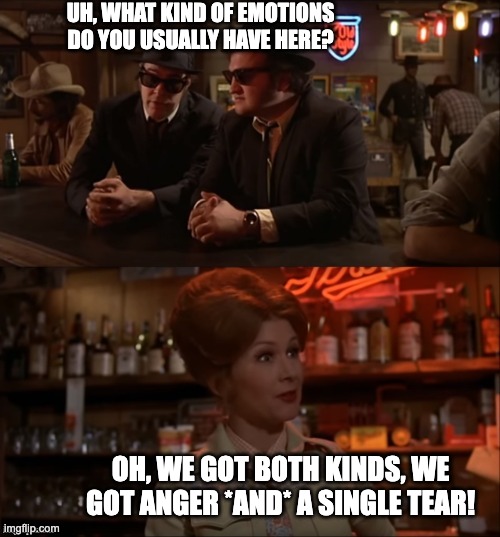
Now when I notice that fear and self-constraint, I try to push through it and act despite it. I don’t want to give in, to cede ground, to let others’ ideas of masculinity stop me from showing my son that he can express more than just anger or a single tear. I’m not going to stop avoiding being scary in public—that’s an important skillset for my son to learn too, something I want him to be aware of—but I want him to know that he doesn’t have to live in the too-small box that I grew up with. I want him to know that masculinity can be larger and encompass more than it did for me.
That means being the full range of myself, as uncomfortable as that might be. That means being the full range of myself even in public spaces where younger-me (or present-me) might fear the repercussions. I want to give my baby that full range, because when you stop using that full range you start losing that full range.
As I learned after high school, the work involved in rebuilding that emotional range is difficult and exhausting. You’re better off not losing it in the first place, if you can avoid it.
Who knows, maybe my child is trans and won’t want to be masculine. Having my baby want to follow in my gender-role footsteps is not the important part. The important part is that I’ll have shown my baby that men can be more than cold, hardened, and strong.


Pingback: Fatherhood & masculinity, cont. 7/9/26 | Fistful of Wits