The Duke’s Men: A DungeonWorld Adventure

A few days ago, I ran a game of DungeonWorld for two of my friends.  It went so well, and ended up feeling so much like a classic Dungeons & Dragons adventure, that I thought I would share the basics of the game with you.  It’s somewhere between an actual play and a scenario description.  I’ll put up an honest-to-goodness Dungeon-starter soon, and with a little creativity you should have an easy time converting it into your own single- or double-episode game.

We didn’t look too closely at the backstories of our heroes, but please allow me to introduce you to the adventures of Kate the thief and Jonah the ranger (and Jonah’s wolfhound, Erasmus), the loyal representatives of Duke Blackforest.  What follows should allow you to live out their adventures for yourself, or change things slightly and experience the adventure anew with other people.

Continue reading

And Then You Die: A Good (Character) Death

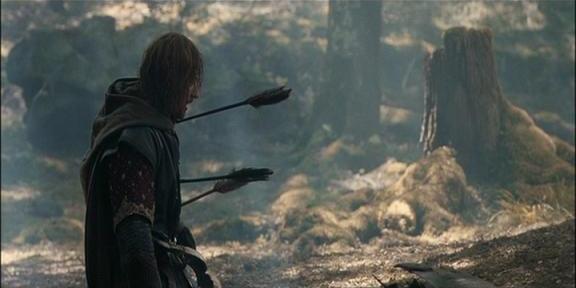
boromir-death-three-arrows

Bye bye Boromir.

I love Boromir.  I know I’m not the only one who does.  And however much I like Boromir when he’s alive, there’s something that’s almost even more (tragically) appealing about him dead.  This is less because I like his ruggedly handsome corpse, and more because of what Homer touched on thousands of years ago: in his death, because of how he died, Boromir becomes something more than he was in life.  Boromir had what we might call a good death.  Key to this, Boromir dies before he truly succumbs to the power of the Ring, and in his death he tries to make up for some of the mistakes that he has made previously.  His act of self-sacrifice protecting the Ring-bearer is a fairly hefty weight in his favor on the scales of Judgement, making up for some of his earlier errors.  Interestingly enough for such a perilous setting, he is also the only member of the Fellowship to die and stay dead.

It turns out that that single heroic death is pretty standard.  Most stories, like most role-playing games, don’t have lots of character death.  In reality, people engaging in the same activities that most adventurers and main characters pursue with wild abandon have a fairly high casualty rate.  People are killed while fighting, they’re permanently injured, they get sick… and in many cases, their deaths and debilities feel meaningless.  For every handful of people that die doing something we would idolize as heroic, far more are killed or injured in an almost banal fashion.  Would we feel the same way about Boromir’s death if he had, I don’t know, been killed without having a chance to fight back?  Stepped on a landmine?  Slipped in the shower and broken his neck?

Continue reading

Define Your Terms! Talking about RPGs

Let’s start with the title.  When I say RPG, I (usually) don’t mean rocket-propelled grenade.  Usually.

No, this post is meant to unpack the terminology surrounding role-playing games, and to be used as a future point of reference.  I’m also going to refer back to Mattias’ excellent post about role-playing, because he did such a damn fine job of describing what role-playing is.

All three of us have written about role-playing games (check out the GMing category, and look at the older articles).  Yet for the most part our posts have assumed a certain level of familiarity with RPGs and their terminology.  I’ve certainly presumed that other people know what I’m talking about; but what the heck does it mean when I call a system “sparsely elegant“?

In an effort to minimize confusion, here’s a quick primer that will begin to bring you up to speed.  I’ll do my best not to cover things that were done better elsewhere (see Mattias’ article, really), but there may be a little bit of overlap.

The terminology and topics that I plan to cover…

Continue reading

Temple in the Sands: A Musical Teaser

I’ve been working on a module for Call of Cthulhu for several years now, and I’ve finally found a model I like for organizing my written content.  It’s not fancy, and I’ll have to alter a few things eventually when I get around to posting maps and pictures alongside the text, but it will mean that other people can play the game that I’ve made without me running it for them.  But the module isn’t done yet, and is already far longer than most of our posts.  So with that in mind…

Continue reading

Fleshing out the Details

So now that we have a setting, let’s add in some details! One thing that can derail a campaign most are details. Why? Well, because details are at once meaningful and arbitrary. That is, details have to be consistent with your universe, and they shouldn’t establish any themes which your  universe/story isn’t tackling, but they also aren’t always important. I once had to name a tavern at random. So I decided on a color and an animal/cooking object. After all, Black Bull, and the White Swan, or the Red Ladle, are all perfectly good tavern names. And this is how I ended up with the Red Bull Tavern, something Henry was so nice as to tease me about it here, and I’ll probably never hear the end of how I named the Mayor ‘Hamer’, which was intended to be pronounced “ha-Mare”, but ended up being called “Mayor ha-Mayor”. So it is important to make sure to make sure that your random details are unobstructive. But how do you craft important details that are meaningful?

Continue reading

Gamer Typology a la Robin Laws

We’ve been talking a lot about improvisation and working with your players, but we haven’t given you nearly enough background for the topic.  There’s a book that I found years ago called Robin’s Laws of Good Game Mastering, and I lend or recommend it to every one of my friends who asks me for tips on how to be a good storyteller.  I like it so much that when I started looking through my old copy again while I was starting this article, I had to stop myself from simply quoting the book word for word.  It’s more than just a good place to start; the book has an impressively down-to-earth approach that will give you a basis for campaign and adventure design, for preparing easy improvisation, and for reading and managing your gaming group’s social (and problem solving) dynamics.  It also offers a very simple gamer typology that should allow you to identify what drives you and your players and what rewards them most in the realm of RPGs.  If you’re interested in gaming or in group dynamics, I couldn’t recommend a better read.

Continue reading

Zompocalypses: A New Look

gentleman-gustaf-figure

Zombies are one of the common narratives to arise in the modern era. People say this is for a lot of reasons. I can talk on and on about how zombies represent the mindlessness of the modern era, from driving to work to a day-to-day cubicle life to consumerism to the seeming emptiness of modern day choices, whether it be brands of soda or the similarity of politicians. But ultimately, this is unimportant: zombies have captured hearts and minds in the modern era.

We can trace the start of the zombie movie epidemic to three major sources. First, the idea of mindless human beings can be traced to Haitian Vodou. Second, George Romero’s Night of the Living Dead can really be called the ancestor to zombie apocalypses. Finally, at some point, the idea of zombies as an infection of some sort has arisen over time, and while I cannot think of a specific source which serves as its origin, the Resident Evil movies will serve as a good exemplar.

So why am I talking about zombies? Because the first setting I’ll be writing about is a zombie setting. And as I said, a good setting plays to tropes, but denies them in some way. A setting that is nothing but tropes will seem campy. On the other hand, a setting that fully defies tropes isn’t really a continuation of the theme, but a new thing entirely. After all, George Romero never even referred to the shambling cannibals in his movie as ‘zombies’, that terminology came later. He wasn’t bringing new light to Vodun Zombies, he was starting a new genre that happened to end up connected to an old genre.

So first, I’ll have to outline what the tropes of zombie apocalypses are, and then which ones I’ll be breaking, and why. Finally, I’ll discuss the effects this has on the universe.

Continue reading

How to Craft a Good Setting

For me, the most interesting part of a creative body of work is the setting. Many people will talk about the characters, and how interesting they are, or the growth they exhibit. Others will point to the plot. But for me, the setting is the foundation; it sets the grounds for any ‘what if’s that the body of work is asking. Now, there are two general qualities of settings.

The first is the obvious: the familiar. By ‘familiar’, I mean that the setting corresponds to our notions of how it typically is. Familiarity is the reason that elves are tall and willowy and removed from the world, dwarves are short and stocky and miners who love alcohol, and halflings/hobbits are playful but possessed of personal hardiness. Familiarity is why protagonists are young and leave their village with mysterious outsiders, and why young people from small towns are protagonists at all. Familiarity is how we know sons kill fathers and hand-loss will show up in half of sci-fi and fantasy, and everything comes in threes. Familiarity is the stuff on which tropes are built.

In this, a good setting is a lot like a good joke. A good joke is all about establishing expectations, building up a story that we all know and understand, and then, in comes the second element: deviation. I agonized over that word for awhile: ‘deviation’. At first, I thought ‘surprise’. But surprise wasn’t quite the word I was looking for. Surprise indicates that you didn’t really see what was coming; didn’t have an inkling. And while there is room for genuine surprise in stories, for the most part, the spectator — the reader, the watcher, the listener — should see the punchline coming. They might not exactly know what that punchline is, but when it does come it should be followed with ‘of course!’ Whether that ‘of course!’ is followed with an ‘I knew it!’ or a ‘How did I not see that coming?’ is largely irrelevant, although it should fall somewhere on that spectrum. That is to say, the context (the setting) should lead up to the punchline.

In a sense, the conclusion — the end of the book, the punchline, the moral — should feel INEVITABLE, even if it wasn’t predictable. When you hear the ending, it should immediately ring true as the ending, or the setting wasn’t established properly. It certainly isn’t impossible that Frodo could simply take the ring at the end of The Lord of the Rings, but it wouldn’t fit in with the tropes of the book: that hobbits are strong of heart and will, that all ages must come to an age, including the age of The Ring and Sauron (much as the age of the Elves is coming to an end even as the books begin), that the thing that distinguished Gollum from Frodo was his close friendship with even just one remaining entity (whereas Smeagol had killed Deagol). Essentially, the plot should live up to the promises that the setting makes, establishing a strong unifying theme.

Now, I’m playing a little fast and loose with ‘setting’, because I’m starting to include parts of the story. But in this case, I don’t mean the plot. I mean the tropes, the imagery, and so on. Sure, discovering the tree elves of Lothlorien happens as a part of the plot, but it is itself not plot; it is a revelation of setting to the spectator. inverting that story in ways we don’t expect but can still clearly see. Reading about a character losing his hand, or being seen surrounded by ravens, or dying and coming back to life is plot, yes. How it happens is plot. But it is also setting, because it serves to establish what tropes the author finds important, and how he chooses to invert them.

If I can walk you through a few examples, I think this will be made clear, but as always, I must warn you of spoilers. In A Song of Ice and Fire (Game of Thrones, on TV), Ned Stark is established as the protagonist quite early on. However, he is killed off before the first book in the series ends. Yes, this is a plot point, but also acts to establish the setting that George R. R. Martin is writing in: in A Song of Ice and Fire, life is short, brutal, and ugly, and you can trust nobody. In a sense, this helps to establish the context of the story. And when the punchline finally comes, that context will be important.

So ultimately, a good setting uses tropes and setting devices to establish the tone of what is expected to happen in the plot.

As such, I’m going to try a new project for my new posts; I’ll be posting a setting I’ve designed, according to these principles, talking about the tropes it exhibits, and how those tropes are inverted, and what those inversions mean!

Player Knowledge and the History of RPGs

First, two quotes to start us off:

“No plan survives contact with the enemy.” (paraphrased quote from Helmuth von Moltke the Elder, a man who was actually quite keen on extensive planning and who might be considered the great-grandfather of RPGs)

“The players are the enemy.” (the storyteller’s corollary to the first quote, promoted in old gaming literature and still embraced by some gamers today)

***

I’ve often heard these quoted, seriously or jokingly, by my RPG playing friends.  The first one I agree with: opposition is a chaotic force, and will often ruin your most carefully laid plans.  The second one I only agree with insofar as players are an inherently chaotic force.  They are other people, and will often do the unexpected.  Unfortunately, the second quote is often interpreted literally.  Players are seen as the opposition and their characters are therefore meant to be outwitted, led by the nose, and then set upon while at a disadvantage.

Worryingly enough, I most often hear these quotes spoken seriously by my friends who have not yet run many games.  With a literal interpretation, where the hell do those two quotes lead us?  If the players are the enemy, it stands to reason that everything the storyteller does is in opposition to the players.  More to the point, it sets up a clearly antagonistic relationship between the players and the storyteller in which the two sides have no reason to cooperate with each other.  It’s like they’re not actually playing a game together.

If they are playing a game together, it’s more like a strategy wargame in which all details are included solely to “get” the players.  This is, of course, where the genre originated: the first games that we would recognize as RPGs grew out of wargames, as the logical result of a progression towards smaller and smaller unit sizes.  Eventually, each player had control of only one individual instead of many units, laying the foundation for the RPG genre that we know today.  The influence of modern gaming’s military history is still visible: the habits of secrets and hostile surprises that we have come to see as part and parcel of the RPG experience come from this background of wargaming.

But even as someone who enjoys wargames, I don’t always want to play a wargame when I sit down to play an RPG.  There’s an opportunity here to explore gaming without those holdouts baked in, and some game designers have been pushing in that direction for years.  Yet if we aren’t following in the habits of our wargaming ancestors, what do we do?

Continue reading

Rolling with the Punches

gentleman-gustaf-figure

For me, as somebody who GMs far more than he plays, roleplaying is all about rolling with the punches. You obviously can’t predict 100% what your players will do, and you can’t predict die rolls, or whatever random element is important in your system. Basically, shit happens, and you’ll have to deal with it. Here are a few tips I’ve found to make that easier:

Continue reading