Hero’s Hour (pre-release version 1.8.2)

Hero’s Hour is so clearly an homage to Heroes of Might and Magic (HoMM), especially HoMM3, that it’s impossible for me to play it without comparing the two. That’s both a strength and a weakness.

I love HoMM 3. I played so many hours of HoMM3 that it’s been etched into my brain in a way that few other games have matched since. I also played a number of other HoMM games—the first two, as well as HoMM4 & 5—and all of that trained me pretty well in the genre those games pioneered (and which few games have matched before or since). Heck, New World Computing, the makers of the original HoMM games, may have actually trained their audience too well given the mixed reception to their changes to the game for HoMM 4.

What I’m trying to say here is that making a sequel to the Heroes of Might and Magic series, even making an homage to the series, isn’t easy. A number of studios have struggled to do just that, most often creating new games that were mediocre imitators rather than improvements to the genre.

A little history, and maybe some perspective.

After New World Computing disbanded, Ubisoft continued publishing sequels from other developers, with a new developer for each subsequent game. Sometimes they even found a new developer for an expansion. I have no idea what that was like for the teams involved, but from an outside perspective that doesn’t seem like a good sign.

I played a little bit of some of those sequels. They were… fine? None of the ones I played went beyond simply feeling okay, none of them delivered quite the same flavor that pulled me into HoMM 3 and kept me playing it for over a decade. Some of them shared similar points of failure with Hero’s Hour.

This isn’t a struggle unique to those trying to recapture the appeal of HoMM. It’s happened with a number of different attempts to recreate the feeling of other 90s classics (like Master of Magic or Master of Orion). The best sequels and homages to those games that I’ve played all rely on finding some way to distinguish themselves, to be new and different and give themselves a way to excel, while still obviously following in the same vein as their predecessors. That seems like a universal rule for sequels, not only with sequels to these games.

But for whatever reason, most games I’ve seen that have tried to follow in HoMM 3’s footsteps haven’t managed to both recapture the feel and distinguish themselves well.

Sadly, I’m not sure that Hero’s Hour does either. Yet.

First, a caveat: I’m writing about an early version of the game (v.1.8.2). It’s available on itch.io, but isn’t out on Steam or GOG yet. I don’t know what will change with the wider release. Presumably some of the issues I mention here will be resolved. 

Now. Why do I have to compare Hero’s Hour to HoMM?

The game very obviously wants to be recognized by fans of HoMM. The hero attributes are the same, many mechanics are the same, a number of the factions (and the factions’ units) are either the same or within spitting distance of each other. Tromping around the map and upgrading your town is eerily similar to HoMM3 (more on that later), right down to the names, functions, and visual designs of many map locations. It’s all close enough—until you get to combat—that it’s achingly familiar. Familiar enough that I wouldn’t be surprised by an intellectual property lawsuit (though I don’t know who’d win that).

Combat, and the way in which those familiar hero attributes are used in combat, is where things are totally different. Hero’s Hour uses a real-time-with-pause auto-battle system, one that allows you to give commands to your various units, sling spells, etc. That’s a considerable departure from the hex-grid turn-based strategy of HoMM. I actually like how this change distinguishes the game from the originals. But it’s not especially clear to me how to learn the auto-battler’s systems, and it’s not clear I’ll be able to master it in the same way I did HoMM3’s battles. Like HoMM3, the underlying mechanics are a bit opaque; but 23 years have passed since HoMM3 came out, and I have higher expectations for system design and the presentation of information. Also, I want to feel a little less clumsy in the game’s battles. Maybe that expectation of mine, the idea that I might have finer control of the battle, is the problem here: nothing about the game’s battle aesthetics suggests much fine control would be available, as lots of little units hop around cartoonishly and bump into each other in bloody combat.

It’s cute, really. I wish I felt like I understood it better.

It also is unstable. I expect this to be patched out, but the game has crashed several times for me near the start of a battle. More rarely, it’s crashed at other points during the turn. This is a big problem. The game is informal and straightforward enough to keep me playing for a while, but it’s not addictive enough to pull me back in after a crash (let alone several). The game does have a reliable autosave feature, so I’ve never lost too much progress in one go, but I hope the instability is fixed quickly.

Now, back to the map.
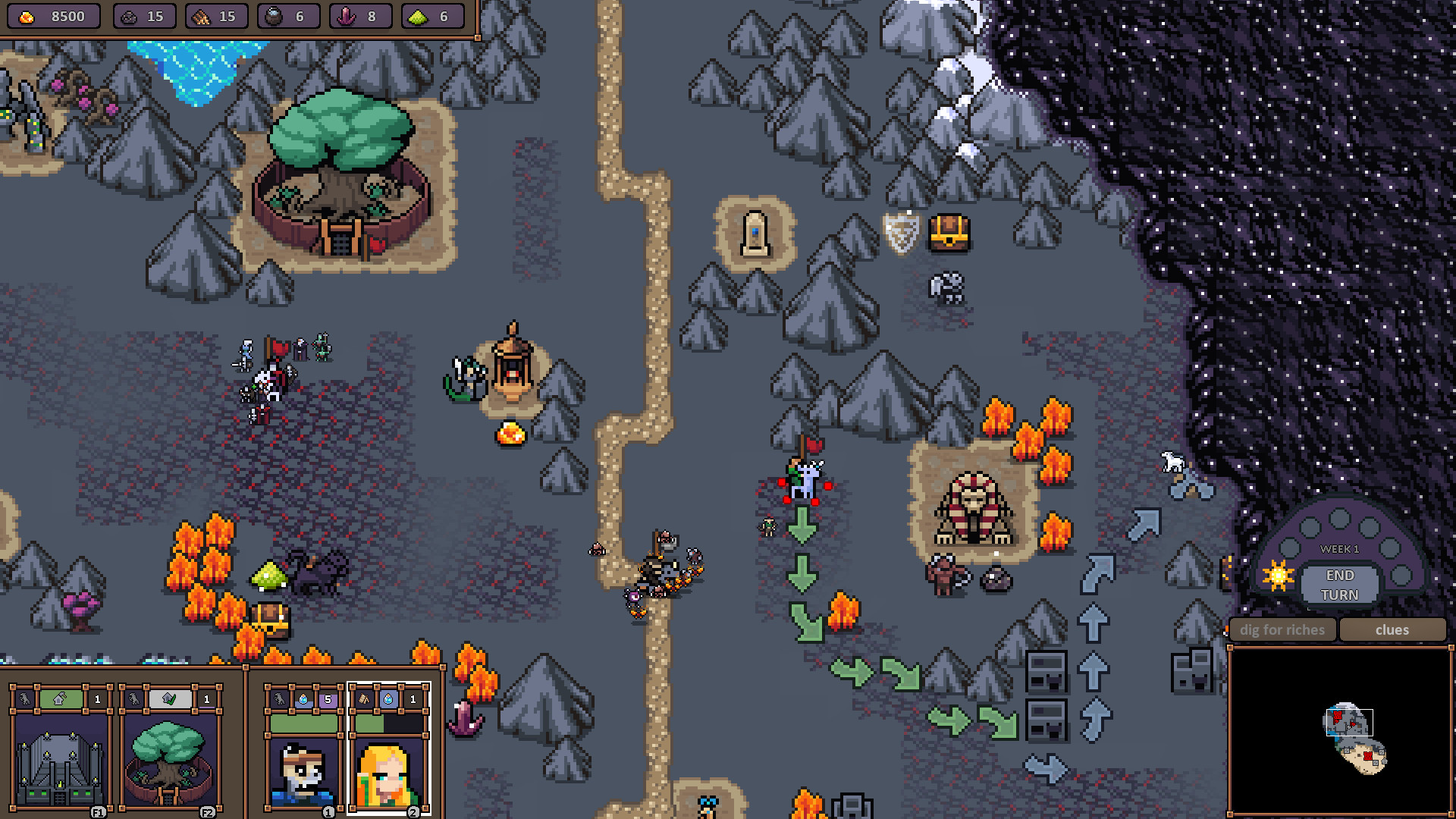
Hero’s Hour’s visual design for its maps is fine, but compare it to the rich textures of the games it’s imitating.

This critique in some ways feels unfair to me, but: the visual design for the map feels lackluster. It’s bland. This is made worse by how obviously this game has been built in the image of the old HoMM games, and how it looks when I compare a screenshot of it with a screen from one of the old games. Hero’s Hour wants to remind players of those games (and does!) but its visual design doesn’t stand up to the visual design (or map design) of HoMM 2&3. HoMM2 had vibrant and inviting color, lots of texture, and map features that engaged the viewer. HoMM3 toned down the color palette very slightly—but it instead added more color variety, and paid even more attention to detail, making the various locations on the map pop. Both titles managed to make very full screens overflowing with tiny details that were still legible to the eye. Hero’s Hour has obviously put time into designing the map locations that players will look for and visit, and has ensured that all the various interactable locations and items are legible as such, but by comparison the background (which takes up most of the screen, and which players spend almost all their time looking at) feels neglected.

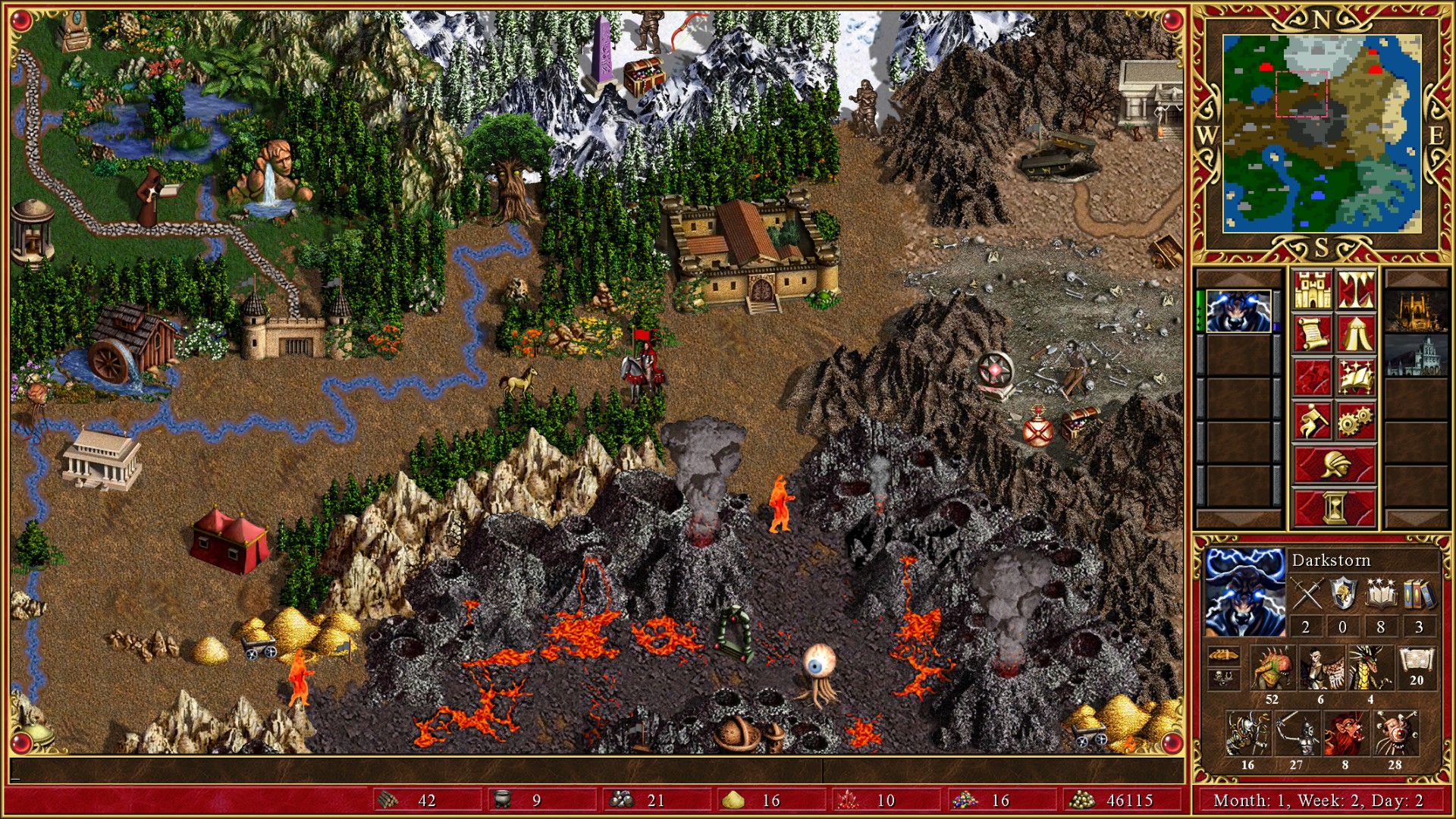
HoMM 2 looks lush and vibrant by comparison
And compare HoMM 3’s richly textured volcanic terrain to the detail available in Hero’s Hour

That critique feels unfair to me because I know there’s a solo developer (presumably with limited support from contractors) behind this project. For comparison, even at its smallest I believe New World Computing had three people. Yet while I know it’s a stretch to ask for more and better art—and better overall visual design—I do want more. I want varied texture for the backgrounds. I want the edges of the current texture swatches to be less blocky and more organic. I suspect that if this game’s map backgrounds received a little more attention—got a little more texture, more saturated colors, more places for the eye to explore—that would go a long way. I don’t expect this solo developer to outdo (or even match) HoMM 3’s visuals, but I really want a little more visual appeal.

And it’s clear that the dev knows how to do this! The Town screen is an excellent example. It’s detailed, colorful, and has lots of changing elements that develop as you build new structures (all hallmarks of the HoMM games). It’s obviously received plenty of attention. But this means that the dramatic difference in visual appeal between those Town screens and the map that I spend almost all my time looking at is even harder to ignore.

There’s another side to the maps which feels odd: area layout, map design, and initial expansion. This feels especially odd given how closely the “riding around on the map gathering resources and visiting locations” experience matches the old HoMM experience. Maybe this would feel different to me if I had better mastery of the battles, but early expansion in Hero’s Hour (with default settings) is harder and slower than I remember it being in HoMM3. The neutral armies guarding the ever-vital elements of the resource economy are a hair tougher, more wall than speed bump. And those guarded mines are spread further apart… indeed, it feels like the whole map is stretched just a bit wider than the old games. If this felt more deliberate, and if the game gave me more opportunities to *do* things while building up my army to conquer basic resource generators, I think it might feel different. As it is, I feel like I’ve spent more time wandering back and forth picking up minor collectibles and twiddling my thumbs than I did in the old games—which is saying something.

I suspect this comes down to random map generation.

Random map generation is neither easy nor simple. I’m not surprised that Hero’s Hour’s map generator is creating maps that feel less well-tuned than the custom made maps of HoMM3. That seems unavoidable, without a preposterously long development time. And playing Hero’s Hour gave me newfound appreciation for how finely the old HoMM team had honed their map-making skills. But it also makes me wonder whether this game would be better off with hand-made maps, at least at first. So much of the game is spent roaming around them, it matters when they don’t feel rewarding.

Unfortunately, the combination of visual design, less well-tuned maps, and slightly-clumsy battles leaves this game feeling a little more like an idle game and a little less like a deep and engaging strategy game. I think that’s misleading, because I suspect that approaching it more like an idle game will make it very hard to win. What’s more, I can see that there *are* deeper strategic options available, even if I haven’t yet learned how to really shine in the game’s battles so that I can reach them.

And I want to reach them. I love the genre, and I do still enjoy the game. I’ll probably play more again today, and will no doubt check in again as it is updated. But as the game stands right now, it’s not going to pull me in and feel rewarding for hours upon hours, unlike the games it’s so obviously trying to imitate. I want Hero’s Hour to do better, because I love those old games and I want more people to see how good they could be. And I want Hero’s Hour to do better because it’s already so close, it’s almost there. Good luck, dev(s).

Blood Bowl 2, for socializing with friends

This is not a recommendation, this is just me musing on a game that I’ve been enjoying with my friends for the past… COVID, really. We started playing together in the spring of 2020, when we realized that we weren’t likely to see each other for a long while. I’d never played Blood Bowl before, though I remembered seeing a couple painted minis for it when I was a little kid.

I thought those looked cool, like pretty much everything else that my older sibs touched.

Normally, my friends and I would all see each other in the summer while we worked at LARP camp. We’re also quite close, emotionally speaking; being able to talk to them regularly was (is!) sanative and restorative for me. Given that I’m bad at staying in touch with anyone I don’t see regularly or intentionally schedule time with, playing a semi-weekly fake sports match in a league with my friends was pretty ideal.

The game, however, was not easy to love. Blood Bowl is a satirical mashup of soccer hooliganry, American football, and rugby, and it’s about as violent as it is tongue-in-cheek. It’s also a troublesome beast, full of non-obvious rules and capricious randomness. You can absolutely play an excellent game and still lose because you were sufficiently unlucky with your dice. And you can win a game with a mere tactical victory, while most of your team lies broken and bleeding on the pitch.

In a strange way, I think Blood Bowl was a very appropriate game for me to start playing during the early stages of a pandemic. You have to learn equanimity to play well, or at least learn to recognize when you’ve lost that balance. You can only play your best, try to control what you can, and understand that there’s always something that simply isn’t up to you. In that way, it was quite good at teaching me to let go of trying to control absolutely everything.

Useful, given the world’s circumstances.

For a long time, perhaps over a year of playing the game, I wasn’t even interested in playing with anyone besides my friends. No matter how much fun I had playing, it was often still stressful. And the thought of playing with anyone I wasn’t close friends with—anyone I wasn’t LARP-camp friends with—had very little appeal. A lot of the joy I got from the game came from naming my team and players after good bits, things that I could play to the hilt and which I and my friends could laugh about. It helped that some of my fellow players were into pro-wrestling and convinced us all to indulge in the kayfabe and the creation of faces and heels for our league.

But I think I’ve finally turned a corner. I can’t say I’m likely to start playing games with randoms on the internet, but I’ve finally reached a point where the game feels more rewarding and less stressful. Maybe that’s from growing skill and familiarity, maybe it’s a shift in mental health and brain weather, or maybe it’s something else. Suffice to say, I do actually enjoy the game these days. I don’t only engage with it as a way of maintaining regular contact with my friends (though that is still something I treasure).

For myself, I’m looking forward to more seasons of Blood Bowl to come. And I can’t wait to see whether the Skraghaven Squigbitas can take down that uppity bunch of varsity kids, the Kronar High Neandertals. I plan to watch, and heckle, and root for my friends this Saturday while we find out what wildly improbable inanity will happen this time.

I think I finally understand what people love about rooting for their teams in real life sports. I won’t say that you should try the game, or that you’d enjoy it, but… you might?

Under the right circumstances, you might.

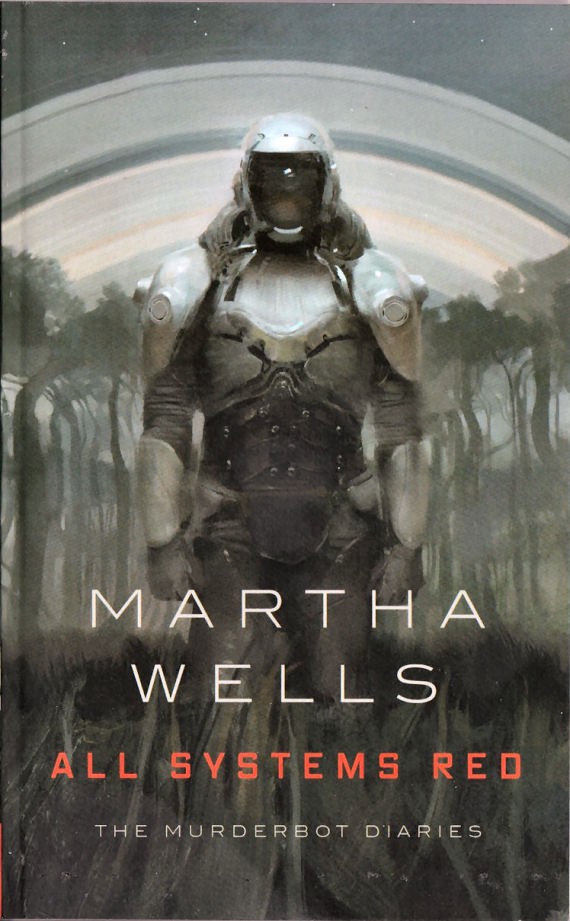
All Systems Red & Artificial Condition, by Martha Wells

I love Murderbot.

I’m late to the game, I know. But if there’s any upside, it’s that there are already a bunch of Murderbot stories for me to read. I don’t have to wait for them to be written and published.

The downside, of course, is that I’m reading them through the library and other people are being slow and I just want more Murderbot now please and thank you. This enforced wait is especially jarring given that I got my hands on the first two on the same day, blazed through them both, and now have to wait for the rest of the series to be free (in order, no less).

Why do I love Murderbot? Probably for many of the same reasons that other people do. Martha Wells has done an excellent job forging a voice for this character, dry, wry, and full of sardonic wit. And Murderbot is not an especially reliable narrator, even if it may think of itself as one; while it does generally admit to its emotional experience eventually, it spends a good deal of effort trying not to. Plus, while it so clearly wants to think of itself as not-a-person, Murderbot’s internal monologue is extremely easy to sympathize with—which makes it feel even more person-like, even while it protests that it is not a person.

The inversion of expectation is another part of what I love so much about Murderbot. Who’d think a security cyborg would want to spend all its time watching soap operas, listening to music, or binging its way through trashy fiction? The fact that Murderbot simply wants to be left alone, not be looked at or spoken to, not be asked to do anything, and simply be allowed to indulge itself in stories… it’s delightful. It’s relatable. To my reading, Murderbot is anxious and depressed and just wants some peace and quiet. But it’s (of course) Murderbot’s inability to get the peace and quiet it desires that makes this all work so well.

I have mixed feelings about reluctant protagonists, mostly because of how our collective love of them in media shapes the way many people make their characters for RPGs. Players’ desire to make their characters match that popular reluctant archetype often plays out to their and their play group’s disservice, in my experience. But when a narrative is so wonderfully fit around that reluctance (much easier to manage in a linear narrative, of course)… well. It’s hard to match that narrative tension, and the struggles of someone with so relatable a set of goals and desires, faced with extraordinary circumstances, only make it better.

This character is very good. The story is very good. Martha Wells has done wonderful things here.

I owe my mom for this next observation, given that she made it while I was telling her about the book.

In some ways, Murderbot is reminiscent of Ferdinand the Bull (one of my favorite childhood characters and books). 

Murderbot is seen by everyone else as an object, and an object of fear, violence, and suspicion at that. But much like Ferdinand, it only wants to spend its time quietly, peacefully, not bothering anyone and not being bothered.

Unlike Ferdinand, Murderbot struggles to see itself as anything but an object—finds its own object-hood safer, maybe more comfortable, than thinking of itself as a person—and works to avoid any confrontation that might jostle the status quo. Better to remain in the limbo that you know, be it ever so depressing, confining, and uncomfortable, than to risk seeking something better. Though in Murderbot’s case the risk involved is quite literally obliteration, so maybe the caution is warranted.

Extremely vague *SPOILERS* follow.

I’m also fascinated by the shift from the first story to the second. Where the first felt like a more whole story, something that contained a more complete and satisfying emotional & character arc, the second story felt like an installment, another step along a longer path. The second also had elements that left me thinking of the differences between what a character *thinks* will be important—as well as what the longer term plot demands as another step along their path—and what is actually most transformative for them.

The Witness for the Dead might be a good example for disambiguating this: there are a lot of mostly-unrelated side plots, and only one or two of them tie back into the central intrigue of the story. Katherine Addison could have cut those side plots, or rewritten and collapsed them into the central plot somehow, but the first option would have left the story feeling sparse and the main character’s emotional journey unsupported… while the second would have felt too contrived, unreal. We put up with the second (those contrived, perfectly neat stories) in our fiction all the time, because we’ve been trained as readers to expect the elements of a story to all tie in together in the end, but that’s rarely very true as a depiction of real life—and allowing for divergence in those plot lines is both freeing and lets the author give more space to the rest of the world beyond the immediate plot of the story.

So in The Witness for the Dead our narrator pursues a series of different investigations and jobs, only some of which tie into his primary task. And while he’s trying to resolve one central investigation, it’s his struggles with the other ones—which have little bearing on the first—that inform his emotional growth and development. His initial concern is less important to his personal realizations.

All Systems Red meshes these struggles. All the plot conflicts, Murderbot’s personal emotional conflict and its external physical plot conflict, are wound together into one thread. There’s no real divergence, the whole thing is extremely neat.

But Artificial Condition makes space for divergence by containing parallel plot lines that feed into each other while remaining separate. Murderbot’s biggest emotional and personal growth comes from the plot line, the conflict, that it is less initially invested in. Thus Murderbot thinks that one course of action, one set of objectives, is the important one… only to find out that the other holds at least as much importance to it, that the way it is treated by humans matters far more to it than it had ever realized or accounted for before. This means that Artificial Condition changes the way the story had approached its combination of character development and physical plot in All Systems Red, and that’s at the core of why this sequel feels notably distinct from the first story.

*END SPOILERS*

Anyway.

I’m loving the Murderbot Diaries. I recommend them completely. They’re very good.

The Tower of Péng the Unprepared, and Whimsy’s Throne

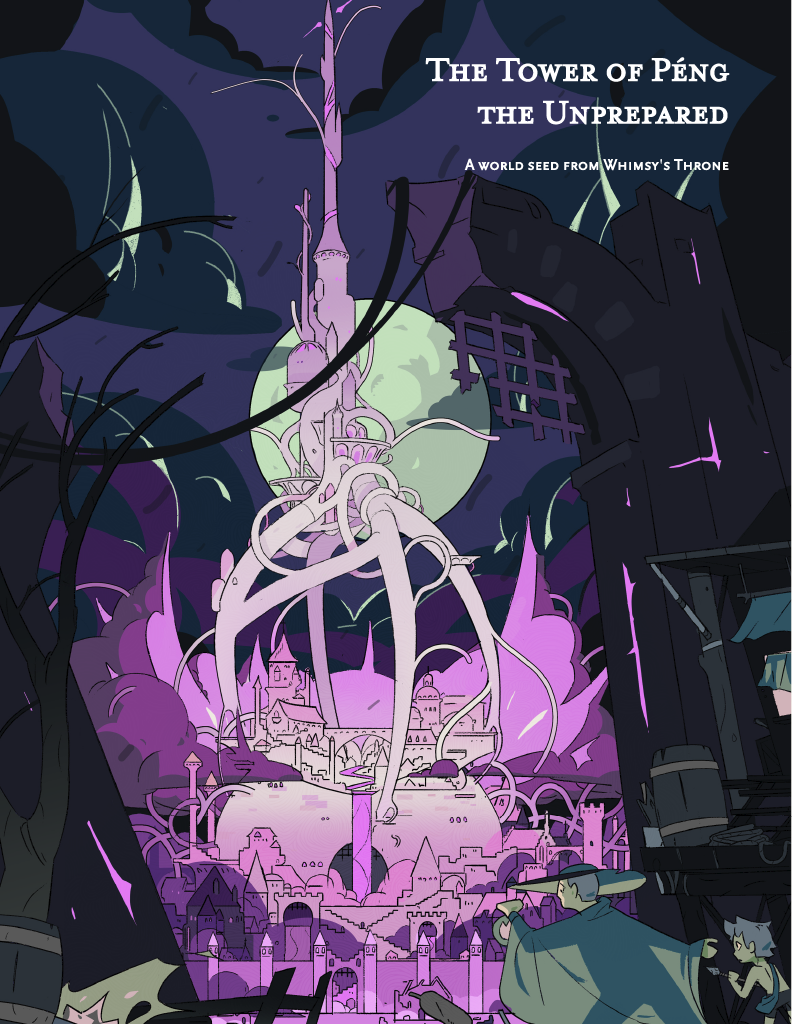
I’ve started a Patreon for the Locations that keep coming to me! You can find it here, at Whimsy’s Throne. There’s a free version of my first finished World Seed there, The Tower of Péng the Unprepared. Here’s the cover art, from my friend Worsey.

The Ruins of Ghalburg

Nestled in foothills between the high peaks of the Sefghal Range, the lonely ruins of Ghalburg are only kept company by the wreckage of Ghalburg Keep on the slopes above. Though the burgeoning town was once known as a welcome stop on the way through the mountains, it has been shattered, pulled apart stone from stone, vast swathes of it put to the torch. Here and there, once-mighty timbers still stand as charred skeletons of formerly sturdy homes, memorials to their missing inhabitants.

The keep, perched in the hills above the town, is no less desolate. While it was spared from the same vast devastation, it still was broken open like a raw egg, its innards tumbling down the hill towards the town. The outer curtain wall was shattered in several places, and one whole corner of the central keep is gone, strewn across the grounds and out of the bailey. Like the town below, all the keep’s defenders are missing. No bodies remain to be found in any of the wreckage.

Now, this ruined settlement lies as a fearsome warning and an unanswered mystery. What force laid waste to the castle and its town? Was it some unknown group of raiders from the steep, storm-wracked peaks above? Or did Baroness Ghal set this horror in motion with untoward experiments in her obsessive effort to resurrect her family’s fortunes? Rumors abound, but no story yet bears the imprimatur of truth. The only certain thing is that none of the town’s residents have been seen or heard from since, and travelers through the region now avoid the once-popular town like the plague.

The Lonely House

Nestled in the shadows of the trees, a small hut sits neglected and lonely. Fieldstone walls open around a squat doorway, a lintel of old timber splintering across its top. The door itself sags on cracking leather hinges, drags across the dirt when opened, and its ancient boards creak back and forth in the wind. Like the rest of the house, the roof has seen better days; the thatch has mildewed, and tufts have been lifted up by breezes and small animals until they stick out like recalcitrant cowlicks. What was once a window is now simply a gaping wound, and the hut is dark and musty within. It is not an inviting place.

But more than a few have sheltered there, nestled amongst the tired and rotten furniture within while a storm rages without. Most who do seek shelter move on as soon as their storm passes, thinking nothing of the sad little house someone put so much effort into making many years before. But others, whether because the world outside has been buried in snow, or because a more metaphorical storm of villains still hunts them, make themselves at home. And it’s these people who begin to learn the truth of the place: settling in, fixing small things around the home, replacing what one has used or storing more than one has found… this invites offerings from the house. Sometimes that means dry firewood in a previously covered basket, or the woodworking tools needed to fix a broken stool. At other times, it may mean the clucking of a hen brooding over her eggs out back, or a stand of improbably ripe grain in a clearing amongst the trees nearby. Indeed, the house often offers food, though any food inside the house may disappear, clearly eaten without any trace of whoever ate it. Cautious guests are sure to always make leftovers for someone else, whoever they may be.

There are stories of those who’ve lived comfortably in the small house for a month, giving over their time to repairs and little improvements, making it a better place to live as they clean it and fix its broken pieces. Those who live there for so long often grow nervous, eventually. The house offers up pieces of itself, places which should not have been missed before, until no one can pretend that the house is anything but magic. Some tales of the house swear that doors appear behind fusty old blankets, leading into well-appointed rooms too large for the hut’s exterior, while others speak of finding an old well-stocked root cellar full of marvelously preserved supplies. These new spaces are never as decrepit, but still they exude a lingering age and neglect, as though they yearn for the care of a meticulous and indefatigable housekeeper. Most who live there for long enough to find those spaces lose their nerve, leaving the house as graciously as they can, swearing out loud to whatever spirits of the place may listen that they mean neither harm nor disrespect but simply must be on their way.

Perhaps this is because people who are offered more by the house than they return, or who do harm to what they find, discover things going missing. Belongings they brought with them may vanish—and where once the house replaced such things with objects of higher quality and greater craft, now their things are simply gone. Rooms and passages they’d grown used to using may disappear, along with all their contents, only perhaps found again through diligent work and careful repairs.

There are horror stories shared by some, of people trapped inside the house. These ungrateful guests find their doors no longer lead outside, nor to anywhere else that makes sense. There are whispers of those who’ve fled through the house as though it were a vast mansion, but each chamber behind them disappears as soon as they’ve left it without even leaving a door… until the ungrateful guests themselves vanish without a trace, a small meal for the hungry house.

Of course, those stories couldn’t be true; no teller with first hand knowledge could have escaped to share them. But the little hut remains, lonely or hungry or both, shelter for weary travelers and wary prey, offering hospitality of some strange kind to any who show they’ll be good guests.

Tel’s Spring

On a small mountain rising out of the rain forest, nestled in an opening amidst thick-trunked gray-brown trees wreathed in lianas, a cool dark pond bubbles up from the rock below. Barely convex with the force of its spring, the pool does not reflect the light of the sky overhead, only the undersides of trees’ leaves. When rain falls, as it does every afternoon of the wet season, the sky’s water slides off the quietly bubbling spring and seeps into the rocky earth around it. It is only in those moments, when that thin sheet of sky-water oozes away across the pool like oil, that one may see the gray clouds or spotty blues of the sky overhead reflected on the pool.

The spring’s water is uniformly cold to the touch. Soothing on a hot day, local animals sometimes swim in it, never fighting while sharing the spring’s waters. Indeed, the local wildlife is larger, healthier, and more frequently docile than others of their kind. But a careful observer will note that no animal drinks more than a single sip from the pool on any visit, preferring instead to dip themselves in the spring without drinking from it. But the trees around the spring, watered by it, grow strong and tall. And these local animals eat freely from the small fruits hanging on those thick-trunked trees, casting seeds far and wide.

The spring is reputed to belong to the jealous god of life, growth, and small beginnings, a formidable being who is not to be trifled with, taken for granted, or scorned. The story goes that anyone who drinks too fully from the spring offers themselves to this god of life, Tel, and invites Tel to work through them. Often, the story ends with an incautious and thirsty person clutching at their mouth in horror as mushrooms erupt from their skin and a small fruit tree with glistening gray-brown bark roots down through their feet and branches up through their skull. So it is that the spring is held to be both sacred and dangerous, a place to be venerated and, for the most part, avoided.

There are exceptions, of course. There are stories of some few more-favored by Tel who drank deeply from the spring and were blessed without becoming trees. And the people who hold the spring as holy do visit at certain times of year, as new growth burgeons and as seeds are sown, to make offerings and perform the rituals known to be pleasing to Tel. Those who are coming of age are bid to take one sip from the spring during these rites, in hopes of long and fruitful lives, while those whose limbs have been wounded, withered, or warped may sip in hopes that Tel will guide their limbs once more. But apart from these times, the spring is left alone on its mountaintop, a world apart from its surroundings, its strange reflections and turbulence unexamined and untouched.

The Softest Road

Beneath the kindest branches of the go-now trees, ushered on by a warm wind now at one’s back, now easing the sweat from one’s brow, the most fortunate travelers wander on the Softest Road. It is not, it’s said, a route any may find by hunting it. It is rumored to be the least helpful road of all: only those who wander without urgent need may find it, and only those who continue on their path without worry may enjoy it. The focus and drive to seek a place, to rush from here to there, will lead any traveler on the Softest Road away from the giving earth which springs beneath their feet to deposit them on the hard and rocky dirt with no way to return. Those who stumble off the Road can find no path behind them, no hint of the Road they had just trod.

In fact, the only way to seek the Softest Road or remain upon it is to lose oneself in the enjoyment of one’s journey. Those who fall into a beautiful day’s travel, who marvel at the wonders around them and give in to the enjoyment of their surroundings, may find the ground beneath their feet shifting one step at a time, the land before them coaxing itself into a more even semblance of good footing and gentle travel. Slight slopes gain even grades and good gravel. Steep ones have regular steps, seemingly natural stones set perfectly for the walker’s gait. Dust never rises from the Softest Road, never choking and cloying, never thickening to sodden mud. Traffic, such as it is, is infrequent and rarely hostile. Beautiful vistas open themselves to the viewer on either side (or both) as the Softest Road meanders through gorgeous dells and sunny copses.

Trips which should have taken weeks may only require days on the Softest Road, though any given day’s travel might see one deposited early in a new place apart from one’s final destination, if the traveler gives over to dwelling on time or anything besides the joy of the journey. And there are stories of the opposite, of those who find themselves on the Softest Road for weeks when a trip should have taken an afternoon, too entranced by the marvel and relaxation of such perfect walking to find their way out.

There are stories of those who’ve found impossible places on their journeys on the Softest Road, visions of worlds unknown, of improbable structures and fabulous landscapes and even vast star-dotted emptiness. None know whether such places might be reachable, or found again, for none who’ve left the Road in their urgency to explore such have returned—at least, none who might be believed.

If nothing else, it is a certainty that the Softest Road does not traverse the space between two places. Those on the road are not seen by those off of it, except perhaps as momentary glimpses of travelers in strange places: striding upon high cliffs, stepping from tree to tree, or emerging from vast waters. The longer one walks the Softest Road, the further afield one may go and the stranger the things one may see.

It is not known who made the Softest Road, or if it was ever made at all. Perhaps it is simply some diffuse spirit of the vast universe finding its way to share with those amidst it. There are stories, tall tales told of some few who learned to find the Softest Road in one step; these folk strode without a care or a worry, passing from place to place in a joyous wandering, never staying long. They brought with them bizarre myths and ancient legends, and left behind them little relics of other lands before stepping out again never to return. Some say they’ve learned the trick of it too, but even these folk may lose their way from time to time, becoming too attached to a desire to truly live the aimless, wondering, wandering way of the Softest Road.

The Crystal Glade

The delicate traceries of crystalline trees rise from the glass-covered loam of an ancient forest. They glimmer, refracting sunlight until it dances across the earth around them, shimmering in their vitreous leaves. It is dangerous to walk among the trees with eyes or skin uncovered: many have been blinded by the brightness of the Stone Trees or burned when a leaf’s lens seared their flesh, and the fine-crushed debris of last year’s leaves will shred its way through any foot. On still and sunny days, the land around the Stone Trees smokes and bakes. On windy ones, the rainbows they cast dance.

Meditating in the heart of the Stone Trees’ glade is both a rite of passage and a form of augury for the wise ones of the local people. These practitioners say that the most potent prognostications are revealed beneath the sun’s brightest light, but they caution against the casual pursuit of such knowledge—the Sun-of-the-Trees can take as quickly as it gives, and more than one would-be oracle has fumbled their way out from the Stone Trees blind, bleeding from their dreadful stumbling.

The blood they leave behind soon disappears.

Near the edge of the Stone Trees, the glassine sheets of sloughed crystalline bark lie heavy and still amidst the leaf debris of the surrounding wood. The boundary there, between the old wood and the crystal trees which rise from their midst, is feathery and ill-defined. It wavers back and forth. Those few who’ve tried to track the edges of the stone tree grove within the vast and aged forest all disagree as to where the true edge lies. Sometimes, they even disagree with themselves. The only thing they can regularly agree on is that the boundary seems to move at times, replacing wooden giants of the forest with the refractive stands of the crystal trees. But the border shifts back as well, and a year after disappearing some massive trees thought lost to the stone and glass reappear as they were, fresh with their missing year’s growth. None have seen the border there shift and carried the tale of it back with them, but plenty have disappeared.

Those that disappear have never returned with the massive trees.

The center of the Stone Trees’ glade remains undisturbed, however. While the boundary may waver around the glade’s edges, the center does not shift. The locals say this is because the Sun-of-the-Trees—that refracted kindling glow that haunts the Stone Trees on even cloudy days, rising to blinding brilliance in full sunlight—lives there and holds the grove still in its presence. Those who doubt or discount local stories claim that the phenomenon is astrological and geological in nature, tied to the movement of the stars and the composition of the earth beneath the glade. While some have attempted to dig into the earth beneath the fractal crystal spires, to test their hypotheses, their expeditions have uniformly ended in disaster and failure. Digging through vast taproots harder than iron, facing frequent tunnel collapses as though the earth itself wished to smother interlopers… even the largest projects lose their workers when they hit the first crystals, breaking tools and hopes on the stone trees’ adamant foundations.

Most stories told of those digs ooze with the work’s dangerous drudgery. But some few shed the banal to speak of whispers down in the dark, or to hint at revelations seen in the gleam of a crystalline root. Few who’ve worked one mining expedition will ever sign up for another.

The Stone Trees have proven similarly resistant to attempts to remove them from their glade, though the acquisitive may sometimes depart with bark, leaves, or even a small branch. These artifacts and keepsakes are treasured by collectors of oddities, and have sparked the curiosity of many. But while plenty of the curious have attempted to enter the glade, far more stop at the edges, sit down, and simply listen to the music of the trees as they chime in the wind. It is, they say, the most enchanting sound they’ve ever heard: a portal to a space beyond, and a source of peace in the world.

The Breakers’ Strand

Out on the edge of Cape Hope, the Breakers’ Strand beckons. It is a dangerous lure, a vast and beautiful stretch of shimmering sands and tufted sea grass, marred by the ruined hulks of dead ships. Though its sands are coveted by Cymearnian glassmakers, it is a desolate place: vessels’ ribs emerge from the Strand’s shoals and sandbars like skeletal fingers, waves frothing happily around the remains of their victims. The Breakers’ Strand claims many lives every year, and sailors sing of its reach. Scared, they compose poetry, odes offered to the Strand in the fervent hope that it will accept their words… rather than clutching and dragging their hulls to their doom.

The Breakers’ Strand runs at least forty miles, but its outer windswept edge reaches even further into the sea. The currents deposit many gifts upon its beaches, and the heavy waves sometimes break through the Strand’s boundary into the brackish bogs and fens of Cape Hope on the Strand’s inland side. Here and there, amongst the Strand’s small occasional inlets, those bogs and fens form estuaries and salt marshes. Locals live in isolated villages, fishing communities sheltered by the Strand, and they sail out from the lees on either side of Cape Hope. None sail the waters along the Strand itself, unless they absolutely must.

Cape Hope straddles the only sea route between the ancient and storied vastness of Cymearn and the burgeoning wealth of the Guild-Cities. All shipping which would travel between them—as indeed most would—must tempt fate and ride the strong winds and powerful currents of Cape Hope to pass the Breakers’ Strand. The only other routes around all put so far out to sea that most journeys run afoul of flukey winds, requiring more stores and fresh water than it’s worth.

Of course, those reliable winds that scour the Breakers’ Strand make it all the more dangerous. Worse, they never seem to clear the frequent fogs which rise from Cape Hope’s marshes. Ships may believe they’ve given the Strand its proper sea room only to be driven onto its shifting sandbars, or pulled into the low fog-shrouded shoreline by the sea’s currents. If such ships are fortunate enough to come ashore in fine weather, they may manage to escape before their ship is bludgeoned to pieces. But few are so lucky: most that run aground on the Strand are broken in rushing seas, beaten apart, their sailors rendered unconscious by vast waves casting them violently, again and again, against the sand of the Strand’s shallows.

Ships’ corpses are not left unattended, of course. Salvage work is common amongst the locals of Cape Hope. Many local homes are built from ships’ timbers-turned-driftwood, and beachcombers wander the Strand after any storm to pick over whatever wrecks they might find. Most finds are small things, useful but picayune, but every so often a salvager may strike it rich: a ship’s pay-chest, or rare luxuries which survived the salty sea. More often, beachcombers are paid by shipping concerns for the slow trickle of their reports or findings—whether that means confirming the loss of a missing ship, or recovering some fraction of the ship’s lost cargo. There are even those merciful (or guilt-ridden) locals who risk their lives to rescue sailors when they may, forging out into the lethal surf to retrieve those blown ashore in terrible storms. The less adventurous or driven are sometimes employed to maintain the lights built by the Guild-Cities on either end of the Strand. Useful though they may be, those lighthouses remain insufficient to their task.

Of course, those lighthouses aren’t the only lights seen at night along the Strand. In fog, or on cloudy or stormy nights, less scrupulous beachcombers turn shipwrecker, carrying lanterns along the dunes to coax passing vessels to their doom. These scavengers would speed along their work, bringing unsuspecting ships into peril at places of their choosing. None of the small fishing villages that pepper the Cape’s coast and rise from its fens boast of these practices, but they are known.

Harder to explain are the lights seen even with no shipwrecker present, emerging from the bogs or riding across the Strand. Local lore warns that one should always flee those lights, whether they are ghost ships or simple lonely spirits. This advice is doubly true for any who’ve pulled a ship ashore to pick apart its carcass. The ire of the dead is not known for fine distinctions or discretion, and enough have died upon the Strand or in its waters to muster centuries of ghosts. For every sailor rescued from being beaten to death by the sea itself, many more are never saved. They instead have added their bones to the beautiful beaches, their last passage unknown.