In By Schism Rent Asunder, Weber continues the Safehold series that he started with Off Armageddon Reef. He returns to his burgeoning Age of Sail adventure that pits a lovable and clearly heroic pseudo-England against a corrupt and controlling Mother Church, in what will soon become a holy war. This recipe has been tried before, and it turns out that it tastes just fine.
DEFCON: How about a nice game of chess?
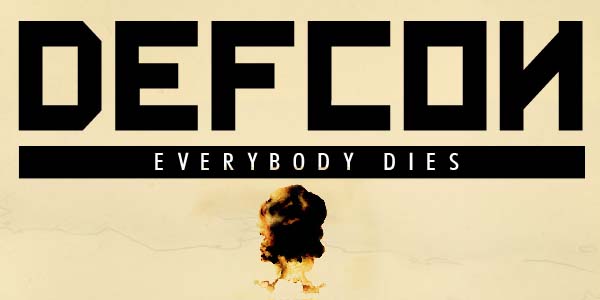
Just kidding. We all know you just want to play Global Thermonuclear War. Poor Theaterwide Biotoxic and Chemical Warfare never gets any love. DEFCON, developed by Introversion Software, offers all the Global Thermonuclear War you could ever want. Its spartan and elegant graphics looks just as appropriate today as they did on release in 2006, with clean glowing lines showing up beautifully on the dark background of the world; Introversion took the design aesthetics of the global tactical displays from various Cold War nuclear war thrillers, and created a game that perfectly delivers their inhuman reductionism. It is a cold, hard, unfeeling game that leaves you feeling challenged, rewarded, and maybe a little bit broken inside as you watch the megadeaths pile up and desperately hope that you can kill a few more people than you lose.
RED brings comedy to a knife-fight, wins
I suppose it would be more accurate that they bring guns to a knife-fight and then laugh about it. RED is none other than Retired, Extremely Dangerous, a movie about aging covert operatives who appear to be targeted for forceful extra-retirement by some very well connected people. Loosely inspired by Warren Ellis’ graphic novels of the same name, this movie takes those books’ themes and runs with them, delivering in a huge way. A few names you’ll recognize own the movie’s screen with their presence: Bruce Willis, Morgan Freeman, Helen Mirren, John Malkovich, Brian Cox, Karl Urban, and Mary-Louise Parker. They’re maybe kind of a big deal, and they totally make the movie.
What is Steampunk?

Those who know me will know of my love for steampunk. So are many others; steampunk has been a bit of a buzzword in recent years. But what exactly IS steampunk?
Artemis Bridge Simulator Offers Arch Entertainment
Pun aside, this game is not about building bridges. It is about being on bridges. Spaceship bridges. While it can be legitimately panned for its exceedingly high computer requirements (it isn’t demanding about system specs, it demands many systems), this game is a multiplayer gem of excellent quality. I played it for the first time this weekend, and now…
Science Fiction vs Fantasy
These two genres are considered largely similarly, despite vast differences between them. They’re both kept in the same section of book stores, they’re both definitely ‘nerd’ books, and they’ve both been a part of the explosion of recent sci-fi/fantasy movies, between LotR/Harry Potter, superhero movies, or Star Trek.
They have one thing in common, that distinguishes them from typical literature; whereas fiction describes events that occur in a world that is largely our own, these genres tend to describe events in a world that is significantly different from our own. That is, science-fiction and fantasy are both speculative fiction: they answer questions of the form “what if…?” This is why we consider novels like Brave New World, 1984, and Harrison Bergeron to be science-fiction of a sort (they are typically referred to as ‘speculative fiction’). But from there, they diverge wildly. To sum it up, with a quote from Miriam Allen de Ford: Science fiction deals with improbable possibilities, fantasy with plausible impossibilities.
Off Armageddon Reef, by David Weber
Do you like Arthurian legend, religious war motivated by politics, and the burgeoning Age of Sail? If yes, then try Off Armageddon Reef. This book will feel abundantly familiar to anyone who has read a moderate number of David Weber‘s other works. Not only is he recognizable by his language (and especially by his descriptions of violence in naval combat, which bear a striking resemblance to those used in the Honor Harrington series), but the story itself is often assembled from elements which he has already used in other books. It speaks well for him that he’s found another way to combine those pieces, and used them to explore new topics and themes. With naval battles and wonderful Arthurian parallels, I’m sold on this series. Maybe I’ll change my mind six books from now, but I suspect that much like with the Honor Harrington series I’ll continue to be drawn in by the story being told here. I happily anticipate gorging myself on the next book posthaste.
Movie Review: World War Z

I recently saw World War Z at a local Carmike theater, and while it was fun I ended up feeling like I had just watched a generic zombie film, and not a World War Z film. Where the book is one of the greatest pieces of zombie media ever made, the film instead missed the mark on what makes the whole zombie genre interesting. In a way this will be a double review as I will discuss what features made the book special, and how the loss of those features made the film feel generic.
Goddess of the Ice Realm, by David Drake
Once again I have grabbed hold of a David Drake book by the lapels, roughed it up, and shaken it until all the delicious story-bits come out. Goddess of the Ice Realm continues the formula that David Drake has found so successful previously, returning to his excellently conceived Roman / Greek / Atlantean setting and pitting the heroes against multiple enemies serving one greater terrifying threat. There are few innovations in this addition to the series, and most of the storylines will feel familiar to those who have read the previous books of the series, but if you like the characters and enjoyed the previous books you’ll almost certainly like this one too.
Top 25 Sci-Fi/Fantasy Books/Series
Today’s post is a bit on the light side, but I’ve had a few requests for this, so here goes: my favorite science-fiction and fantasy series. Oh, and there’s actually 26, plus some at the end I haven’t read yet but want to. I’ve only put a brief blurb for each, or this would take 400 pages, but don’t worry, I’ll review most of these in the future. And sorry if I left X series you love off, I’m sure it’s fantastic, but I own too many books to go thoroughly through them all.
Fantasy
- Game of Thrones – George R.R. Martin
Game of Thrones is a masterpiece of genre-defying. If you read this in reverse order, you’ll know that I said that most fantasy is derivative of Tolkien to some degree. Well, Game of Thrones is one of the series that doesn’t stand a chance of having that accusation placed. Gritty? Check. Humans only? Sort of. Fantasy almost doesn’t feel like the right genre for Game of Thrones. I think the right genre is medieval politics with a dash of ‘man, life really sucks’. - Wheel of Time – Robert Jordan
Everything LotR wanted to do: establish a mythos and a history and build a huge world, Robert Jordan has done a hundred fold, and with a better writing style, to boot (although it falters around books 9-11). LotR follows more PoVs than you’ll ever be able to keep track of, names every character and expects you to remember them when they return, and is all-around THE example for all-encompassing world-building. This series is SO EPIC that I made my first post on Fistful of Wits about it. - Stormlight Archives – Brandon Sanderson
1 book out and it gets my #3 slot. I can’t begin to express how much this book is the beginning of an epic series. The first book is well over a thousand pages, and there are a supposed 9 more coming. So all of you who just got over your epic fantasy addiction when you wrapped up Wheel of Time? Let’s get ready for some more pain and suffering as we wait painstakingly for a series to finish before the author dies. - Lord of the Rings – J.R.R. Tolkien
Dude. It’s LotR. I only didn’t put this in the #1 spot so I wouldn’t be accused of being old-fashioned and biased. Everything most fantasy series have done since? Copied from LotR. Elves? Dwarves? All given vastly diferent representations in TOlkien than in previous literature, and it influences all fantasy that will follow. World of Warcraft might as well be called ‘World of We-All-Really-Wanted-To-Play-A-LotR-Fanfic’. If you’re reading non-gritty fantasy with non-human races? It probably has Tolkienian influences. - Runelords – David Farland
I almost put this above LotR. The magic system is a fascinating metaphor for the feudal system, and the series plays very well, until the author either ran out of ideas or decided on a new direction, and it derails a bit (book 4 or 5). - Mistborn – Brandon Sanderson
Mistborn is a pretty cool trilogy with an extra random book and two more trilogies planned. Basically bad shit has happened to the world, with a tyrant Emperor and maybe a tyrant God, and somebody’s got to overthrow them. As with all Brandon Sanderson, expect a Deus ex Machina ending. - Kingkiller Chronicles – Patrick Rothfuss
Only two books and I’m hooked. The premise isn’t all that interesting: boy goes off to magician college and becomes the most badassingest boy ever to study magic. The character is one giant Gary Stu who will irritate you consistently, and the world is populated with characters who are made more annoying to make it easy for you to side with him. He’s then given unstoppable obstacles and tricks his way around all of them in a way that is explained away by his being the most connivingest boy ever to connive. His character motivations all go on the backburner constantly, until they come up suddenly and they are EVERYTHING to him. And yet none of that matters because Patrick Rothfuss has a writing style that sucks you in and won’t let go. - Saga of Recluse – L.E. Modesitt Jr.
Every time I lend the first 4 books of this series to a friend, they come back a week later and say “MORE”. You will get more of the same, unfortunately, as there are really only 3 or 4 plots that L.E. Modesitt uses in this series. His books tend to stress balance, rather than good and evil, and feature interesting combinations of magic and technology. - Codex Alara – Jim Butcher
I hate Jim Butcher. DESPISE him. I think his pulpy writing style lacks substance, and I always feel like I’ve just wasted time reading his books. And yet I couldn’t help myself with these books. The premise of the series? He contested he could make anything interesting, and the challenge presented was to combine ‘lost legion of Rome’ with ‘Pokemon’. Somehow, he delivers. - Coldfire Trilogy – C.S. Friedman
Friedman presents an incredible view of a type of magic that is very unique and a history that is very interesting, along with a surprisingly diverse cast of characters. Her views on magic have influenced my own writing more than any other author. - Oath of Empire – Thomas Harlan
This is your typical ‘ancient Roman epic with magic thrown in for good measure’. If by typical, you mean fantastic. - Night Angel Trilogy – Brent Weeks
Boy trains to become assassin to get revenge and finds himself part of so much more. - Engineer Trilogy – K.J. Parker
I’ve only read the first one; the character was a bit of a Gary Stu, and the writing style was occasionally dry, but it showed promise, so I’m putting it on here
Sci-Fi
- Deathstalker – Simon R. Green
I’ve talked at length about Deathstalker, and I think it epitomizes (and parodies) Space Opera to a degree that makes it undeniably the most self-aware science fiction I’ve ever read (something you might miss if you mistake the sheer amount of over-the-top it possess as serious). - Hyperion – Dan Simmons
Space Opera at its finest, drawing back to historical earth, with Keats as a character. What’s not to like? One of those Sci-Fi novels that says ‘to hell with combat, I want to do exposition and describe a universe’. - Ender’s Game – Orson Scott Card
It’s hard for me not to put this at #1. When you think ‘boy growing up to save the world, you tend to think Fantasy, but this sci-fi novel takes a much grittier approach, where ‘growing up’ doesn’t mean ‘getting magical powers and learning to fight’, it means ‘learning the hard facts about life’. The series has some stumbles in later books, but the first two books are just straight up fantastic. - The Unincorporated Future – Kollin Brothers
I see this book less as sci-fi and more of that weird brand of political fiction that Ayn Rand was trying to write when she projectile vomited her objectivist crap out. Except well written. And interesting. And nuanced. And worth reading. - Foundation – Isaac Asimov
Sort of a classic of science-fiction. - Hitchhiker’s Trilogy – Douglas Adams
More on the comedy end of sci-fi, but very enjoyable - Dune – Frank Herbert
Defined the space opera genre. If every book but he first hadn’t made me want to curl up in a ball and cry from boredom, this series may be hire up. - Star of the Guardians – Margaret Weis
You know those series’ Deathstalker is parodying? This is one of them. Worth reading just for the context.
Young Adult
- His Dark Materials – Phillip Pullman
I could put this not in Young Adult and it would still stand up with the best sci-fi/fantasy books of all time. A war against god tears the fabric of the universe, sending people into other universes to try and fix the damage that has been done. - Leviathan – Scott Westerfeld
WWI re-imagined with a technological Austria (walkers and tanks) and a Darwinian UK (genetically modified whale zeppelins)? Try not to like this - The Hunger Games – Suzanne Collins
The movie couldn’t even do the sheer emotional impact of this book justice. Expect to cry. - Redwall – Brian Jacques
Woodland critters with weapons and religion! It’s exciting!
Intending to Read
- The Miles Vorkosigan books – Lois McMaster Bujold
- Felix Castor Novels – Mike Carey
- The Baroque Cycle – Neal Stephenson
I tried to start these books, but then I went off to college and never got back to it. - Everything else L.E. Modesitt Jr.
A lot of his series’ are hinted to take place in the same universe, and that attention to detail intrigues me. - First Law Trilogy – Joe Abercrombie
- Malazan Book of the Fallen – Steven Erikson
I’ve tried to read these like 10 times and failed halfway through book 1 each time. But Henry assures me they’re good. One day. One day. - The Dresden Files – Jim Butcher
Fine, I’ll read it! I’ve actually read book one, and enjoyed it a lot. But in the same way that one might enjoy eating 5 bags of skittles. - Sword of Shadows – JV Jones
- Everything by Raymond E. Feist
 Fistful of Wits