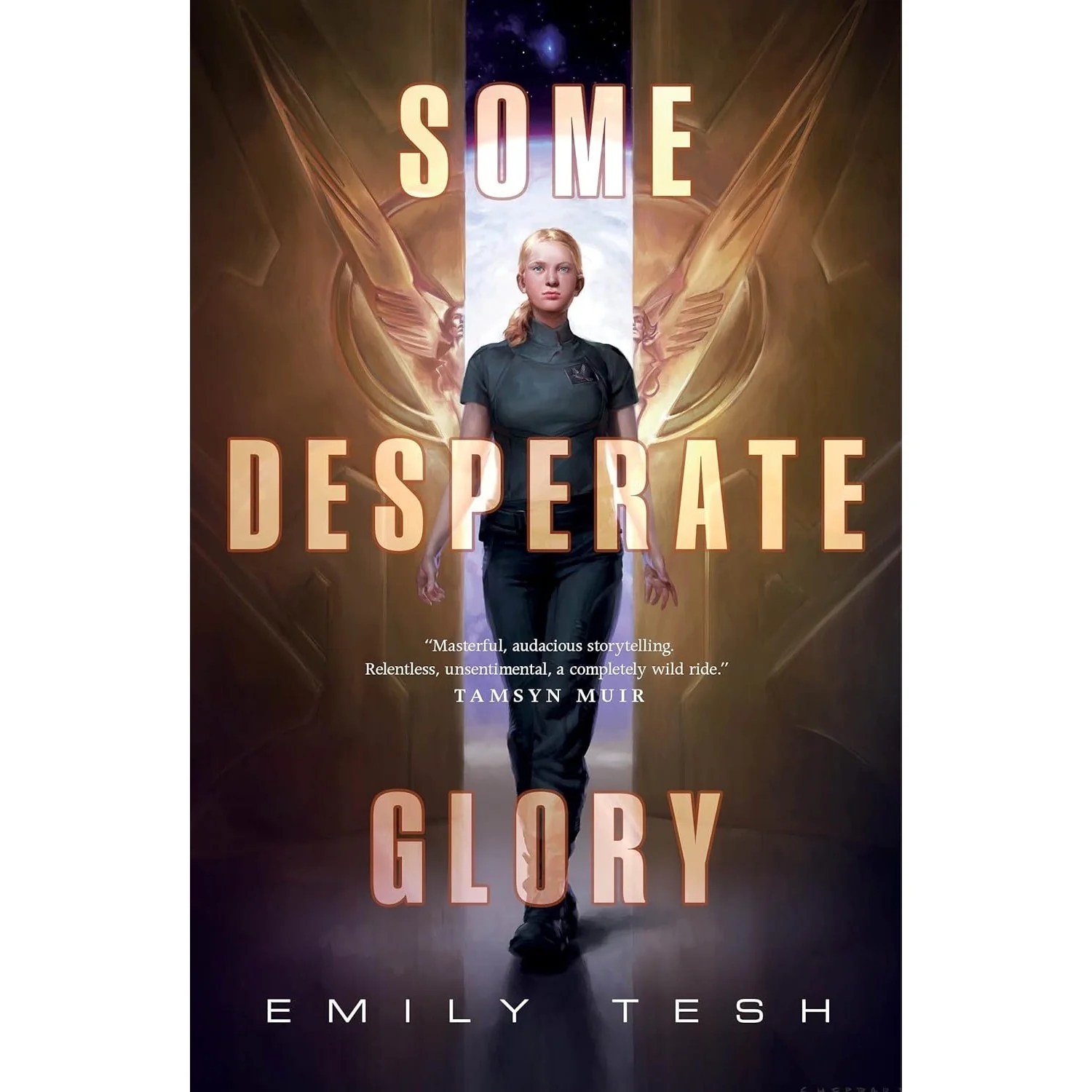
Some Desperate Glory, by Emily Tesh

Emily Tesh’s book Some Desperate Glory is an excellent sci fi story (“queer space opera” quoth many other reviewers) about living inside fascism, coming to terms with and recognizing that fascism, and trying to find ways to resist that fascism even when resistance seems impossible. It’s grim. It’s painful. It feels uncomfortably true, real, and relevant. I mentioned it in passing earlier this spring.

This isn’t a book I wanted to feel was more relevant after I finished it, but here we are.

This is also a book that deals with sexual abuse, assault, forced pregnancy, and suicide. I think the story handles them well, but they’re still rough. You’ve been warned.

With all that said, why does this book still feel hopeful to me?

Continue reading

Star Trek: Prodigy follow-up

I finished the first season.

Wow.

I know I just wrote about Prodigy last week, but I have to weigh in again.

Continue reading

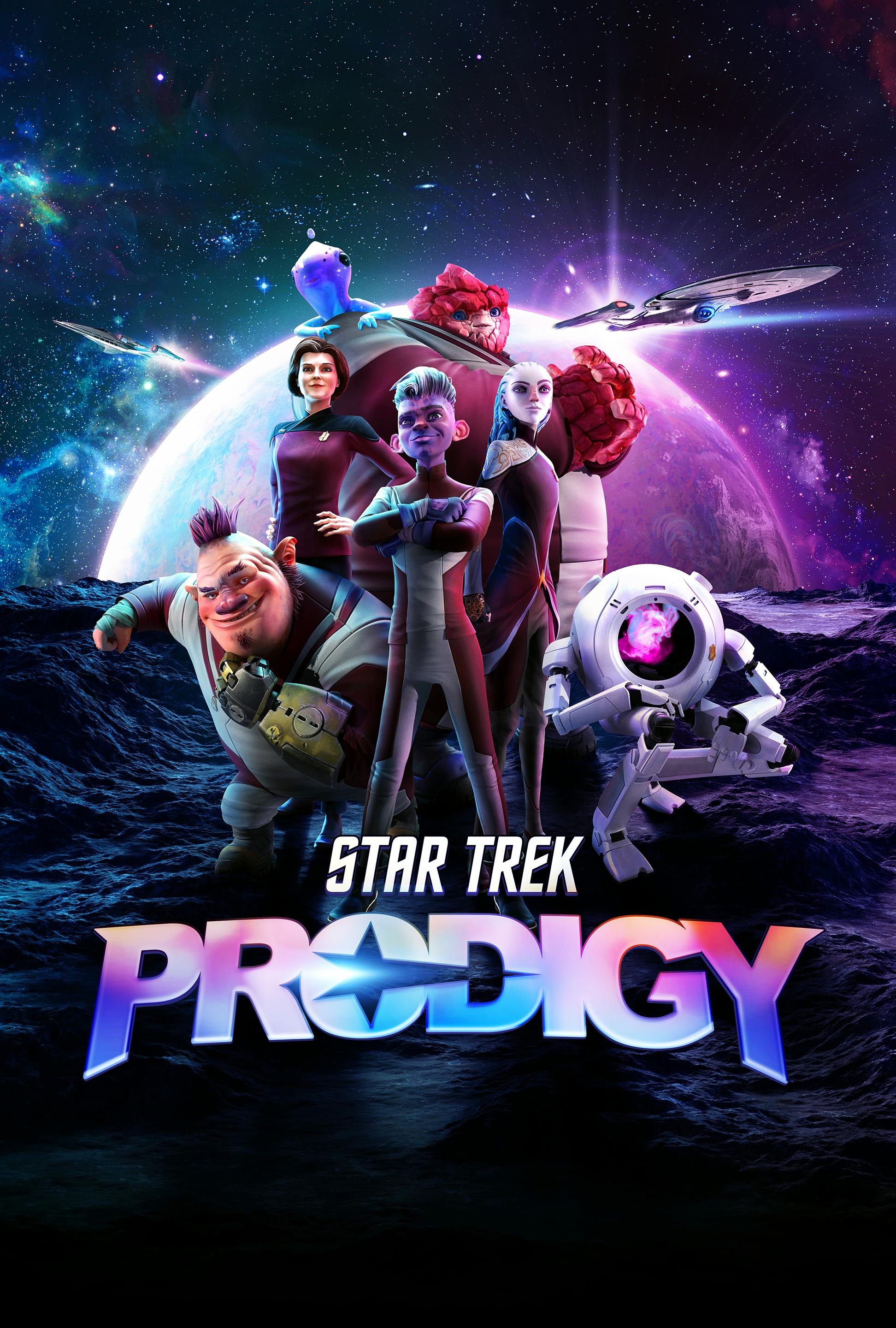
Star Trek: Prodigy, season one

This is for season two, but you get the idea.

As someone who grew up on Star Trek: The Next Generation, Star Trek: Prodigy didn’t quite feel like a Star Trek show until episode six. That might be a good thing. As much as I love TNG’s broad focus on an ensemble cast with highly episodic story telling, Prodigy’s early adventure-focused plots with clear continuity from one episode to another gives us a narrative throughline that TNG sometimes lacks.

That narrative throughline and dramatic adventure feels a little like Star Trek: Discovery. Discovery felt a little off to me in its first couple seasons, due to its fixation on a single overarching narrative and its exploration of Michael Burnham’s character to the detriment of the broader ensemble cast. It wore the trappings of Star Trek, but felt more like a Star Trek movie turned into a miniseries instead of a Trek TV show. Unlike Discovery, Prodigy bridges the gap from overarching-narrative to interspersed episodic and big-narrative episodes and makes a smooth landing in that Star Trek sweet spot with episodes six and seven. It starts without the Star Trek trappings, but ultimately feels more Trek to me than the first season of Discovery ever did.

Admittedly, I haven’t yet watched much further (I think I’m on episode twelve of season one). I’m not sure that matters. Even with continued exploration of the slightly-more-main characters, the show would have to veer sharply into main-character-ism to lose what it has already established. I think the tonal shift happened at the right time too. The dramatic narrative of the show’s opening episodes feels right for a space adventure, and the transformation into a Star Trek show happens as the crew finally gels and discovers that—despite their disparate backgrounds and disagreements—they share a moral core that is increasingly influenced by the ideals of Starfleet and the Federation.

That transformation feels deeply satisfying. The crew’s growing recognition of their shared moral core feels deeply satisfying too. There’s something funny about that to me; when I started watching Prodigy I wasn’t sure I’d be able to love the show. The first couple episodes felt so strongly like a kids’ show—without the idealistic themes I love and identify with Star Trek—that I feared I’d be stuck enjoying it on only one level as decent children’s fiction. The show’s growth as it moved beyond the opening episodes proved those fears wrong.

If you appreciate good children’s literature (yes, I’m using that to describe a TV show), or if you love Star Trek, then you should do yourself a favor and watch this show. My friends who recommended it to me were totally right. Prodigy takes a couple episodes to really get into gear, but it’s a delight.

Writing hope

I’m trying to think of times in my stories when my characters feel hopeful, or when they dream big. I’m struggling.

Continue reading

Star Trek: Strange New Worlds

I’ve only seen the first episode. I loved it. I’m really excited for more.

It’s hard for me to see this show without immediately comparing it to Star Trek: Discovery. Obviously, the two shows are connected by their events and characters. And, very mild but necessary spoilers, if you watch the first episode of Star Trek: Strange New Worlds you will be spoiled for the end of Discovery’s second season. Given the continuity of experience for several main characters (and especially Captain Pike), that’s inevitable.

Most of the details of Discovery aren’t brought up because they’re classified in-setting and there’s little reason for anyone to actually divulge anything. But the vital bits come out in a few conversations, or are heavily hinted at and shown in characters’ internal struggles. This means that you don’t need to have seen Discovery in order to enjoy this show, and all the plot-relevant emotional strife that grew out of the previous show’s events is made accessible to new viewers.

That’s all for the best. I have mixed feelings about Discovery, and I think Strange New Worlds made the right choice by making itself more accessible to new viewers. Moreover, I think Discovery’s emotional and narrative tone felt more like a grim Star Trek movie… and Strange New Worlds feels like a marvelous return to the tone of Star Trek as a TV show.

I’ve written about this here before. Discovery had piles of narrative tension, and character development, and drama… and it felt like watching a high production-value miniseries set in the Star Trek universe, with all the bubbling idealism stripped out. When I watched it, I did not feel hope. I was engaged by the story, and I appreciated the growth seen throughout each season. But Discovery was fundamentally about season-spanning dramatic narrative arcs. 

Star Trek benefits from dramatic narrative arcs. Yet for all my love of a good narrative, Star Trek has long been more focused on exploration, and on ethical, moral, and intellectual engagement with difficult subjects. Sometimes it does that well, sometimes it doesn’t. And sometimes it leavens itself with exciting narrative interludes. But it’s a series anchored in idealism, hope, and a willingness to engage critically with its setting (with varying levels of success).

Strange New Worlds delivers that. Watching Strange New Worlds felt like watching the next iteration of the old Star Trek shows, in the best possible way. I loved it.

I know there are some people who have seen it and don’t like it. I understand that a number of people are upset about the bridge crew being both mostly non-white and/or women. Fuck ‘em. If that’s seriously their gripe with the show, they haven’t paid enough attention to the whole rest of the show’s history—and they’re apparently unsatisfied with the fact that the captain is still a white dude.

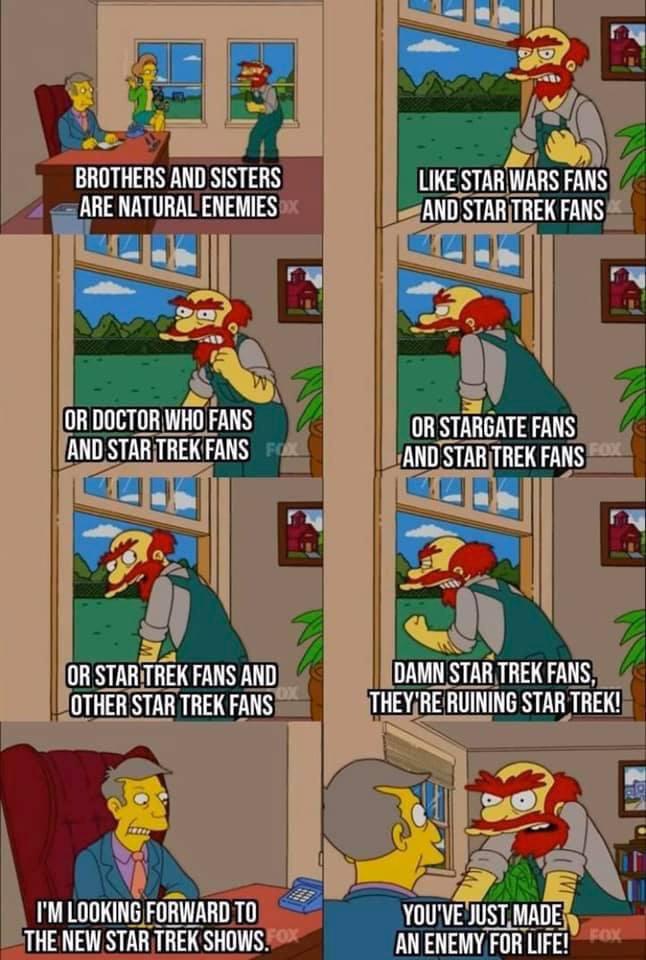
I haven’t yet heard other people’s critiques of the show, and I’d be more curious to hear those. This meme applies, to be sure:

But not only does this new Trek feel hopeful, I once again trust that the show will continue in the optimistic and idealistic traditions of older Star Trek shows rather than chase ”serious drama” at the expense of its emotional and philosophical tone. I am so excited for more.

Star Trek, Discovery, Idealism

Star Trek has been a part of my life since I was tiny. I grew up on The Next Generation, watching it curled up on the couch with my older sibs. While I remember the death of Tasha Yar, I don’t remember Riker without a beard (I see the impossibility there, presumably my brain edits out most of the worse stuff).

I was, arguably, too young for the show. I know it wasn’t geared towards toddlers. Some of my earliest nightmares grew out of Star Trek episodes. Those did not stop me from watching.

Of course, the same can be said for watching my sibs play Doom. Maybe toddler-Henry’s judgement just wasn’t that good. Toddler-Henry almost certainly valued spending time with sibs more than not having nightmares. That’s still true.

All of which is to say, Star Trek has a special place in my heart. Moreover, at a formative age Star Trek fed me an underlying idealism that serves as the keystone for good Star Trek stories. If you’ve watched enough older Trek you know what I’m talking about. When it isn’t there, the Star Trek-ness of the story just falls apart.

That idealism isn’t always well-written. But I admire it all the same. With it, generations of Star Trek have tried to do something that much of the rest of its contemporary narrative milieu dismissed as naive, or uninteresting, or hopelessly unrealistic. Unlike those other stories, well-written Star Trek refuels me.

All of which brings me around to Star Trek: Discovery. I’m working my way through it, bit by bit, but as much as I’m having fun seeing science fiction in the Star Trek universe it still doesn’t feel quite like Trek. This won’t surprise anyone who’s familiar with both Discovery and older Trek. Discovery’s first (and second, so far) season are dramatic and often exciting, and they have more character growth and development than I remember from TOS or TNG, but… they don’t hold the Trek idealism that I love. There are glimpses of it, moments when that idealism comes through, but it’s mostly hidden behind their larger threatening story arcs.

The most Star Trek thing I’ve seen in them so far have been Captain Pike and Number One, part of why I’m so excited for Star Trek: Strange New Worlds.

I have heard good things about Discovery’s third season, however. I’ve heard that it feels more full of the old idealism. I could really use that right now. So I’m still plugging away, doing my best to appreciate the science fiction show wearing Star Trek’s skin, and looking forward to it growing into something more hopeful and idealistic.

Receiver 2: stay safe

Receiver2header

Hunted by kill drones, you’ll sneak through unnervingly empty buildings, scour for messages left by others like you, and hunt down tapes that teach you about the Threat and what you must do to defeat it—while you master every element of your randomly assigned firearm in order to perform well under pressure.

Receiver 2, by Wolfire, is an excellent game. It’s only on Steam right now.

But also, Receiver 2 is not for everyone. Not in a “only cool kids will like this game” way, but in a “you should be ready to engage with strong themes of mental illness, self harm, and the most serious approach to gun safety I’ve seen in a video game” sort of way. Like I said, not for everyone.

I really like this game.

It’s tense. It’s difficult. It is incredibly thorough and extremely well thought out (with a niggling exception that I’ll cover later). It’s the only game I know—besides its game-jam precursor—to bother modeling the underlying mechanisms of the guns you use.

Receiver 2 makes loading, safe-ing, and holstering your gun an actual skill. Learning to clear malfunctions by reflex is necessary, and mastering it is deeply satisfying in a way that simply tapping ‘r’ never is. Receiver 2 also discusses gun safety with extreme frankness, and pushes you to be aware of it constantly. If you screw up or forget, you may shoot yourself.

As someone who’s been a range safety assistant I deeply approve.

Intricately modeled weapons and foes, discoverable story and world-building, maneuvering through the tense spatial puzzles of kill drones’ blindspots in order to achieve your objectives—Receiver 2 is very good. I strongly recommend it, with two qualifications:

The first is that niggling exception from earlier, and something Wolfire says they’re resolving; the game revolves around uncovering tapes to advance through levels, but you lose a level of progress when you quit the game. That’s a problem, and it’s an unfortunate oversight. The game is already challenging, and has no save function, so demoting you a level when you quit feels needlessly punitive. Luckily, Wolfire has said that they’re going to fix that in a patch. Until then, I have read that typing ‘insight’ into the pause screen will advance you one level. Use as you see fit.

Second, if you aren’t in a good space to face strong themes of mental illness and self harm, especially around guns, I recommend caution around this game. I agree with RPS’ review of Receiver 2, but as someone who has dealt with depression and suicidal ideation I think they should have mentioned this content warning.

I’m keeping this non-specific in case you care about spoilers, but Receiver 2 deals with all those aforementioned topics head on. Now, Receiver 2 has one of the most straightforward and positive approaches to discussing depression and suicidal ideation that I’ve seen in a video game. But even though I knew that Receiver 2 had themes of mental illness and self harm, I was *not* ready for what I encountered. I’m glad that I’ve played the game, and I’m extra glad that I’ve *kept* playing because I admire some of Wolfire’s choices in handling these themes. But you should know that this game has difficult content—especially around suicidal ideation and self harm. I want you to be aware of that before you sign up for it.

Finding Hope in Books, Quick Thoughts

There’s a fifth book out in the Commonweal series by Graydon Saunders. Thus far, I’ve only posted here about The March North (an oversight on my part), but I love the whole series. I acknowledge freely that this series is not for everyone—it is not particularly accessible to a casual read—but there’s something to this series that I love, and which moves me in ways that I haven’t found regularly in books for quite a while.

A brief jaunt sideways: I have been a long-standing fan of the Ring of Fire series, started by Eric Flint with the book 1632. At this point it’s long, involved, and serpentine in its narrative’s twists and turns across concurrent books, but I have continued to read (almost) every new entry in the series. For a long time this series was comfort food. Even as I came to recognize the ways in which its idealized portrayal of a particularly inclusive and community-based set of American beliefs didn’t always match history (and didn’t include as many kinds of people as I’d like it to), the idealism that served the series as its foundation was heart-warming and reassuring. We’re better off working together, we’re better off including people and sharing our beliefs, we’re better off helping each other. We can disagree and still find ways to build together. We are stronger together than we are apart, and people are the heart of a nation; aristocracy, as a tiny and overly self-centered fraction of the populace, is at its best an ornamental contributor which can do the most good by advocating for and making space and prosperity for those less well-off than themselves.

It’s obvious why the series felt so comforting when I compare that message with the messages told by many of the other authors I was reading when I started the Ring of Fire series. 1632 was uplifting where other stories were dour, it embraced community where the others proclaimed lonely individualism as the only option, and it had people working together to make a better future where other stories showed people scrabbling against each other to come out on top. For all that I now see gaps in the stories, the Ring of Fire series felt like a salve. It was hopeful.

Which brings me back to the Commonweal series by Graydon Saunders.

This series caught me on so many levels.

On the surface, it’s refreshing to find books which frequently make use of gender neutral pronouns and don’t bother to gender most characters, while also making it clear that there are a variety of people and genders present rather than letting the reader always assume that “unmarked” means “male.” Similarly, it’s a pleasure to find books which so clearly include a wide variety of sexual preferences and orientations as utterly normal. Saunders does an excellent job of creating a setting in which people are welcomed and in which persecution along our own societies’ fracture lines feels alien and anathema.

But the philosophical and ethical determination underpinning the Commonweal is even more inspiring, and it’s all the better for the way in which Saunders bakes the Commonweal’s principles into the narrators’ assumptions and reasoning. Because all of the books are written in the first person (though the narrators vary), these principles are revealed gradually as people wrestle with moral and ethical quandaries or face the unthinkable.

How does one best further the survival of the Peace without exercising dominion or exalting anyone over anyone else? How can a society faced with extinction-level threats move itself into the future without sacrificing its ideals? And how can powerful people exist in such a society when their own capabilities may threaten that society?

How can societies which assume the equality of their members and acknowledge the personhood of outsiders persist in a dangerous world? And what does doing that look like… in a world wracked by a calamity of wizards and all the damage of millennia of magical war?

Which brings me to the setting itself, which continues to delight me. As someone who grew up on genre fiction and learned early on that sometimes settings just didn’t make sense (and that that was okay), it’s a treat to find a setting which digs deep into the reality of a world in which “a wizard did it” is both an explanation and a curse. Even better, it very seriously examines how a community of mostly not-wizards can survive when magic users have existed in a Hobbesian state of nature for long enough to twist much of the world into a fire-and-forget arsenal of “war by other means.”

It’s a deeply nerdy exploration.

And the answer is: that’s hard.

But it’s a story about a community that is dedicated to not only surviving, but to not compromising on their fundamental ethical ideals. And that feels good to me.

It matters that those ideals are ones which appeal to me, of course.

Katherine Addison’s The Goblin Emperor is one of the few other books I’ve read recently that feel similar. Octavia Butler’s Parable of the Sower fits too. Not, in either case, because the writing is similar… but because the feeling of hope and perseverance despite obvious terrible circumstances is so powerful.

I’ll have to write more about this series again later, but I strongly recommend The Commonweal. If you’re good with trying military fiction, start with The March North. If you’d rather read about experimental transhuman wizard school, start with A Succession of Bad Days.

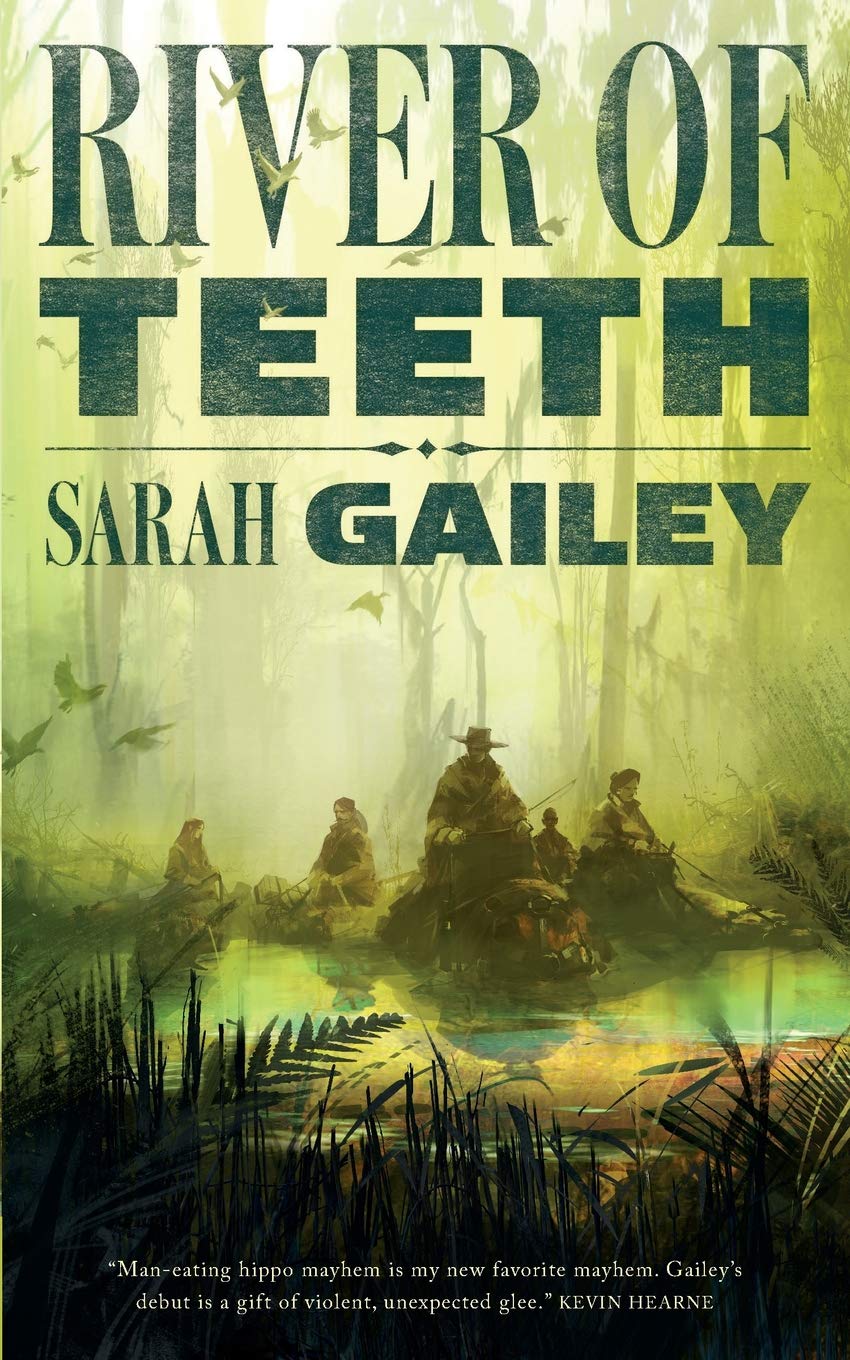
River of Teeth, by Sarah Gailey

RiverOfTeeth

Dang, that cover is gorgeous.

I just realized that I never wrote anything about River of Teeth here.

River of Teeth is a delight. It is compelling, it is exceedingly evocative, and it cemented my tremendous respect for Sarah Gailey. That respect isn’t simply for Gailey’s fabulous what-if—though a heist western about queer hippo-riding cowboys in the swamps of Louisiana wins you lots of points in my book—no, my respect is for Gailey’s obdurate embrace of optimism, hope, and upbeat tone despite nearly every genre expectation insisting otherwise. When I read River of Teeth, I couldn’t recall the last time I’d read a book so fraught with dire struggle, and with emotional conflict, yet which somehow rose above despondency and grimdark. It’s still hard to come up with such titles, but this is one of them.

Gailey’s characters are capable, but merely mortal. They face the impossible. And somehow they never lose heart.

I think it says something that I inhaled River of Teeth, and then immediately inhaled the sequel, and only ever felt better for having done so.

River of Teeth is a small thing, and it’s a marvel that there is so much inside it. I strongly recommend both it and its sequel Taste of Marrow. If you like well-grounded weird historical what-ifs, or westerns, or heists, or stories which adamantly refuse to kill their queers and which hold tight to hope with both hands… this story is for you. If you just want a good time, this story is for you.

Please, go read the book.

The Goblin Emperor, by Katherine Addison

GoblinEmperor

The Goblin Emperor is strangely soothing. I don’t mean that it will make you feel good the entire way through, nor that nothing bad happens; I mean that it’s touching, fun, feels real, and somehow delivers good political intrigue in a grim situation without being dark or gloomy. Also, it hooked me and kept me excited despite being a tome.

I found this book on a Tor list recommending anti-grimdark stories, and it entirely delivers. Though shelved as YA, I think everyone would like it.

You know how sometimes you don’t want a story to end? You reach the finish and sit in that lingering need to see more, stuck on the idea that surely you could get just a little more story out of the book if you squeezed it just a bit harder. That was this book for me. I wanted more, I wanted to see what came next.

But Addison timed the climax and denouement for this book extremely well: she resolved the central issues, the emotional and political struggles that swirl through the heart of the story. Then, with that resolution still in hand, she ended things; no unecessary time is spent dwelling on anything extra or outside the story. Also, no matter how much I want to read more about the good things that happen to these characters, reading about only good things would probably bore me after a while.

And, unless they launched a whole new story, I’d feel sad when things strayed from that quiet feeling of calm stability.

I have more to say. I won’t give you explicit spoilers, but bear in mind that (if you’re strongly in the anti-spoiler camp) you may glean more from my comments than you wish to know. If you want to stop here you can. You should already know by now that I recommend this book.

Anyway, you spoiler-phobes have been warned.

There’s a lot of grimdark out there. There’s an excess of stories that revel in showing us how gritty and real they are by rubbing our noses in how poorly everyone treats each other. It takes a special kind of attention, a particular exercise of will, to write political intrigue—complete with assassinations, nefarious plotting, and villains aplenty—while still clinging to an underlying optimism, and giving everyone relatable humanity.

I rarely read characters I fall in love with in political intrigue novels, people who are quite simply good. They’re usually narrative fodder, intended to show the reader how characters die. So it is an absolute joy to find that The Goblin Emperor neither ignores the dangers of trusting those who desire your power, nor casts the central character as a manipulative super-human. Instead, The Goblin Emperor allows its main character to be manipulated and suffer for his naivety, learning from his mistakes without losing his honesty and decency or being crushed beneath the novel’s narrative heel—this story doesn’t assume that to be kind one must also be stupid. It allows him to be a good person trying to do the right thing in an impossible situation, even as he struggles with the growing weight of understandable paranoia and the inability to know what choices might be the ‘right’ ones.

It helps that The Goblin Emperor doesn’t bother with irredeemable villains; even the people I came to detest still had their own reasons behind their actions. Whether obviously selfish, well-intentioned, or something else, they always felt complexly human and real.

What I’m saying, really, is that this is a good book. Katherine Addison did a good job, and made a story that I strongly recommend. It’s emotionally real, it’s sometimes grim, but it’s also hopeful. And that matters.