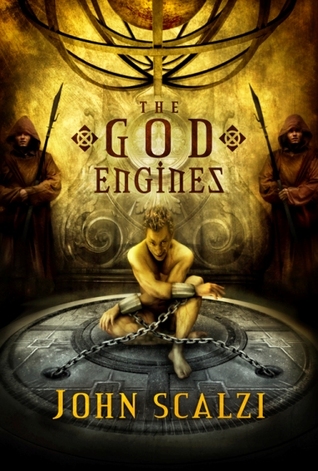
The God Engines, by John Scalzi

6470498

My apologies for the brevity of this post, I’m writing with an odd tremor in my left hand and that’s throwing me off.  Anyway…

If you’ve read my previous reviews of Scalzi‘s work, you’re already familiar with how much I love it.  There’s something about his style that I find captivating, perhaps unreasonably so.

The God Engines is no exception to my love for Scalzi’s writing.  It features space travel powered by faith and subjugated gods, and eschews many of the “upbeat” qualities (for lack of a better word) that I’ve come to recognize in Scalzi’s other pieces.  It’s short, sweet, and ultimately horrifying, and I would happily recommend it to anyone who would like to read about holy war in space.  Having just written that, yes, the setting does feel a little like Warhammer 40k, but not quite in the same grandiose grim-dark fashion for which 40k is pilloried.  I don’t want to say any more that might accidentally spoil sections of the story for the especially perceptive, I’ve already had to rewrite this bit several times to cull possible references to spoiler material.

Also, well done Scalzi for writing an entirely genderless character.  I’m not sure I understand how they fit into the larger scheme of things that you devised for this setting, but they felt wonderfully human in a way that some might have ignored.  And while I loved the appropriate ending of the story, I was sad that it meant that I wouldn’t get to learn more about the world that encompassed all these wonderful and terrible things.  I suppose that means you hit the perfect length for the piece.

I really liked the fact that no character felt like they were entirely “good.”  Some were certainly more sympathetic than others, but mostly people seemed very human: they wanted, they feared, and they cared (or didn’t) in ways that pulled me into the piece.  It never felt like we went very deep with any of them, perhaps due to space restrictions, but I got enough of a sense of them to feel connected before the end of the book.

Would I recommend this book?  Yes, definitely.  It’s short, it’s an easy read (I went through it in one sitting), and it’s a lovely look at a frightening concept.  It’s a quick piece of horror writing done well.

p.s. Oh, and here’s Scalzi’s favorite negative review of The God Engines.  It’s pretty good.

The Restoration Game, by Ken MacLeod

18lq6wx6x76xmjpg


Eastern European politics (both Soviet and post-Soviet), color revolutions, spy games, long hidden family secrets, and a quiet sci-fi premise?  Sign me up.  Ken MacLeod‘s The Restoration Game gives all of that, plus a little bit more.  Maybe that’s why I liked it so much.

It’s a quick read, with an engaging and easy-to-follow female protagonist who, as the story unfolds, comes to feel like the appropriate scion of all those who’ve come before her.  I’ll explain that, I swear.  The book gets bonus points from me for having a female narrator; I’m writing a piece with a teenaged female narrator (as I’ve mentioned previously), and everything is grist for the mill.  And I should note that while I quite liked Lucy’s narration in The Restoration Game, I’d love to hear women’s opinions of the narrator’s experience and voice in this book… I don’t exactly have a good frame of reference by which to judge it.

About that scion comment: our protagonist, Lucy Stone, opens the story with a cliffhanger and no context.  It works well, catching you quickly and pulling you in, and then the entire book becomes an extended digression to give the context for that scene, only finally reaching resolution (appropriately enough) at the very end of the piece.  At the beginning, you have no idea of what Lucy has been through, what her family history is, or what she is capable of… but by the end, things fall wonderfully into place.  It’s wonderfully done, and flows smoothly from start to finish.

Ok, that wasn’t quite right.  There’s still that initial sci-fi premise, right at the very beginning of the book before Lucy ever has a chance to speak, and I bounced off it the first two times I opened the book.  It wasn’t bad, it just wasn’t what I thought I’d set out to read and wasn’t nearly as interesting to me at the very beginning as it was by the very end.  After some reflection, I think MacLeod placed the introduction of the sci-fi premise correctly; there really isn’t a better place to put it that makes more sense and doesn’t disrupt the story further.  Without that initial introduction, later elements of the book would make very little sense and feel insufficiently well signaled (here we are back at the perils and prerequisites of good foreshadowing).  MacLeod clearly set himself a difficult project, possibly without realizing that he was doing it, but I think he managed to do a good job of it.

It looks like this post isn’t even going to have a break.  The Restoration Game is fast enough and internally intricate enough that I don’t want to ruin anything for you by accident, so I won’t bother with the usual danger of discussing potential spoiler material.  Suffice to say that it’s a good book, one worth picking up for quick fun, especially if you’re interested in a jaunt through spy games and epistemological thought experiments.

Rimworld: The Magic Continues

hOGk3vJ

Correction: with Alpha 7‘s release, the space magic continues.  Or, uh, the starving frontier space magic, beset by violent thugs and now diseases.  But let’s look on the bright side of things: even as Ludeon has introduced plague, it has also given us the prosthetics and organ harvesting and transplantation, in addition to a welter of other neat new features.

The introduction of prosthetics is far more important than you might realize.  The last version, Alpha 6, introduced a complex medical system which tracks injury and debility by location, though perhaps without quite the same granularity as Dwarf Fortress‘:

DFCombatLog1

My Alpha 6 colony had a slowly growing number of people who’d lost appendages to chronic cases of gunfire and explosions.  I was forever terrified of having my wonderful and productive citizens maimed horribly while defending the colony.  Now, it looks like we can give our debilitated friends a leg up, so to speak, by building prostheses for them to replace whatever they’ve lost.  Given the constant scarcity of more advanced medical supplies, I foresee specifically targeting raiders with cybernetic prosthetics so that I can strip the things I want from their cold, dead bodies.  Or from their warm and unconscious bodies, if they somehow survive the fusillade of bullets and seem like they aren’t worth rehabilitating.

This is Rimworld, after all, and I already do my best to hunt down fleeing raiders when they’re wearing or carrying things I find especially desirable.  It’s hard to come by powered combat armor without taking it off the body of an erstwhile attacker.  Traits have already made a meaningful entry into the game, affecting everything from move- and work-speed to mental stability and opinions of cannibalism, and there’s nothing quite like having a murder-happy speed demon ready to hunt down your fleeing enemies.  You just have to make sure that they never suffer a mental break or suddenly decide to betray you.

Continue reading

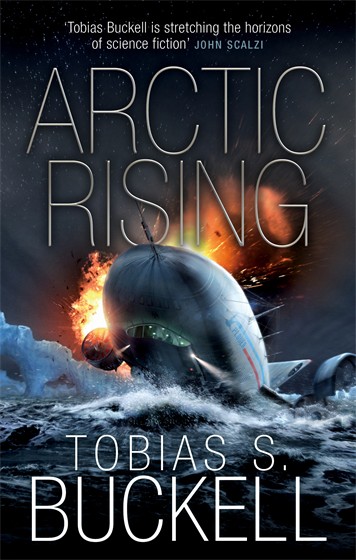
Arctic Rising, by Tobias Buckell

9780091953522


Tobias Buckell has made me very happy indeed.  I can’t decide whether I prefer Arctic Rising to Hurricane Fever, and I really liked Hurricane Fever (seriously, read my review).  It’s rare that I have the pleasure of reading a fast paced high-tension thriller set in a brilliantly developed near-future, let alone reading two of them back to back.  Buckell’s world-building is a tremendous draw for me.  It’s quality shines through in the ease with which he introduces the near-future to the reader; he keeps his obvious enthusiasm for the world he’s created tightly leashed, only revealing it in dribs and drabs, more often than not as an in-character rumination or observation that feels entirely appropriate.  Better yet, I didn’t find any gaping implausibilities.  I’ll admit that I didn’t take a fine-toothed comb to the books and their established background, but they hold together well enough to offer a compelling (and somewhat distressing) view of an imminent future.  If you want to treat yourself to a jaunt down “doesn’t this seem likely…” lane, and you want some hair-raising hijinks in the bargain, try either of these books.  If you don’t want to be spoiled for either book before you read it, be sure to read Arctic Rising first, though I did it in the opposite order and still enjoyed myself immensely.

Why did I enjoy it so much?  Well…

Continue reading

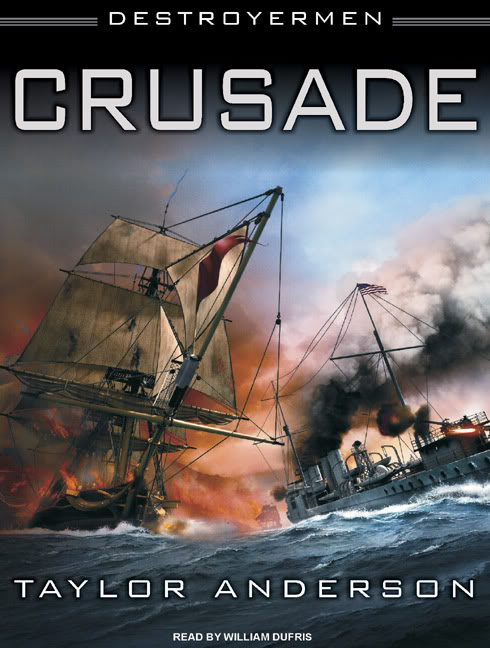
Crusade, by Taylor Anderson

Crusade

I just finished reading Crusade last night, the second book in Taylor Anderson’s Destroyermen series.  It still hits that oddly specific sweet spot I mentioned before, with alt-history technological bootstrapping and idealized social dynamics being the name of the game.  I believe I referred to Into the Storm as a strange mix of Stirling and Flint, but I’ve come to a better understanding of these books’ oddly specific conflux of flavors.  To envision Anderson’s style, strip away most of Stirling‘s semi-religious influences and replace what remains with faith in Honor and Doing What’s Right, convert Flint‘s cheerfully proletariat bonhomie into something just a bit more hierarchical, and toss in Weber or Ringo‘s blood-spattered military adventurism.  Now you’ve got a good approximation of Anderson.  (Just to be clear, I don’t expect any Oh John Ringo No! moments).

This second book in the series sticks with the same characters we met in the first one, and expands the cast slightly to give us a better perspective of the foes our protagonists face.  The setting remains the same, and the various characters on the ship are still wonderful to follow around.  I still sometimes felt like I was reading about a Chopper’s gang from Apocalypse World, and the sometimes aggressive, sometimes malicious pranking and posturing of the crew is reminiscent of my own experiences of living with a large group of other young men.  People are convincingly selfish and obsessive about their various areas of responsibility, and I’ve really enjoyed seeing the gradual induction of non-human characters into the ship’s crew and watching how they adapt to their duties and adopt the mannerisms of the other characters around them.

Ok, speaking of adapting, I need to mention something that I brought up last time as a concern; Anderson very carefully carries through on representing stereotypical 1940s gender roles, and I found that a bit off-putting (not the accuracy, but the roles and expectations themselves).  Fortunately, since the American humans aren’t the only culture in the book, there are groups of characters who aren’t bound by those gender-strictures.  But Crusade doesn’t look much deeper into the disconnect between the human conceptions of propriety and the conceptions of their new Lemurian allies.  I said that I’d be dissatisfied if that didn’t change… and it didn’t really change, and I am dissatisfied.  At the same time, the topic has certainly been discussed (briefly, or as a source of disconcertion) by the characters even if not much has come of it thus far, and it looks like there may be more change coming down the line.  My guess would be that such change will inevitably be lower priority for the story than the themes of military and honor, but I’ll keep reading and keep hoping that the change will come some point soon.  At a guess, the alteration of gender expectations will come about as a fait accompli as more of the humans die and are replaced by Lemurians.  Go figure.

Those quibbles aside, I’m still enjoying the series.  If you liked the sound of the style amalgamation I described above, you’ll probably enjoy it too.

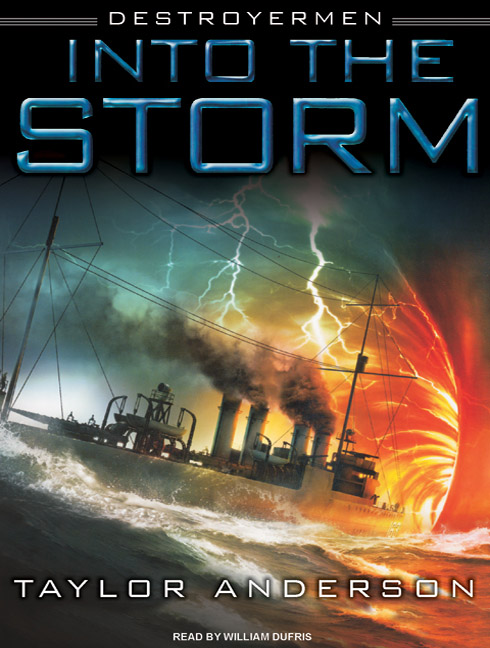
Into the Storm, by Taylor Anderson

islg


This book falls into a strangely particular sweet spot for me; there’s something about the alt-history technological bootstrapping genre that I find appealing, and the obviously idealized social dynamics presented in this book are endearing if not convincing.  Furthermore, S.M. Stirling’s cover blurb pulled me over the edge into reading it.  I was not quite as automatically engrossed as he apparently was, but Into The Storm has made excellent reading material while I’ve been laid up following an unfortunate paintball incident.

The basic concept is very simple, transposing an American WWI destroyer caught in action against the Japanese at the opening of WWII from our world into an alternate world in which (more or less) the dinosaurs never really died away.  The story is all about the destroyer’s crew doing their best to survive in a strange new world, and doing what they can to find friends who might be able to help them keep their ship operating instead of simply falling apart.  It feels a little like S.M. Stirling’s Island in the Sea of Time crossed with Eric Flint’s 1632, but instead of dealing with a town or island it focuses entirely on a very small warship.  The crew is wonderfully convincing, right down to their malicious pranking and oddly neurotic idiosyncrasies, and I enjoy following all of their various perspectives as the story progresses.  The crew actually reminds me a little of the residents of an Apocalypse World hardhold or members of a Chopper’s gang.

Now, when I say “endearing if not convincing” up above, I don’t mean to disparage the author’s conception of hierarchical systems founded on an egalitarian society.  As it’s presented, it seems to work pretty well.  But the author’s clear preference for the system by which ‘the good guys’ operate is so transparent that I feel unable to accept it at face value.  I don’t have experience with living and working on a US Navy vessel, I have no idea whether or not Anderson’s description is anything like the truth, and I suspect that what Anderson describes is closer to the ideal towards which his hierarchical system strives rather than the reality.  I’m certainly aware of many failure modes that would prevent a hierarchical system from working nearly so well as it’s presented in the book.  I think of it as a variation on the likable / wish-fulfillment protagonist problem; it’s really not actually much of a problem, so long as we remain aware of the fact that we’re idealizing the subjects of our attention, be they characters or systems of governance.

Also, I found the gender relations of the human characters (and characterizations of the male vs. female human characters) to be pretty frustrating.  I had a hard time taking the characterizations of the male and female leads seriously, because they seemed so stereotypically 1940s to me.  At a guess, Anderson was trying to ensure that these things were appropriate for a group of people in the US Navy in 1942 (unsurprising given his previous work as a technical and dialogue consultant for movies and documentaries), and I’m ok with that for the most part even though it turned me off the book to some extent (some things, methinks, are better left in the 1940s).  But he doesn’t really explore any of the disconnect between the humans’ attitudes and those of their newfound allies in this first book.  If/when he does get around to exploring that, and looking at the ramifications of further association between their two cultures, I think that has the potential to be super interesting.  If he just glosses over that topic over the next several books, I suspect I’d be a bit disappointed.

So!  If you’ve read and enjoyed Stirling’s Island in the Sea of Time, or Flint’s 1632, I suspect you’ll enjoy this book as well.  If you haven’t read them but are intrigued by the idea of a group of wanderers on the seas of time and space, doing their best to reestablish themselves safely in a dangerous and not-so-subtly different world, you’ll also probably enjoy this book.  If you don’t think you can tolerate some nearly-stereotypically-1940s gender roles, or some very nearly Apocalypse World-like shenanigans, maybe wait and see what I have to see about the next book before deciding whether this one is worth it.

Rimworld: Sci-Fi Frontier Shipwreck Fiction, Round 2

GmX9a8LuhH

The first time I played this game, my people nearly starved to death.  I tried to solve this by getting tricksy and using sunlamps outdoors in order to boost my crop’s growth cycle, only to discover that many electrical systems explode and catch fire when exposed to rain.  I did manage to pull through in the end, but it was pretty tight for a while.

That was all several releases back.  When I last reviewed the game, I mentioned that I thought it wasn’t yet worth its $30 asking price, but that it could be if it continued to develop as well as it had thus far.  Now, here I am several releases later, ready to tell you whether or not I think it’s continued to live up to its earlier promise.

My answer is easy: it has.  I’m not saying that it’s all the way there yet, but the game is damn interesting and its central features have been expanded aggressively over the past few months.  Any given change usually feels small, but the shift from when I first played back in early March has been impressive.  In addition to there simply being more junk that I can make for my colony, the world around my colony has gotten considerably more interesting, and often far more threatening as well.  I won’t cover everything, but…

Continue reading

Rimworld: Sci-Fi Frontier Shipwreck Fiction

GmX9a8LuhHI set down on the planet with complete awareness of the dangers that I would face, and a steady sense that I would do better than those who had come before me.  As I established my new outpost, eagerly digging into the cliff face nearby to harvest the easily accessed metal and provide my fellow accidental colonists with shelter, I was certain that I was in the right place, doing the right thing.  I planned out my dwelling carefully, designed it with defense in mind, and laughed at the idea that I might have missed any of the silly issues which had so beset the Let’s Plays that I had watched before I picked up the game.

I forgot, of course, to plant any food.  Welcome to Rimworld.

Continue reading

My Apologies to Iron Man: Why Power Armor Doesn’t Make Sense

Spam-Can

The contents of Iron Man’s suit after the third explosion.

My argument is somewhat more elaborate than this, but the gist of it is thus:

  1. Place monkey in tin can.
  2. Shake can vigorously.
  3. Remove pulped monkey from can with preferred utensil.

***

What’s the deal with power armor?

I love science fiction, and I often enjoy seeing science fiction become science fact (even if it is scary at times).  Plenty of things that we’ve dreamed up in our stories eventually come to pass in real life, whether it is because they inspired others to make them or because they were the product of careful forethought on the part of an author.  But what about power armor?  It’s been a staple of military-oriented science fiction for decades.  For the sake of simplicity, I’ll assume that power armor is an armored exoskeleton which offers its onboard human operator enhanced strength, mobility, and protection (sounds pretty cool, right?).  Yet while I’m usually pretty excited about science fiction becoming reality, I’m not so sure about seeing power armor become real.  Let me explain.

The Army’s TALOS project is now pushing for an armored exoskeleton, something which is essentially power armor.

R&D has a reputation for being a little bonkers sometimes; people fixate on really cool ideas and try to make them work, regardless of whether or not the ideas are practical or have any clear application.  That’s perfectly alright, in my opinion, as we never know where such things might take us.  Military R&D often turns that fixation up to eleven, which becomes a bit more problematic.  Sometimes the things we develop are impractical or nonsensical to implement (like 747s mounting lasers to provide missile interception), sometimes the tactical or strategic role intended for a weapon disappears before it is completed (as with Japan’s WWII submarine aircraft carriers), and sometimes the intended capabilities don’t make very much sense in the first place.  In the case of power armor, it all has to do with these things called “bodies.”

Continue reading

Who Did it Better: Elysium vs Johnny Mnemonic

Zeeblee

I just saw Elysium, and in discussing it with a coworker we determined that it was indeed a cyberpunk film.  Our fellow coworkers weren’t familiar with the genre, and in introducing them to it we remembered the 1995 film Johnny Mnemonic.  We then realized that Elysium shares many aspects of the classic William Gibson story.  From this point on there will be spoilers, and unlike previous posts I won’t be whiting them out, so if you don’t want either film’s secrets to be revealed, you should stop reading.

Continue reading