Love/Hate: Priming your game with NPCs & Groups

In our own world, there are people we love and people we hate. Our feelings about others might be distant or dispassionate, or they might be personal and urgent. Sharing a love for the people of a neighborhood, a country, a sports team, or a gang is a quick and easy way to bond with someone else—as is sharing a hatred.

As storytellers, we can use this.

Continue reading

D&D 5e’s alignment trap

The 5e alignment system is a useful shorthand and a misleading trap. The Outer Planes as presented in the 2014 Player’s Handbook and Dungeon Master’s Guide only make the alignment system’s problems worse. The perfect overlap between alignments and planes—and the total lack of alternative Outer Planes—reinforces the alignment system’s worst inclinations: easy stereotyping, reductionist thinking, and a restriction of creative possibilities.

So what the heck are you supposed to do?

Continue reading

Worldbuilding: a swashbuckling campaign

I reviewed The Three Musketeers: D’artagnan recently, but I only realized I hadn’t yet reviewed it because I was deep in the process of creating a T3M inspired setting for an RPG. I knew I wanted the intrigue, the swordplay, the ambition, and the thrill of being small players discovering a much larger political game. So I hunted for and pulled out the themes that felt crucial to T3M’s fun, trying to find ways to create a setting that would evoke those while also incorporating the elements my players contributed.

I’ll lay some of it out for you.

Continue reading

Make Games Your Own

Always make your games your own.

I was trying to convince my sibling to play Blades in the Dark with me, and kept running into a wall. They just didn’t want to—more than that, they said it felt icky. I, like a good little sibling, kept poking at them until truth poured out.

Continue reading

Banality and slow-burn horror

What if horror games are actually driven by banality? Is Call of Cthulhu best when it’s mostly full of the everyday?

Continue reading

Worldbuilding: leave room for later

Leave yourself room for later. If there’s anything I’ve learned from doing lots of worldbuilding—for my own linear fiction and for the collaborative fiction of RPGs—it’s that trying to fill every last nook and cranny of a setting is a daunting task. And actually filling up everything is choking, stifling. Don’t fill up everything. It leaves no room for the future, and it leaves no room for anyone else.

Continue reading

Megacorp Nobility, my cyberpunk + feudalism brainworm

Cyberpunk megacorps are feudal hierarchies… or at least they’re close enough that we can map one to the other. My brain wandered into this realization a few months ago, and now I can’t stop thinking about cyberpunk stories and fantasy or historical fiction through this lens. If I’m stuck with it, I might as well share it with you.

A set of feudal class assumptions are baked into many cyberpunk stories; the corporate elite, the people running the mega corps are just a renamed set of feudal lords. This lends itself perfectly to the preservation of power within the corporation’s systems. Story-wise, this parallel makes the corporate power politicking easier to understand. We can simply hold onto our assumptions about feudal nobility, swap the words in the marquee, and get a rough idea of whatever is going on.

Is the mapping perfect? Not quite. Some power structures are a little different. Some power is passed differently from one generation of leaders to the next than it is / was in feudal nobility. Transitions of power are probably less bloody.

But the same class divide is still there, separating those with rank in the megacorp (nobility) from the have-nots. The nepotism is often still there. The same sense of inbred privilege and power is there. The same social expectations still reign supreme—a scion of the corporation owes their loyalty to the corp, and will obey the CEO their liege. Power flows down through the hierarchy, and the ultimate responsibility of any person in authority is to contribute the power they create to the corporation’s (the kingdom’s) bottom line.

Most of the same caveats apply too. Maybe someone plans to make a power play, attempting to supplant a current member of the C-suite or the Board. They still need to create a strong enough claim to that position, garner influence and support, etc., before they attempt any sort of uprising. People in a cyberpunk megacorp who make a play for a higher position and fail are likely to suffer consequences, from a slap on the wrist to firing to pressing criminal charges (with whatever repercussions those charges might have).

Honestly, I could go further, draw more parallels with other systems: the key, as far as I can tell, is how each system embodies kyriarchy (a power structure built around assumptions of domination). I’ll leave it here for the moment.

As with many other elements of cyberpunk worldbuilding, I think this connection between semi-feudal social dynamics and corporate hierarchy was frustratingly prescient. Advocates for neo-feudalism exist now (usually with ties to one or many of authoritarianism, the Dark Enlightenment, white supremacist movements, accelerationists, and extreme adherents to the Gospel of Wealth-style capitalist meritocracy myth). Our society’s continuing concentration of power, privilege, and access to wealth and its benefits further stratifies the population and creates a new form of aristocracy, breaking down the egalitarianism that strengthens democracy. All this—the way in which our world continues to develop in strange parallel with the dystopian warnings of cyberpunk novels—gives us another perspective on how to map historical or fantasy feudalism and corporate feudalism onto each other.

I don’t have more here at the moment. I’ve just had this brainworm gnawing at my thoughts for a while. That’s why I’ve been dreaming up feudal fantasy versions of cyberpunk stories and cyberpunk versions of classic tales of medieval nobility. There could be something fun done with the Fisher King in a cyberpunk setting, right?

Circles of Belief, Quick Thoughts

I first heard the phrase “circle of belief” as a young teen, and have found it to be a useful mental model ever since. I thought I’d written about it here before, and was wrong. While looking for other sourcing for this post I found a lot of Slayer lyrics and not much else, so… here goes.

Someone’s circle of belief governs what they see as plausible, something they can follow along with, versus what they see as implausible or alien. There’s a lot of overlap with genre expectations or something similar, but they’re not quite the same. The key is that everyone has a circle of belief for any given context. When I’m trying to shape someone’s circle of belief I’m not trying to alter their genre expectations writ large—just their specific assumptions for a given story or game.

Note: this is more or less how propaganda and political messaging works. Here, though, I’m going to focus on fun fiction and story games.

Expected and accepted elements exist inside the circle of belief—they do not require any additional suspension of disbelief from the audience. Working inside a circle of belief is relatively low effort. Inside the circle of belief, you don’t have to convince the audience to agree with you. You don’t risk alienating your audience by including an element that doesn’t fit. Breaking an established circle of belief, however, may push someone out of the story.

When reading a fantasy story, elements like dwarves and elves probably fit inside most people’s circle of belief, while giant killer robots probably don’t. Similarly, a sober spy novel has lots of room within most readers’ circles of belief for skullduggery and betrayal. But if that spy story suddenly featured a goblin going on air and declaring herself a prophet, that might break the audience’s circle of belief and create cognitive dissonance. That cognitive dissonance can lead to confusion and disenchantment. Breaking the circle of belief can break audience members’ emotional investment in a story or their suspension of disbelief,  and a story which had been fun could become too bizarre to enjoy.

This isn’t to say that those examples above would be inherently bad stories. Each of those examples could exist and be done well. The audience’s circle of belief could be shaped to include them. But shaping that circle of belief requires specific work, and it takes more work the further the new circle of belief is from the audience’s existing circles of belief.

That work could involve carefully laying out clues and hints before some surprise reveal, a genre twist. Alternately, that work could require laying out the future story elements as early and blatantly as possible to prepare the audience for later. Tropes and foreshadowing, for example, offer more options for manipulating circles of belief—as does marketing copy. If I describe a story as “Harry Potter but ___,” the audience will probably assume they know large chunks of what to expect.

Each person’s expectations will be a little different, of course. Everyone has their own circles of belief.

In many ways, this laying-out-the-elements is what worldbuilding is about. Every little detail can build context for the larger story, and thereby shape the audience’s expectations. But it’s easiest to do this work at the very start of a story. That’s because, in general, the longer a given circle of belief remains static the more work you must do to change it.

In RPGs, and any time that you’re in a shared narrative space, it’s important to know what is inside and what is outside of your fellow players’ circles of belief. That could be for the structure of the game itself: I might assume that my character could die, or that the storyteller is my adversary, while someone else might assume that we’re playing a collaborative narrative game. It could also be for the fiction within the game: I presume that we’re playing a hard fantasy game, while the storyteller thinks this is a magical post-apocalypse full of the ruins of ancient civilizations. These assumptions aren’t all incompatible with each other, but you can probably see how they might cause trouble if unaddressed.

 The simplest way to handle this is to talk about the story elements everyone wants to play with (or avoid) before you play. You can also check back in about these things, and see whether there are any pieces people want to add or remove after any given session. I recommend checking in every once in a while. You’re less likely to be unhappily surprised that way, and more likely to make stories that everyone finds fun.

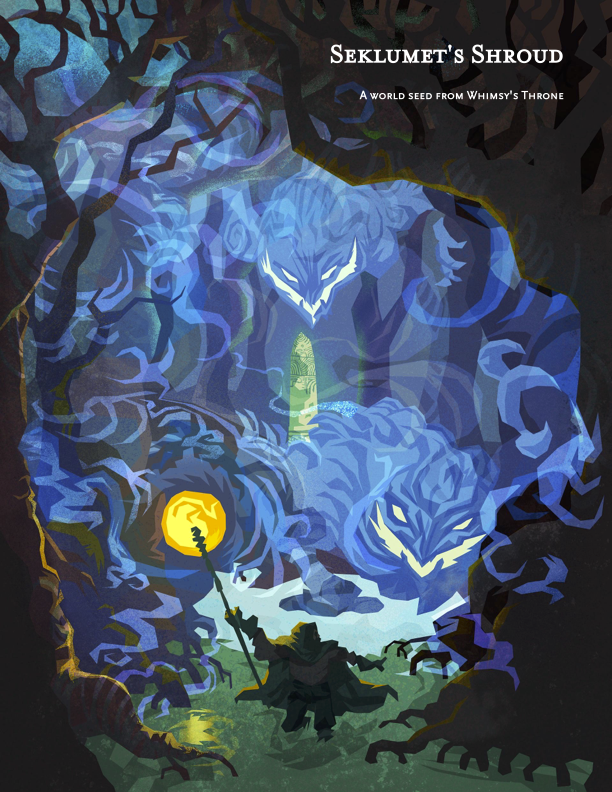
Whimsy’s Throne is live on DriveThruRPG!

You can find the first two World Seeds here. If you read and enjoy these World Seeds, please leave a positive review. That would mean a lot to me.

My goal, as I said a little while back, is to continue producing these Seeds for the foreseeable future. If you’d like to see the process in action, learn about how I’ve repeatedly edited out half—or even two-thirds—of the words in a piece, or see the art as it moves from concept to completion, you can do that at Whimsy’s Throne.

There’s still more to do, of course. I want to find another artist to work with next—if you make art, and would be willing to make something like what you can see in those Seeds for $400, let me know. I also want to have more legible covers for the DriveThruRPG store, which will require some tinkering.

And I’m trying to figure out where in the World Seeds (and how) to add a reference to Ginny Di’s video about advice she struggled with as a novice GM. I want these World Seeds to be as accessible as possible, to engage people in as many ways as possible (hence having both art and words). And while I can’t address the audio-preferred crowd very well in my pdfs, I can share videos that fill that gap. And I think her video has a usefully different approach to a lot of the advice my World Seeds give or imply.

It’s not advice that veteran storytellers are likely to need, but these World Seeds are supposed to be accessible to storytellers of all skill levels (ideally without feeling pedantic and overbearing). And while you could (and likely would) reach her conclusion by reading lots of material from The Alexandrian (like this, or this), I think she does a good job of saying it fairly concisely… and in a way that some GMs might understand more readily. I don’t know whether I want to expand World Seeds into a broader “RPG education” tool, or whether I want to do that in some other format, but I keep finding tidbits to add because I want these World Seeds to be a complete package for people at any level of comfort and confidence with storytelling.

Next week I might miss a post, as I’ll be traveling. I’ll be back before too long though. You should see me here again the week after.

World Seeds, Whimsy’s Throne, DriveThruRPG

I’ve made a DriveThruRPG storefront for my World Seeds project (see Whimsy’s Throne for details). I’ll link to that after I’ve uploaded my first Seeds. I knew this step was coming, once I had another finished Seed ready for publication. And now I’m dealing with the intricacies of posting content on DriveThruRPG while trying to figure out how to optimize the PDFs I’ve made for general distribution. I don’t want to publish content that immediately breaks when a stranger tries to open it, after all.

Unfortunately for me, I also don’t want to optimize my published content such that the art turns fuzzy and indistinct. This might be an issue.

My next steps are to upload the two World Seeds I have thus far. I’m making one available for free, and one for cash. Then I need to find another artist I like working with. Meanwhile, I’ll keep chugging along: writing more rough location descriptions and expanding existing descriptions into full-fledged Seeds.

My goal with this project has always been to produce a bunch of these things. And I want them to have notably distinct art styles for each Seed, for the most part. If I can have different artists bringing distinct styles (or experimenting with styles that are new to them), that’s perfect. I’m happy to do repeat work with artists, of course—I’ve really enjoyed collaborating with the artists I’ve worked with so far. I look forward to working with them again—I just don’t want the Seeds to be tied to only one style. The more variations, the merrier.

My hope is that I can have a varied body of artwork and styles reminiscent of the huge variety that was present in early 90’s Magic: the Gathering art. That’s what I grew up with. And while some of it was bad, I loved the way I could find so many totally novel art styles in the same game. During the 00’s MtG homogenized their style significantly, allowing some variation between sets but building a unified “house style.” While I can see how that makes sense for a company managing such a large quantity of content (and a company concerned with consistency in its artistic brand), I feel like MtG lost something when they stopped having such significant variation in artistic style from one card to the next. The individuality and experimentation faded away.

Given that I’m trying to build a product that engages people on as many levels as I can, and which appeals to as broad a group as possible, I feel like changing up art from one Seed to the next is my best option. If someone hates one art style, maybe they’ll love a different one and pick up that Seed. The dream would be for people to love and use every World Seed, but I’ll absolutely settle for catching people’s eye with a few different options.