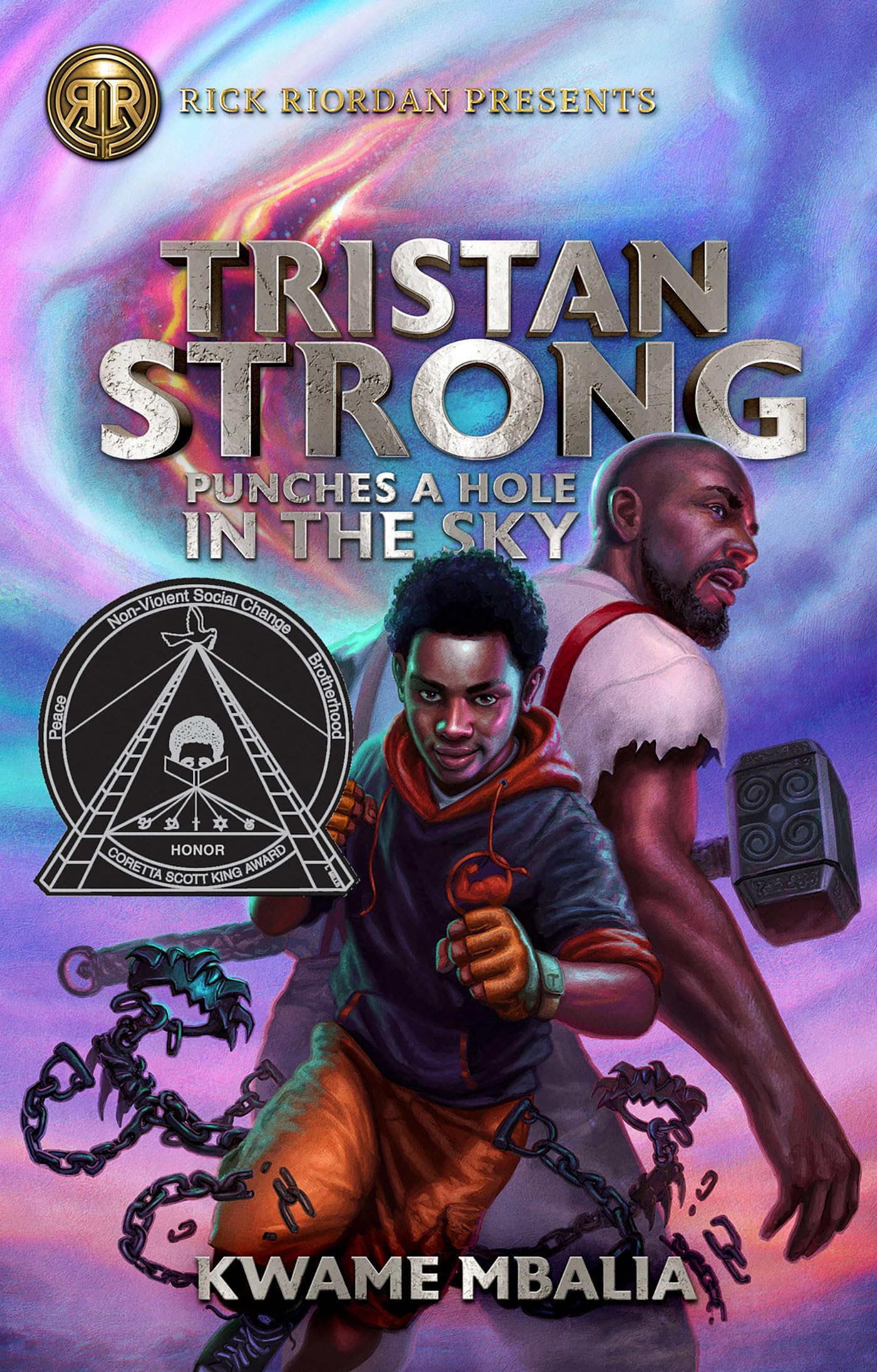
Tristan Strong Punches A Hole In The Sky, by Kwame Mbalia

I love a good middle grade adventure story. That’s precisely what this is. As you might expect from something published under Rick Riordan’s imprint, it’s full of mythology and folk tales and legends. Tristan Strong Punches a Hole in the Sky, by Kwame Mbalia, is all about one young boy’s discovery that the stories he’s grown up with (African-American stories with American folk heroes like John Henry, African trickster figures like Anansi, and those who blur the lines like Brer Rabbit) are all far more real than he ever could have believed. It’s fun, it’s pretty fast, it’s (heh) punchy. This is a good book.

I admit, my appreciation for this book is influenced by my desire for more high quality middle grade adventure stories aimed at boys. There’s a lot more to unpack there, some of which can be better understood by reading Of Boys And Men by Richard V Reeves. Read on for some of those details, as well as my few quibbles with Tristan Strong.

Continue reading

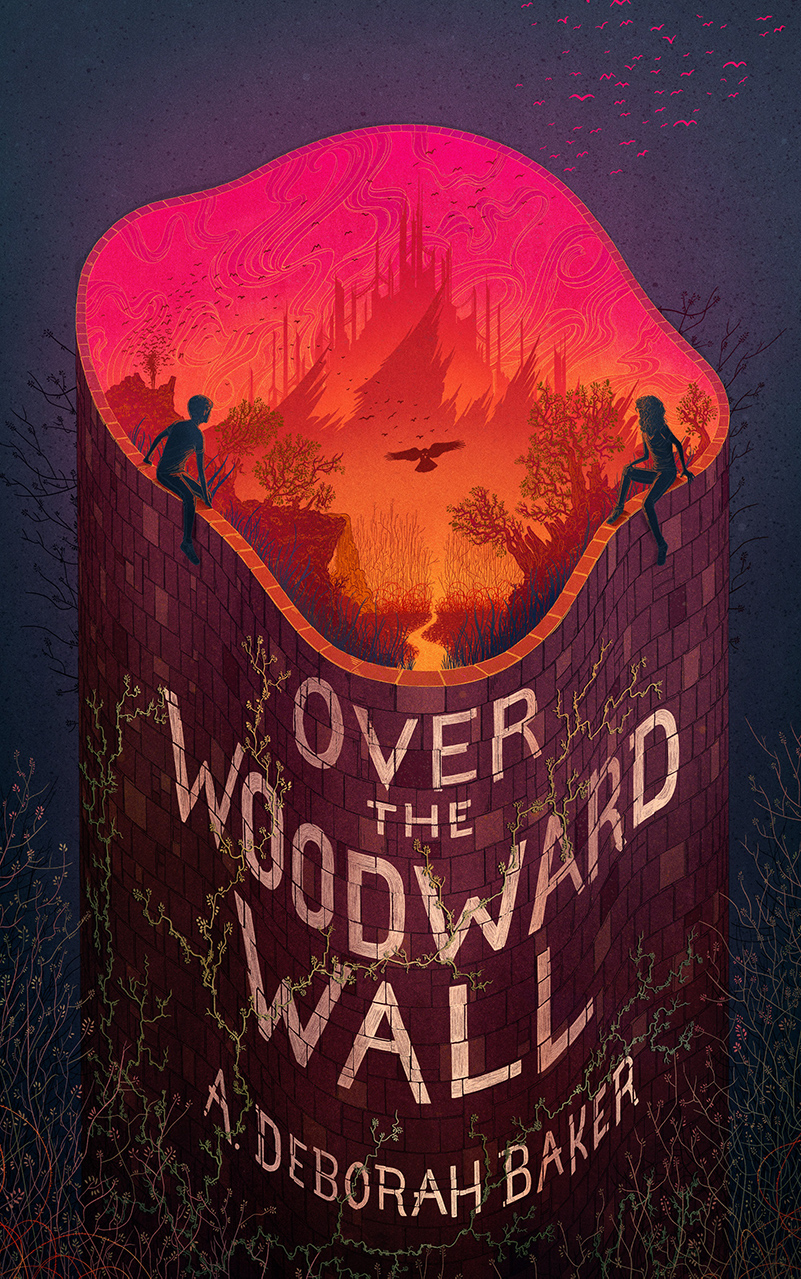
Over the Woodward Wall, by A. Deborah Baker

Over the Woodward Wall (written by Seanan McGuire under her pen name A. Deborah Baker) is the first in a series of middle grade adventure stories in a mixed up sometimes-lovely sometimes-scary fairytale land. In many ways, it evokes Alice’s Adventures in Wonderland. The setting’s surreality contrasts perfectly with the very real-feeling children who are this story’s stars, and the book does an excellent job of conveying earnestly true human experiences and life lessons while taking us on a dreamy-and-nightmarish impossible (sorry, I mean improbable) journey.

This should be a guaranteed home run for me. However, my fondness for this book ebbs and flows, a cycle driven by my mixed opinions about the narrator. It is my fondness that shifts though—I like it, I just like it by varying amounts depending on my mood. So what do I simultaneously admire and want to complain about?

Continue reading

Portals and the hero’s journey

I figured out what I like about isekai and portal fiction—and why some of it feels so bad.

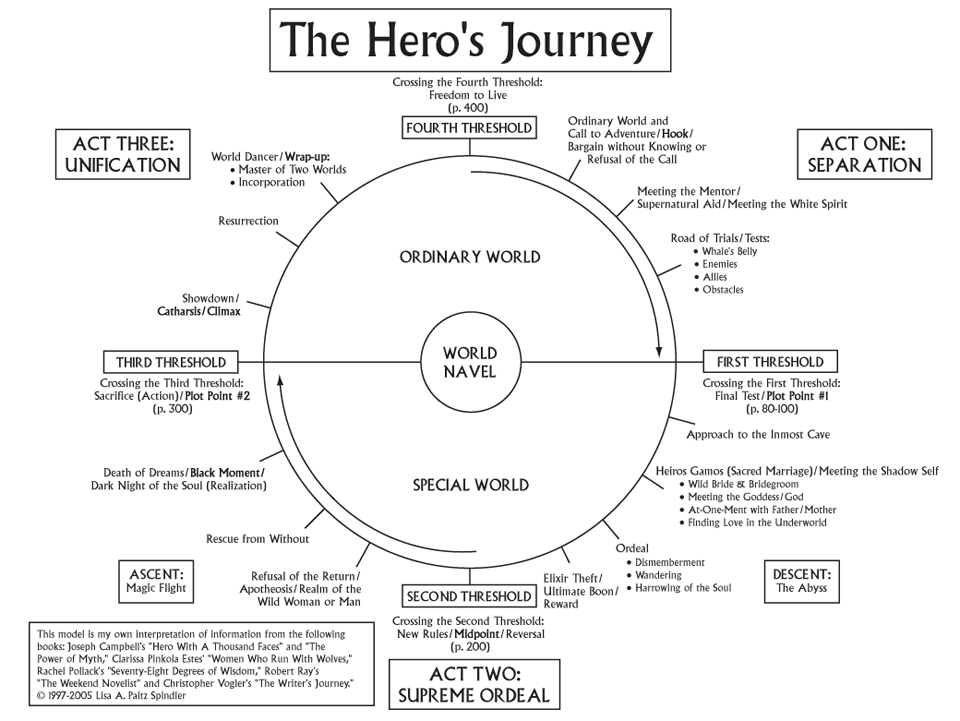
The portal fiction I love most plays with the hero’s journey. It is, at its core, about characters traveling into the unknown and experiencing growth through trials and tribulations. It’s the same pattern that so much adventure fiction I love adheres to.

The hero’s journey puts a big emphasis on coming home to confront the ways one has grown (in the image above, the Act Three segment saying “Master of Two Worlds” & “Incorporation”). But it’s confronting that growth which is the important part; what home you’re coming home to doesn’t particularly matter, as long as the recognition, confrontation, and resolution with past-self happens. The hero could literally return to their home world, or recognize any space within their new world as sufficiently home-like to be their new home—as long as they have that final confrontation and resolution.

And that’s the thought I had when everything clicked.

Continue reading

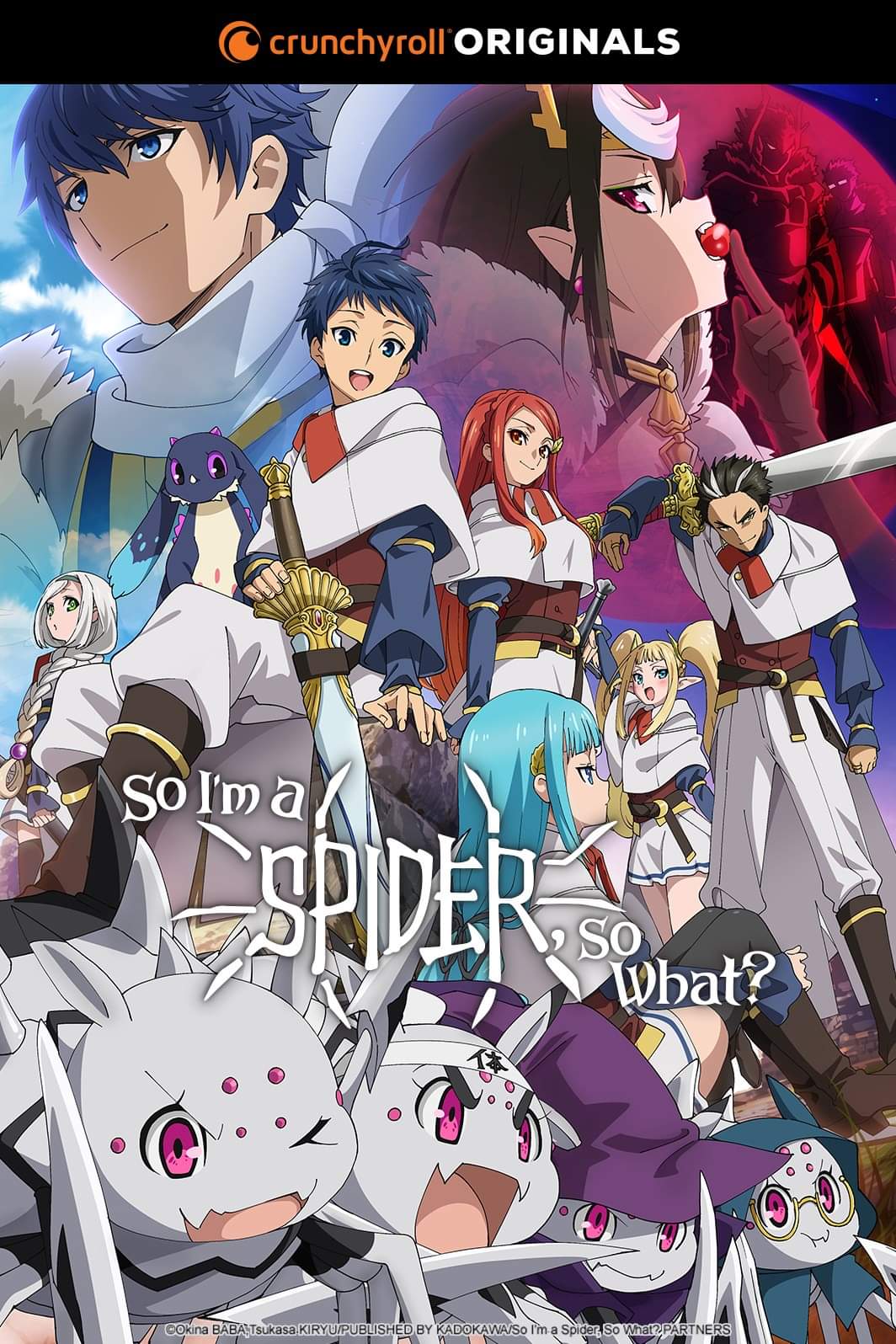
So I’m A Spider, So What? pulls out neat tricks

I just wrote about portal fiction and isekai anime, stories about people from one world (usually ours) transposed into a second world. All the stuff I said about loving this genre is still true. And, having just inhaled So I’m A Spider, So What? (an isekai anime about a schoolgirl reincarnated as a spider in a fantasy world), I’ve got some more thoughts for you about the show.

I inhaled the show, and…

Continue reading

Sucked into the portal (fiction) again

I’m a sucker for portal fiction, so it’s no surprise that I’m fond of—or at least eager to try—many isekai anime. I’ll even keep watching isekai long after I’ve decided that I don’t like the show. Something about it is compelling. It grabs part of my brain and refuses to let go.

There’s a lot of schlock out there. And worse. Hell, I watched at least ten episodes of The Rising of the Shield Hero, despite that show being a rotten apologia for toxic incels making slave harems (don’t be a shithead, and practice your kink consensually mmkay?). Someone else wrote more or less what I should have posted here about that show years ago—it’s a solid critique, check it out.

But that means when I find isekai that isn’t awful, that doesn’t feel like it’s spoon-feeding me poison and whispering sweet justifications of heinous shit, I’m delighted. And when I keep watching that isekai and find hints that they’re building towards bigger, more interesting twists with potentially interesting moral conundrums… heck. They’ve got me hook, line, and sinker. All of which is to say…

Continue reading

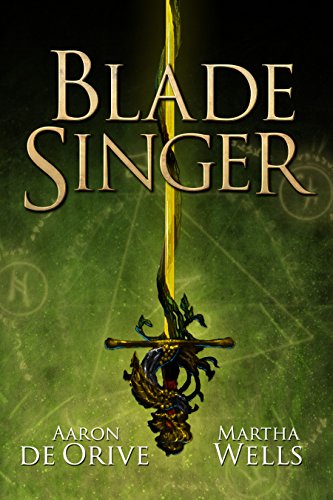
Blade Singer, by Aaron de Orive and Martha Wells

This isn’t Murderbot.

It’s really not fair to compare the two. But because I found this book by looking for other things involving Martha Wells—that felt like Murderbot—I’m afraid it’s doomed to comparison. This was the available book, with Martha Wells’ name attached. It wasn’t what I was looking for.

I did finish it.

Blade Singer isn’t Murderbot. It’s straightforward portal fiction, with a powerful fey three musketeers vibe. All genres I like. Clearly intended for that awkward threshold between middle grade and young adult, where the plot is very middle grade but the writing is a tad more complex, Blade Singer has a mix of genres (and a target audience marketing category) that I have strong opinions about.

Honestly, this book is fine. I enjoyed it. My quibbles with it are perhaps unreasonable.

Leaving aside my desire for more Murderbot, I think this is actually a solid book to give to a younger reader who enjoys fantasy, fey and faeries, swashbuckling and musketeers, or portal fiction. And it’s a solid choice for any younger reader who might like those things and hasn’t gotten deep into books yet. It isn’t as immediately accessible as other simpler reads (it’s no Warrior Cats), but it’s not especially difficult either. On that front, it lands the upper middle grade rating pretty solidly.

However… as someone who’s quite familiar with (and enjoys) all the genres involved, this book also doesn’t offer any big surprises or new takes. It isn’t transforming the genres, or at least not in a way that offers a story more complex and nuanced and to my taste. It doesn’t succeed where other ostensibly-for-children fiction has thrived, with the depth required for cross age-market appeal (think She-Ra and the Princesses of Power, most Pixar movies, or Nnedi Okorafor’s middle grade work like Akata Witch or Shadow Speaker).

Blade Singer’s stumbling blocks for me, I think, were its moral and emotional plots. They were present, all the requisite structure was there, but they felt almost bland. Like I could see the action on the page, and I knew how it would or should play out, but I never felt pulled into it, into feeling it. And I know this book could have done that. All the puzzle pieces were there.

Part of that could have been the close over-the-shoulder third person narration, but I know other close third stories have succeeded for me where this book didn’t. And while adding more filigrees to the moral and emotional plots might have helped make them less straightforward, I don’t think that would have solved the issue for me—I don’t feel pulled in just because something’s complex, I enjoy something being complex when I’ve already been pulled in. I think it came down to something about the characterization, and the fact that I simply bounced off of fully connecting with the narrator, Manny.

Your mileage may vary.

But that emotional bounce, and having a solid physical plot while struggling with the emotional and moral plot, reminds me of my own experience first writing fiction. With most of my preceding storytelling experience coming from running RPGs, I struggled to make stories with emotional connection or character depth. I’ve written about all that on this blog before.

And maybe I’m reading too closely here, but I think Aaron de Orive had a similar starting point (both in terms of games and the fiction he consumed). He’s involved in writing for RPGs and video games, and the authors he mentions on his personal site aren’t known for their excellent depictions of relatable complex emotional people, not like the modern authors I’d compare them to. Many are the same authors I read as a kid.

For me at least, writing linear fiction was a puzzle that I didn’t even realize I wasn’t solving. Most adventure fiction I’d read as a kid didn’t have much emotional depth or nuance. And while I knew how to elicit reactions from my players, that was all about setting up the stage with the right plot pieces and then letting them complete all the robust internal character struggle in their own heads. I didn’t know how to show that on the page. Sometimes, I still don’t.

But I wanted Aaron de Orive (and Martha Wells, she’s credited as a co-author even though this doesn’t feel anything like her other work I’ve read so far) to yank on my heartstrings. I wanted these authors to reel me in deep and leave me really feeling the joys and sorrows of the characters involved. That didn’t happen. And I didn’t feel attached enough (as I did with Murderbot) to complete the loop myself.

But as I said above, my quibbles are probably unreasonable. Blade Singer has more emotional depth than those adventure stories I read as a kid. It’s not a bad book! It’s perfectly fine, and I do recommend it to anyone who likes the relevant genres. And, to really enjoy it, I think you’re best off reading it as a kid who doesn’t have as much experience with these stories.

Child of a Hidden Sea, by A.M. Dellamonica

Wheee, portal fiction!  When done well, this stuff is great.  I got this book for free somehow, though I can’t remember why.  I’m glad that I did.  It’s quite enjoyable.  I’ve already seen the next book in the series in my local library, and I’m looking forward to getting my hands on it.

I don’t want to spoil the fun for you, but I do want to say a few more words in favor of you reading this book.  It’s got a female protagonist and non-hetero characters, it’s got lots of sailing and boats, and it has a climax that I found very appealing.  Lots of fun.  It’s intrigue and sea-adventure wrapped up in a portal fiction premise.  What’s not to like?