I’m trying to think of times in my stories when my characters feel hopeful, or when they dream big. I’m struggling.
Continue readingCategory Archives: Books
Portals and the hero’s journey
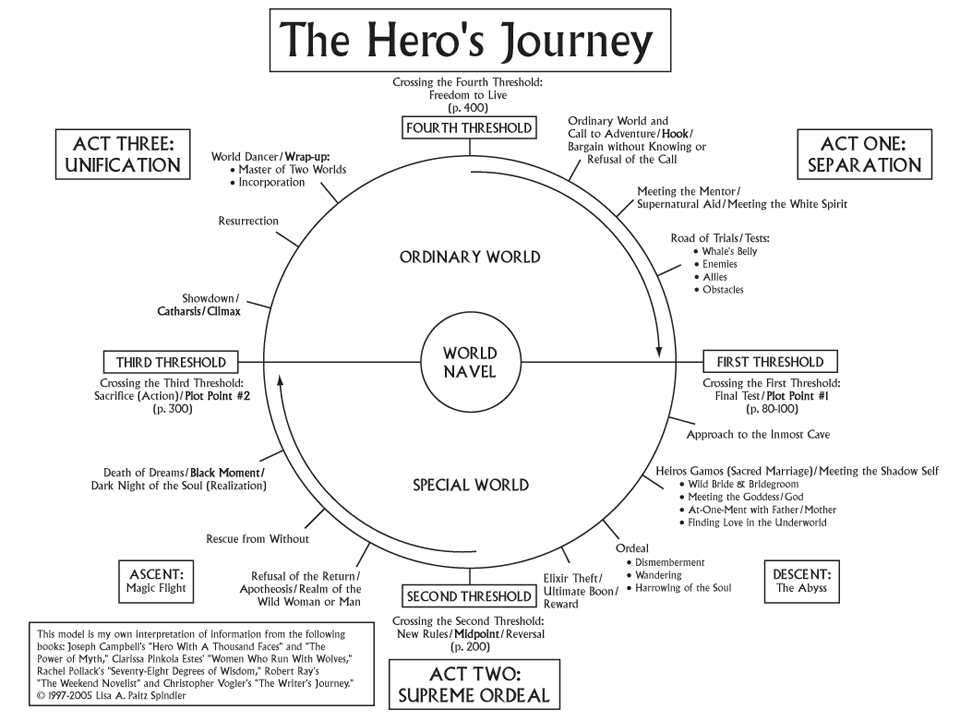
I figured out what I like about isekai and portal fiction—and why some of it feels so bad.
The portal fiction I love most plays with the hero’s journey. It is, at its core, about characters traveling into the unknown and experiencing growth through trials and tribulations. It’s the same pattern that so much adventure fiction I love adheres to.
The hero’s journey puts a big emphasis on coming home to confront the ways one has grown (in the image above, the Act Three segment saying “Master of Two Worlds” & “Incorporation”). But it’s confronting that growth which is the important part; what home you’re coming home to doesn’t particularly matter, as long as the recognition, confrontation, and resolution with past-self happens. The hero could literally return to their home world, or recognize any space within their new world as sufficiently home-like to be their new home—as long as they have that final confrontation and resolution.
And that’s the thought I had when everything clicked.
Continue readingSo I’m A Spider, So What? pulls out neat tricks
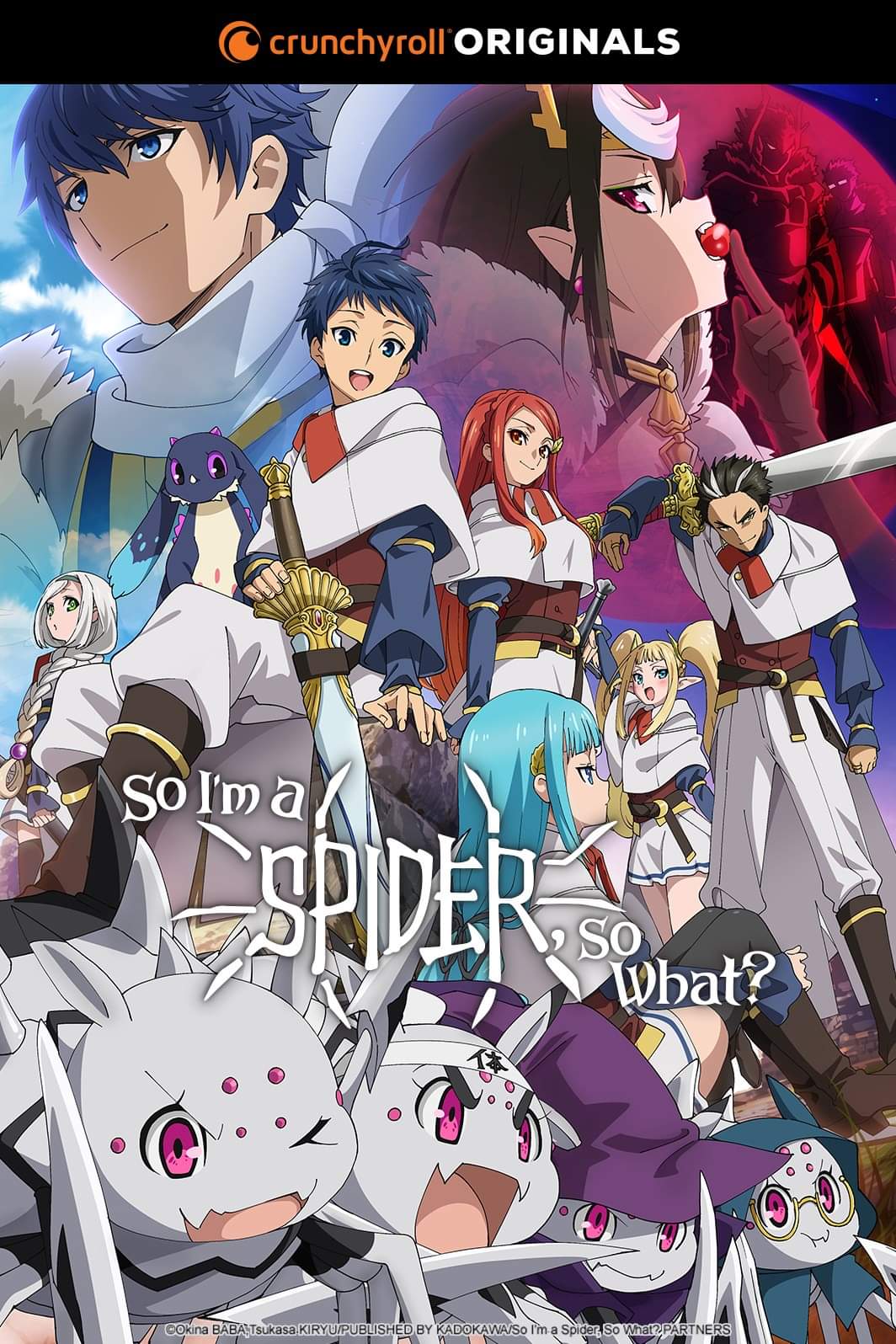
I just wrote about portal fiction and isekai anime, stories about people from one world (usually ours) transposed into a second world. All the stuff I said about loving this genre is still true. And, having just inhaled So I’m A Spider, So What? (an isekai anime about a schoolgirl reincarnated as a spider in a fantasy world), I’ve got some more thoughts for you about the show.
I inhaled the show, and…
Continue readingWhen will I learn? Reading Freya Marske around family

I’m reading the new Freya Marske book, A Power Unbound, to review for GeeklyInc. I made a mistake.
To be clear, I have no regrets about reading this book. I enjoyed the prior two (you can find my thoughts on them here and here), and…
Continue readingCity of Bones by Martha Wells, and the evolution of character archetypes

I am such a sucker for this art style.
It’s odd, reflecting on the ways in which an author I love has grown (and stayed the same) over the years.
I’m specifically thinking about Martha Wells. I recently read City of Bones, which was originally published in 1995. I’m in the middle of reviewing City of Bones, because it’s being rereleased this year in trade paperback by Tor. I’ll have my review of that up on GeeklyInc in the not-too-distant future.
City of Bones is intrigue, archaeology, lost civilizations and past apocalypses. It’s a thriller, a mystery, it’s got political machinations and murder… you know, the good stuff. What stood out to me though, was…
Continue readingThe Black God’s Drums, by P. Djèli Clark (2018)

The Black God’s Drums is a sprint. It’s a sprint full of flavor, a window into another world that feels overflowing and wild and vibrant—a fantastical reimagining of our own world’s history, bringing us to a “might have been” that feels true and honest and exciting, with plenty of our own world’s horror worked in. It’s quick, here and gone again, and a greater pleasure for it.
Thinking about a recent conversation with a fellow book-nerd friend, I have to warn you:
Continue readingGhosts, a tiny post
This is just a brief one, but…
I’ve been reading A Lesson in Vengeance, been part way through it for a while. The combination of that book, plus my own meditations, has left me musing on the nature of ghosts and how they work in stories. I don’t think I’m saying anything revolutionary when I say that, while ghosts are often said to have unfinished business, they can also be interpreted as the unfinished business of those they haunt.
Ghosts make a neat device for unwelcome and intrusive thoughts.
Continue readingProgress for Deep in Trouble
It’s been a while since I last wrote about Deep in Trouble, Cesi’s sequel to Bury’em Deep. A friend of mine inhaled Bury’em Deep recently, and her enthusiasm has reinvigorated mine. It’s also prompted me to revisit the setting and my ideas for how Deep in Trouble would work, and I’ve started making progress again!
Continue readingMrs. Pollifax, elderly women as spies cont.
As I was writing last week’s post, I knew that I was forgetting something. I’d read fun stories about an elderly woman involved in espionage before. Or more accurately, I’d listened to them: some of my childhood’s many long car rides were filled with hours of Dorothy Gilman’s Mrs. Pollifax books on tape. Young Henry thought those books were both hilarious and excellent.
I haven’t read them since. But I want to. I want to read them again, find out whether or not they’re as fun as I remember them being. In my memory, they were a perfect storm of ridiculousness and good genre fiction.
That said, I’m a little hesitant too. The first books in the series (there are many of these books) were written in the 60s. The last one was published in 2000. Given the gulf of years, I bet I’m going to stub my toes on something.
But I’m willing to bet it’ll be worth it. At worst, they’ll give me a place to start in my hunt for similar genre fiction. And if they’re anywhere near as good as I recall, I’ll probably be guffawing my way through them.
Plus, for all the absurdity and narrative contrivances that I remember in the several Mrs. Pollifax books I listened to, I think they captured several very important points that flashier spy stories forget. It’s valuable to be overlooked and underestimated. And—maybe this was just my impressionable youth speaking, but—Dorothy Gilman was nearly of an age with my grandmother, and Mrs. Pollifax’s surprising skillset reminded me of my grandmother too.
I remember growing up with plenty of stories about my grandmother. She fixed a stranger’s broken car on the side of the road (in Uganda or Kenya I think), using safety pins and pantyhose to replace a timing belt. She reversed a van at speed down a dirt track while being chased by a bull elephant. She had other adventures too, but more regularly she would weigh and vaccinate hundreds of babies in an open-air clinic, or help local women establish clinics in their villages and towns. And when I knew her as an older woman, she kept a thriving thicket of a garden, pointing me to the various things she wanted me to cut or harvest, showing me the good berry brambles.
So when I read Mrs. Pollifax, I see a little bit of my grandmother. They’re not the same person at all, they’re not doing the same things, but… in some ways they’re cut from similarly capable cloth. And reading that in a piece of spy fiction, when the protagonist sometimes underestimates herself almost as badly as her opposition does, is simply a treat.
Anyway, yes, I’m looking forward to picking up those books again. Maybe I’ll have something more for you here when I do.
White boys and spy stories
There’s more to be written here than I’ll address today. I’m putting this here because I’m sure I’ll have future posts on the topic. This particular topic came to mind through watching some of The Recruit, and through starting Arabella The Traitor of Mars.
Lots of spy fiction (I haven’t done a survey but I’d bet it’s the majority of it) is obsessed with the perspectives of white men. A revolutionary realization, I’m sure.
The thing is… that obsession is laughable. It’s ridiculous. I’ve known this for some time, but every so often I’m forcibly reminded of it.
Despite the relative position of power held by white men in Western society—no, because of it—white men are a strange choice for your default spies. If you could pick someone to be your spy, you’d be better off picking someone more likely to be overlooked or ignored by the society in which you want to gather intelligence. There are certainly other challenges for agents who aren’t white men, and those agents might struggle to reach every place or position of influence an agency might want access to (honestly, spy agencies should want agents of every shape and flavor), but I think there’s a solid reason the British SOE valued middle-aged and not-quite-elderly women for work in Nazi-occupied Europe.
And yet, so many of our spy stories still dwell on white male protagonists. It’s not surprising. White male protagonists have been the default for many genres for many decades, alas. But I’d love to see some fun spy fiction about a frumpy little elderly woman who is consistently overlooked and underestimated. I’m sure the genre exists, now I just need to go find it.
 Fistful of Wits