City of Bones by Martha Wells, and the evolution of character archetypes

I am such a sucker for this art style.

It’s odd, reflecting on the ways in which an author I love has grown (and stayed the same) over the years.

I’m specifically thinking about Martha Wells. I recently read City of Bones, which was originally published in 1995. I’m in the middle of reviewing City of Bones, because it’s being rereleased this year in trade paperback by Tor. I’ll have my review of that up on GeeklyInc in the not-too-distant future.

City of Bones is intrigue, archaeology, lost civilizations and past apocalypses. It’s a thriller, a mystery, it’s got political machinations and murder… you know, the good stuff. What stood out to me though, was…

Continue reading

The Black God’s Drums, by P. Djèli Clark (2018)

The Black God’s Drums is a sprint. It’s a sprint full of flavor, a window into another world that feels overflowing and wild and vibrant—a fantastical reimagining of our own world’s history, bringing us to a “might have been” that feels true and honest and exciting, with plenty of our own world’s horror worked in. It’s quick, here and gone again, and a greater pleasure for it.

Thinking about a recent conversation with a fellow book-nerd friend, I have to warn you:

Continue reading

Ghosts, a tiny post

This is just a brief one, but…

I’ve been reading A Lesson in Vengeance, been part way through it for a while. The combination of that book, plus my own meditations, has left me musing on the nature of ghosts and how they work in stories. I don’t think I’m saying anything revolutionary when I say that, while ghosts are often said to have unfinished business, they can also be interpreted as the unfinished business of those they haunt.

Ghosts make a neat device for unwelcome and intrusive thoughts.

Continue reading

Progress for Deep in Trouble

It’s been a while since I last wrote about Deep in Trouble, Cesi’s sequel to Bury’em Deep. A friend of mine inhaled Bury’em Deep recently, and her enthusiasm has reinvigorated mine. It’s also prompted me to revisit the setting and my ideas for how Deep in Trouble would work, and I’ve started making progress again!

Continue reading

Mrs. Pollifax, elderly women as spies cont.

As I was writing last week’s post, I knew that I was forgetting something. I’d read fun stories about an elderly woman involved in espionage before. Or more accurately, I’d listened to them: some of my childhood’s many long car rides were filled with hours of Dorothy Gilman’s Mrs. Pollifax books on tape. Young Henry thought those books were both hilarious and excellent.

I haven’t read them since. But I want to. I want to read them again, find out whether or not they’re as fun as I remember them being. In my memory, they were a perfect storm of ridiculousness and good genre fiction.

That said, I’m a little hesitant too. The first books in the series (there are many of these books) were written in the 60s. The last one was published in 2000. Given the gulf of years, I bet I’m going to stub my toes on something.

But I’m willing to bet it’ll be worth it. At worst, they’ll give me a place to start in my hunt for similar genre fiction. And if they’re anywhere near as good as I recall, I’ll probably be guffawing my way through them.

Plus, for all the absurdity and narrative contrivances that I remember in the several Mrs. Pollifax books I listened to, I think they captured several very important points that flashier spy stories forget. It’s valuable to be overlooked and underestimated. And—maybe this was just my impressionable youth speaking, but—Dorothy Gilman was nearly of an age with my grandmother, and Mrs. Pollifax’s surprising skillset reminded me of my grandmother too.

I remember growing up with plenty of stories about my grandmother. She fixed a stranger’s broken car on the side of the road (in Uganda or Kenya I think), using safety pins and pantyhose to replace a timing belt. She reversed a van at speed down a dirt track while being chased by a bull elephant. She had other adventures too, but more regularly she would weigh and vaccinate hundreds of babies in an open-air clinic, or help local women establish clinics in their villages and towns. And when I knew her as an older woman, she kept a thriving thicket of a garden, pointing me to the various things she wanted me to cut or harvest, showing me the good berry brambles.

So when I read Mrs. Pollifax, I see a little bit of my grandmother. They’re not the same person at all, they’re not doing the same things, but… in some ways they’re cut from similarly capable cloth. And reading that in a piece of spy fiction, when the protagonist sometimes underestimates herself almost as badly as her opposition does, is simply a treat.

Anyway, yes, I’m looking forward to picking up those books again. Maybe I’ll have something more for you here when I do.

White boys and spy stories

There’s more to be written here than I’ll address today. I’m putting this here because I’m sure I’ll have future posts on the topic. This particular topic came to mind through watching some of The Recruit, and through starting Arabella The Traitor of Mars.

Lots of spy fiction (I haven’t done a survey but I’d bet it’s the majority of it) is obsessed with the perspectives of white men. A revolutionary realization, I’m sure.

The thing is… that obsession is laughable. It’s ridiculous. I’ve known this for some time, but every so often I’m forcibly reminded of it.

Despite the relative position of power held by white men in Western society—no, because of it—white men are a strange choice for your default spies. If you could pick someone to be your spy, you’d be better off picking someone more likely to be overlooked or ignored by the society in which you want to gather intelligence. There are certainly other challenges for agents who aren’t white men, and those agents might struggle to reach every place or position of influence an agency might want access to (honestly, spy agencies should want agents of every shape and flavor), but I think there’s a solid reason the British SOE valued middle-aged and not-quite-elderly women for work in Nazi-occupied Europe.

And yet, so many of our spy stories still dwell on white male protagonists. It’s not surprising. White male protagonists have been the default for many genres for many decades, alas. But I’d love to see some fun spy fiction about a frumpy little elderly woman who is consistently overlooked and underestimated. I’m sure the genre exists, now I just need to go find it.

Away

I’m visiting family, and I’ve neglected to prepare a post for today. I am part way through A Taste of Gold and Iron, by Alexandra Rowland, and I’ll probably post about that soon. It’s fun. Court intrigue, gay romance, fun.

I hope that you’re doing well and staying safe and warm. Happy holidays.

A House With Good Bones, by T. Kingfisher

My experience of reading A House With Good Bones was weird, because I made some silly assumptions. It was also fun, and good, and I’d recommend the book. However, this isn’t an in-depth review; I’ll share more about this book elsewhere through GeeklyInc, so I’m focusing on my reading experience here. When I dive deep into the book, I’ll let you know.

Onwards.

I’ve previously read and enjoyed several other books from T. Kingfisher (Ursula Vernon). I’ve come to expect, for better or worse, a certain flavor of genre fiction. Her Saint of Steel series and her Clocktaur War books are all fantasy romance with other genres laced in (murder mystery, adventure, horror, etc). I foolishly allowed myself to think that everything she published as T. Kingfisher would therefore also have strong romance genre elements, and would feel like romance overall.

I was wrong!

Okay, I wasn’t that wrong. There are still hints of romance genre conventions here. There are plenty of things in this story that feel like they belong in a romance novel. They’re fun when they show up and they help lighten the mood. But the book doesn’t deliver all the requisite story beats for it to feel like or qualify as romance. Instead, it has just enough romance to allow the audience to enjoy a little bit of that flavor while enjoying all the rest of what the book is really about.

Which is horror. Spooky, weird horror. Spooky, weird gradual horror that reminds me powerfully of the RPG Unknown Armies, which is in turn inspired by the fiction of Tim Powers (who you’ll be shocked to know also writes some spooky, weird horror).

And Ursula Vernon, aka T. Kingfisher, is good at writing this horror.

I already knew she was good at other flavors of horror. Her Saint of Steel books revolve around the murder mystery and fantasy horror genres (yes, with romance), and I had a grand time with those. But the horror of those books is different from the horror of A House With Good Bones. And that difference, plus the less-present romance, threw me for a loop.

To dig into that flavor metaphor, I took my first bite of this dish thinking I was eating Italian and found out I was eating Indian. Sure, both words start with “I,” both cuisines make good use of tomatoes, and both are delicious—but what I got was not what I was expecting.

I figured out what was going on pretty quickly. I was happy with it. I spent a good portion of my time with this book smacking my lips and saying “huh!” and trying to suss out the different ingredients.

So. Yes, I recommend this book when it comes out. Yes, I had fun with it. Yes, if you like T. Kingfisher’s other work you’ll probably enjoy this too. But keep in mind that this is—first and foremost—something besides romance. With that, I think you’ll have a good time.

Hoping for more Thufir Hawat

This is about Dune. It has some spoilers.

I saw news about filming for Dune: Part Two, and got excited again. I’ll try to explain a little bit of why.

First off, a warning for the unfamiliar. The book Dune has… problems. Plenty of them. It has uncomfortable themes of colonialism and orientalism baked into the original text, and those are still present in most interpretations of its story. It has white savior tropes. It has the gender norms and judgments of a White American man from the 1950s and 60s, complete with a fixation on effeminacy that would fit right in with creepy racist 1800s anthropology. Heck, Dune so exemplifies the troublesome and implicitly misogynistic “hard times make hard men” mythos that Bret Devereaux named his dissection of that mythos “the Fremen Mirage” when writing about it at ACOUP.

But in all that mess there are beautiful, very human stories–and I’d absolutely recommend watching Dune: Part One (preferably on a large screen with a very good sound system). One of those stories, one I’m desperately hoping to see finished on the screen in Denis Villeneuve’s Dune: Part Two, is the tragedy of Thufir Hawat. It’s a sad story of personal loyalty, betrayal and manipulation, and love, and it carries with it all the weight of classical dramatic feudal intrigue.

See, while Dune came out in the era of classic hard science fiction, and certainly takes place in a setting with interstellar travel and many other things we associate with hard sci fi, it’s focused on society and people rather than technology. It is feudal intrigue and political maneuvering in space, an extremely human-focused story exploring the impacts of a technologically constrained setting built from a wide variety of different inspirations. In many ways this is socially and personally focused “soft” sci fi, much as Ursula Le Guin’s work was (maybe the only time I’ll say Dune is like Le Guin’s work). 

Perhaps that personal focus is why Thufir Hawat’s story would fit as neatly in a Shakespearean tragedy as it would in any novel of spaceships and distant worlds.

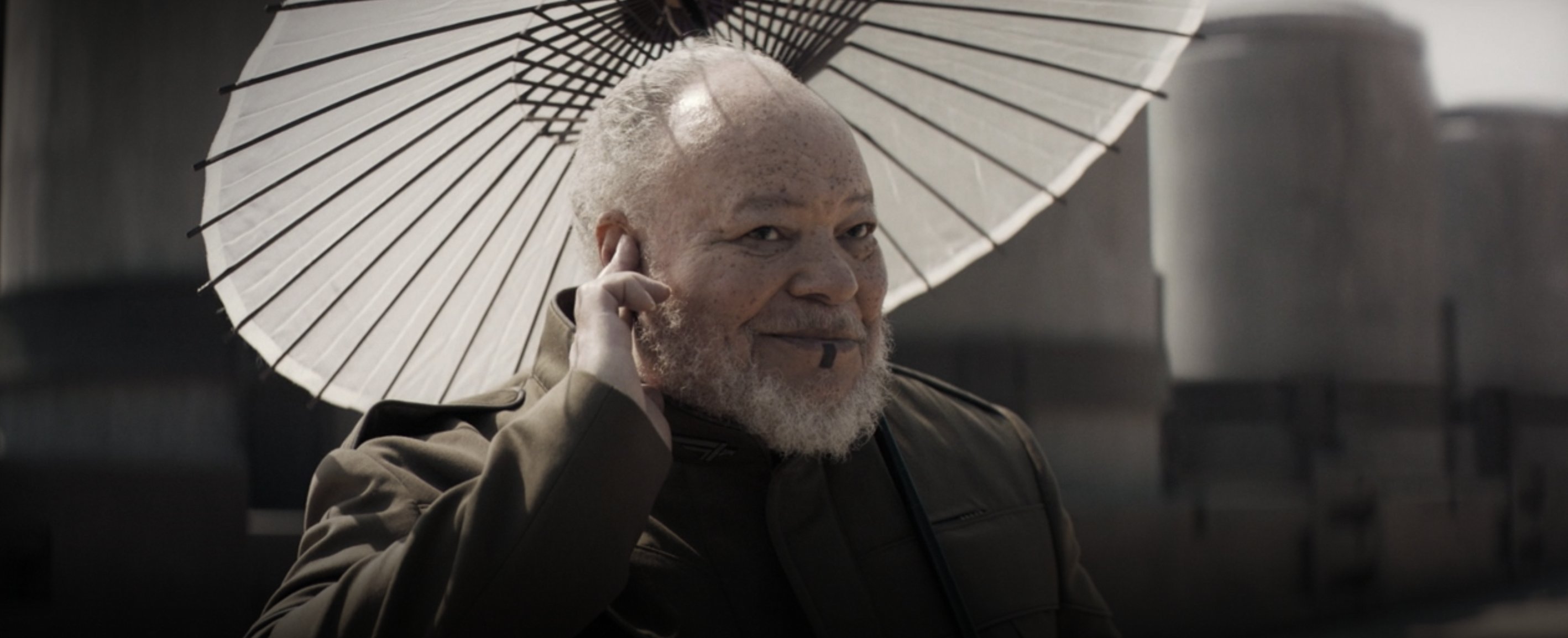
I love Thufir Hawat in the 2021 version of Dune. Stephen McKinley Henderson does a phenomenal job. It’s Henderson’s performance which anchors my love for Hawat, and which leaves me hoping to see the rest of the mentat’s tragedy. I don’t recall having such deep and abiding affection for the character when I read the book (decades ago) or saw the David Lynch version of the movie (also long ago). Perhaps I would feel that connection if I reread the book today, but I wager my fondness would also be a reflection of how I feel for Henderson’s portrayal.

The relationship between Thufir Hawat and Paul Atreides is close. It’s avuncular. This rings true for basically all the Atreides retainers, even Dr. Wellington Yueh in his moment of betrayal, but you can see Hawat’s love for Paul—and his scathing self-judgment—in his immediate and anguished reaction to the assassination attempt against Paul. That continues through the rest of his time on screen, especially when we see his stone-faced, pained stiffness as people commend Paul for outsmarting the hunter-killer.

In fact, 2021’s Dune does a spectacular job of showing us the constellation of House Atreides’ retainers. Villeneuve put so much work into showing us the Atreides as a tight-knit family, as Paul’s family. And the actors played that family to the hilt. It was beautiful. The twisting of their emotional ties as they are caught up in the complex machinations intended to destroy them, the way Paul and each other family member reacts as they see their loved ones shorn away by treachery… it makes the fall of House Atreides all the more tragic.

No doubt that poignant tragedy is why I’m so caught up in the drama of the fall of House Atreides. And why I’m so looking forward to seeing Henderson return as Hawat in Dune: Part Two

I know what the book has in store. Thufir Hawat rises to prominence within House Harkonnen, replacing the Mentat Piter De Vries (poisoned following the Harkonnen attack on Arrakis). In his new position as Mentat for the Harkonnen, Hawat does his best to keep himself alive while setting the Harkonnen against themselves (moreso than they already were). When he finally learns the truth, that Paul survived, he kills himself rather than follow Baron Harkonnen’s orders to kill Paul.

It’s Shakespearean.

Denis Villeneuve has been remarkably faithful to the book thus far. And so I’m extremely excited to see Stephen McKinley Henderson bring all his remarkable talent to the sad path that awaits Thufir Hawat. Thufir Hawat is an excellent tragic hero, and I trust Henderson to once again remind me why I love a good tragedy.

I just hope that the full arc of Hawat’s story makes the cinematic cut.

This is me, sitting with fingers crossed, waiting for Dune: Part Two.

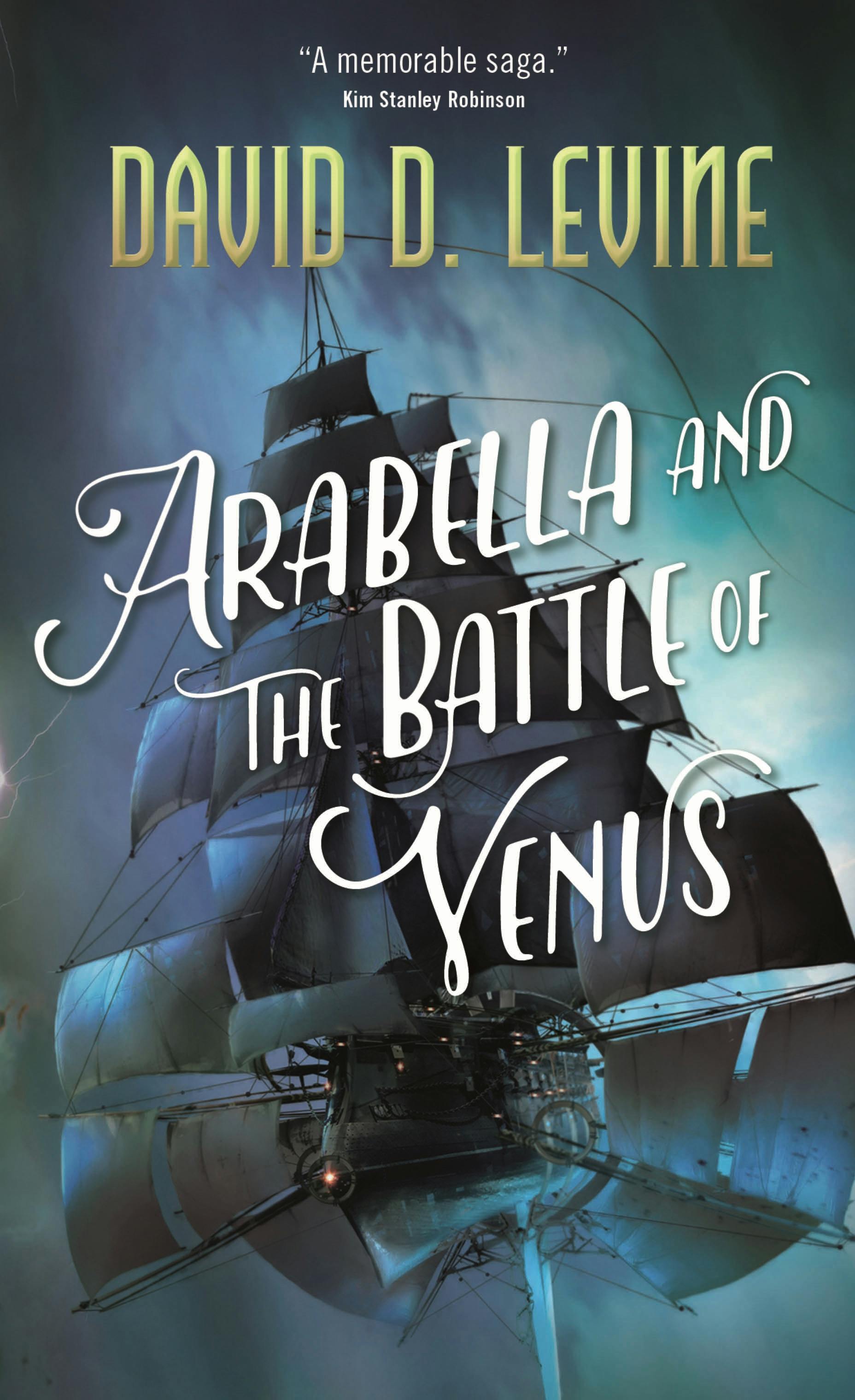
Arabella and the Battle of Venus, by David D. Levine

I really enjoyed the first book in this series, Arabella of Mars, and I’m glad to say that Arabella and the Battle of Venus lived up to all my expectations and then some. David D. Levine has crafted another excellent adventure story in his science fiction alternate history setting. If you like Regency-era drama, Age of Sail adventure, and historical science fiction, these books will (heh, it’s funny if you’ve read the books) float your boat.

If you took my advice and read and enjoyed the first book (yes, I advise you to enjoy the book), I think you’ve got a safe bet with this one. Arabella and the Battle for Venus is a solid sequel. Reading it was a delight, though I did squirm a little bit (more on that in a moment). It offers another excellent adventure while cleaving to the genres of the first book, and reminds me of the enjoyment I found reading Hornblower books in sixth grade but with altogether more depth… and the promise of additional depth to come.

Now, mild thematic and book jacket-level spoilers.

There is a little more weight lent to the romantic subplot this time around, as one might expect from a story about a young woman racing across a war zone to free her fiancé from a POW camp. I hadn’t expected there to be any other romantic complications, though I should have, and those stressed me out a bit! They’re what made me squirm, maybe for the same reasons rom coms do. I’m still not sure I fully understand that part of myself. But—despite my squirming—I think the book and characters are probably better off for those complications. They help to grow Arabella emotionally from where she started in the first book, and I appreciate that.

I’m going to take a tangent here, weaving back through the first book. I’ll eventually return to this book, and my tangent will have some vague thematic spoilers without hitting any concrete plot points.

My biggest concern with the first book was that it wasn’t clear to me whether Arabella—the character or the books in general—would more clearly confront the colonialism and racism of the setting over the course of the series. The first book had some confrontations with these ”isms,” in fairly constrained contexts, but our point of view character Arabella did not seem fully aware of their pervasiveness or their larger ramifications. Nor did she seem cognizant of the implications of her own life on Mars as an Englishwoman living among Martians.

In short, the Arabella of the first book was convincingly blind to problems that her privilege didn’t require her to face. Honestly, that felt very real. I think it was an understandable writing choice, and a solid one.

Crucially, this is not to say that Arabella was willfully blind or actively in denial. She set herself on the right side of those conflicts when they arose, opposing and loudly disagreeing with racist arguments. But it wasn’t clear whether the later books would also dig into the inherent colonialism of the setting.

So. I hoped, and I read into the titles of the two following books and the jacket blurb of this book (Battle of Venus), and I made some assumptions from my sense of the author. All of that, plus the tonal hints of the first book, encouraged me.

Having finished book two, it looks like I was right to be encouraged. I’m glad to say that Levine does continue to bring these issues to the fore. Problems and disagreements slowly and seamlessly bubble up into Arabella’s awareness through her immediate context. The positions Arabella takes and the solutions she finds all suggest that Levine is continuing this thread of growing Arabella’s awareness of the injustices around her, and that these things will all come to a head soon.

Now, Arabella doesn’t feel especially radical from a modern perspective. Arabella’s positions and opinions—as they’ve developed so far—don’t feel revolutionary. Except… they kind of are.

Context matters!

Arabella has a keenly felt sense of justice. She has a disregard for her society’s gender norms that is heartening to a modern reader and would probably place her at the forefront of the women’s suffrage movement in her time, which was (contextually) a pretty damn radical place to be. Her opposition to racism and racist arguments is similarly steadfast, and admirably radical for the time. And that opposition extends to the casual anti-Martian & anti-Venusian racism she encounters, which I think is present to set up for her bigger and more overt confrontation with colonialism in the third book—though that’s merely genre-savvy speculation, since I haven’t read book three yet.

Basically, it looks like Levine has planned all this from the outset, just as I’d hoped. He pulled apart Arabella’s various stages of personal growth and burgeoning awareness into three books, allowing her emotional and political arc to develop across multiple perfectly solid adventure stories. If he’d tried to write this personal arc all in one go, the book would have felt congested and emotionally tumultuous—Arabella’s growth would have felt implausibly rushed and unreal. Instead, because Levine paid attention to spacing this arc out across narrative time and separate books we’re able to enjoy Arabella’s personal growth without ever choking on it.

This is another good example of the dynamic I mentioned in my reflections on Murderbot.

Given all that, I suspect that Levine will stick the landing in book three. I’ll let you know once I’ve finished it.

Okay, that’s enough for now. Like I said at the start, I’m really enjoying these books. Unless those genres I mentioned above sound like torture to you, I suspect you’ll enjoy these books too. Try them out!

Wait, one last thing. Based on his Author’s Note, David Levine finished this book while losing his wife to cancer. Finishing a book is hard enough in good times. I can only imagine that doing so (and doing it well) while experiencing that loss must be tremendously painful and difficult. David, if you read this, thank you for this story. And thank you for persevering to share it with us. May Kate Yule’s memory be a blessing and a comfort for you.